Chapter 4 – Product Costing for Manufacturing Companies
4-1
Product Costs and Job Order
Costing
Learning Objectives
1. Distinguish between product and period costs. (Unit 4.1)
manufacturing overhead. (Unit 4.1)
3. Trace the flow of product costs through the inventory accounts. (Unit 4.2)
4.3)
5. Compute product costs using a job order costing system. (Unit 4.3)
6. Dispose of under- and over-applied overhead. (Unit 4.4)
Summary of End of Chapter Material
Difficulty: E = Easy, M = Moderate, D = Difficult
Bloom: K = Knowledge, C = Comprehension, AP = Application, AN = Analysis, S = Synthesis, E = Evaluation
AACSB: A = Analytic, C = Communication, E = Ethics
AICPA FN: DM = Decision modeling, RA = Risk Analysis, M = Measurement, R = Reporting, RS = Research, T = Technology
AICPA PC: C = Communication, I = Interaction, L = Leadership, P = Professional demeanor, PM = Project Management,
PS = Problem Solving and Decision Making, T = Technology
IMA: BA = Business applications, BP = Budget Preparation, CM = Cost Management, DA = Decision Analysis,
PM = Performance Measurement, R = Reporting, SP = Strategic Planning
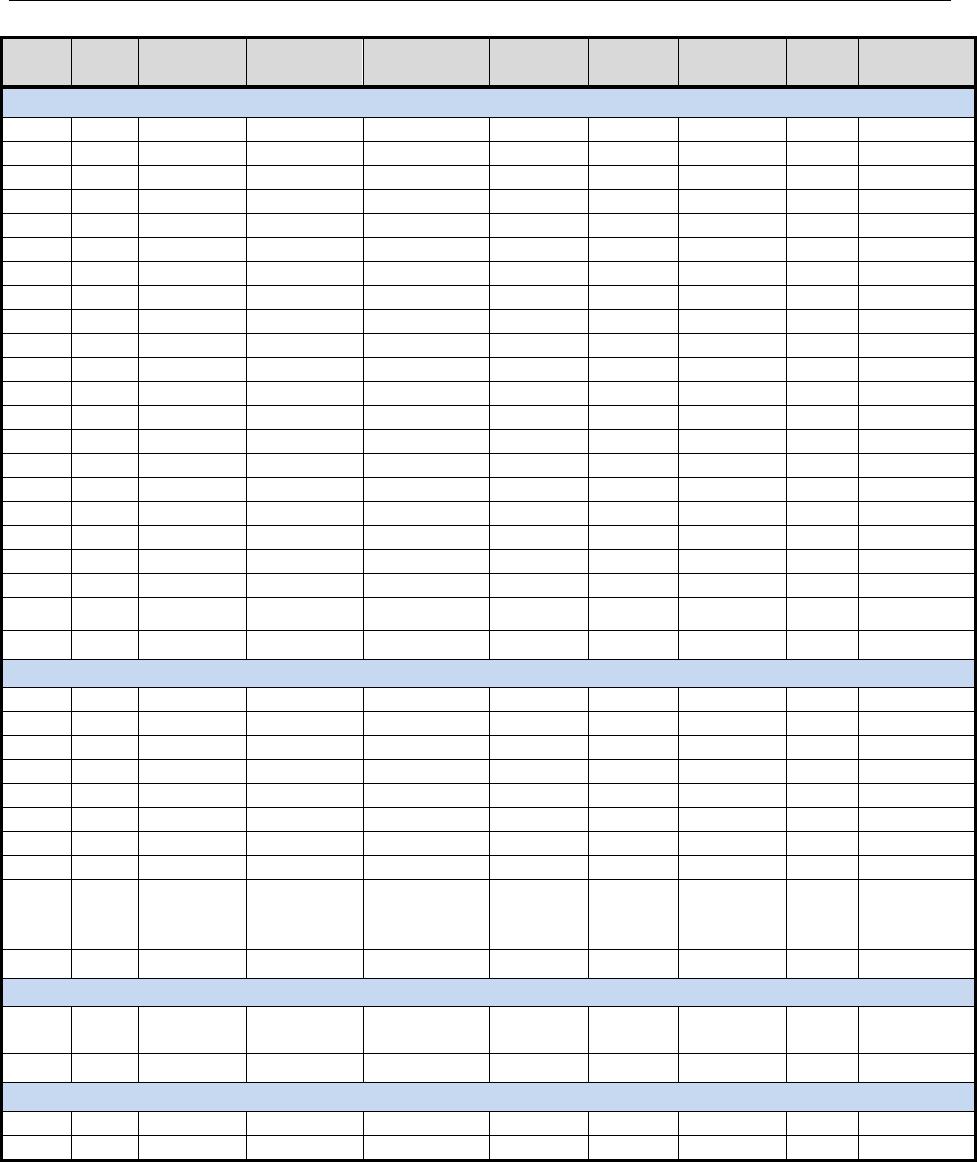
Item
L. O.
Difficulty
Level
Minutes to
Complete
Bloom’s
Taxonomy
AACSB
AICPA
FN
AICPA
PC
IMA
Ethics
Coverage
GUIDED UNIT PREPARATION
Unit 4.1
1
1
M
3
C
A
R
C
CM
2
1
E
3
K
A
R
C
CM
3
1
E
3
K
A
R
C
CM
4
2
E
3
K
A
R
C
CM
5
2
D
3
C
A
R
C
CM
Unit 4.2
1
3
E
10–15
C
A
M
PS
CM
2
3
M
4
K
A
M
PS
CM
Unit 4.3
1
4
M
3
C
A
M
PS
CM
2
4
E
2
K
A
M
PS
CM
3
4
D
4
C
A
M
PS
CM
4
5
D
3
C
A
M
PS
CM
5
5
M
3
AP
A
M
PS
CM
6
5
D
3
AP
A
M
PS
CM
Unit 4.4
1
6
M
4
C
A
M
PS
CM
2
6
E
4
K
A
M
PS
CM
CHAPTER
4
photo: © jsnyderdesign / iStockphoto
Solutions for Davis & Davis, Managerial Accounting, 2nd ed.
4-2
Item
L. O.
Difficulty
Level
Minutes to
Complete
Bloom’s
Taxonomy
AACSB
AICPA
FN
AICPA
PC
IMA
Ethics
Coverage
EXERCISES
4-1
1
M
18–20
AP
A
R
C
CM
4-2
1, 2
D
15
AP
A
R
C
CM
4-3
2
M
15
AP
A
R
C
CM
4-4
1, 2
M
10–15
AP
A
M
PS
CM
4-5
3
M
10–15
AN
A
M
PS
CM
4-6
3
M
15–20
AP
A
M
PS
CM
4-7
3
E
8-10
AP
A
M
PS
CM
4-8
3
D
10
AN
A
M
PS
CM
4-9
3
M
20–25
AN
A
M
PS
CM
4-10
4
D
16–20
AP
A
M
PS
CM
4-11
4
E
8
AP
A
M
PS
CM
4-12
4
E
8
AP
A
M
PS
CM
4-13
3, 4
M
15–20
AP
A
M
PS
CM
4-14
3, 4
D
25–30
AP
A
M
PS
CM
4-15
5
M
5-7
AP
A
M
PS
CM
4-16
4, 5
D
12–15
AP
A
M
PS
CM
4-17
5, 6
M
30–35
AP, AN
A
M
PS
CM
4-18
6
M
12
AP, AN
A
M
PS
CM
4-19
6
D
15
AP, AN
A
M
PS
CM
4-20
6
M
15
AP
A
M
PS
CM
4-21
6
D
15–20
AP
A
M
PS
CM
PROBLEMS
4-22
1
M
15
AP, AN
A
R
C
CM
4-23
3
D
25–30
AP
A
M
PS
CM
4-24
3, 4
M
25–30
AP
A
M
PS
CM
4-25
4, 5
D
25–30
AP, AN
A
M
PS
CM
4-26
5
M
25–30
AP
A
M
PS
CM
4-27
5
D
25–30
AP
A
M
PS
CM
4-28
6
M
25–30
AP, AN
A
M
PS
CM
4-29
6
D
25–30
AP, AN
A
M
PS
CM
4-30
1, 2,
3, 4,
5, 6
D
35–40
AP, AN
A
M
PS
CM
C&C CONTINUING CASE
4-31
3, 4,
5, 6
D
25–30
AP, AN
A
M
PS
CM
CASES
4-32
1
D
20–25
AN
E
R
C
BA
4-33
3, 5
D
35–40
C, AP, AN
A
M
PS
CM
Chapter 4 – Product Costing for Manufacturing Companies
4-3
SOLUTIONS TO GUIDED UNIT PREPARATION
Unit 4.1
1. Managers need to understand how companies incur costs to make
until the products are sold, cash is needed to acquire the inputs for
2. A product cost is any cost incurred to acquire raw materials and
vats at Russell Stover Candies.
3. A period cost is any cost incurred to sell a product or run the
the cost of maintaining a corporate jet.
4. Direct materials is the cost of raw materials that can be directly traced
process. Manufacturing overhead is all production costs other than
direct materials and direct labor.
5. Indirect materials is the cost of raw materials that are either not a
significant component of a product (very low cost) or too difficult to
transformation of the finished product.
Solutions for Davis & Davis, Managerial Accounting, 2nd ed.
4-4
Unit 4.2
1. a. Purchases of raw materials increases the inventory account.
Issuing direct and indirect materials to production decreases the
inventory account.
inventory (cost of goods manufactured).
(cost of good sold).
d. Manufacturing overhead is increased when the company actually
e. Cost of goods sold is increased when completed units are sold to
customers.
2. Cost of goods manufactured is the total cost of all units completed
during the period and transferred from Work in Process Inventory (a
manufacturing overhead added to Work in Process Inventory during a
period (recorded as debits to the account).
Chapter 4 – Product Costing for Manufacturing Companies
4-5
Unit 4.3
1. Manufacturing overhead is applied to products rather than assigned
treatment is to apply this overhead across all units of output using an
application base.
2. The predetermined overhead rate calculation is
estimated manufacturing overhead
accounting period.
3. First, some manufacturing overhead costs are not known at the time
overhead costs are fixed and not related to the actual activity level
attained during the period.
4. Job cost sheets report all costs incurred on a particular job and
5. An attorney would treat each case as a job. All costs incurred for a
6. This is not the actual cost of Job 6052 because the applied overhead
is an estimate, not the true overhead cost for that job.
Solutions for Davis & Davis, Managerial Accounting, 2nd ed.
4-6
Unit 4.4
1. Companies that use job order costing apply manufacturing overhead
to jobs throughout the year using a predetermined overhead rate that
2. If the amount of under- or overapplied overhead is small, the full
amount can be disposed of by adjusting the Cost of Goods Sold
SOLUTIONS TO EXERCISES
Exercise 4-1
a. product
g. period
b. product
h. product
c. period
i. period
d. period
j. product
e. period
k. period
f. product
l. product
Exercise 4-2
a. product – direct materials
f. product – direct material
b. period
g. product – other manufacturing overhead
c. product – indirect labor
h. product – indirect material
d. product – direct labor
i. period
e. period
j. period
Chapter 4 – Product Costing for Manufacturing Companies
4-7
Exercise 4-3
a. direct materials
f. indirect materials
b. direct materials
g. other manufacturing overhead
c. direct materials
h. indirect labor
d. direct labor
i. indirect labor
e. indirect materials
j. other manufacturing overhead
Exercise 4-4
a.
Advertising
$20,000
Sales office utilities
2,000
Freight to ship the clamps to customers
2,500
Sales department executives’ salaries
34,000
Total period costs
$58,500
b.
Fire insurance premium for the factory building
$ 5,000
Air filters for the buffing machines used to produce clamps
1,500
Aluminum used to produce the clamps
30,000
Rent on the factory building
8,000
Production supervisors’ salaries
18,000
Assembly line workers’ wages
48,000
Total product costs
$110,500
c.
Fire insurance premium for the factory building
$ 5,000
Air filters for the buffing machines used to produce clamps
1,500
Rent on the factory building
8,000
Production supervisors’ salaries
18,000
Total manufacturing overhead
$32,500
4-8
Exercise 4-5
Raw Materials
Work in Process
Finished Goods
10,000
15,000
25,000
a
60,000
DM
b
d
e
12,000
DL
48,000
d
16,000
MOH
72,000
23,000
a. Use the Raw Materials Inventory account.
Beg. Balance + Purchases – Raw Materials Used
= Ending Balance
$10,000 + Purchases – $60,000
= $12,000
Purchases
= $62,000
c. Use the Work in Process Inventory account.
Direct Materials Used + Direct Labor + Overhead
= Total Manufacturing
Cost
$60,000 + $48,000 + $72,000
= $180,000
d. Use the Work in Process Inventory account.
Beg. Balance + Total Manufacturing Cost – COGM
= Ending Balance
$15,000 + $180,000 – COGM
= $23,000
Cost of Goods Manufactured
= $172,000
e. Use the Finished Goods Inventory account.
Beg. Balance + COGM – COGS
= Ending Balance
$25,000 + $172,000 – COGS
= $16,000
Cost of Goods Sold
= $181,000
Chapter 4 – Product Costing for Manufacturing Companies
4-9
Exercise 4-6
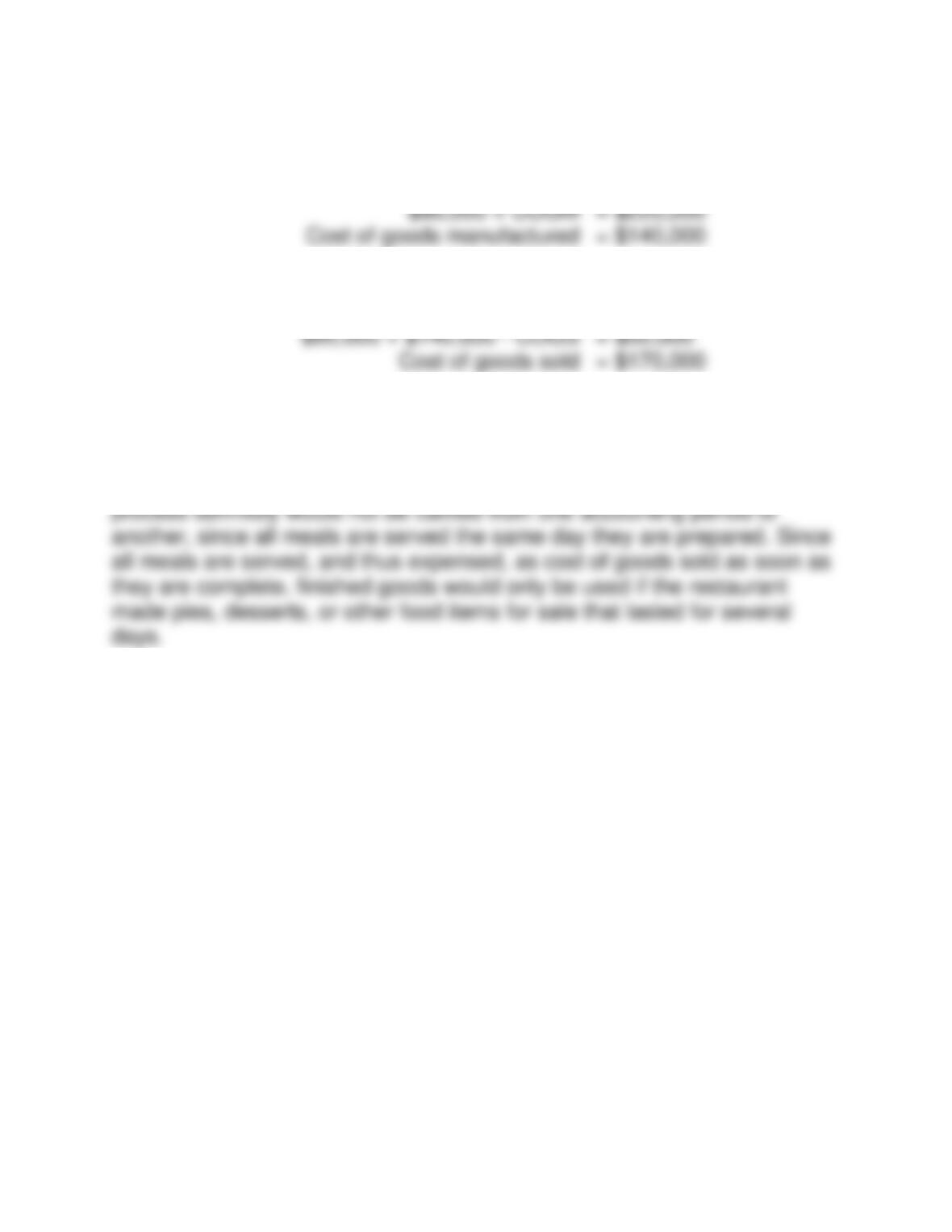
Rocket Company
Schedule of Cost of Goods Manufactured
Direct materials
Direct materials, beginning balance
$ 80,000
Add: Direct materials purchases
940,000
Subtract: Direct materials, ending balance
( 122,000)
Direct materials used in production
$898,000
Direct labor
780,000
Manufacturing overhead
Insurance, factory
50,000
Depreciation, factory
22,000
Indirect labor
220,000
Utilities, factory
17,000
Property taxes, factory
18,000
Total manufacturing overhead
327,000
Total manufacturing costs
2,005,000
Add: Work in process, beginning balance
140,000
Subtract: Work in process, ending balance
( 95,000)
Cost of goods manufactured
$2,050,000
Solutions for Davis & Davis, Managerial Accounting, 2nd ed.
4-10
Exercise 4-7
a.
Beginning Finished Goods Balance + COGM
= Goods available for sale
$80,000 + COGM
= $220,000
Cost of goods manufactured
= $140,000
b.
Beg. Finished Goods Bal. + COGM – COGS
= End. Finished Goods Bal.
$80,000 + $140,000 – COGS
= $50,000
Cost of goods sold
= $170,000
Exercise 4-8
It is likely that raw materials is the only inventory account used. Work in