Chapter 1 – Accounting as a Tool for Management
1-1
Accounting as a Tool for
Management
Learning Objectives
1. Define managerial accounting. (Unit 1.1)
2. Describe the differences between managerial and financial accounting. (Unit 1.1)
3. List and describe the four functions of managers. (Unit 1.1)
5. Discuss the importance of ethical behavior in managerial accounting. (Unit 1.3)
Summary of End of Chapter Material
Difficulty: E = Easy, M = Moderate, D = Difficult
Bloom: K = Knowledge, C = Comprehension, AP = Application, AN = Analysis, S = Synthesis, E = Evaluation
AACSB: A = Analytic, C = Communication, E = Ethics
AICPA FN: DM = Decision modeling, RA = Risk Analysis, M = Measurement, R = Reporting, RS = Research, T = Technology
AICPA PC: C = Communication, I = Interaction, L = Leadership, P = Professional demeanor, PM = Project Management,
PS = Problem Solving and Decision Making, T = Technology
IMA: BA = Business applications, BP = Budget Preparation, CM = Cost Management, DA = Decision Analysis,
PM = Performance Measurement, R = Reporting, SP = Strategic Planning
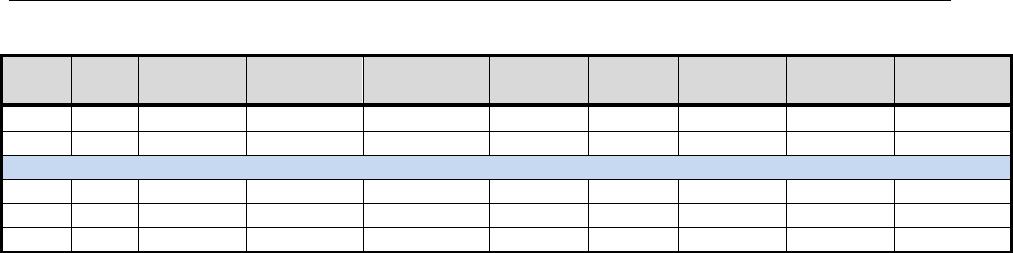
Item
L. O.
Difficulty
Level
Minutes to
Complete
Bloom’s
Taxonomy
AACSB
AICPA
FN
AICPA
PC
IMA
Ethics
Coverage
GUIDED UNIT PREPARATION
Unit 1.1
1
1
E
2
K
C
R
C
R
2
2
E
2
K
C
R
C
R
3
2
E
2
K
C
R
C
R
4
2
M
5-10
C
C
R
C
R
5
3
E
5-7
K
C
R
C
DA
Unit 1.2
1
4
M
4
C
A
R
C
PM, SP
2
4
D
5-7
C
A
R
C
SP
Unit 1.3
1
5
M
4
C
E
R
C
BA
2
5
M
4
C, E
A, E
R
C
BA
EXERCISES
1-1
1
M
12
AP
A
DM
PS
DA
1-2
2
D
10–15
AP
C
R
C
R
1-3
3
D
10–12
C
A
R
C
DA
1-4
4
M
12
AP
A
M
PS
SP
1-5
4
D
15–20
S, AN
A
DM
PS
DA,SP
1-6
4
M
10–15
C
C
R
C
PM
1-7
5
D
20
AP, AN
A, E
R
C
BA
PROBLEMS
1-8
1, 3,
4
M
15–20
AP, AN
A
DM
PS
DA, SP
CHAPTER
1
photo: © jsnyderdesign / iStockphoto
Solutions for Davis & Davis, Managerial Accounting, 2nd ed.
1-2
Item
L. O.
Difficulty
Level
Minutes to
Complete
Bloom’s
Taxonomy
AACSB
AICPA
FN
AICPA
PC
IMA
Ethics
Coverage
1-9
5
M
15–20
C, AN
E
R
C
BA
CASES
1-10
3, 4
M
15–20
S, AN
A
DM
PS
DA, SP
1-11
5
D
15–20
AN, E
A, E
R
C
BA
Chapter 1 – Accounting as a Tool for Management
1-3
SOLUTIONS TO QUESTIONS
Unit 1.1
1. Managerial accounting is the generation of relevant information to
support managers’ decision making activities.
2. The primary users of financial accounting are decision makers who
3. The primary users of managerial accounting are managers within the
development.
4.
Managerial Accounting Information
Financial Accounting Information
Prepared for internal managers
Prepared for external users
Not subject to mandated rules
Must follow GAAP
Focuses on segments of the
organization, such as product
lines, regions, and divisions
Focuses on the organization
as a whole
Uses results of past
performance to project future
results
Reports results of past
performance
Prepared as needed to meet
decision requirements
Prepared after the end of the
accounting period
Timeliness is not sacrificed for
absolute accuracy
Emphasis is on accuracy
rather than timeliness
5. Planning means setting a direction for the organization. Long-term,
or strategic planning, provides direction for a five- to ten-year period.
the process of comparing a particular period’s actual results to
planned results, for the purpose of assessing managerial
1-4
performance. Decision making means choosing between
alternative courses of action.
Unit 1.2
1. Information is used by managers to monitor progress toward the
achieving corporate strategy.
2. Decision making activities should be made to move the organization
toward a particular strategy, and the accounting information used by
decision makers will change depending on the organization’s
strategy. For example, an organization following a product
Unit 1.3
1. A code of conduct provides employees guidance in how to act. It
requires all publicly-traded companies to have a code of conduct or to
2. An employee’s unethical behavior can have a number of effects on
an organization. As employees witness such behavior without

Chapter 1 – Accounting as a Tool for Management
1-5
SOLUTIONS TO EXERCISES
Exercise 1-1
Student responses will vary depending on the position they choose. The
following is one example of a solution a student might give.
Position: Sales manager for a consumer products company
Decision
Information Needed
What price to charge for a
new product
Cost to produce one unit of product,
demand for the product, production
capacity, availability of required
materials
Number of units that must
be sold to break even
Current price per unit, fixed costs,
variable costs
Whether to run a new
advertising campaign
Current sales volume, expected
increase in sales volume, sales
price, unit cost, expected cost of
advertising campaign
Exercise 1-2
a. managerial – focus is on reducing cost in an operating segment
b. financial – focus is on reporting quarterly financial data of the
Solutions for Davis & Davis, Managerial Accounting, 2nd ed.
1-6
Exercise 1-3
Exercise 1-4
b. The focus should be on information about the region, such as
the divisions as a whole.
Chapter 1 – Accounting as a Tool for Management
1-7
Exercise 1-5
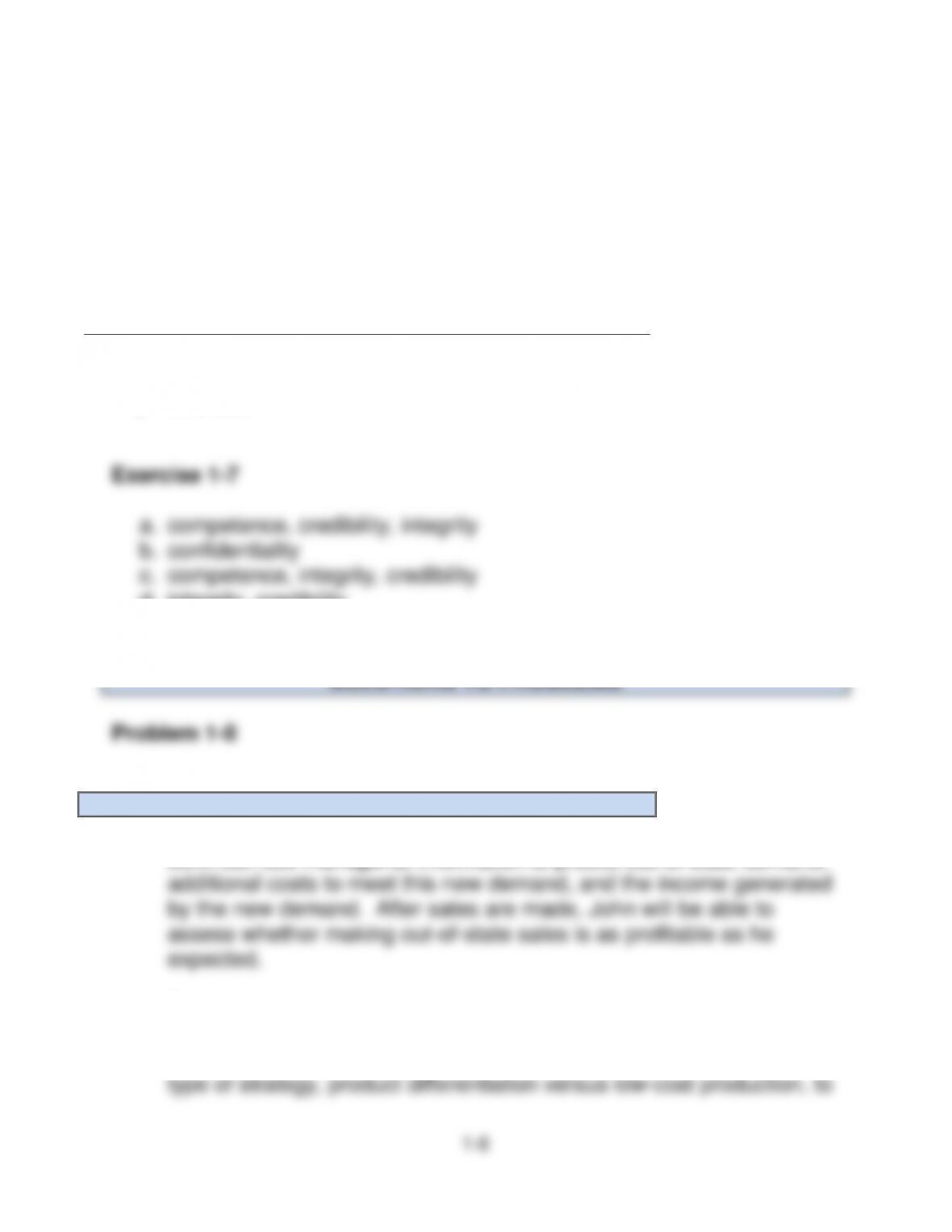
The following supply chain for a newspaper is one example.
Supply Chain Partner
Decisions affecting other partners
Tree farm
Variety of trees to plant, number of acres to plant
Timber harvester
Timing of timber harvest, choice of delivery method
Paper mill
Paper grades to produce, quantity of paper to produce
Publisher/Printer
Price charged per newspaper, choice of acceptable retail outlets
Independent carrier
Pick-up and delivery time
End customer
Desired days of delivery
Tree farm
Timber
Harvester
Paper Mill
Publisher/
Printer
Independent
Carrier
End
Customer
1-8
Exercise 1-6
Exercise 1-7
SOLUTIONS TO PROBLEMS
Problem 1-8
assess whether making out-of-state sales is as profitable as he
expected.
b. One important decision that John would need to make is how much to
1-9
pursue when growing his business. He will also need to decide how
performance will be evaluated.
resources are to be allocated.
Problem 1-9
Student responses will vary.
SOLUTIONS TO CASES
Case 1-10
b. Some of the costs Martin would incur include:
job quotes for customers

1-10
successful.
Case 1-11
If the lab is providing high-quality tests at a low price, the clinic may be
services.