BRIEF EXERCISE 14-2
(a) The three tools of financial statement analysis are horizontal analysis,
vertical analysis, and ratio analysis. Horizontal analysis evaluates a series
(b) Horizontal Analysis
2014
2015
2016
Current assets
100%
105%
120%
2014
2015
2016
Current assets*
40%
35%
39%
*as a percentage of total assets
Ratio Analysis
2014
2015
2016
Current ratio
1.33:1
1.25:1
1.30:1
(1.33 = $200,000/$150,000; 1.25 = $210,000/$168,000;
1.30 = $240,000/$184,000)
BRIEF EXERCISE 14-3
Horizontal analysis:
Increase
or (Decrease)
Dec. 31, 2015
Dec. 31, 2014
Amount
Percentage
Accounts receivable
Inventory
Total assets
$ 520,000
$ 840,000
$3,000,000
$ 400,000
$ 600,000
$2,500,000
$120,000
$240,000
$500,000
30%
40%
20%
120,000
400,000
= .30
600,000
240,000
= .40
500,000
2,500,000
= .20
BRIEF EXERCISE 14-4
Vertical analysis:
Dec. 31, 2015
Dec. 31, 2014
Amount
Percentage*
Amount
Percentage**
Accounts receivable
Inventory
Total assets
$ 520,000
$ 840,000
$3,000,000
17.3%
28.0%
100%
$ 400,000
$ 600,000
$2,500,000
16.0%
24.0%
100%
*520,000
3,000,000
= .173
** 400,000
2,500,000
= .16
* 840,000
3, 000,000
= .28
** 600,000
2,500,000
= .24
BRIEF EXERCISE 14-5
2016
2015
2014
Net income
$522,000
$450,000
$500,000
Increase or (Decrease)
Amount
Percentage
(a)
(b)
2014–2015
2015–2016
(50,000)
(72,000)
(10%)
(16%)
50,000
500,000
= .10
72,000
450,000
= .16
BRIEF EXERCISE 14-6
2015
2014
Increase
Net income
$585,000
X
20%
X .20 =
585,000 – X
X
.20X = 585,000 – X
BRIEF EXERCISE 14-6 (Continued)
1.20X = 585,000
BRIEF EXERCISE 14-7
Comparing the percentages presented results in the following conclusions:
The net income for Dody increased in 2015 because of the combination of
BRIEF EXERCISE 14-8
2016
2015
2014
Sales
Cost of goods sold
Expenses
Net income
100.0
60.2
25.0
14.8
100.0
62.4
25.6
12.0
100.0
63.5
27.5
9.0
Net income as a percent of sales for Kochheim increased over the three-
BRIEF EXERCISE 14-9
(a) Working capital = Current assets – Current liabilities
BRIEF EXERCISE 14-9 (Continued)
(b) Current ratio:
Current assets
Current liabilities
=
$45,918,000
$40,644,000
= 1.13:1
(c) Acid-test ratio:
Cash+ Short–term investments
+ Receivables (net)
Current liabilities
=
$8,041,000 + $4,947,000 + $12,545,000
$40,644,000
=
$25,533,000
$40,644,000
= .63:1
BRIEF EXERCISE 14–10
(a) Asset turnover =
Net sales
Average assets
=
$95,000,000
$14,000,000 + $18,000,000
2
= 5.9 times
(b) Profit margin =
Net income
Net sales
=
$11,440,000
$95,000,000
= 12.0%
BRIEF EXERCISE 14–11
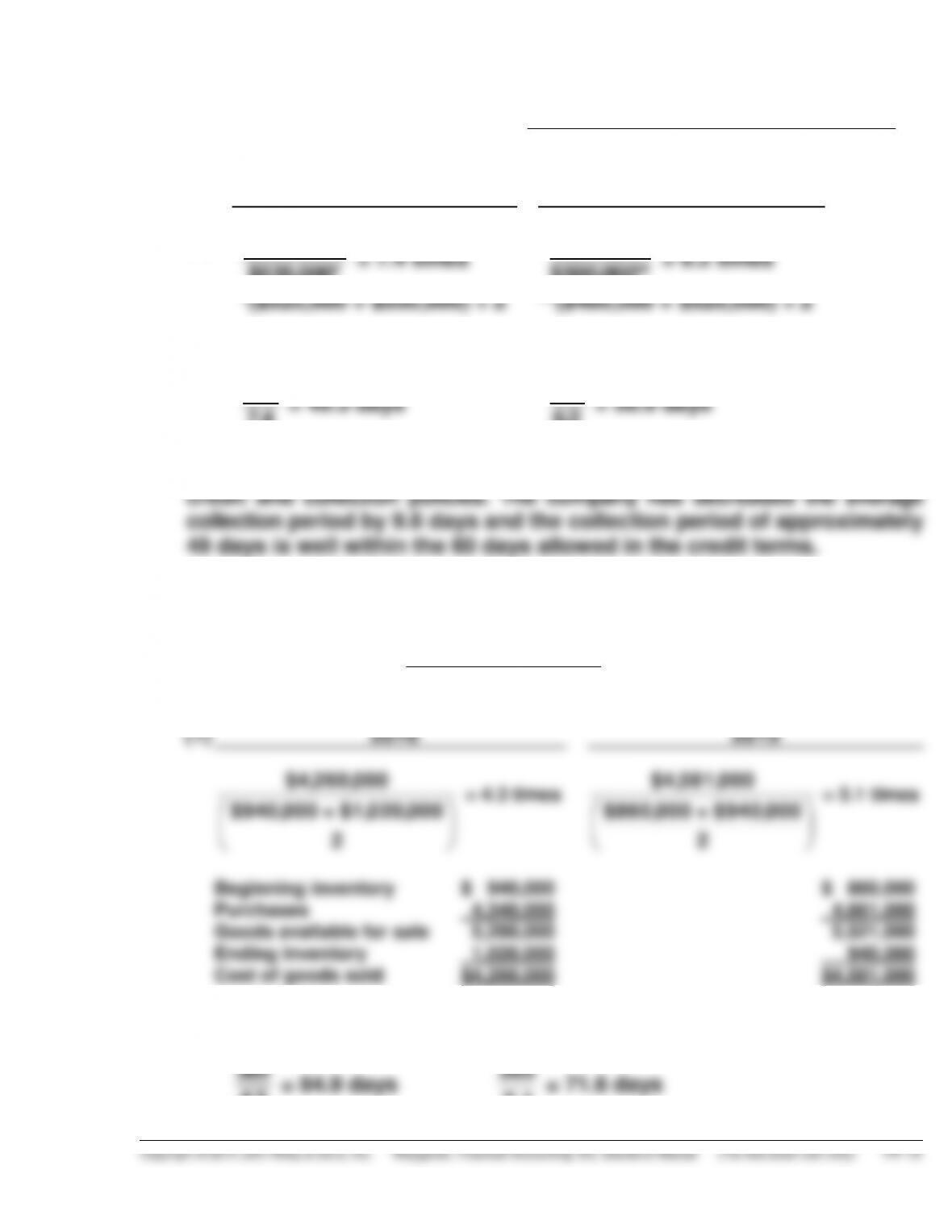
(a) Accounts Receivable turnover =
Net credit sales
Average net accounts receivable
2016
2015
(1)
$3,960,000
$535,000*
= 7.4 times
$3,100,000
$500,000**
= 6.2 times
*($520,000 + $550,000) ÷ 2
**($480,000 + $520,000) ÷ 2
(2)
Average collection period
365
7.4
= 49.3 days
365
6.2
= 58.9 days
(b) Rainsberger Company should be pleased with the effectiveness of its
BRIEF EXERCISE 14–12
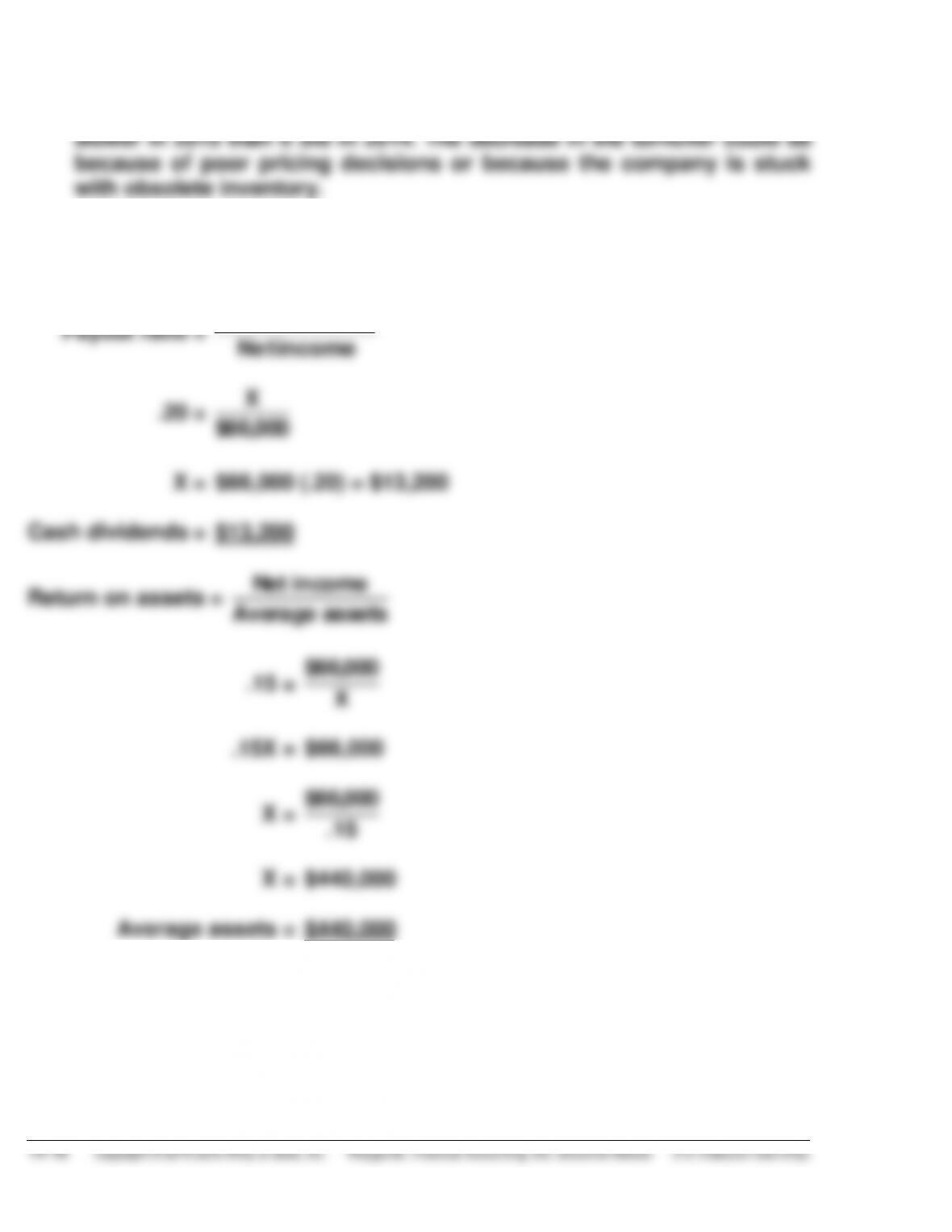
(a) Inventory turnover =
inventory Average
sold goods ofCost
(1)
2016
2015
$4,260,000
$940,000 + $1,020,000
2
= 4.3 times
$4,581,000
$860,000 + $940,000
2
= 5.1 times
Beginning inventory $ 940,000
Purchases 4,340,000
Goods available for sale 5,280,000
Ending inventory 1,020,000
Cost of goods sold $4,260,000
$ 860,000
4,661,000
5,521,000
940,000
$4,581,000
(2) Days in inventory
365
4.3
= 84.9 days
365
5.1
= 71.6 days
BRIEF EXERCISE 14-12 (Continued)
(b) Management should be concerned with the fact that inventory is moving
BRIEF EXERCISE 14–13
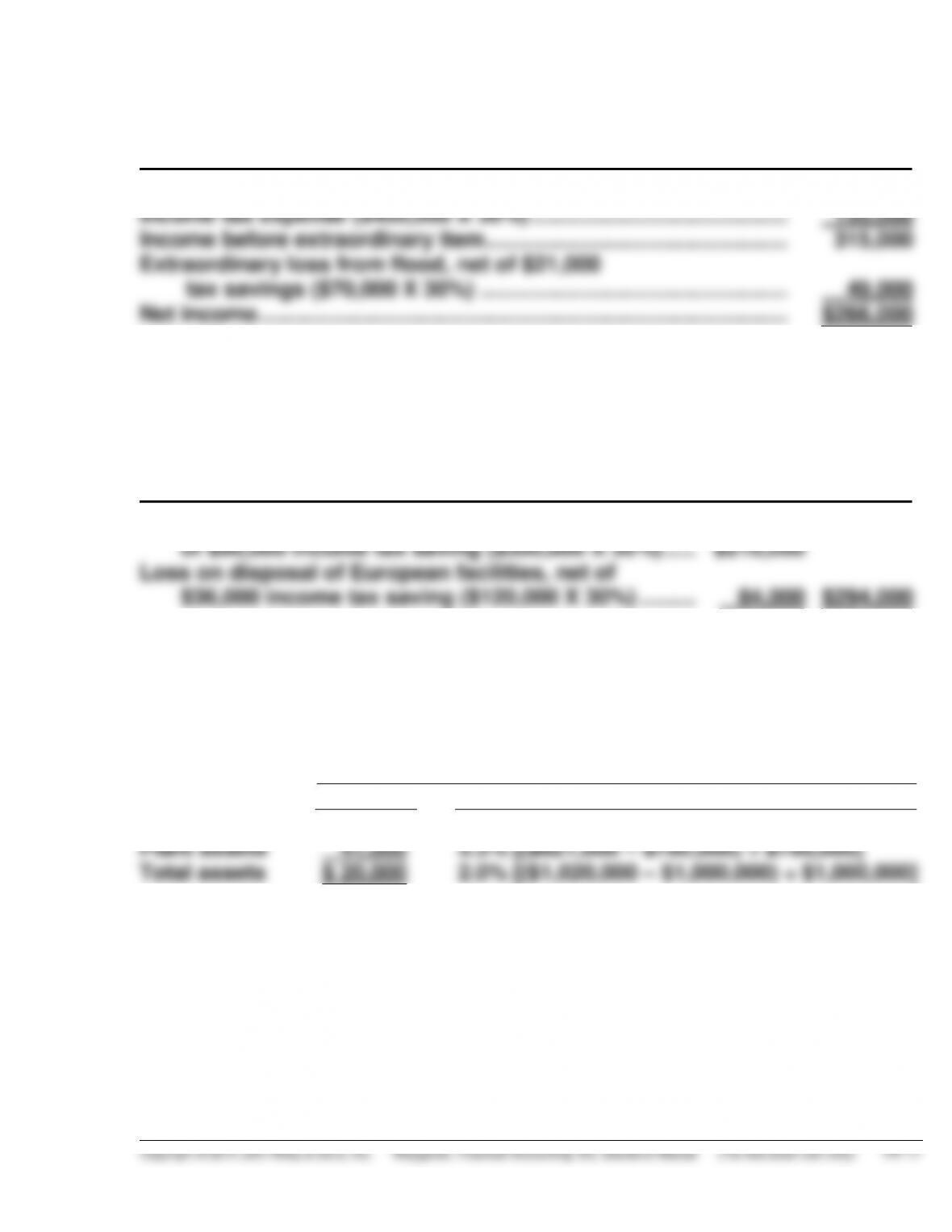
dividends Cash
BRIEF EXERCISE 14–14
SILVA CORPORATION
Partial Income Statement
Income before income taxes ………………………………………………… $450,000
BRIEF EXERCISE 14–15
HOLLOWAY CORPORATION
Partial Income Statement
Loss from operations of European facilities, net
SOLUTIONS FOR DO IT! REVIEW EXERCISES
DO IT! 14-1
Increase (Decrease) in 2015
Amount
Percent
Current assets $(21,000) (9.5)% [($199,000 – $220,000) ÷ $220,000]
DO IT! 14-2
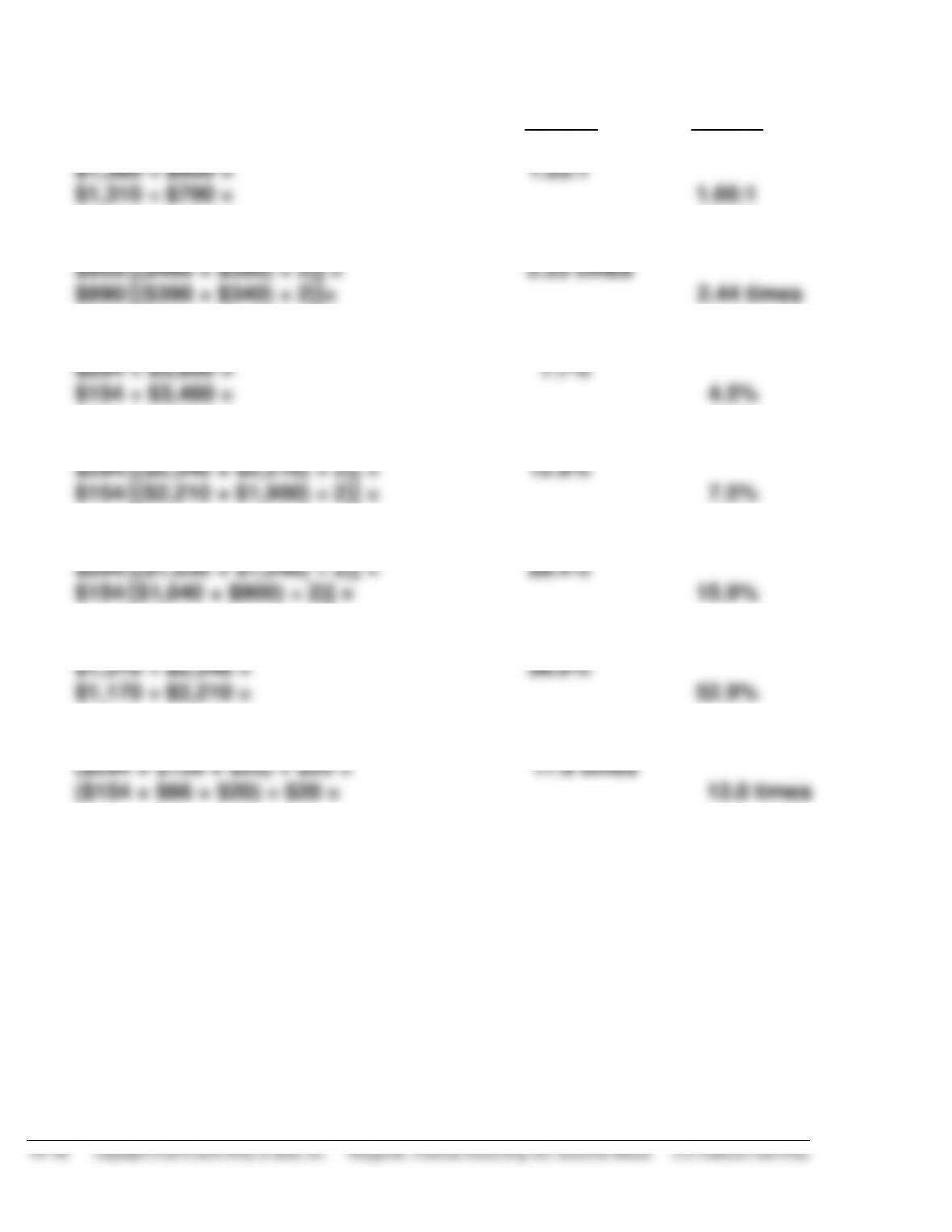
2015 2014
(a) Current ratio:
(b) Inventory turnover:
(c) Profit margin ratio:
(d) Return on assets:
(e) Return on common stockholders’ equity:
(f) Debt to assets ratio:
(g) Times interest earned:
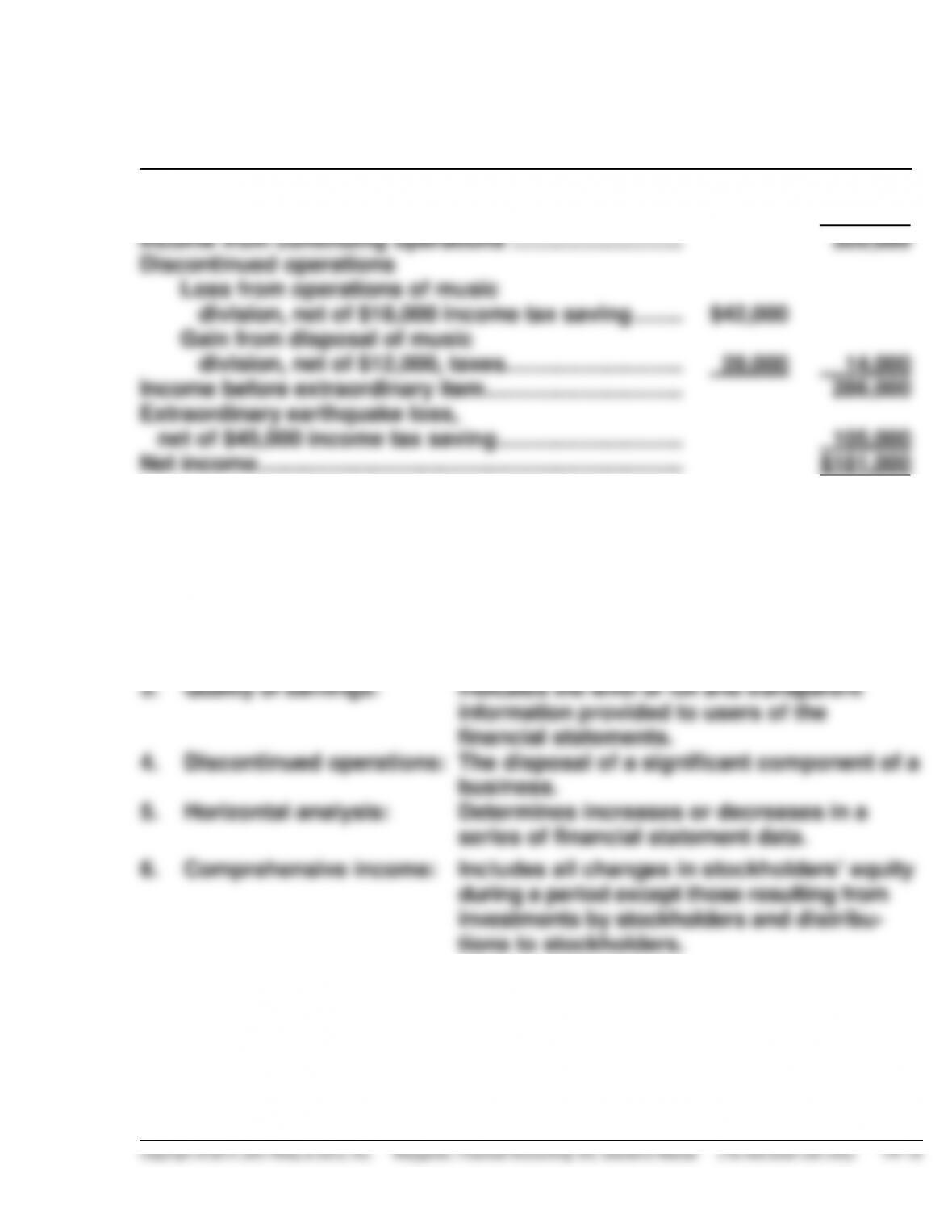
DO IT! 14-3
HRABIK CORPORATION
Income Statement (Partial)
Income before income taxes …………………………………. $500,000
Income tax expense ……………………………………………… 200,000
DO IT! 14-4
1.
Current ratio:
A measure used to evaluate a company’s
liquidity.
2.
Pro forma income:
Usually excludes items that a company
thinks are unusual or nonrecurring.
3.
Quality of earnings:
Indicates the level of full and transparent
information provided to users of the
financial statements.
4.
Discontinued operations:
The disposal of a significant component of a
business.
5.
Horizontal analysis:
Determines increases or decreases in a
series of financial statement data.
6.
Comprehensive income:
Includes all changes in stockholders’ equity
during a period except those resulting from
investments by stockholders and distribu-
tions to stockholders.
SOLUTIONS TO EXERCISES
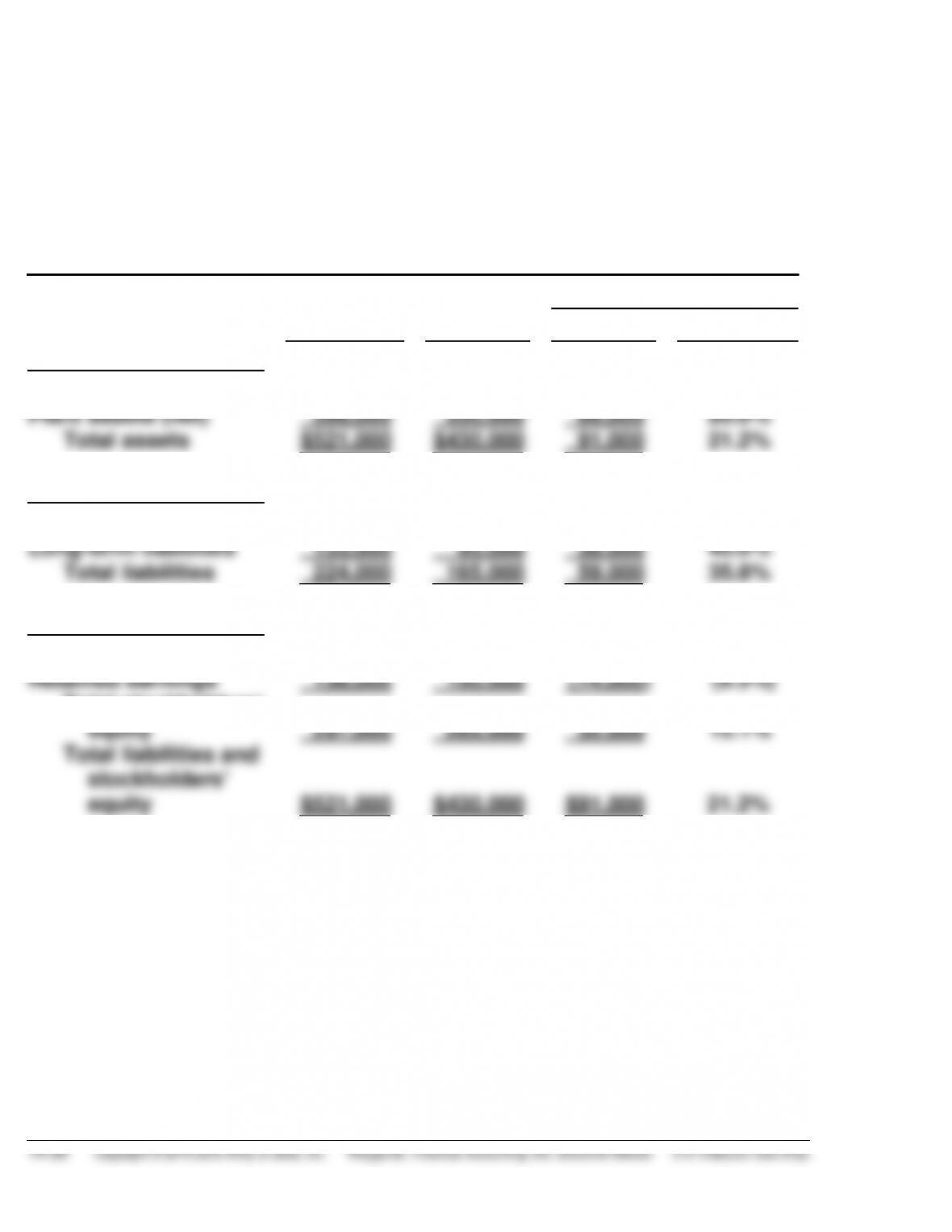
EXERCISE 14-1
KURZEN INC.
Condensed Balance Sheets
December 31
Increase or (Decrease)
2015
2014
Amount
Percentage
Assets
Current assets
Plant assets (net)
Total assets
$125,000
396,000
$521,000
$100,000
330,000
$430,000
($25,000
( 66,000
91,000
(25.0%)
(20.0%)
(21.2%)
Liabilities
Current liabilities
Long-term liabilities
Total liabilities
$ 91,000
133,000
224,000
$ 70,000
95,000
165,000
($21,000)
( 38,000)
( 59,000)
(30.0%)
(40.0%)
(35.8%)
Stockholders’ Equity
Common stock, $1 par
Retained earnings
Total stockholders’
equity
Total liabilities and
stockholders’
equity
161,000
136,000
297,000
$521,000
115,000
150,000
265,000
$430,000
( 46,000
(14,000)
( 32,000)
($91,000)
(40.0%)
(9.3%)
( 12.1%)
21.2%