CHAPTER 9
Budgetary Planning
ASSIGNMENT CLASSIFICATION TABLE
Learning Objectives
Questions
Brief
Exercises
Do It!
Exercises
A
Problems
B
Problems
1. Indicate the benefits of
budgeting.
1, 2, 4
1
2. State the essentials of
effective budgeting.
3, 5, 6,
7, 8
1
1
3. Identify the budgets
that comprise the
master budget.
9, 10, 11,
12, 13, 14,
15, 16
1, 2, 3, 4,
5, 6, 7
1, 2, 3
1, 2, 3, 4,
5, 6, 7,
8, 9, 10,
11, 12
1A, 2A, 3A
1B, 2B, 3B
4. Describe the sources for
preparing the budgeted
income statement.
17, 18
8
4
13
1A, 2A,
3A, 6A
1B, 2B, 3B
5. Explain the principal sections
of a cash budget.
19, 20
9
5
14, 15, 16,
17, 18, 19
4A, 6A
4B
6. Indicate the applicability of
budgeting in nonmanufacturing
companies.
21, 22
10
3, 18,
19, 20
5A
5B

ASSIGNMENT CHARACTERISTICS TABLE
Problem
Number
Description
Difficulty
Level
Time
Allotted (min.)
1A
Prepare budgeted income statement and supporting
budgets.
Simple
30–40
2A
Prepare sales, production, direct materials, direct labor,
and income statement budgets.
Simple
40–50
3A
Prepare sales and production budgets and compute cost
per unit under two plans.
Moderate
30–40
4A
Prepare cash budget for two months.
Moderate
30–40
5A
Prepare purchases and income statement budgets for a
merchandiser.
Simple
30–40
6A
Prepare budgeted income statement and balance sheet.
Complex
40–50
1B
Prepare budgeted income statement and supporting
budgets.
Simple
30–40
2B
Prepare sales, production, direct materials, direct labor,
and income statement budgets.
Simple
40–50
3B
Prepare sales and production budgets and compute cost
per unit under two plans.
Moderate
30–40
4B
Prepare cash budget for two months.
Moderate
30–40
5B
Prepare purchases and income statement budgets for a
merchandiser.
Simple
30–40

BLOOM’S TAXONOMY TABLE
Copyright © 2012 John Wiley & Sons, Inc. Weygandt, Managerial Accounting, 6/e, Solutions Manual (For Instructor Use Only) 9-3
Correlation Chart between Bloom’s Taxonomy, Learning Objectives and End–of-Chapter Exercises and Problems
Learning Objective
Knowledge
Comprehension
Application
Analysis
Synthesis
Evaluation
1. Indicate the benefits of
budgeting.
Q9-1
Q9-2
Q9-4
E9-1
2. State the essentials of
effective budgeting.
DI9-1
Q9-3
Q9-5
Q9-6
Q9-7
Q9-8
E9-1
3. Identify the budgets
that comprise the
master budget.
DI9-1
Q9-9
Q9–10
Q9–11
E9-1
Q9–12
Q9–13
Q9–14
Q9–15
Q9–16
BE9-2
BE9-3
BE9-4
BE9-5
BE9-6
BE9-7
DI9-2
DI9-3
E9-2
E9-3
E9-4
E9-5
E9-6
E9-7
E9-8
E9-9
E9–10
E9–11
E9–12
P9–1A
P9–2A
P9–1B
P9–2B
BE9-1
P9–3A
P9–3B
4. Describe the sources for
preparing the budgeted
income statement.
Q9–18
Q9–17
BE9-8
DI9-4
E9–13
P9–1A
P9–2A
P9–6A
P9–1B
P9–2B
P9–3A
P9–3B
5. Explain the principal
sections of a cash budget.
Q9–19
Q9–20
BE9-9
DI9-5
E9–14
E9–15
E9–17
E9–18
E9–19
P9–4A
P9–6A
P9–4B
E9–16
6. Indicate the applicability
of budgeting in
nonmanufacturing
companies.
Q9–21
Q9–22
BE9-10
E9-3
E9–18
E9–19
E9–20
P9–5A
P9–5B
Broadening Your Perspective
BYP9-1
BYP9-3
BYP9-4
BYP9-5
BYP9-6
BYP9-2
BYP9-7
BYP9-8
BYP9-9

ANSWERS TO QUESTIONS
1. (a) A budget is a formal written statement of management’s plans for a specified future time period,
expressed in financial terms.
an important basis for evaluating performance.
2. The primary benefits of budgeting are:
(1) It requires all levels of management to plan ahead and to formalize goals on a recurring basis.
before things get out of hand.
(4) It facilitates the coordination of activities within the business by correlating the goals of each
segment with overall company objectives.
3. The essentials of effective budgeting are: (1) a sound organizational structure, (2) research and
4. (a) Disagree. Accounting information makes major contributions to the budgeting process. Accounting
actual results with planned objectives and provide a basis for evaluating performance.
5. The budget period should be long enough to provide an attainable goal under normal business
budget period is one year.
6. Disagree. Long-range planning usually encompasses a period of at least five years. It involves
than budget reports.
7. Participative budgeting involves the use of a “bottom–to–top” approach, which requires input from
lower level management during the budgeting process so as to involve employees from various
disadvantage of participative budgeting is that it takes more time, and thus costs more. Another
Questions Chapter 9 (Continued)
8. Budgetary slack is the amount by which a manager intentionally underestimates budgeted
9. A master budget is a set of interrelated budgets that constitutes a plan of action for a specified
inventories and a very conservative sales budget may lead to inventory shortages.
anticipated sales and ending inventory requirements.
12. The required units of production are 155,000 (160,000 + 15,000 = 175,000 – 20,000 = 155,000).
13. The desired ending direct materials units are 21,000 (64,000 + 9,000 = 73,000 – 52,000 = 21,000).
14. Total budgeted direct labor costs are $960,000 (80,000 X .75 X $16 = $960,000).
15. (a) Manufacturing overhead rate based on direct labor cost is 48% [$198,000 + $162,000 =
$360,000; $360,000 ÷ (150,000 X 1/3 X $15/hr.) = 48%].
(b) Manufacturing overhead rate per direct labor hour is $7.20 ($360,000 ÷ 50,000).
$50,000]. The second quarter total is $78,800 [(12% X $240,000) + $50,000].
Total budgeted gross profit is $475,000 (25,000 X $19).
overhead.
19. The three sections of a cash budget are: (1) cash receipts, (2) cash disbursements, and (3) financing.
The cash budget also shows the beginning and ending cash balances.
20. Cash collections are:
21. The formula is: Budgeted cost of goods sold plus desired ending merchandise inventory minus
22. In a service company, expected revenues can be obtained from expected output or expected
SOLUTIONS TO BRIEF EXERCISES
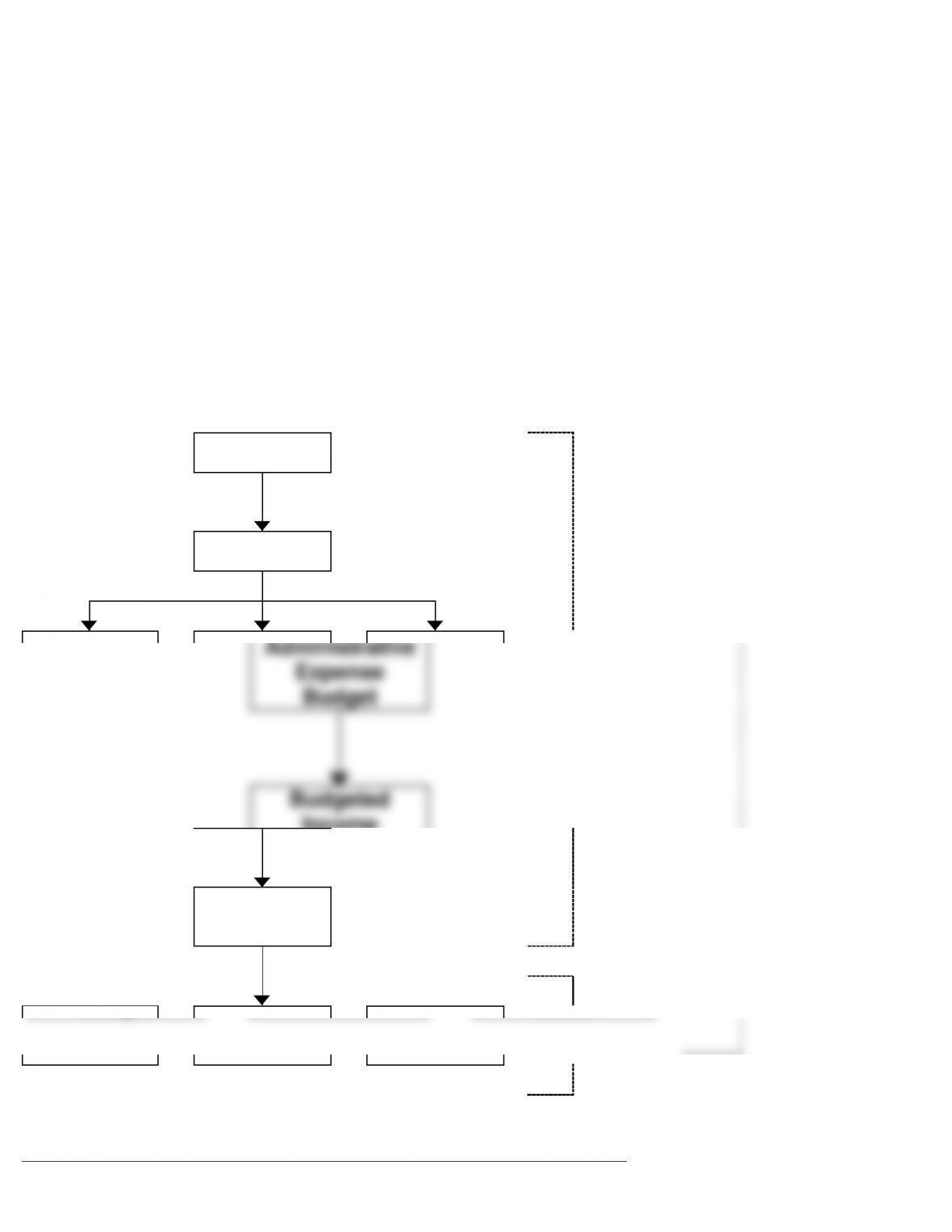
BRIEF EXERCISE 9-1
Sales
Budget
Production
Budget
Direct
Materials
Budget
Direct
Labor
Budget
Manufacturing
Overhead
Budget
Operating
Budgets
Selling and
Administrative
Expense
Budget
Budgeted
Income
Statement
Capital
Expenditure
Budget
Cash Budget
Budgeted
Balance
Sheet
Financial
Budgets

BRIEF EXERCISE 9-2
PALERMO COMPANY
Sales Budget
For the Year Ending December 31, 2014
Quarter
1
2
3
4
Year
Expected unit
sales
Unit selling
price
Total sales
10,000
X $70
$700,000
12,000
X $70
$840,000
15,000
X $70
$1,050,000
18,000
X $70
$1,260,000
55,000
X $70
$3,850,000
BRIEF EXERCISE 9-3
PALERMO COMPANY
Production Budget
For the Six Months Ending June 30, 2014
Quarter
Six
Months
1
2
Expected unit sales
Add: Desired ending finished goods
Total required units
Less: Beginning finished goods inventory
Required production units
10,000
3,000
13,000
2,500
10,500
a
b
12,000
3,750
15,750
3,000
12,750
c
23,250
a12,000 X .25 b10,000 X .25 c15,000 X .25

BRIEF EXERCISE 9-4
PERINE COMPANY
Direct Materials Budget
For the Month Ending January 31, 2014
Units to be produced ………………………………………………. 4,000
Direct materials per unit …………………………………………. X 2
Total pounds required for production………………………. 8,000
Add: Desired ending inventory (25% X 5,000 X 2) …… 2,500
BRIEF EXERCISE 9-5
MIZE COMPANY
Direct Labor Budget
For the Six Months Ending June 30, 2014
Quarter
Six
Months
1
2
Units to be produced
Direct labor time (hours) per unit
Total required direct labor hours
Direct labor cost per hour
Total direct labor cost
5,000
X 1.6
8,000
X $15
$120,000
6,000
X 1.6
9,600
X $15
$144,000
$264,000

BRIEF EXERCISE 9-6
ROCHE INC.
Manufacturing Overhead Budget
For the Year Ending December 31, 2014
Quarter
1
2
3
4
Year
Variable costs
Fixed costs
Total manufacturing overhead
$20,000
40,000
$60,000
$25,000
40,000
$65,000
$30,000
40,000
$70,000
$35,000
40,000
$75,000
$110,000
160,000
$270,000
BRIEF EXERCISE 9-7
NOBLE COMPANY
Selling and Administrative Expense Budget
For the Year Ending December 31, 2014
Quarter
1
2
3
4
Year
Variable expenses
Fixed expenses
Total selling and administrative
expenses
$22,000
40,000
$62,000
$26,000
40,000
$66,000
$30,000
40,000
$70,000
$34,000
40,000
$74,000
$112,000
160,000
$272,000
BRIEF EXERCISE 9-8
NORTH COMPANY
Budgeted Income Statement
For the Year Ending December 31, 2014
Sales ………………………………………………………………………. $2,250,000
Cost of goods sold (50,000 X $25) ……………………………. 1,250,000
Gross profit …………………………………………………………….. 1,000,000

BRIEF EXERCISE 9-9
Collections from Customers
Credit Sales
January
February
March
January, $200,000
February, $260,000
March, $300,000
$150,000
$150,000
$ 50,000
195,000
$245,000
$ 65,000
225,000
$290,000
BRIEF EXERCISE 9-10
Budgeted cost of goods sold ($400,000 X 65%) …………………… $260,000
Add: Desired ending inventory ($480,000 X 65% X 20%) ……. 62,400
SOLUTIONS FOR DO IT! REVIEW EXERCISES
DO IT! 9-1
1. Operating budgets
2. Master budget
DO IT! 9-2
ZELLER COMPANY
Production Budget
For the Six Months Ending June 30, 2014
Quarter Six
1 2 Months
Expected unit sales 20,000 24,000
Add: Desired ending finished goods inventory 2,400 2,900*