BYP 8-3 (Continued)
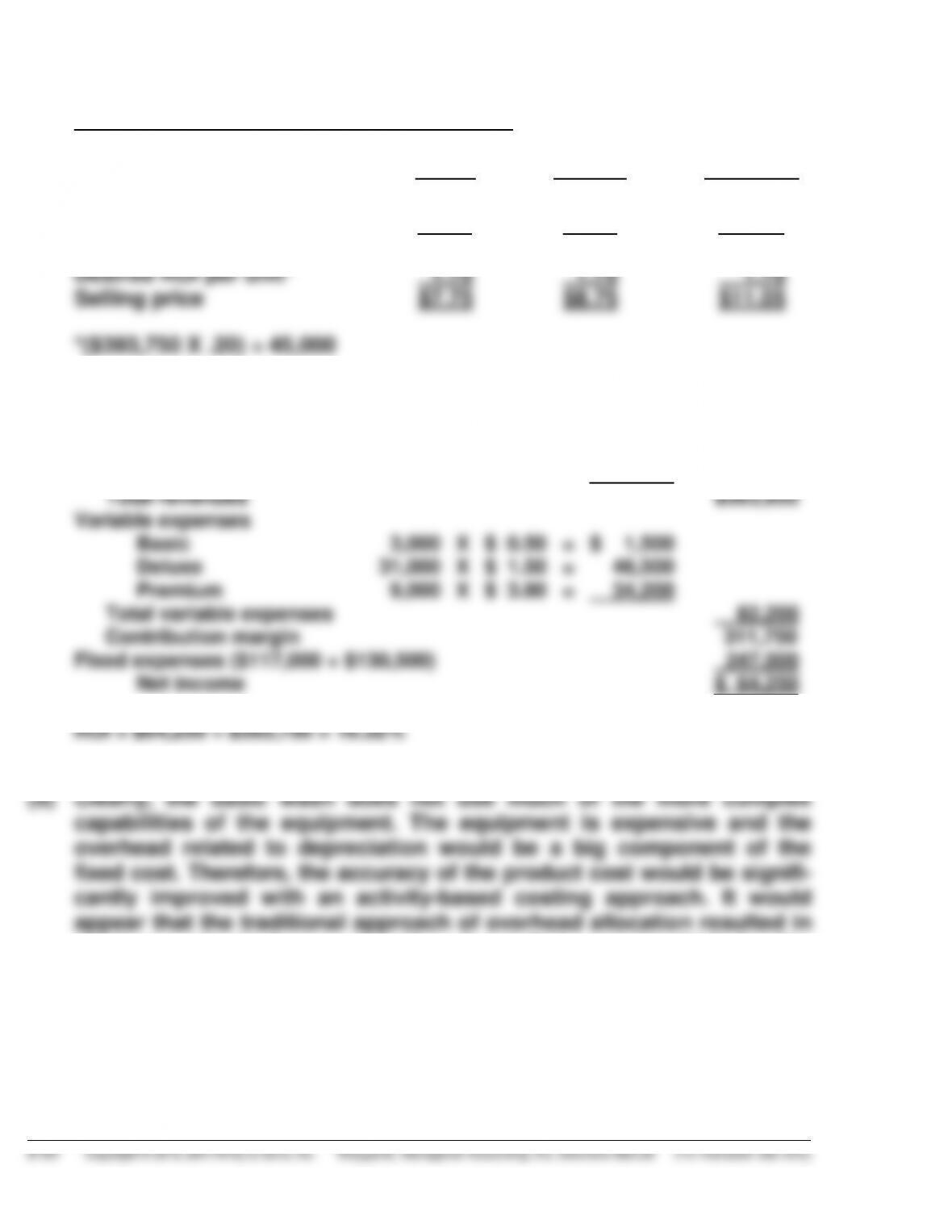
Computation of selling price (45,000 units)
Basic
Deluxe
Premium
Variable cost per unit
Fixed cost per unit
Total unit cost
Desired ROI per unit*
Selling price
$0.50
5.50
6.00
1.75
$7.75
$1.50
5.50
7.00
1.75
$8.75
$ 3.80
5.50
9.30
1.75
$11.05
*($393,750 X .20) ÷ 45,000
(c)
Revenues
Basic
Deluxe
Premium
Total revenues
Variable expenses
Basic
Deluxe
Premium
Total variable expenses
3,000
31,000
9,000
3,000
31,000
9,000
X
X
X
X
X
X
$ 7.75
$ 8.75
$11.05
$ 0.50
$ 1.50
$ 3.80
=
=
=
=
=
=
$ 23,250
271,250
99,450
$ 1,500
46,500
34,200
$393,950
82,200
Contribution margin
Fixed expenses ($117,000 + $130,500)
Net income
311,750
247,500
$ 64,250
product costs (and consequently prices) that were too high for the
basic wash and too low for the premium.
BYP 8-4 REAL-WORLD FOCUS
(a) Pricing in the pharmaceutical industry is complicated by a number of
factors:
company to charge a higher price.
2. The nature of the product is such that demand is relatively inelastic.
3. In light of 2., pharmaceutical companies must be careful not to
industry by the government.
4. Many prescription drugs are paid for by health insurance policies.
and health maintenance organizations are constantly questioning
5. The pharmaceutical industry is heavily regulated worldwide. However,
(b) Normally, if a difference exists in the price of a product across markets,
that difference will be eliminated as people take advantage of the
difference by shipping the goods. Eventually, the difference should be
equal to the cost of transporting and selling from one market to
another. However, in the pharmaceutical industry, barriers exist which
allow significant differences in price to persist. For example, it is often
BYP 8-4 (Continued)
(c) In arriving at a price for a drug, the company would need to take into
account market factors as well as its costs. Ultimately, the price will be
arrived at through a combination of cost-plus pricing, market considera–
tions, and consideration of the other factors discussed in (a). When
BYP 8-5 REAL-WORLD FOCUS
(a) Answers will vary.
(b) One concern is the security of providing credit card information over
credit information, over the Internet.
(c) In the same way that sometimes consumers will choose a brick-and-
mortar retailer even though its prices are higher, the same is true of
the Web. For brick-and-mortar stores, the reasons for this often have
the Amazon name and have more confidence in the process when
dealing with a well-known company.
(d) These shopping “robot” sites have tremendous implications for retailers.
BYP 8-6 COMMUNICATION ACTIVITY
To: Jane Fleming
From: Student
The student’s memo should address the following points:
1. In a traditional transfer pricing problem, the transactions are between
divisions within the same company. In the case of related divisions, the
2. It is similar to a transfer pricing case in that, for a variety of reasons, it
would be desirable to deal with the related (in this case literally)
parties. For example, quality is more assured. Some costs, such as
3. Jane should gather information regarding what she would pay to other
suppliers as well as documenting other issues (perceived quality,
reliability, and convenience) in addition to price. She should also
BYP 8-7 ETHICS CASE
(a) The stakeholders in this case are:
The two airlines
The flying public in the affected cities
Federal transportation regulators
costs because of smaller operations.
(c) Jumbo services many different locations. If it loses money for a while
on one location, it can make it up on other locations. Econo doesn’t
(d) If it feels that Jumbo’s actions are anti-competitive, it can take Jumbo
to court. The problem is that anti-competitive behavior is difficult to
prove, and legal remedies are slow. It is likely that Econo will be out of
business by the time the court acts. Ironically, one possibility would
to service regional communities.
(e) Whether this is ethical behavior is difficult to say. On the one hand, it
can be argued that Jumbo is simply acting to protect its interests by
maintaining its market share. And it can be argued that the flying
BYP 8-8 CONSIDERING YOUR COSTS AND BENEFITS
(b) Clarus Technologies often charges significantly higher prices for its
equipment when compared to competitive products. In order for the
company to compete, one option would be for the company to lower
its price. It has chosen instead to keep its prices high, and then to
analysis to justify this price.
(c) The five categories of costs used by the authors to evaluate the
Tornado and examples of each type of cost are:
a. Usual costs: Personnel and fuel savings.
disposal fees.
c. Liability costs: Reduction of potential contingencies, fines and
penalties.
e. Environmental focused costs: Reduced soil contamination and
reduced air pollution.
(d) Full-cost accounting, as developed by the EPA, looks at all costs incurred
more common aspect of business decisions.