PROBLEM 8-5B
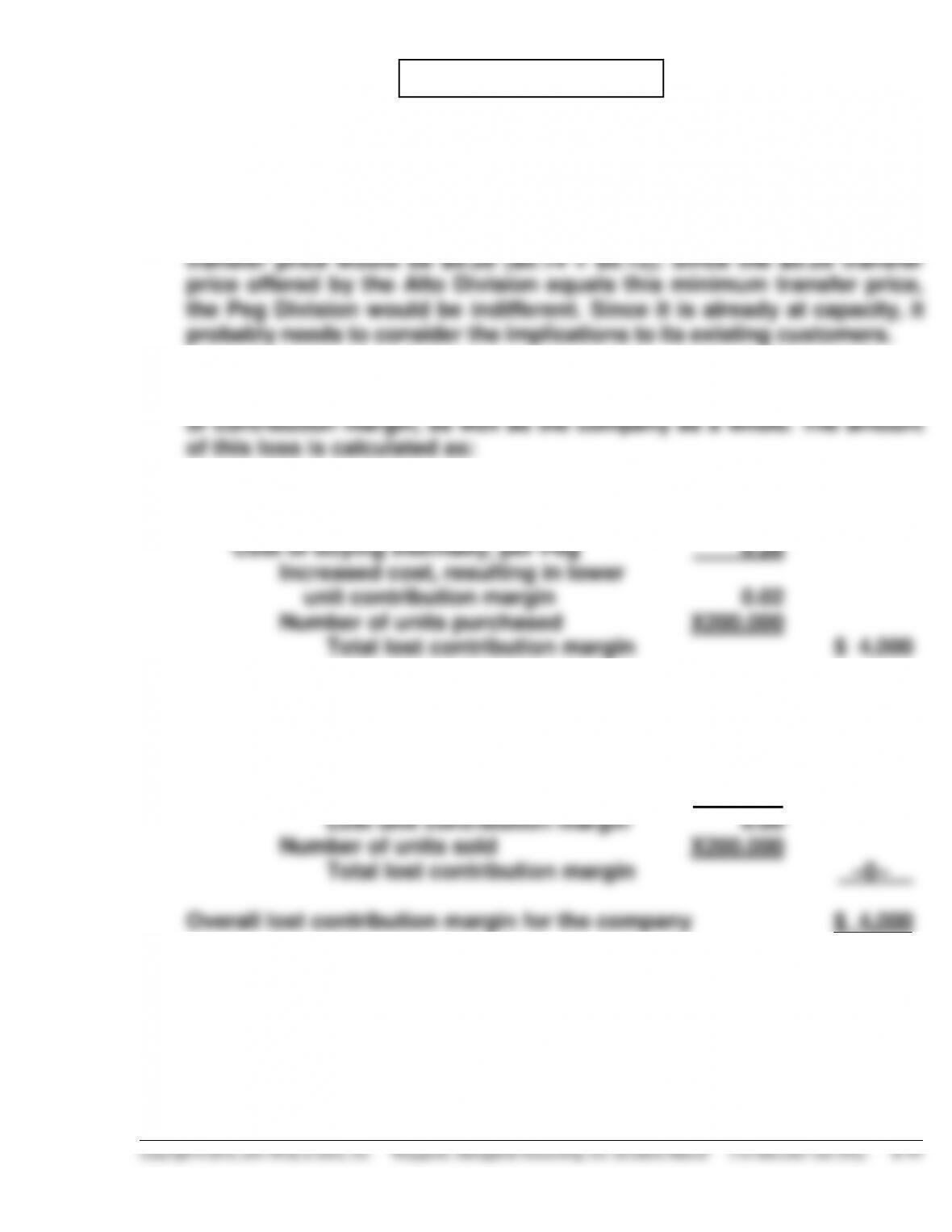
(a) The minimum transfer price is based on the variable cost of units
transferred internally, plus the opportunity cost of units sold externally.
The variable cost of internal sales would be $0.14 ($0.18 – $0.04). The
opportunity cost would be $0.12 ($0.30 – $0.18). Therefore, the minimum
(b) If the Peg Division rejects the offer, the Alto division will suffer a loss
Lost contribution margin by Alto Division:
Cost of buying externally, per Peg $0.28
Lost contribution margin by Peg Division:
Unit contribution margin on internal sales
($0.26 – $0.14) $0.12
Unit contribution margin on external sales
($0.30 – $0.18) 0.12
PROBLEM 8-6B
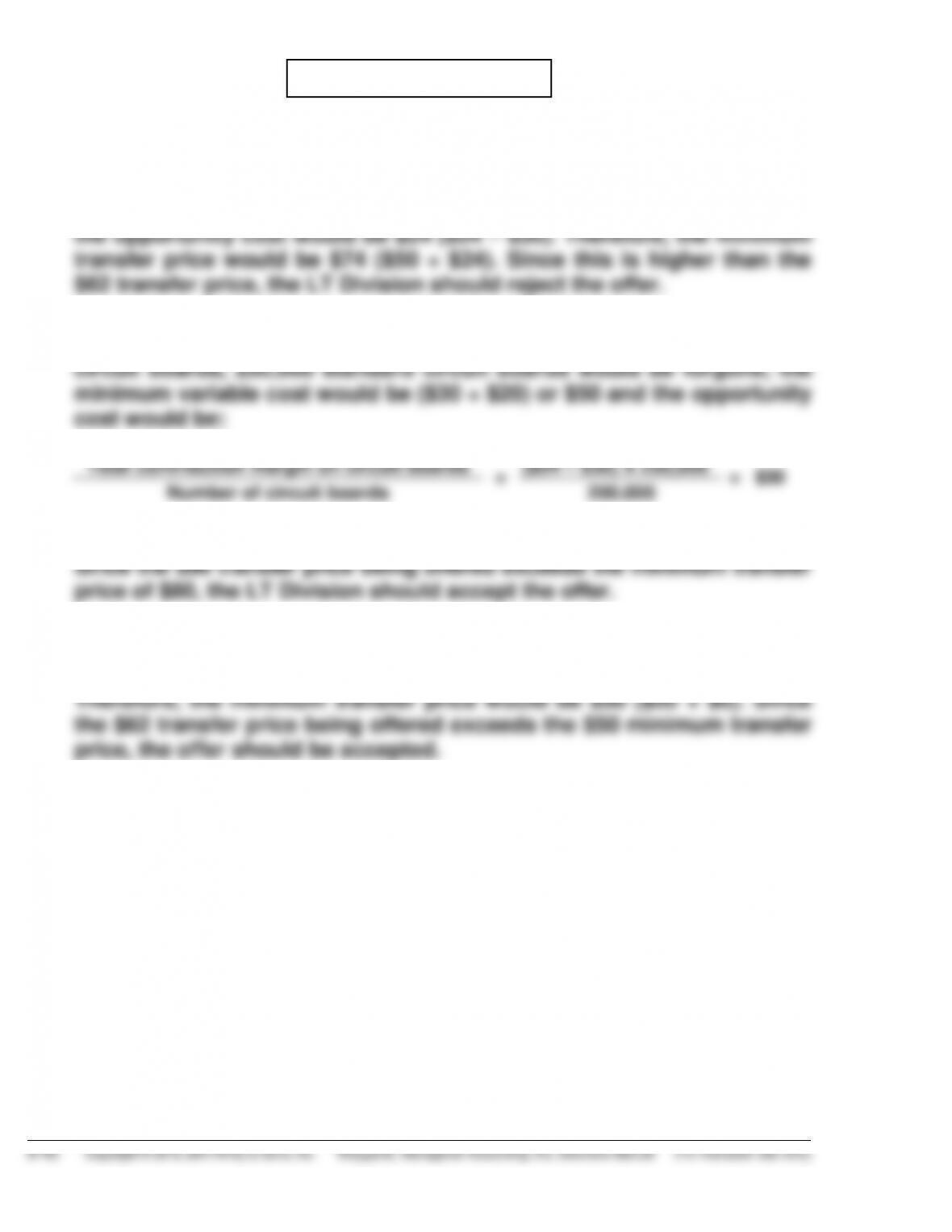
(a) Assuming no available capacity, and that the number of new units
produced would be equal to the number of standard units forgone,
variable cost of the special circuit board would be $50 ($30 + $20) and
(b) Assuming no available capacity, and that in order to produce the 200,000
Total contribution margin on circuit boards
=
($54 – $30) X 250,000
=
$30
Number of circuit boards
200,000
Therefore, the minimum transfer price would be $80 [($30 + $20) + $30].
(c) Assuming that the LT Division has available capacity, variable cost
would be $50 ($30 + $20) and the opportunity cost would be zero.
*PROBLEM 8-7B
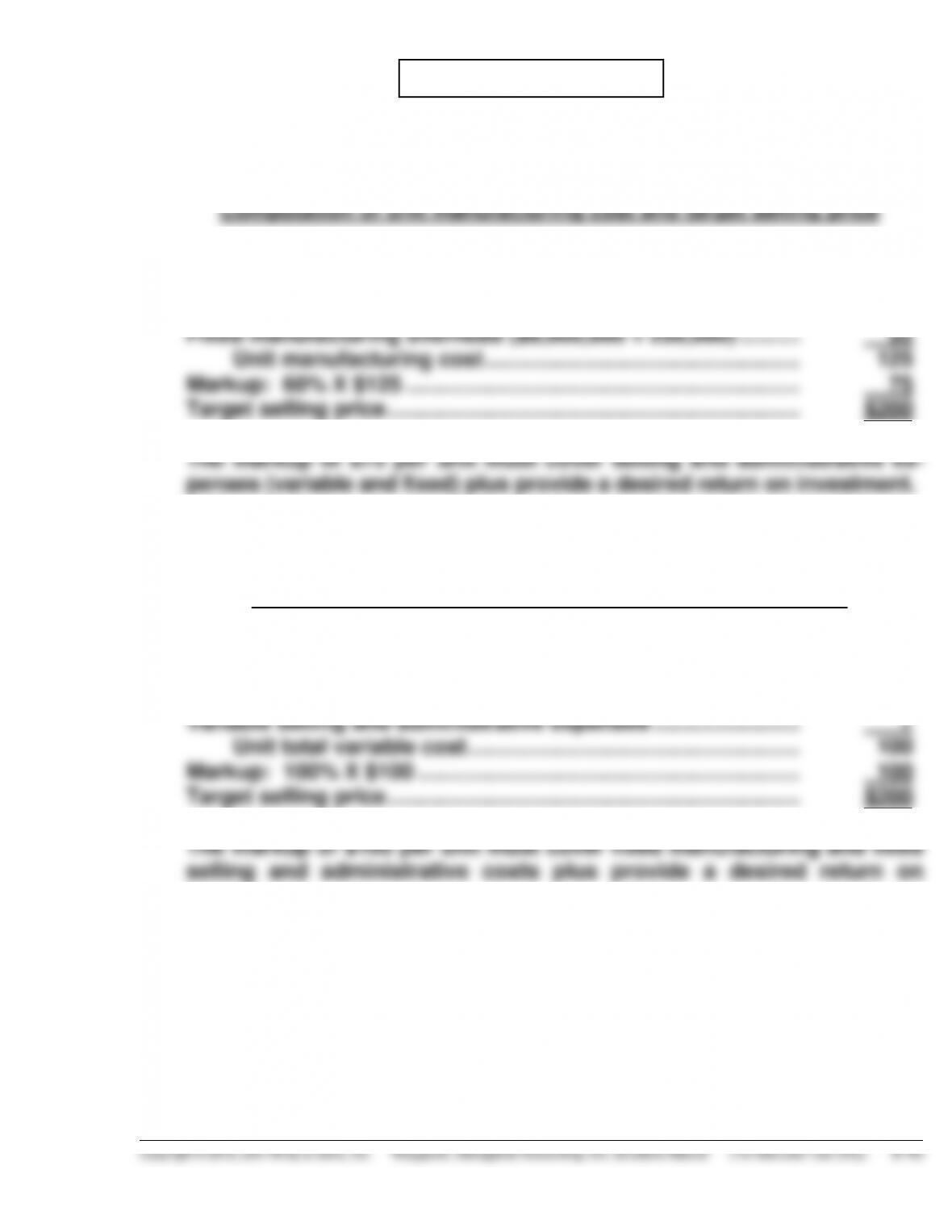
(a) Absorption-cost pricing:
Direct materials ………………………………………………………………. $ 50
Direct labor …………………………………………………………………….. 30
Variable manufacturing overhead ……………………………………. 13
(b) Variable-cost pricing:
Computation of total variable cost and target selling price
Direct materials ………………………………………………………………. $ 50
Direct labor …………………………………………………………………….. 30
Variable manufacturing overhead ……………………………………. 13
investment.
*PROBLEM 8-8B
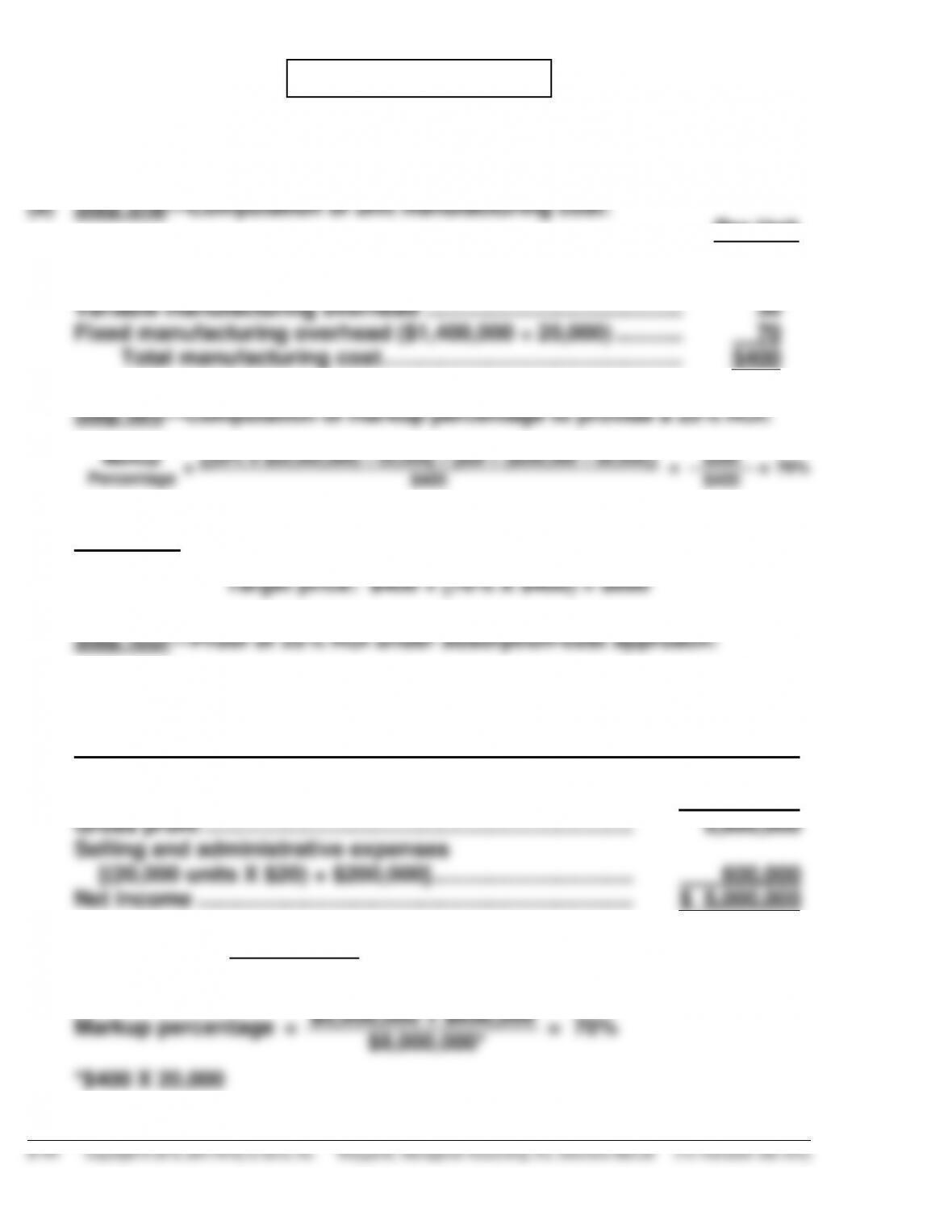
Absorption-cost pricing
Per Unit
Direct materials ………………………………………………………………
Direct labor …………………………………………………………………….
Variable manufacturing overhead ……………………………………
Fixed manufacturing overhead ($1,400,000 ÷ 20,000) ………..
Total manufacturing cost ………………………………………….
$200
100
30
70
$400
Markup
Percentage
=
[(25% X $20,000,000) ÷ 20,000] + [$20 + ($200,000 ÷ 20,000)]
=
$280
=
70%
$400
$400
(b) Step three—Computation of target price:
GEORGIA GOULD BIKES INC.
Budgeted Absorption-Cost Income Statement
(Mountain Bike)
Revenues (20,000 units X $680) ……………………………….. $13,600,000
Cost of goods sold (20,000 units X $400) ………………….. 8,000,000
Desired ROI
=
$5,000,000
=
25%
$20,000,000
Markup percentage
=
$5,000,000 + $600,000
=
70%
*$8,000,000*
*$400 X 20,000
*PROBLEM 8-8B (Continued)
Variable-cost pricing
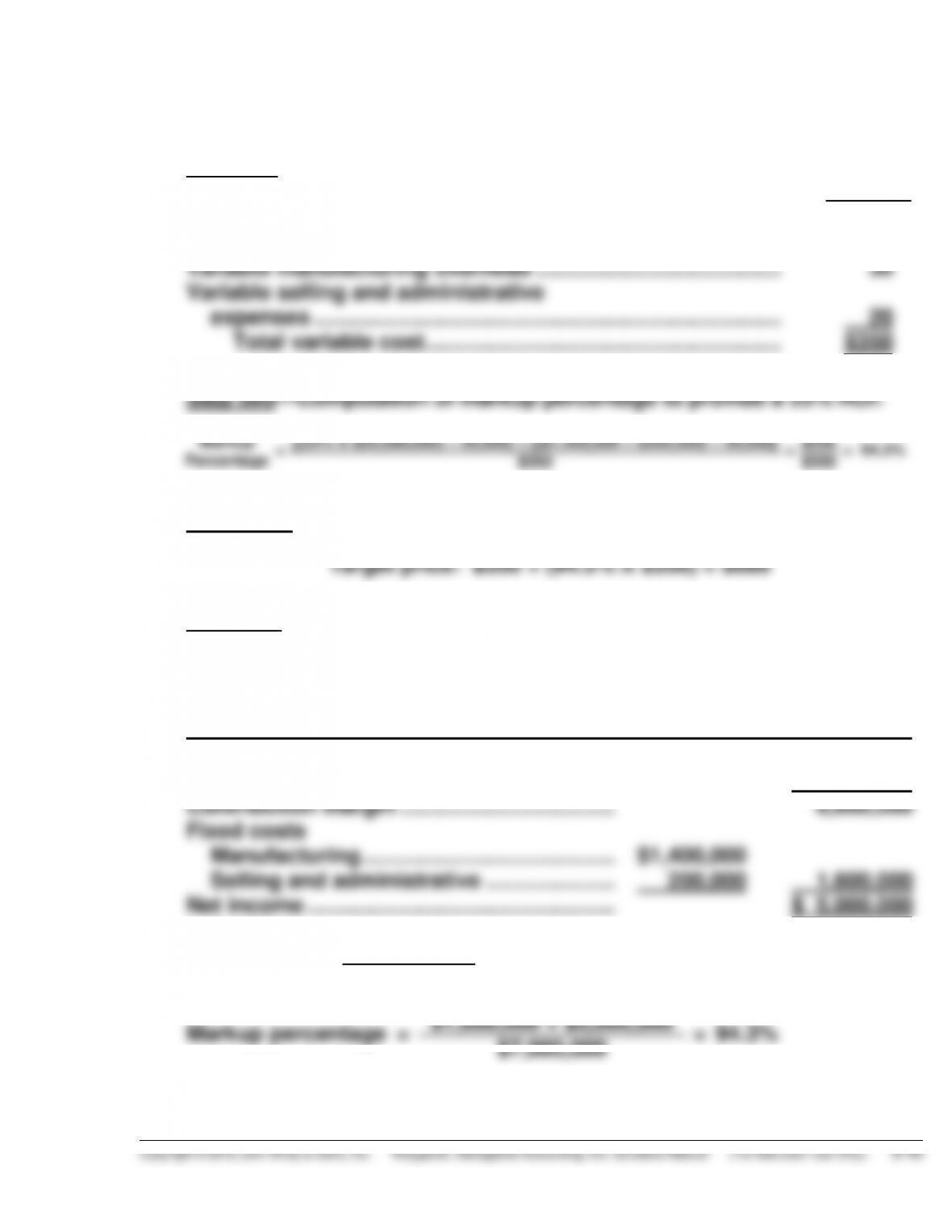
(c) Step one—Computation of unit variable cost:
Per Unit
Direct materials …………………………………………………………….
Direct labor …………………………………………………………………..
Variable manufacturing overhead ………………………………….
Variable selling and administrative
expenses ……………………………………………………….…………
Total variable cost ………………………………………………….
$200
100
30
20
$350
Markup
Percentage
=
[(25% X $20,000,000) ÷ 20,000] + [($1,400,000 + $200,000) ÷ 20,000]
=
$330
=
94.3%
$350
$350
(d) Step three—Computation of target price:
Step four—Proof of 25% ROI under variable-cost pricing:
GEORGIA GOULD BIKES INC.
Budgeted Variable-Cost Income Statement
(Mountain Bike)
Revenue (20,000 units X $680) ………………. $13,600,000
Variable costs (20,000 units X $350) ……… 7,000,000
Desired ROI
=
$5,000,000
=
25%
$20,000,000
Markup percentage
=
$1,600,000 + $5,000,000
=
94.3%
$7,000,000
*PROBLEM 8-8B (Continued)
(e) Both absorption-cost pricing and variable-cost pricing are used because
they have differing merits.
Absorption-cost pricing, especially when it includes full or all costs, is
preferred by some because in the long-run all costs plus a normal profit
margin must be covered. Using only variable costs, as the variable-cost
pricing does, is thought to encourage decision makers to set too low a
Variable-cost pricing is preferred by some, even though the basic
accounting data is less accessible, because it is more consistent with
BYP 8-1 DECISION-MAKING AT CURRENT DESIGNS
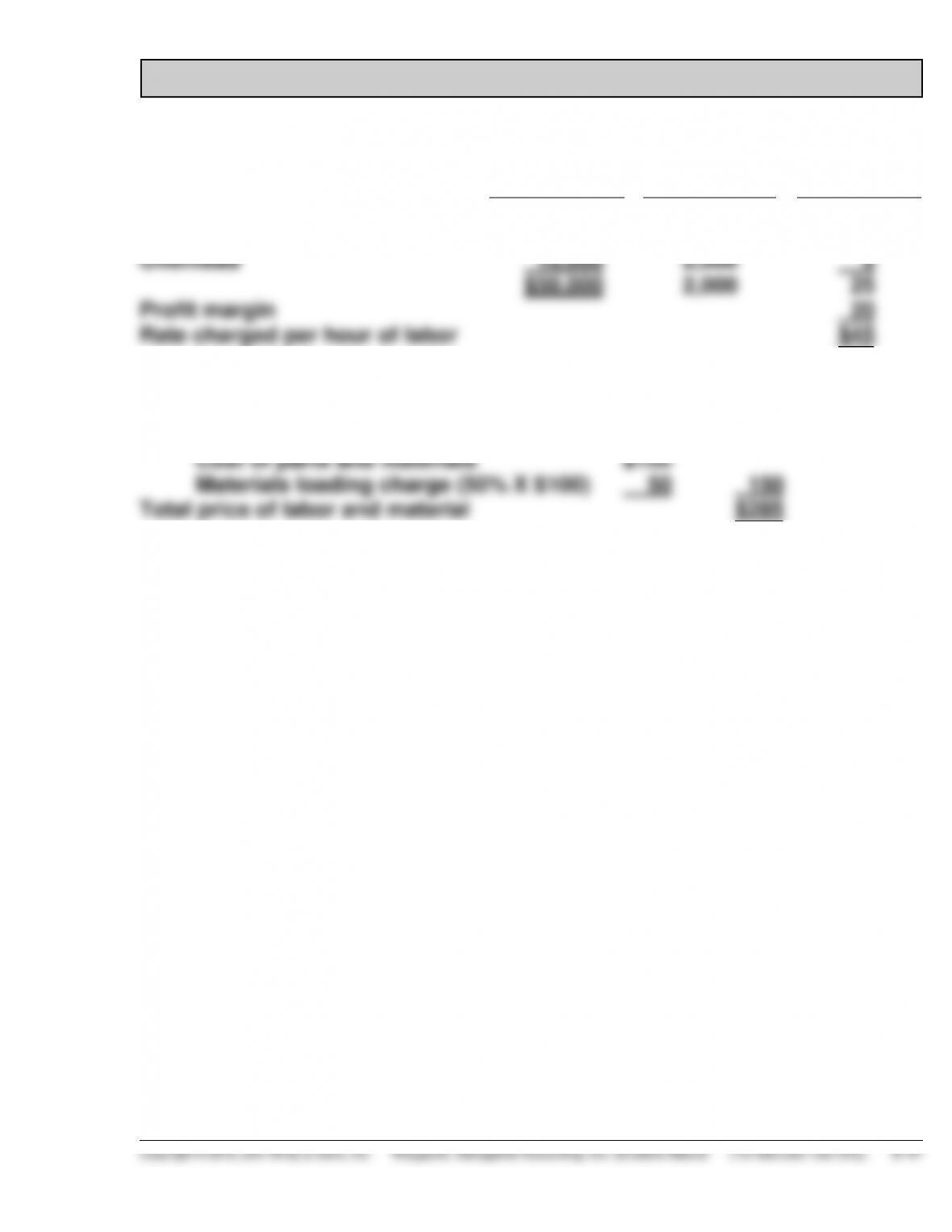
Total Cost
Total Hours
Per Hour
Charge
Repair-technician’s wages
$30,000
2,000
$15
Fringe benefits
10,000
2,000
5
Overhead
10,000
2,000
5
$50,000
2,000
25
Profit margin
20
Rate charged per hour of labor
$45
Job: Composite kayak repair
Labor charges: 3 hours @ $45 $135
Materials charges
BYP 8-2 DECISION-MAKING ACROSS THE ORGANIZATION
(a) Purchasing goods from within the company offers a number of
running closer to full capacity.
(b) Frequently the buying division will be required to buy from within the
company as long as the selling division can provide goods of compara–
ble quality and price. A selling division should not normally be forced
internally.
(c) The Wheel division would find this desirable. It would be able to get
higher quality bearings at a cost savings of $3 per set. The Bearing
division would find this very undesirable. Instead of making a profit of
worse off per set.
(d) One possible solution is to continue on with the current situation. As
pointed out in (c), the current situation is clearly better than forcing the
Bearing division to sell its high quality bearings to a division that
capacity.
BYP 8-3 MANAGERIAL ANALYSIS
(a) Dave must consider a number of issues in arriving at a price. First, he
service offered at the gas station. Furthermore, he offers a higher level
of service for those interested in really taking care of their cars. He has
initially decided to offer only three levels of service. He may ultimately
decide to offer additional different levels of service. Often businesses
in advance.
(b) Variable cost per unit
Basic
Wash
Deluxe
Wash
Premium
Wash
Direct materials
Direct labor
Variable overhead
Variable selling and administrative
expenses
$0.30
0.00
0.10
0.10
$0.50
$0.80
0.40
0.20
0.10
$1.50
$1.10
2.40
0.20
0.10
$3.80
Fixed cost per unit
Total
Costs
÷
Budgeted
Volume
=
Cost
Per Unit
Fixed overhead
Fixed selling and administrative
expenses
Fixed cost per unit
$117,000
130,500
45,000
45,000
$2.60
2.90
$5.50