*PROBLEM 8-7A
(a) Absorption-cost pricing:
Computation of unit manufacturing cost and target selling price
Direct materials ………………………………………………………………. $ 20.00
Direct labor …………………………………………………………………….. 40.00
Variable manufacturing overhead ……………………………………. 10.00
The markup of $42.50 per unit must cover selling and administrative
(b) Variable-cost pricing:
Computation of total variable cost and target selling price
Direct materials ………………………………………………………………. $ 20.00
Direct labor …………………………………………………………………….. 40.00
Variable manufacturing overhead ……………………………………. 10.00
The markup of $52.50 per unit must cover fixed manufacturing and
investment.
*PROBLEM 8-8A
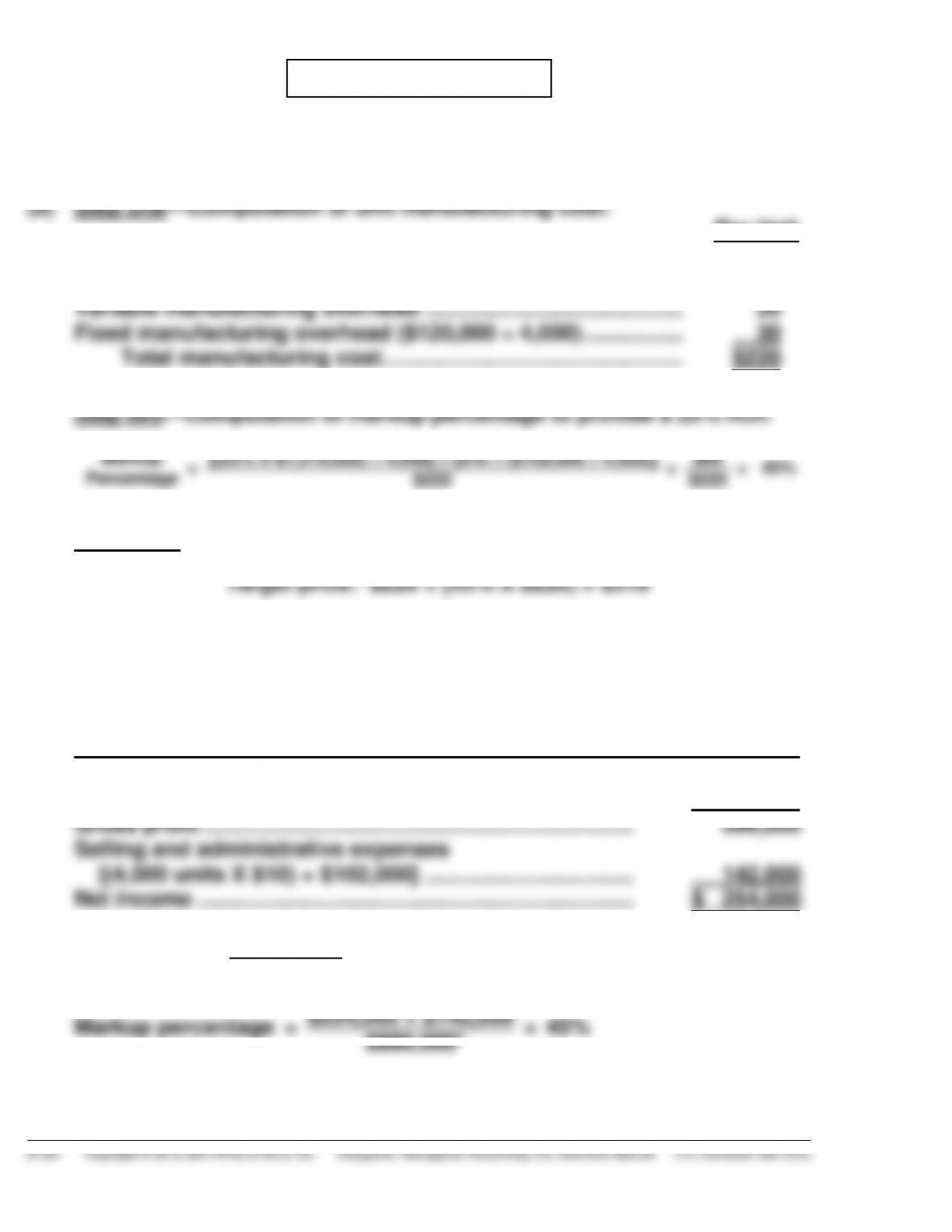
Absorption-cost pricing
Per Unit
Direct materials ………………………………………………………………
Direct labor …………………………………………………………………….
Variable manufacturing overhead ……………………………………
Fixed manufacturing overhead ($120,000 ÷ 4,000) …………….
Total manufacturing cost ………………………………………….
$100
70
20
30
$220
Markup
Percentage
=
[(25% X $1,016,000) ÷ 4,000] + [$10 + ($102,000 ÷ 4,000)]
=
$99
=
45%
$220
$220
(b) Step three—Computation of target price:
Proof of 25% ROI under absorption-cost pricing:
ANDERSON WINDOWS INC.
Budgeted Absorption-Cost Income Statement
(Tinted Window)
Revenues (4,000 units X $319) …………………………………. $1,276,000
Cost of goods sold (4,000 units X $220) ……………………. 880,000
Desired ROI
=
$254,000
=
25%
$1,016,000
Markup percentage
=
$254,000 + $142,000
=
45%
*$880,000*
*$220 X 4,000
*PROBLEM 8-8A (Continued)
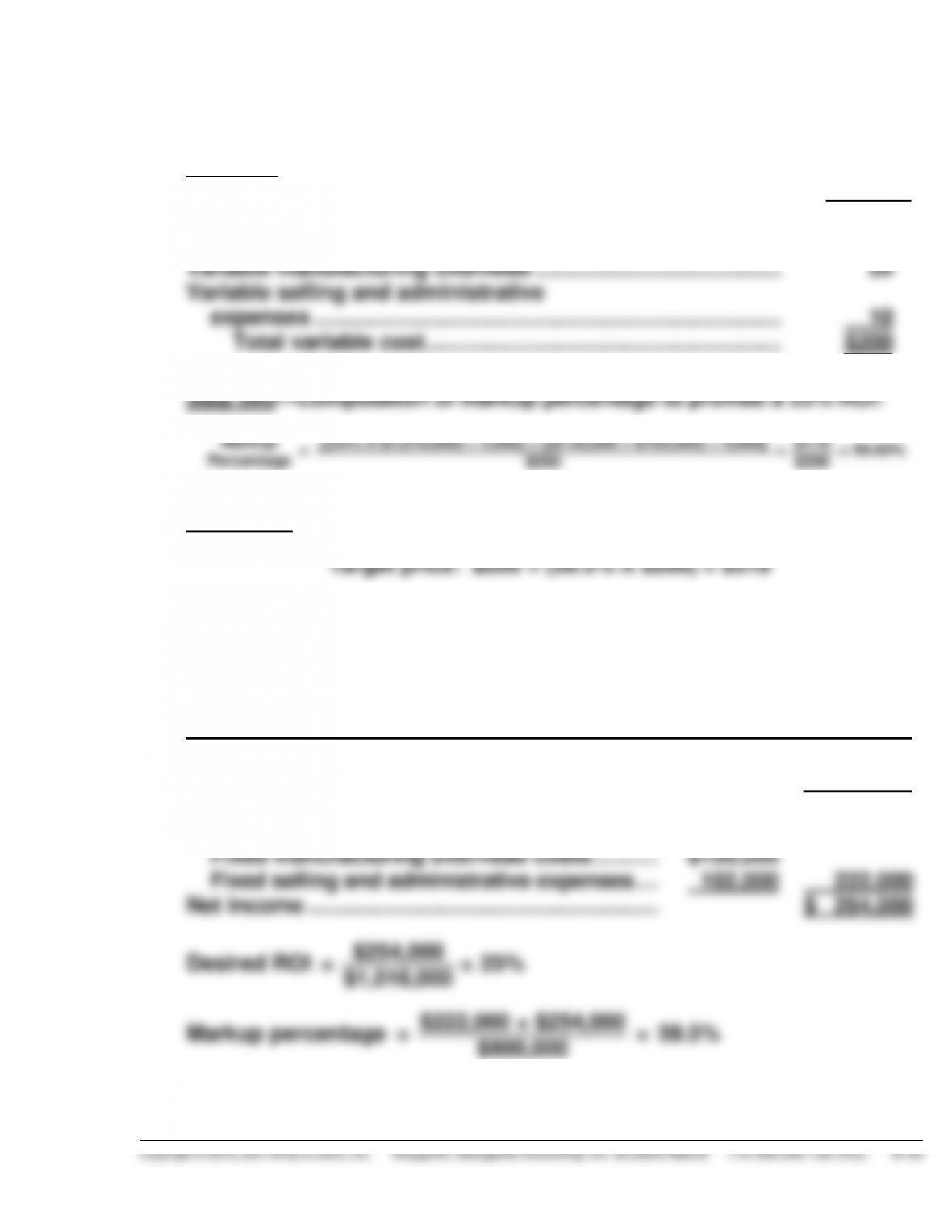
Variable-cost pricing
(c) Step one—Computation of unit variable cost:
Per Unit
Direct materials …………………………………………………………….
Direct labor …………………………………………………………………..
Variable manufacturing overhead ………………………………….
Variable selling and administrative
expenses ………………………………………………………………….
Total variable cost …………………………..……………………..
$100
70
20
10
$200
Markup
Percentage
=
[(25% X $1,016,000) ÷ 4,000] + [($120,000 + $102,000) ÷ 4,000]
=
$119
=
59.50%
$200
$200
(d) Step three—Computation of target price:
Proof of 25% ROI under variable-cost pricing:
ANDERSON WINDOWS INC.
Budgeted Variable-Cost Income Statement
(Tinted Window)
Revenue (4,000 units X $319) ………………………. $1,276,000
Variable costs (4,000 units X $200) ……………… 800,000
Contribution margin …………………………………… 476,000
Fixed costs
*PROBLEM 8-8A (Continued)
(e) Both absorption-cost pricing and variable-cost pricing are used because
they have differing merits.
Absorption-cost pricing, especially when it includes full or all costs, is
preferred by some because in the long-run all costs plus a normal profit
margin must be covered. Using only variable costs, as the variable-cost
Variable-cost pricing is preferred by some, even though the basic
accounting data is less accessible, because it is more consistent with
PROBLEM 8-1B
(a) Direct materials ……………………………………………………………….. $ 8
Direct labor ……………………………………………………………………… 14
Total
Costs
÷
Budgeted
Volume
=
Cost
Per Unit
Fixed manufacturing overhead
Fixed selling and administrative
expenses
Fixed cost per unit
$2,000,000
1,200,000
$3,200,000
÷
÷
÷
100,000
100,000
100,000
=
=
=
$20
12
$32
Variable cost per unit ………………………………………………………. $ 35
Fixed cost per unit …………………………………………………………… 32
Total cost per unit ……………………………………………………………. $ 67
(b) Total cost per unit ……………………………………………………………. $ 67
(c) Total cost per unit ……………………………………………………………. $67.00
PROBLEM 8-2B
(a) Direct materials ………………………………………………………………. $30
Direct labor …………………………………………………………………….. 20
Total
Costs
÷
Budgeted
Volume
=
Cost
Per Unit
Fixed manufacturing overhead
Fixed selling and administrative
expenses
Fixed cost per unit
$2,500,000
500,000
$3,000,000
÷
÷
÷
100,000
100,000
100,000
=
=
=
$25
5
$30
Variable cost per unit ……………………………………………………… $ 75
Fixed cost per unit ………………………………………………………….. 30
Total cost per unit …………………………………………………………… $105
Desired ROI per unit
=
30% X $3,000,000
=
$9
100,000
Markup percentage
=
$9
=
8.57%
$105
Total cost per unit …………………………………………………………… $105
Total
Costs
÷
Budgeted
Volume
=
Cost
Per Unit
Fixed manufacturing overhead
Fixed selling and administrative
expenses
Fixed cost per unit
$2,500,000
500,000
$2,900,000
÷
÷
80,000
80,000
80,000
=
=
$31.25
6.25
$37.50
PROBLEM 8-2B (Continued)
Desired ROI per unit
=
30% X $3,000,000
=
$11.25
80,000
Markup percentage
=
$11.25
=
10%
$112.50
PROBLEM 8-3B
(a) Computation of time charge rate
Total
Cost
Total
Hours
Per Hour
Charge
Hourly labor rate for repairs
Shop employees’ wages and benefits
Overhead costs
Office employee’s salary and benefits
Other overhead
Total
Profit margin
Rate charged per hour of labor
$36,000
15,000
19,000
$70,000
÷
÷
÷
÷
2,500
2,500
2,500
2,500
=
=
=
=
$14.40
6.00
7.60
28.00
5.00
$33.00
(b) Computation of material loading charge
Material
Loading
Charges
Total Invoice Cost,
Parts and Materials
Material
Loading
Percentage
Overhead costs
Parts supervisor’s salary
and benefits
Office employee’s salary
and benefits
Other overhead
Total
Profit margin
Material loading percentage
$20,000
10,000
30,000
15,000
$45,000
÷
÷
÷
$75,000
75,000
75,000
=
=
=
40.00%
20.00%
60.00%
15.00%
75.00%
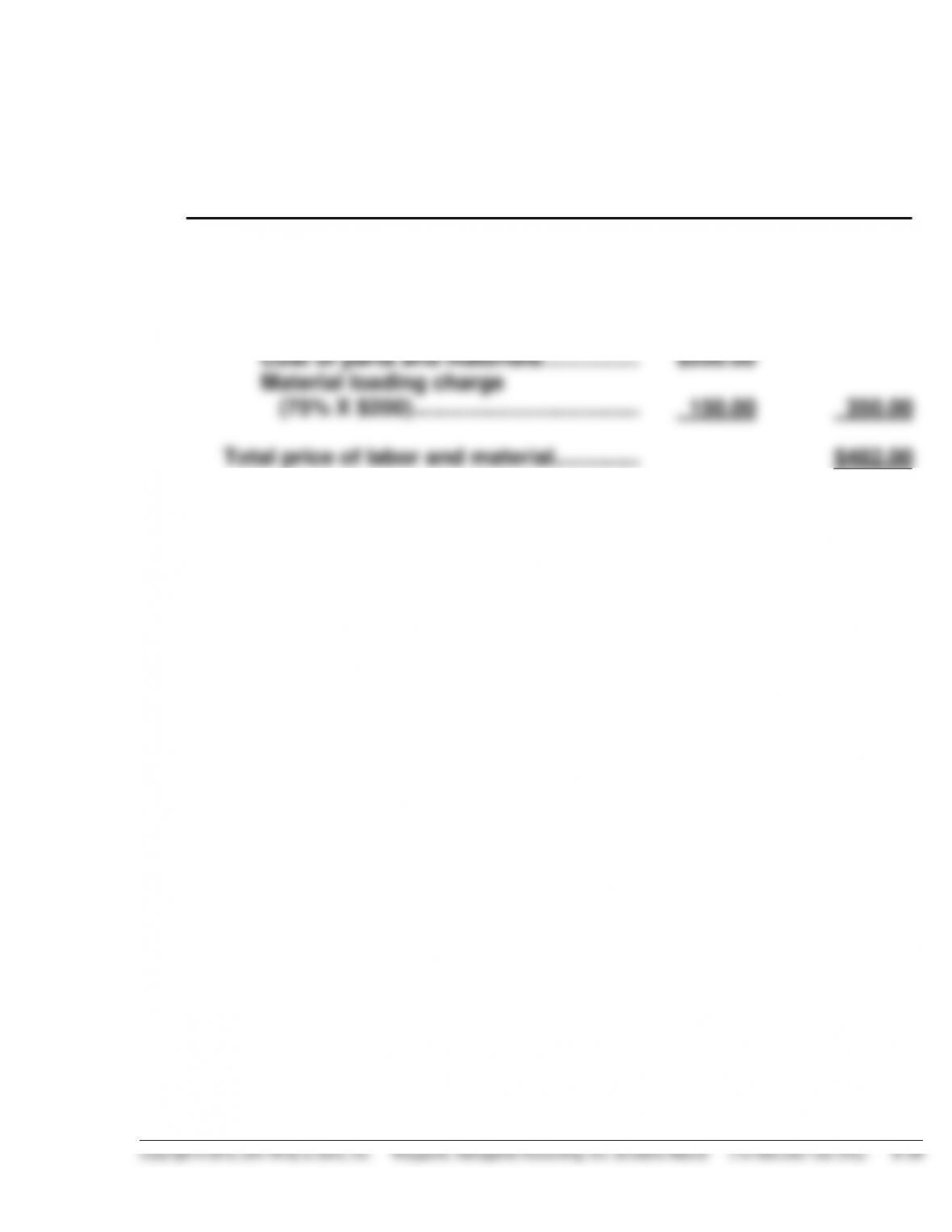
PROBLEM 8-3B (Continued)
(c) Price quotation for time and material
ARMSTRONG BIKE REPAIR SHOP
Time and Material Price Quotation
Job: Fix Superior Mountain bike
Labor charges: 4 hours @ $33 ……………. $132.00
Material charges
PROBLEM 8-4B
(a) Assuming no available capacity, the printing operation’s variable cost
price of $0.016.
(b) Assuming that the printing operation has available capacity, the print–
ing operation’s variable cost is $0.014 and its opportunity cost is $0.
The minimum transfer price would be $0.014 ($0.014 + $0). Therefore,
(c) The advantages of having all of the company’s printing done intern–
ally include: (1) ensuring that the company’s quality expectations are
met, (2) ensuring that all projects are completed on a timely basis, and
(d) The printing operation would lose:
Winner! would save: