*EXERCISE 8-18
(a) Cost per unit:
Per Unit
Direct materials ………………………………………………………………..
Direct labor ………………………………………………………………………
Variable manufacturing overhead ……………………………………..
Fixed manufacturing overhead ($3,000,000/500,000) …………..
Variable selling and administrative expenses …………………….
Fixed selling and administrative expenses
($1,500,000/500,000) ……………………………………………………..
$ 7
9
15
6
14
3
$54
(c)
Absorption-cost pricing
markup percentage
=
$13 + ($14 + $3)
=
81.08%
($7 + $9 + $15 + $6)
(d)
Variable-cost pricing
markup percentage
=
$13 + ($6 + $3)
=
48.89%
($7 + $9 + $15 + $14)
*EXERCISE 8-19
(a) The cost base of absorption-cost pricing includes only manufacturing
costs. All selling and administrative costs are excluded from the cost
base and are added back in the numerator of the markup percentage.
Absorption-cost pricing
markup percentage
=
$20 + ($9 + $11)
=
50%
($20 + $25 + $14 + $21)
(b) The cost base of variable-cost pricing includes only variable costs. All
Variable-cost pricing
markup percentage
=
$20 + ($21 + $11)
=
76.47%
($20 + $25 + $14 + $9)
*EXERCISE 8-20
(a)
Fixed manufacturing
overhead per unit
=
$1,800,000
=
$600 per unit
3,000
Fixed selling and administrative
expenses per unit
=
$324,000
=
$108 per unit
3,000
(b)
Desired ROI per unit
=
20% X $51,000,000
=
$3,400 per unit
3,000
(c)
Absorption-cost pricing
markup percentage
=
$3,400 + ($55 + $108)
=
265.499%
$380 + $290 + $72 + $600
(d)
Variable-cost pricing
markup percentage
=
$3,400 + ($600 + $108)
=
515.433%
$380 + $290 + $72 + $55
SOLUTIONS TO PROBLEMS
PROBLEM 8-1A
(a) Direct materials ……………………………………………………………….. $20
Direct labor ……………………………………………………………………… 40
Total
Costs
÷
Budgeted
Volume
=
Cost
Per Unit
Fixed manufacturing overhead
Fixed selling and administrative
expenses
Fixed cost per unit
$1,440,000
960,000
$2,400,000
÷
÷
÷
80,000
80,000
80,000
=
=
=
$18
12
$30
Variable cost per unit ………………………………………………………. $ 75
(b) Total cost per unit ……………………………………………………………. $ 105
(c) Total cost per unit ……………………………………………………………. $105.00
(d) Variable cost per unit ……… $ 75 (same as above)
PROBLEM 8-2A
(a) Direct materials ………………………………………………………………. $ 50
Direct labor …………………………………………………………………….. 26
Total
Costs
÷
Budgeted
Volume
=
Cost
Per Unit
Fixed manufacturing overhead
Fixed selling and administrative
expenses
Fixed cost per unit
$ 600,000
400,000
$1,000,000
÷
÷
÷
50,000
50,000
50,000
=
=
=
$12
8
$20
Desired ROI per unit
=
25% X $1,000,000
=
$5
50,000
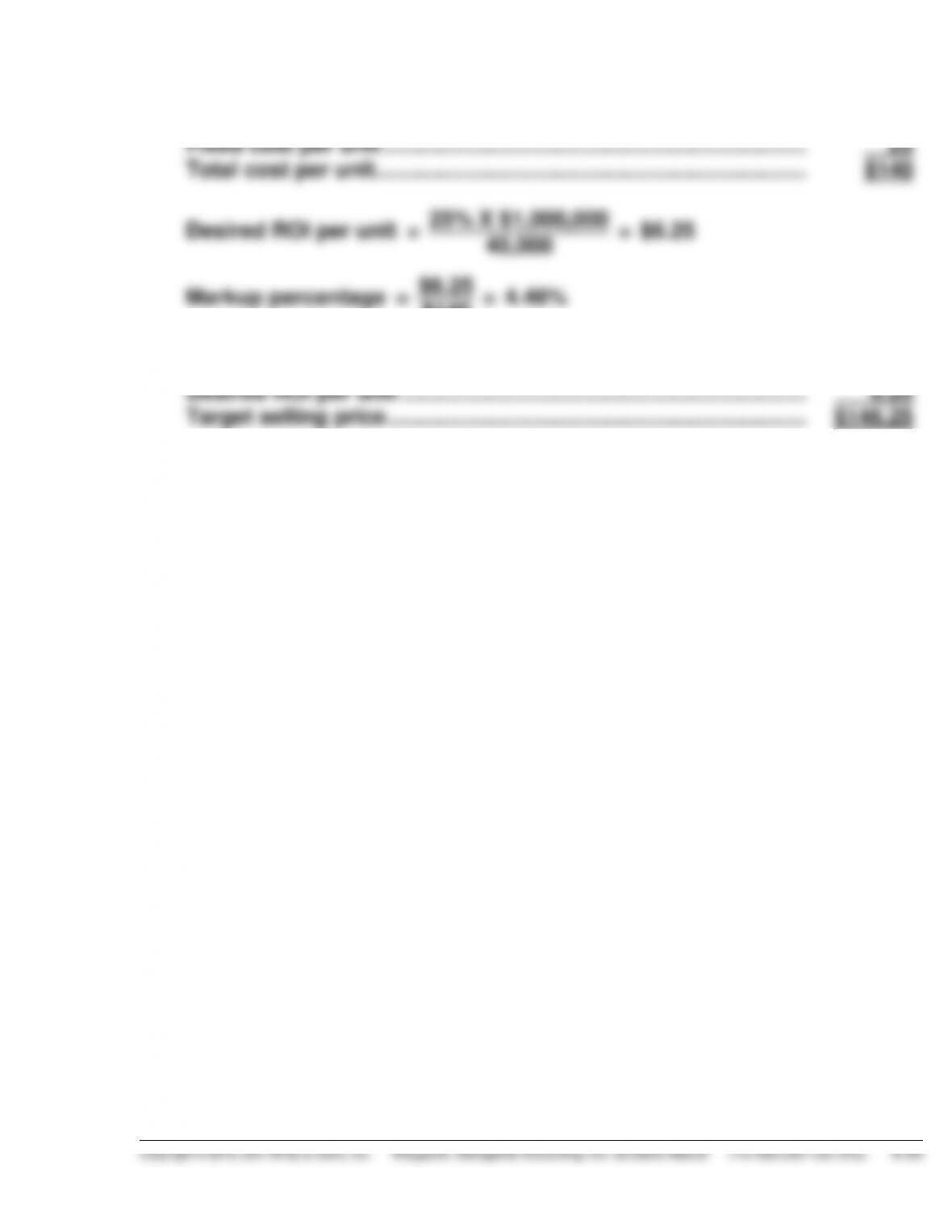
Markup percentage
=
$5
=
3.70%
$135
Total cost per unit …………………………………………………………… $135
(b) Variable cost per unit ……………………………………… $115 (same as (a))
Total
Costs
÷
Budgeted
Volume
=
Cost
Per Unit
Fixed manufacturing overhead
Fixed selling and administrative
expenses
Fixed cost per unit
$ 600,000
400,000
$1,000,000
÷
÷
÷
40,000
40,000
40,000
=
=
$15
10
$25
PROBLEM 8-2A (Continued)
Variable cost per unit ………………………………………………………. $115
PROBLEM 8-3A
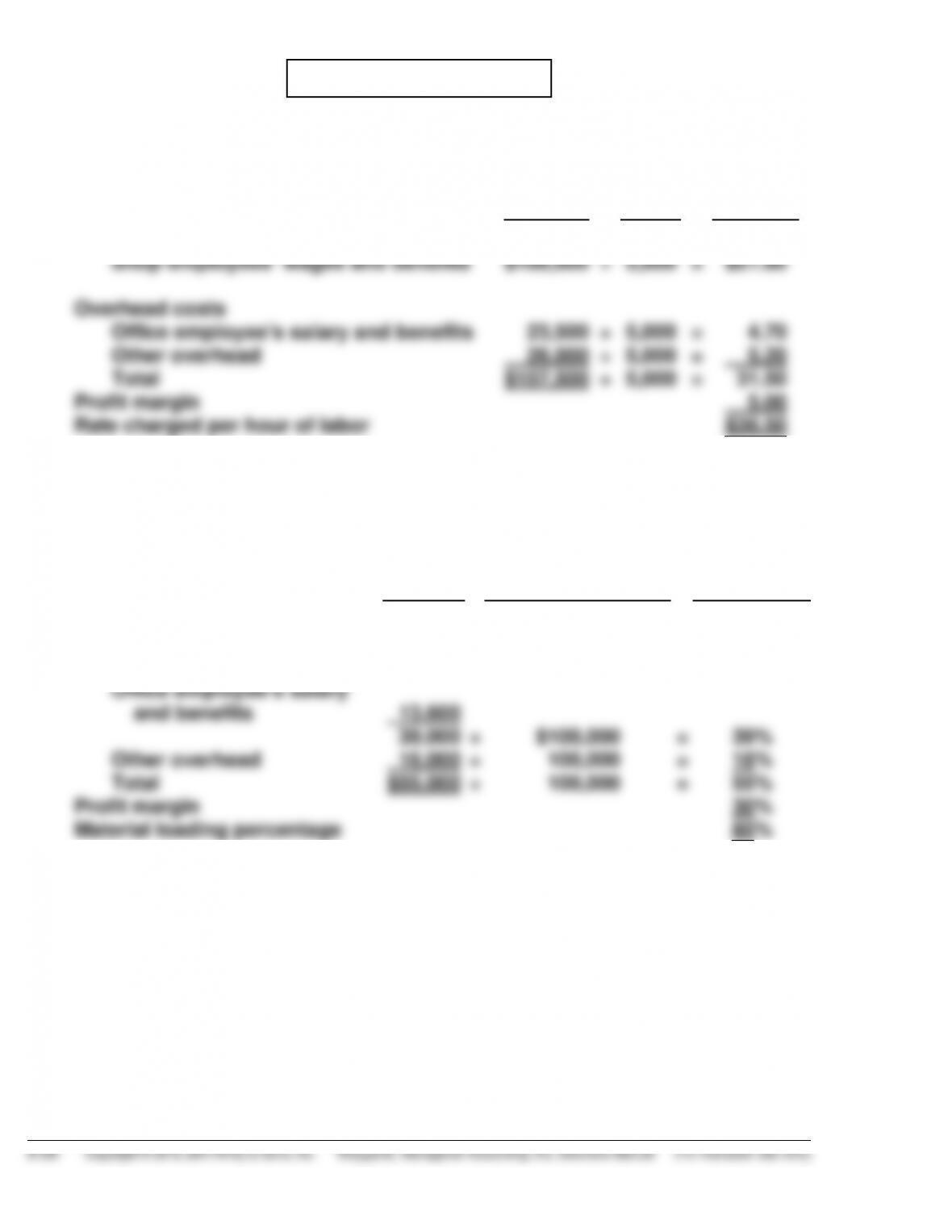
(a) Computation of time charge rate
Total
Cost
÷
Total
Hours
=
Per Hour
Charge
Hourly labor rate for repairs
Shop employees’ wages and benefits
Overhead costs
Office employee’s salary and benefits
Other overhead
Total
Profit margin
Rate charged per hour of labor
$108,000
23,500
26,000
$157,500
÷
÷
÷
÷
5,000
5,000
5,000
5,000
=
=
=
=
$21.60
4.70
5.20
31.50
5.00
$36.50
(b) Computation of material loading charge
Material
Loading
Charges
÷
Total Invoice Cost,
Parts and Materials
=
Material
Loading
Percentage
Overhead costs
Parts manager’s salary
and benefits
Office employee’s salary
and benefits
Other overhead
Total
Profit margin
Material loading percentage
$25,400
13,600
39,000
16,000
$55,000
÷
÷
÷
$100,000
100,000
100,000
=
=
=
39%
16%
55%
30%
85%
PROBLEM 8-3A (Continued)
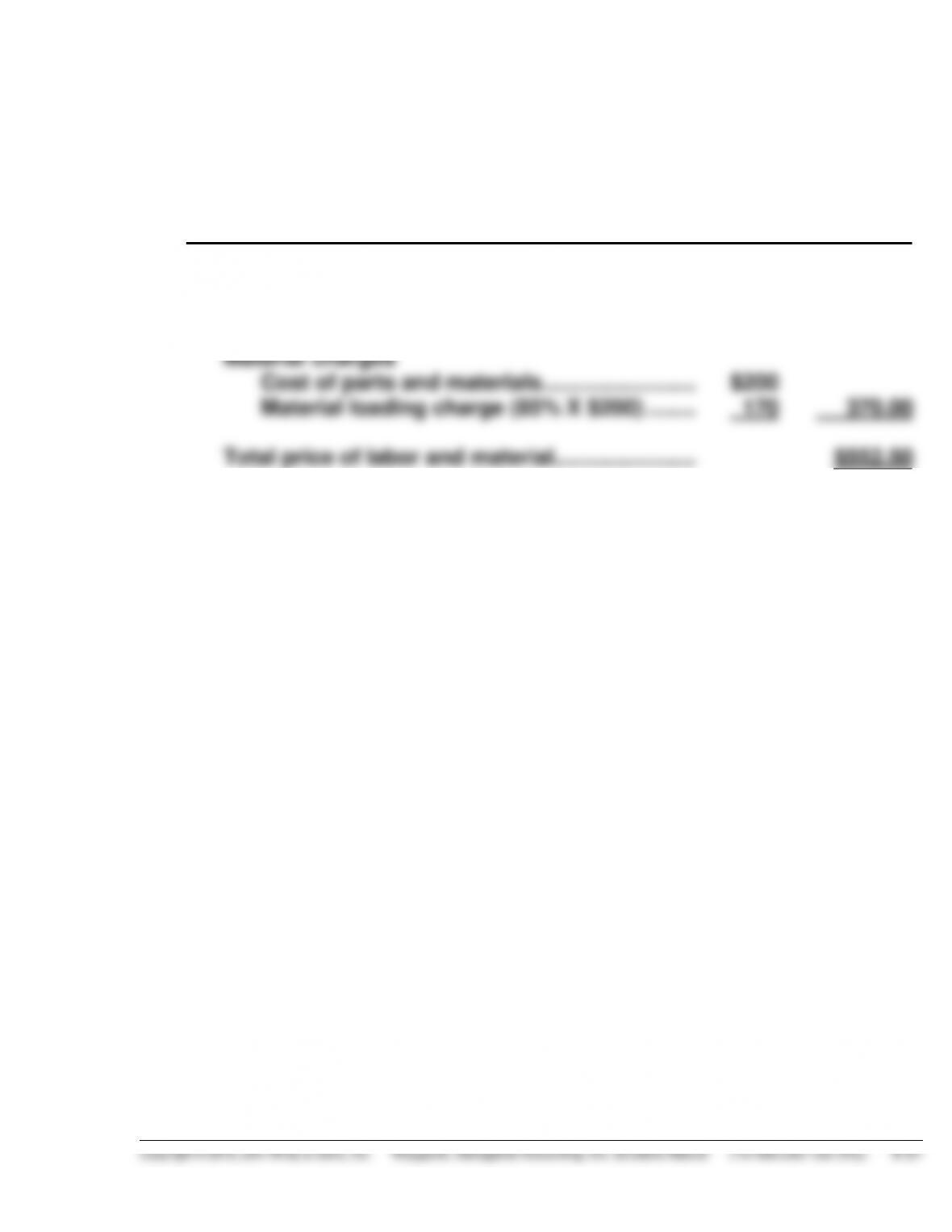
(c) Price quotation for time and material
JOSE’S ELECTRONIC REPAIR SHOP
Time and Material Price Quotation
January 5, 2014
Job: Fix big screen TV set
Labor charges: 5 hours @ $36.50 ……………….. $182.50
PROBLEM 8-4A
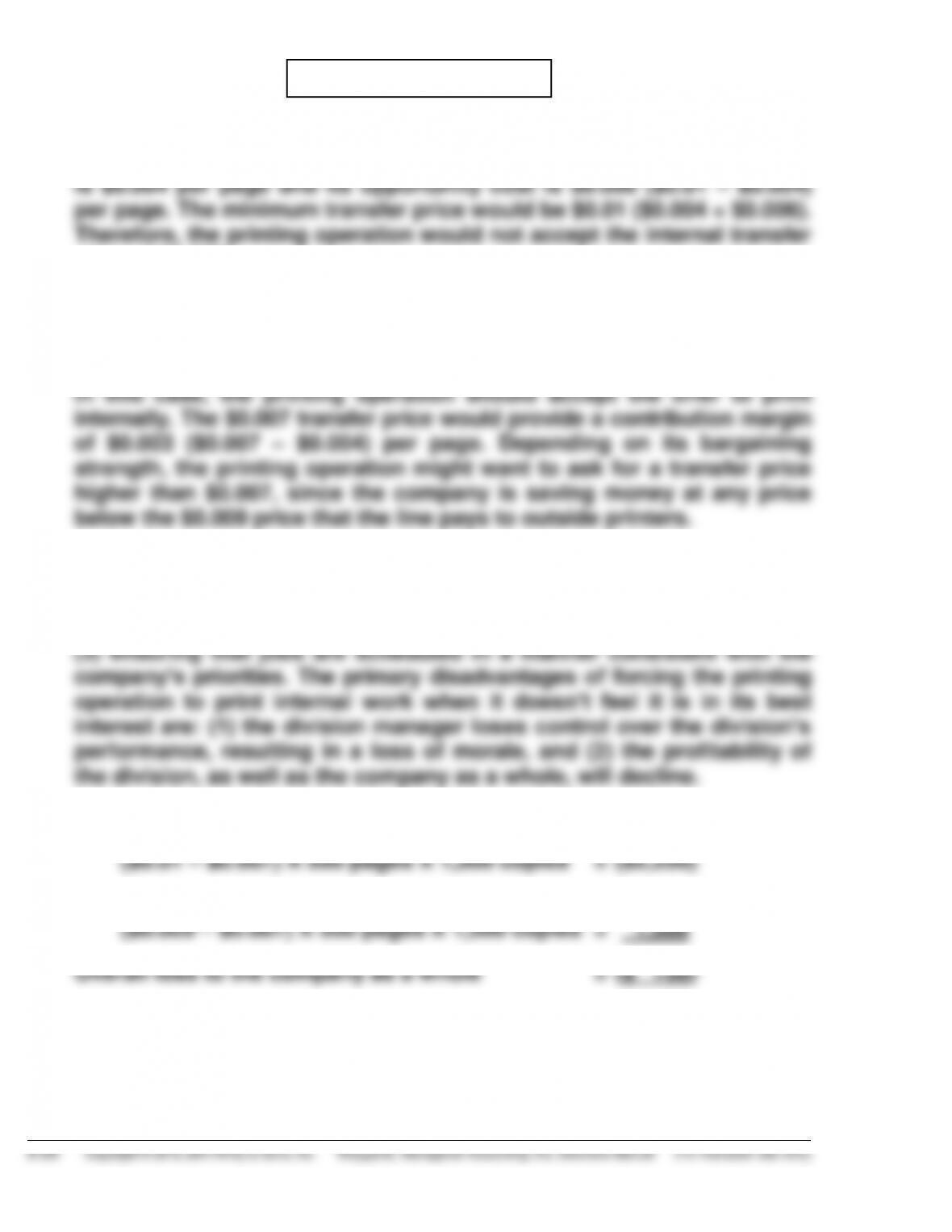
(a) Assuming no available capacity, the printing operation’s variable cost
price of $0.007.
(b) Assuming that the printing operation has available capacity, the print–
ing operation’s variable cost is $0.004 and its opportunity cost is $0.
The minimum transfer price would be $0.004 ($0.004 + $0). Therefore,
(c) The advantages of having all of the company’s printing done intern–
ally include: (1) ensuring that the company’s quality expectations are
met, (2) ensuring that all projects are completed on a timely basis, and
(d) The printing operation would lose:
Business Books would save:
PROBLEM 8-5A
Chip Division should sell the chip internally. Since it is already at
capacity, it probably needs to consider the implications to its existing
customers.
of this loss is calculated as:
Lost contribution margin by Board Division:
Cost of buying externally, per chip $22
Lost contribution margin by Chip Division:
Unit contribution margin on internal sales
($20 – $10) $10
PROBLEM 8-6A
(a) Assuming no available capacity, and that the number of new units
(b) Assuming no available capacity, and that in order to produce the
12,000 special pagers, 16,000 standard pagers would be forgone, the
cost would be:
Total contribution margin on standard pagers
=
($95 – $50) X 16,000
=
$60
Number of special pagers
12,000
Therefore, the minimum transfer price would be $140 [($50 + $30) +
(c) Assuming that the CD Division has available capacity, variable cost
would be $80 ($50 + $30) and the opportunity cost would be zero.