EXERCISE 7-17 (Continued)
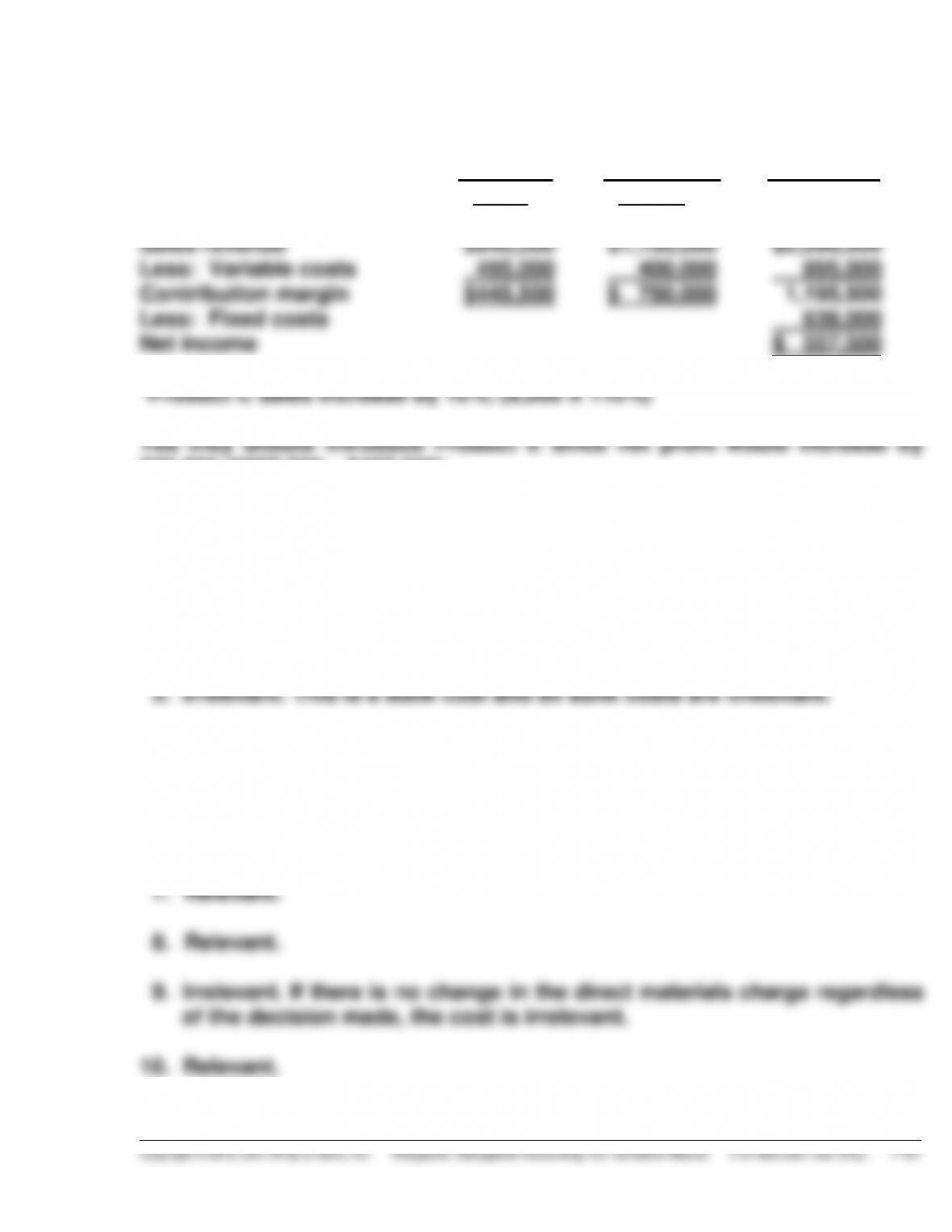
Company profit with Products C and E:
C E Total
Units sold 9,900* 10,000
$90,500 ($557,500 – $467,000).
EXERCISE 7-18
1. Irrelevant. Unavoidable costs will be incurred regardless of the
decision made.
2. Relevant.
4. Irrelevant. These are sunk costs.
5. Relevant.
6. Relevant.

SOLUTIONS TO PROBLEMS
PROBLEM 7-1A
(a)
Reject
Order
Accept
Order
Net Income
Increase
(Decrease)
Revenues (10,000 X $27)
Cost of goods sold
Selling and administrative
expenses
Net income
$0
0
0
$0
$270,000
220,000
20,000
$ 30,000
(1)
(2)
$ 270,000
( (220,000)
( (20,000)
$ 30,000
(1) Variable costs = $3,600,000 – $960,000 = $2,640,000;
$2,640,000 ÷ 120,000 units = $22.00 per unit;
10,000 X $22.00 = $220,000.
(2) Variable costs = $405,000 – $225,000 = $180,000;
$180,000 ÷ 120,000 units = $1.50 per unit;
10,000 X ($1.50 + $0.50) = $20,000.
(b) Yes, the special order should be accepted because net income will
increase by $30,000.
(c) Unit selling price = $22.00 (variable manufacturing costs) + $2.00 variable
selling and administrative expenses + $4.00 net income = $28.
(d) Nonfinancial factors to be considered are: (1) possible effect on domestic
sales, (2) possible alternative uses of the unused plant capacity, and
(3) ability to meet customer’s schedule for delivery without increasing
costs.

PROBLEM 7-2A
(a)
Make CISCO
Buy CISCO
Net Income
Increase
(Decrease)
Direct materials
(8,000 X $4.80)
Direct labor
(8,000 X $4.30)
Indirect labor
(8,000 X $.43)
Utilities (8,000 X $.40)
Depreciation
Property taxes
Insurance
Purchase price
Freight and inspection
(8,000 X $.35)
Receiving costs
Total annual cost
$38,400
34,400
3,440
3,200
3,000
700
1,500
0
0
0
$84,640
$ 0
0
0
0
900
200
600
80,000
2,800
1,300
$85,800
($38,400)
( 34,400)
( 3,440)
( 3,200)
( 2,100)
( 500)
( 900)
( (80,000)
( (2,800)
( (1,300)
($ (1,160)
(b) The company should continue to make CISCO because net income
would be $1,160 less if CISCO were purchased from the supplier.
shown below:
Make CISCO
Buy CISCO
Net Income
Increase
(Decrease)
Total annual cost
Opportunity cost
Total cost
$84,640
3,000
$87,640
$85,800
0
$85,800
$(1,160)
(3,000)
$(1,840)
when they are needed by Shatner.
PROBLEM 7-3A
(a) (1)
Table Cleaner Not Processed Further
Sales:
FloorShine (600,000 ÷ 30) X $20
$400,000
Table Cleaner (300,000 ÷ 25) X $18
216,000
Total revenue
$616,000
Costs:
CDG
210,000
Additional costs of FloorShine
240,000
Total costs
450,000
Gross profit
$166,000
(2)
Table Cleaner Processed Further
Sales:
FloorShine
$400,000
Table Stain Remover (300,000 ÷ 25) X $14
168,000
Table Polish (300,000 ÷ 25) X $14
168,000
Total revenue
$736,000
Costs:
CDG
210,000
Additional costs of FloorShine
240,000
TCP
100,000
Total costs
550,000
Gross profit
$186,000
PROBLEM 7-3A (Continued)
(b)
Don’t Process
Table Cleaner
Further
Process
Table Cleaner
Further
Net Income
Increase
(Decrease)
Incremental revenue
$216,000
$336,000
$120,000
Incremental costs
0
100,000
(100,000)
Totals
$216,000
$236,000
$ 20,000
PROBLEM 7-4A
(a)
Cost
$120,000
Accumulated depreciation
(24,000*)
Book value
96,000
Sales proceeds
(25,000)
Loss on sale
$ 71,000
*$120,000 ÷ 5 years = $24,000
(b) (1)
Retain Old Elevator
Revenues ($240,000 X 4 yrs.)
$960,000
Less costs:
Variable costs ($35,000 X 4)
$140,000
Fixed costs ($23,000 X 4)
92,000
Selling & administrative
116,000*
Depreciation
96,000
444,000
Net income
$516,000
*($29,000 X 4)
(2)
Replace Old Elevator
Revenues
$960,000
Less costs:
Variable costs ($10,000 X 4)
$ 40,000
Fixed costs ($8,500 X 4)
34,000
Selling and administrative
116,000
Depreciation
160,000
350,000
Operating income
610,000
Less: Loss on old elevator
71,000
Net income
$539,000
(c)
Retain
Old Elevator
Replace
Old Elevator
Net Income
Increase
(Decrease)
Variable operating costs
$140,000
$ 40,000
$ 100,000
Fixed operating costs
92,000
34,000
58,000
New elevator cost
160,000
(160,000)
Salvage on old elevator
.
(25,000)
25,000
Totals
$232,000
$209,000
$ 23,000
PROBLEM 7-4A (Continued)
(d) MEMO
TO: Ron Richter
FROM: Student
When deciding whether or not to replace any old equipment, the analysis
should only include cost data relevant to the replacement decision. The
$71,000 loss that would be experienced if we replace the old elevator with
the newer model is related to a sunk cost, namely the cost of the old
The loss occurs when comparing the book value of the old elevator to the
cash proceeds that would be received. The book value of $96,000 would be
deducted as depreciation expense over the next four years if the elevator
were retained. If the elevator is replaced with the newer model, the book
either alternative, making it irrelevant.
PROBLEM 7-5A
(a)
Division I
Division II
Sales
Variable costs
Cost of goods sold
Selling and administrative
Total variable expenses
Contribution margin
$250,000
150,000
30,000
180,000
($ 70,000)
$200,000
172,800
42,000
214,800
$ (14,800)
(b)
(1)
Division I
Continue
Eliminate
Net Income
Increase
(Decrease)
Contribution margin (above)
Fixed costs
Cost of goods sold
Selling and administrative
Total fixed expenses
Income (loss) from operations
$(70,000)
(50,000)
(45,000)
(95,000)
$(25,000)
$( 0)
(25,000)
(22,500)
(47,500)
$(47,500)
$(70,000)
25,000
22,500
47,500
$(22,500)
(2)
Division II
Continue
Eliminate
Net Income
Increase
(Decrease)
Contribution margin (above)
Fixed costs
Cost of goods sold
Selling and administrative
Total fixed expenses
Income (loss) from operations
$(14,800)
(19,200
( 18,000
( 37,200
$(52,000)
$( 0)
( 9,600)
( 9,000)
(18,600)
$(18,600)
$14,800
( 9,600
9,000
18,600
$33,400
is eliminated.
Division I should be continued because it is producing positive con–
tribution margin of $70,000. Income from operations will decrease
$22,500 by discontinuing this division.
PROBLEM 7-5A (Continued)
(c) GUTIERREZ COMPANY
CVP Income Statement
For the Quarter Ended March 31, 2014
Divisions
I
III
IV
Total
Sales
Variable costs
Cost of goods sold
Selling and
administrative
Total variable
costs
Contribution margin
Fixed costs
Cost of goods sold (1)
Selling and
administrative (2)
Total fixed
costs
Income (loss) from
operations
$250,000
150,000
30,000
180,000
70,000
53,200
48,000
101,200
$(31,200
)
$500,000
240,000
30,000
270,000
230,000
63,200
33,000
96,200
$133,800
$450,000
187,500
30,000
217,500
232,500
65,700
23,000
88,700
$143,800
$1,200,000
577,500
90,000
667,500
532,500
182,100
104,000
286,100
$ 246,400
50% = $9,600]. Each division’s share is $3,200.
(2) Division’s fixed selling and administrative expense plus 1/3 of
Division II’s unavoidable fixed selling and administrative expenses
[$60,000 X (100% – 70%) X 50% = $9,000]. Each division’s share
is $3,000.
income from operations without Division II.