EXERCISE 7-3
(a)
Reject
Order
Accept
Order
Net Income
Increase
(Decrease)
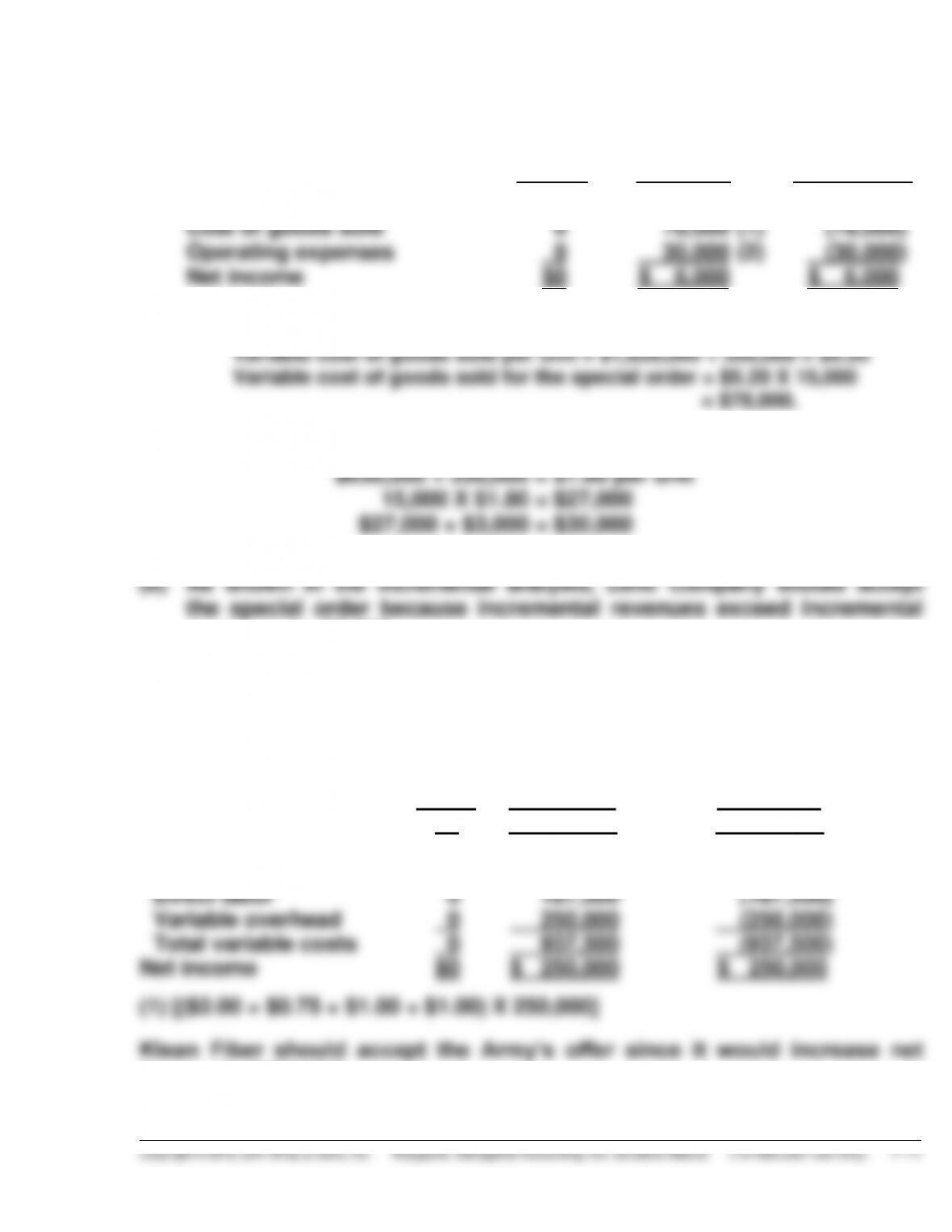
Revenues (15,000 X $7.60)
Cost of goods sold
Operating expenses
Net income
$0
0
0
$0
$114,000
78,000
30,000
$ 6,000
(1)
(2)
($114,000)
( (78,000)
( (30,000)
($ 6,000)
(1) Variable cost of goods sold = $2,600,000 X 70% = $1,820,000.
(2) Variable operating expenses = $840,000 X 75% = $630,000
expenses by $6,000.
EXERCISE 7-4
Reject
Order
Accept
Order
Net Income
Increase
(Decrease)
Revenues
$0
$1,187,500 (1)
$1,187,500
Variable costs:
Direct materials
0
500,000
(500,000)
Direct labor
0
187,500
(187,500)
Variable overhead
0
250,000
(250,000)
Total variable costs
0
937,500
(937,500)
Net income
$0
$ 250,000
$ 250,000
(1) [($2.00 + $0.75 + $1.00 + $1.00) X 250,000]
Klean Fiber should accept the Army’s offer since it would increase net
income by $250,000.
EXERCISE 7-5
(a)
Make
Buy
Net Income
Increase
(Decrease)
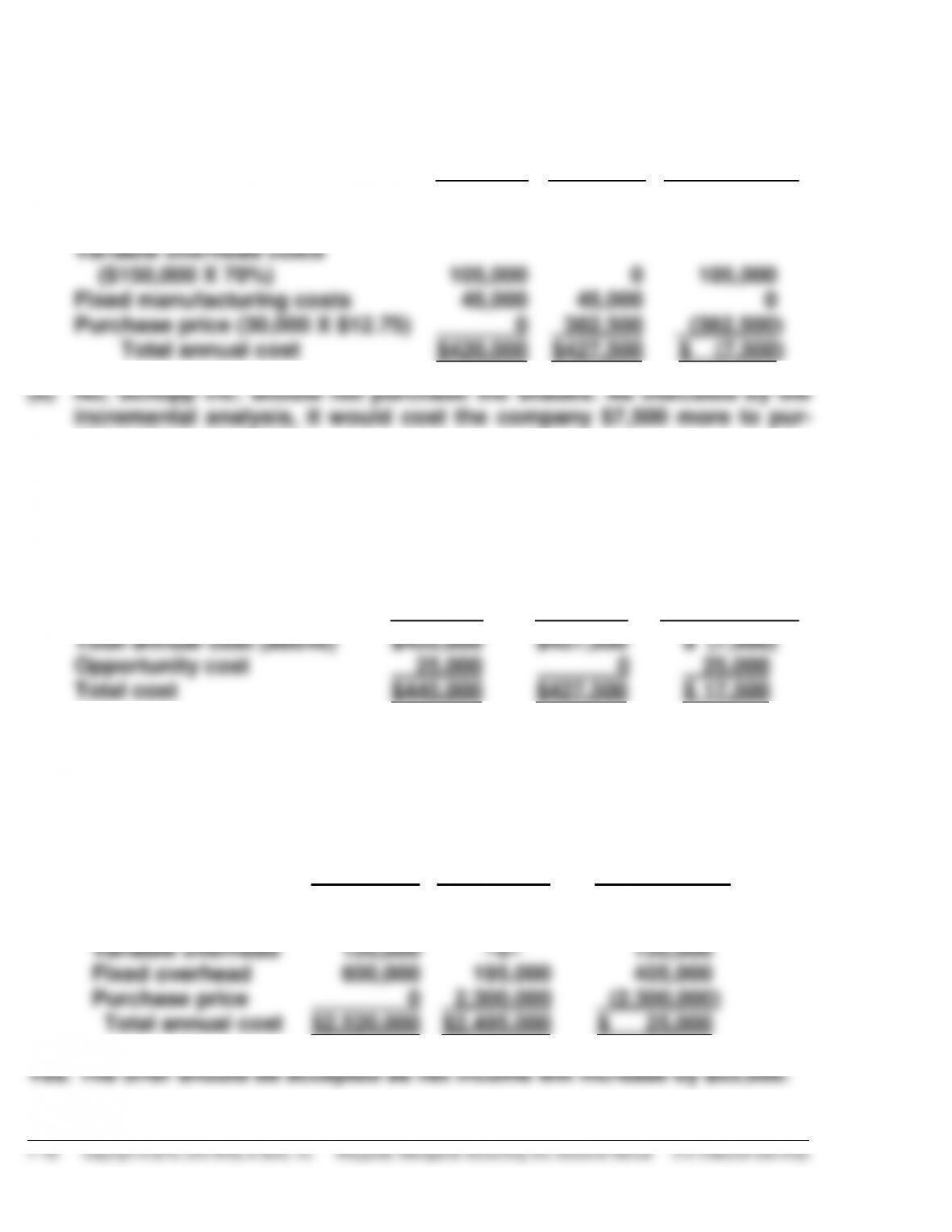
Direct materials (30,000 X $4.00)
Direct labor (30,000 X $5.00)
Variable overhead costs
($150,000 X 70%)
Fixed manufacturing costs
Purchase price (30,000 X $12.75)
Total annual cost
$120,000
150,000
105,000
45,000
0
$420,000
$ 0
0
0
45,000
382,500
$427,500
$ 120,000
150,000
105,000
0
( (382,500)
($ (7,500)
chase the lamp shades.
(c) Yes, by purchasing the lamp shades, a total cost saving of $17,500 will
result as shown below.
Make
Buy
Net Income
Increase
(Decrease)
Total annual cost (above)
Opportunity cost
Total cost
$420,000
25,000
$445,000
$427,500
0
$427,500
$ (7,500)
(25,000)
$(17,500)
EXERCISE 7-6
(a) 1.
Make
Buy
Net Income
Increase
(Decrease)
Direct materials
$1,000,000
$ –0–
$ 1,000,000
Direct labor
800,000
–0–
800,000
Variable overhead
120,000
–0–
120,000
Fixed overhead
600,000
195,000
405,000
Purchase price
0
2,300,000
(2,300,000)
Total annual cost
$2,520,000
$2,495,000
$ 25,000
EXERCISE 7-6 (Continued)
2.
Make
Buy
Net Income
Increase
(Decrease)
Direct materials
$1,000,000
$ 0
$ 1,000,000
Direct labor
800,000
0
800,000
Variable overhead
120,000
0
120,000
Fixed overhead
600,000
600,000
0
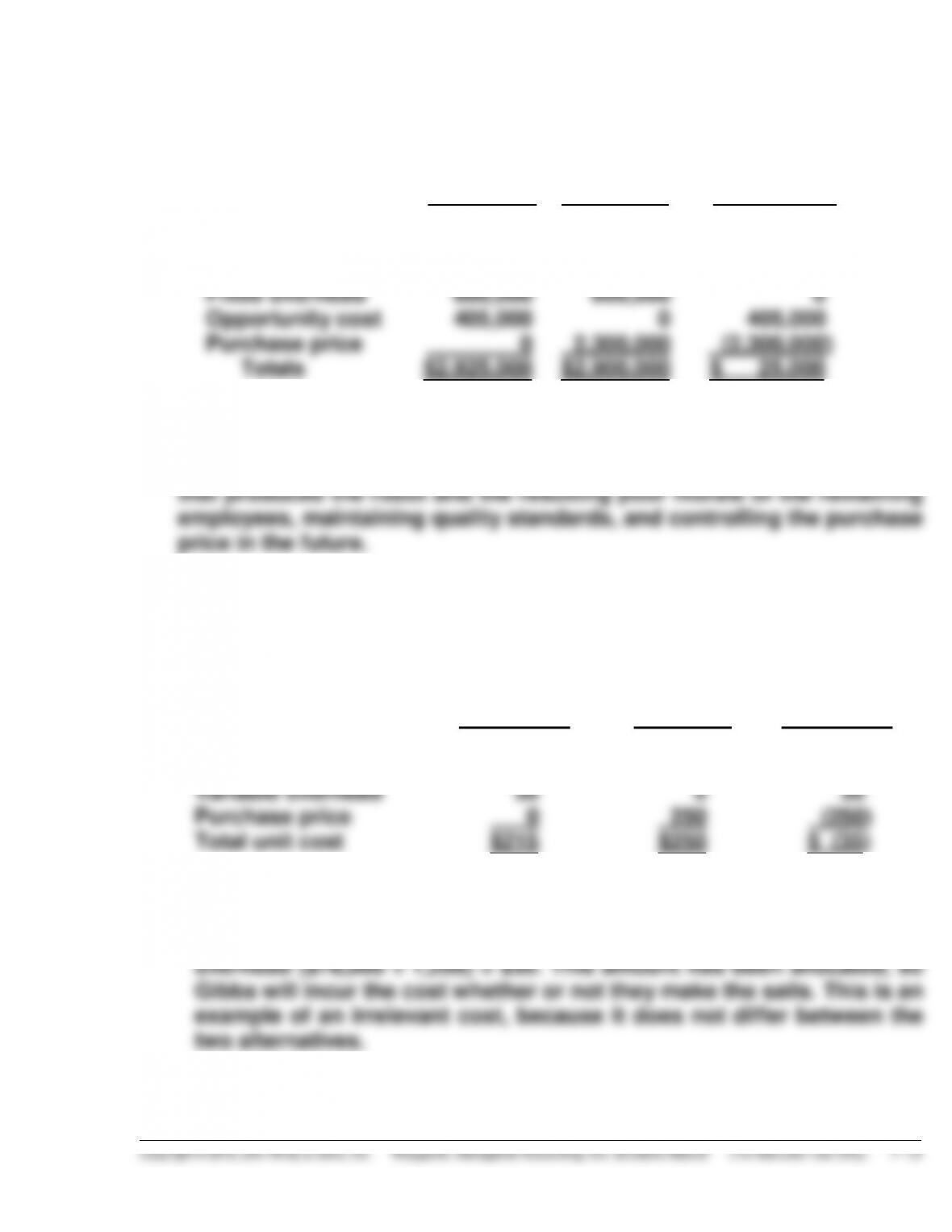
Opportunity cost
405,000
0
405,000
Purchase price
0
2,300,000
(2,300,000)
Totals
$2,925,000
$2,900,000
$ 25,000
Yes. The offer should be accepted as net income would be $25,000 more.
(b) Qualitative factors include the possibility of laying off those employees
EXERCISE 7-7
(a) Net Income
Increase
Make Sails Buy Sails (Decrease)
Direct materials $100 $ 0 $ 100
Direct labor 80 0 80
Gibbs should be making the sails, because they could save $35 per
unit or $42,000. The president was including the fixed overhead cost
in the calculation. Variable overhead = Total overhead ($100) – Fixed
EXERCISE 7-7 (Continued)
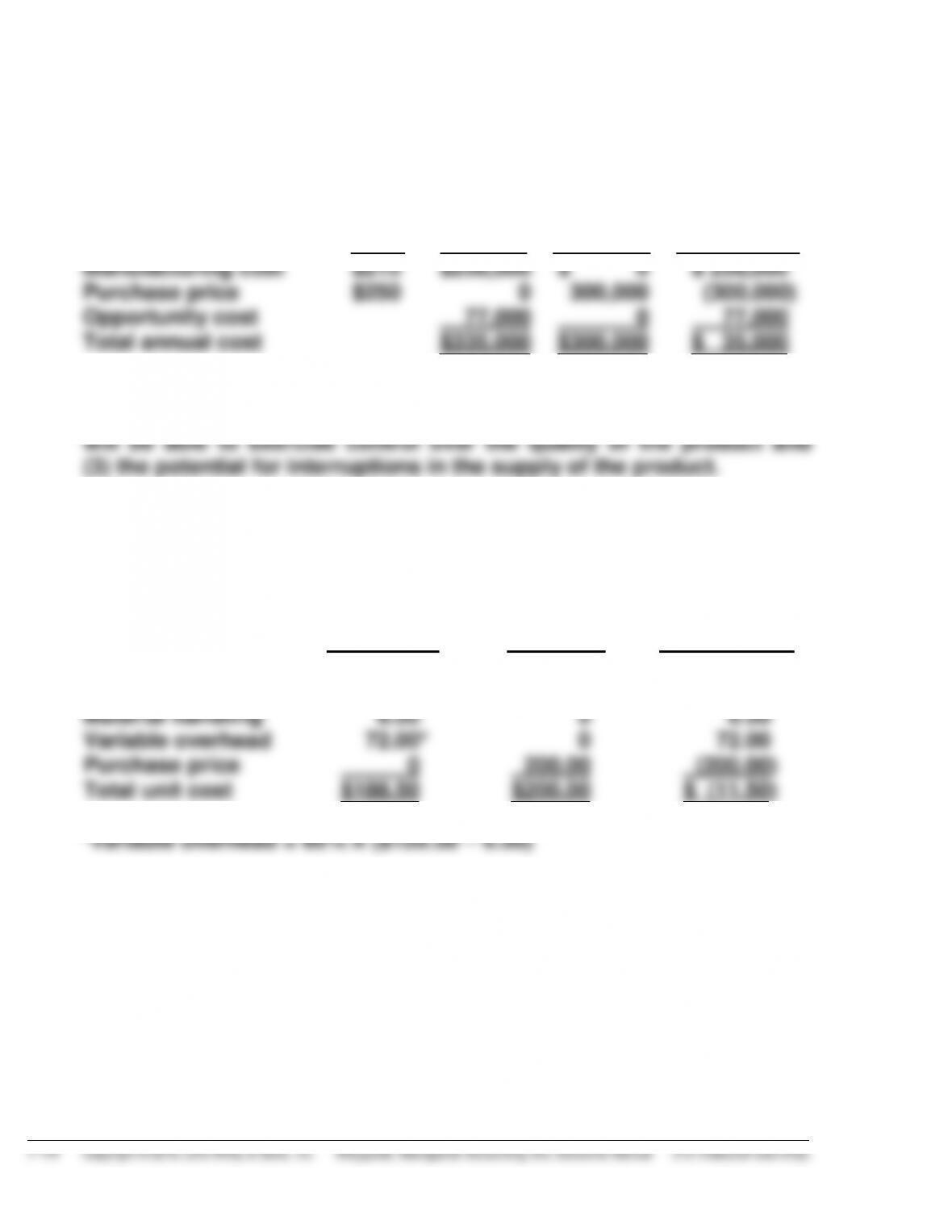
(b) The best decision would be to rent out the space as shown below.
The differential savings would be $77,000 – $42,000 = $35,000.
Net Income
Per Make Increase
(Based on 1,200 units) Unit Sails Buy Sails (Decrease)
(c) Qualitative factors to consider would be (1) whether Gibbs will be able
to exercise control over the future price of the product (2) whether Gibbs
EXERCISE 7-8
(a) Net Income
Increase
Make IMC2 Buy IMC2 (Decrease)
Direct materials $ 65.00 $ 0 $ 65.00
Direct labor 45.00 0 45.00
The unit should not be purchased from the outside vendor, as the per
unit cost would be $11.50 greater than if they made it.
EXERCISE 7-8 (Continued)
(b) In order for Innova to make an accurate decision, they would have to
know the opportunity cost of manufacturing the other product. As
determined in (a), purchasing the product from outside would cost
(c) Qualitative factors to consider would be (1) quality of the component
EXERCISE 7-9
Sell
(Basic Kit)
Process Further
(Stage 2 Kit)
Net Income
Increase
(Decrease)
Sales per unit
Costs per unit
Direct materials
Direct labor
Total
Net income per unit
$30
$14
0
$14
$16
( )$35( )
( ) $ 7 (1)
( ) 9 (2)
( ) $16 ( )
( ) $19 ( )
$(5)
$(7)
(9)
$(2)
$(3)
(2) The total time to make the two kits is one hour at $18 per hour or
$9 per unit.
EXERCISE 7-9 (Continued)
processing the kits further.
EXERCISE 7-10
(a)
Sales ($60,000 + $15,000 + $55,000)
$ 130,000
Joint costs
(100,000)
Net income
$ 30,000
(b)
Sales ($190,000 + $35,000 + $215,000)
$ 440,000
Joint costs
(100,000)
Additional costs ($100,000 + $30,000 + $150,000)
(280,000)
Net income
$ 60,000
(c)
Product 10
Product 12
Product 14
Incremental revenue(1)
$ 130,000
$ 20,000
$ 160,000
Incremental costs
(100,000)
(30,000)
(150,000)
Incremental profit (loss)
$ 30,000
$(10,000)
$ 10,000
Products 10 and 14 should be processed further and product 12 should be
sold at the split-off point.
(d)
Sales ($190,000 + $15,000 + $215,000)
$ 420,000
Joint costs
(100,000)
Additional costs ($100,000 + $150,000)
(250,000)
Net income
$ 70,000
EXERCISE 7-11
sold as is or processed further.
Larco
Marco
Narco
Incremental revenue
Incremental cost
Incremental profit (loss)
$100,000*
(110,000)
$ (10,000)
$100,000
(85,000
$ 15,000
**
)
$395,000
(250,000
$145,000
***
)
should be sold as is.
EXERCISE 7-12
(b) Revenue after further processing:
Product D—$60,000 (4,000 units X $15.00 per unit)
Product E—$97,200 (6,000 units X $16.20 per unit)
Product F—$45,200 (2,000 units X $22.60 per unit)
Revenue at split-off:
Product D—$40,000 (4,000 units X $10.00 per unit)
Product E—$69,600 (6,000 units X $11.60 per unit)
Product F—$38,800 (2,000 units X $19.40 per unit)
D E F
Incremental revenue $20,000 $27,600 $ 6,400
(c) The decision would remain the same. It does not matter how the joint
costs are allocated because joint costs are irrelevant to this decision.
EXERCISE 7-13
(a)
Cost
$100,000
Accumulated depreciation
(25,000*)
Book value
75,000
Sales proceeds
40,000
Loss on sale
$ 35,000
(b)
Retain
Scanner
Replace
Scanner
Net Income
Increase
(Decrease)
Annual operating costs
$315,000*
$225,000**
$ 90,000
New scanner cost
110,000
(110,000)
Old scanner salvage
(40,000)
40,000
Total
$315,000
$295,000
$ 20,000
(c) As shown in (a) above, replacing the old scanner will result in
reporting a loss of $35,000. Reluctance to report losses of this nature
is the usual reason for not recognizing that a poor decision was made
in the past. The remaining book value of the old scanner ($75,000) is
pay ($40,000).
EXERCISE 7-14
Retain
Machine
Replace
Machine
Net Income
Increase
(Decrease)
Operating costs
New machine cost
Salvage value (old)
Total
$125,000
0
0
$125,000
(1)
($100,000)
( 25,000)
( (6,000)
($119,000)
(2)
($ 25,000
( (25,000)
( 6,000
($ 6,000
(1) $25,000 X 5.
(2) $20,000 X 5.
current machine.
EXERCISE 7-15
Continue
Eliminate
Net Income
Increase
(Decrease)
Sales
Variable costs
Cost of goods sold
Operating expenses
Total variable
Contribution margin
Fixed costs
Cost of goods sold
Operating expenses
Total fixed
Net income (loss)
$100,000)
( 61,000)
(26,000)
(87,000)
(13,000)
(15,000)
(24,000)
(39,000)
$(26,000)
$( 0)
( 0)
( 0)
( 0)
( 0)
(15,000)
(24,000)
(39,000)
$(39,000)
$(100,000)
(61,000)
(26,000)
(87,000)
(13,000)
( 0)
( 0)
( 0)
$ (13,000)
(Note: None of the fixed costs can be avoided.)
EXERCISE 7-16
(a) $30,000 + $70,000 – $40,000 = $60,000
(b)
Tingler
Shocker
Total
Sales
Variable expenses
Contribution margin
Fixed expenses
Net income
$300,000
150,000
150,000
142,500*
$ 7,500
$500,000
200,000
300,000
267,500**
$ 32,500
$800,000
350,000
450,000
410,000
$ 40,000
*$30,000 + [($300,000 ÷ $800,000) X $300,000]
expenses.
EXERCISE 7-17
Calculation of contribution margin per unit:
C D E
Fixed costs = $22 X (9,000 + 20,000) = $638,000
Company profit with Products C and D:
C D Total
Units sold 9,000 20,000