PROBLEM 6-2B (Continued)
(2) Contribution margin ratio = $314,000 ÷ $1,000,000 = .314
(3) Break-even point in dollars = $431,000 ÷ .314 = $1,372,611 (rounded)
The break-even point in dollars declined from $1,690,000 to $1,372,611.
This means that overall the company’s risk has declined because it doesn’t
have to generate so much in sales. The two changes actually had opposing
effects on the break-even point. By changing to a more commission-based
PROBLEM 6-3B
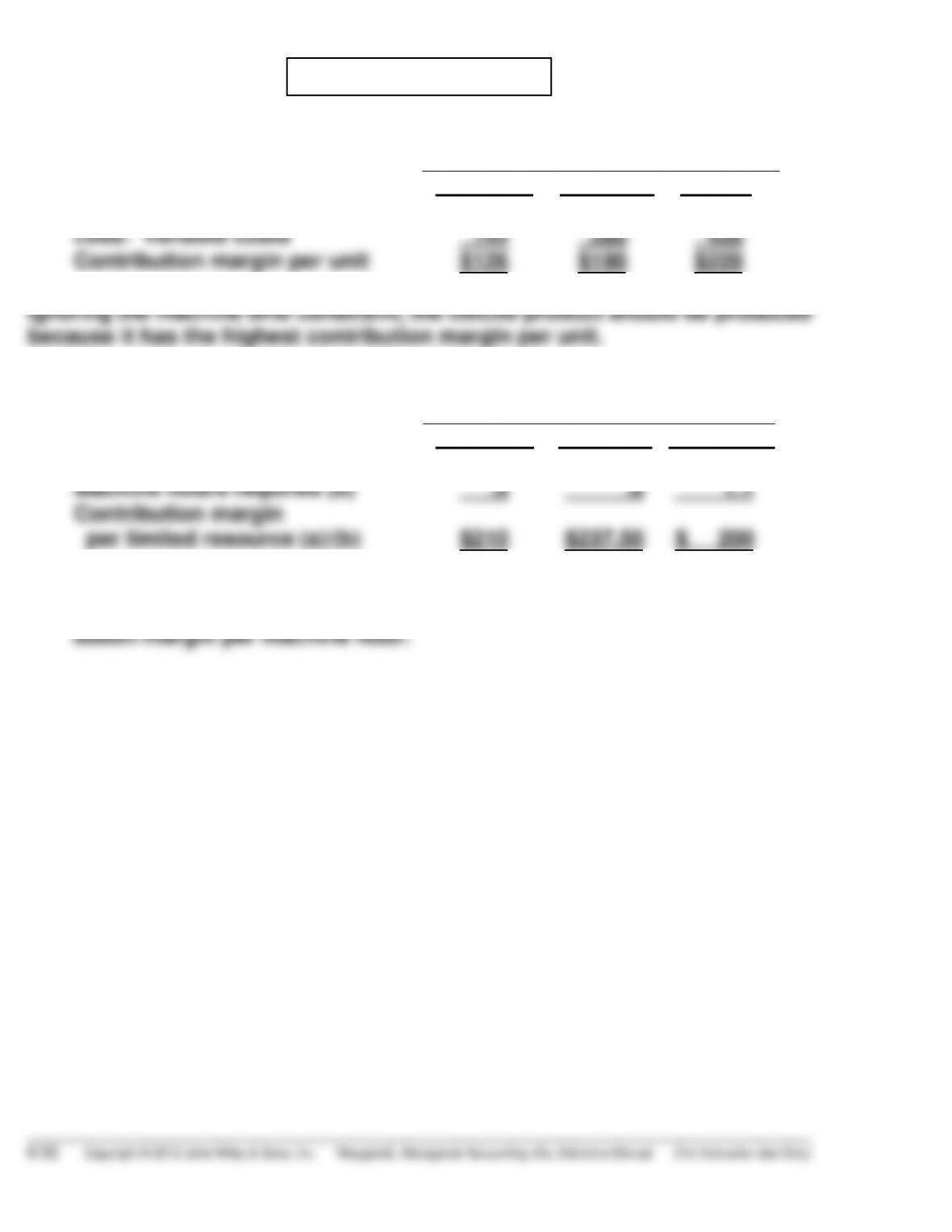
(a)
Product
Economy
Standard
Deluxe
Selling price
$270
$450
$650
Less: Variable costs
144
260
430
Contribution margin per unit
$126
$190
$220
(b)
Product
Economy
Standard
Deluxe
Contribution margin per unit (a)
$126
$ 190
$ 220
Machine hours required (b)
.6
.8
1.1
Contribution margin
per limited resource (a)/(b)
$210
$237.50
$ 200
(c) If additional machine hours become available, the additional time should
be used to produce the Standard product since it has the highest contri–
PROBLEM 6-4B (Continued)
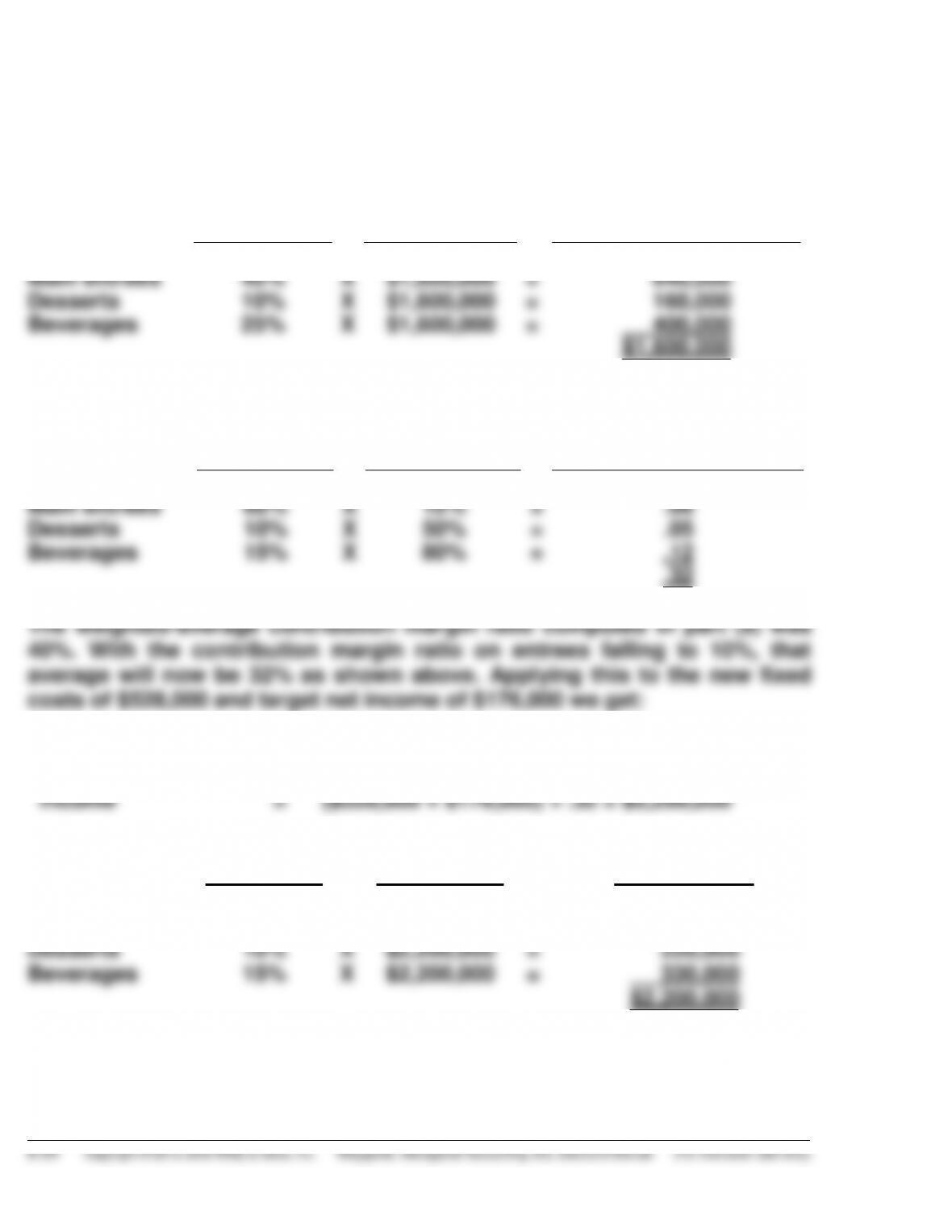
Thus, sales would have to increase by $280,000 ($1,600,000 – $1,320,000) to
achieve the target net income. This increase in sales is driven by the
increase in fixed costs. The sales of each product line would be:
Sales Mix
Percentage
X
Total Sales
Needed
=
Sales Dollars
Per Product
Appetizers
Main entrees
Desserts
Beverages
25%
40%
10%
25%
X
X
X
X
$1,600,000
$1,600,000
$1,600,000
$1,600,000
=
=
=
=
$ 400,000
640,000
160,000
400,000
$1,600,000
(c)
Sales Mix
Percentage
X
Contribution
Margin Ratio
=
Weighted-Average
Contribution
Margin Ratio
Appetizers
Main entrees
Desserts
Beverages
15%
60%
10%
15%
X
X
X
X
60%
10%
50%
80%
=
=
=
=
.09
.06
.05
.12
.32
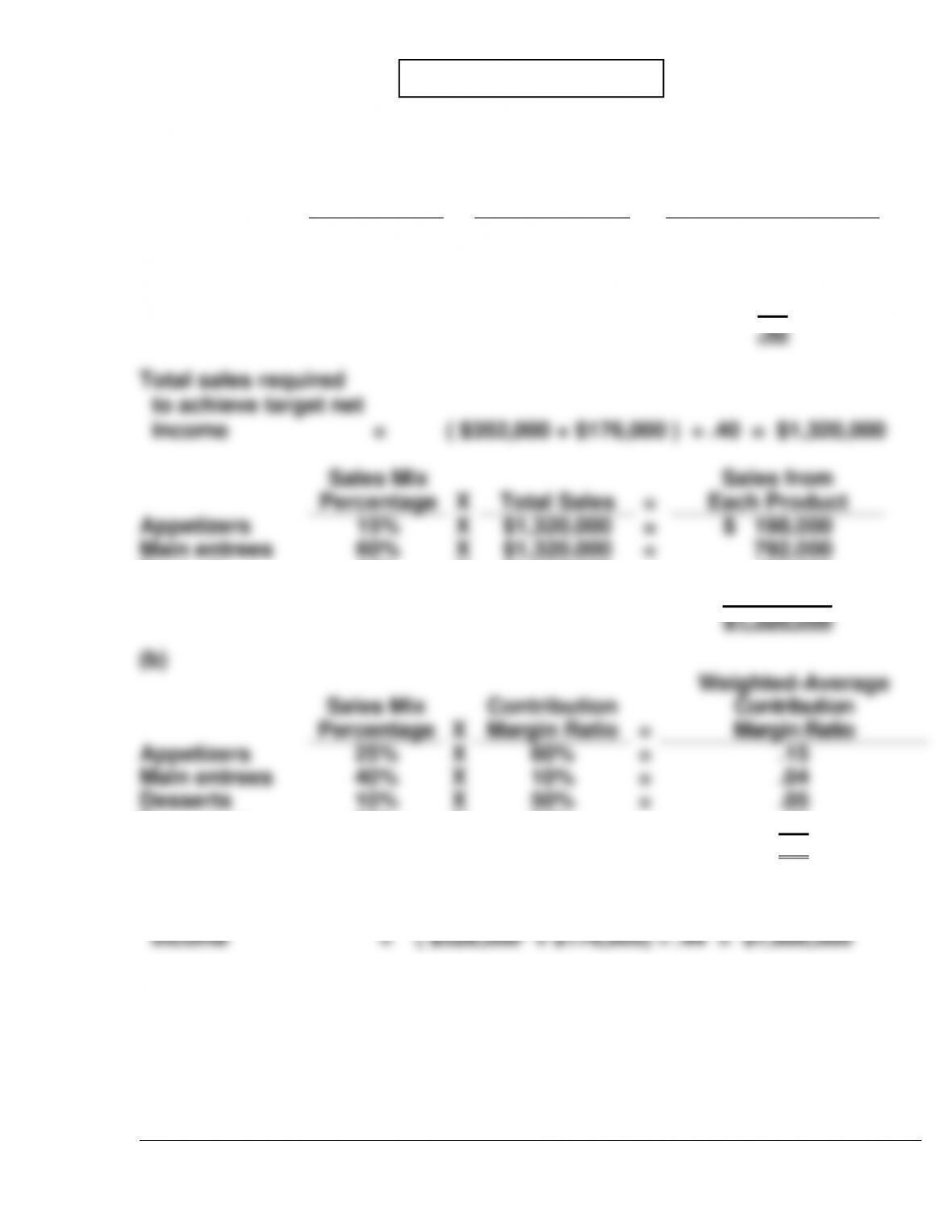
Total sales required
to achieve target net
Sales Mix
Percentage
X
Total Sales
Needed
=
Sales from
Each Product
Appetizers
Main entrees
Desserts
Beverages
15%
60%
10%
15%
X
X
X
X
$2,200,000
$2,200,000
$2,200,000
$2,200,000
=
=
=
=
$ 330,000
1,320,000
220,000
330,000
$2,200,000
PROBLEM 6-4B (Continued)
Relative to parts (a) and (b), the total required sales for (c) would increase.
It appears that the least risky approach would be for Michael to switch to
PROBLEM 6-5B
Contribution
Margin
÷
Sales
=
Contribution
Margin Ratio
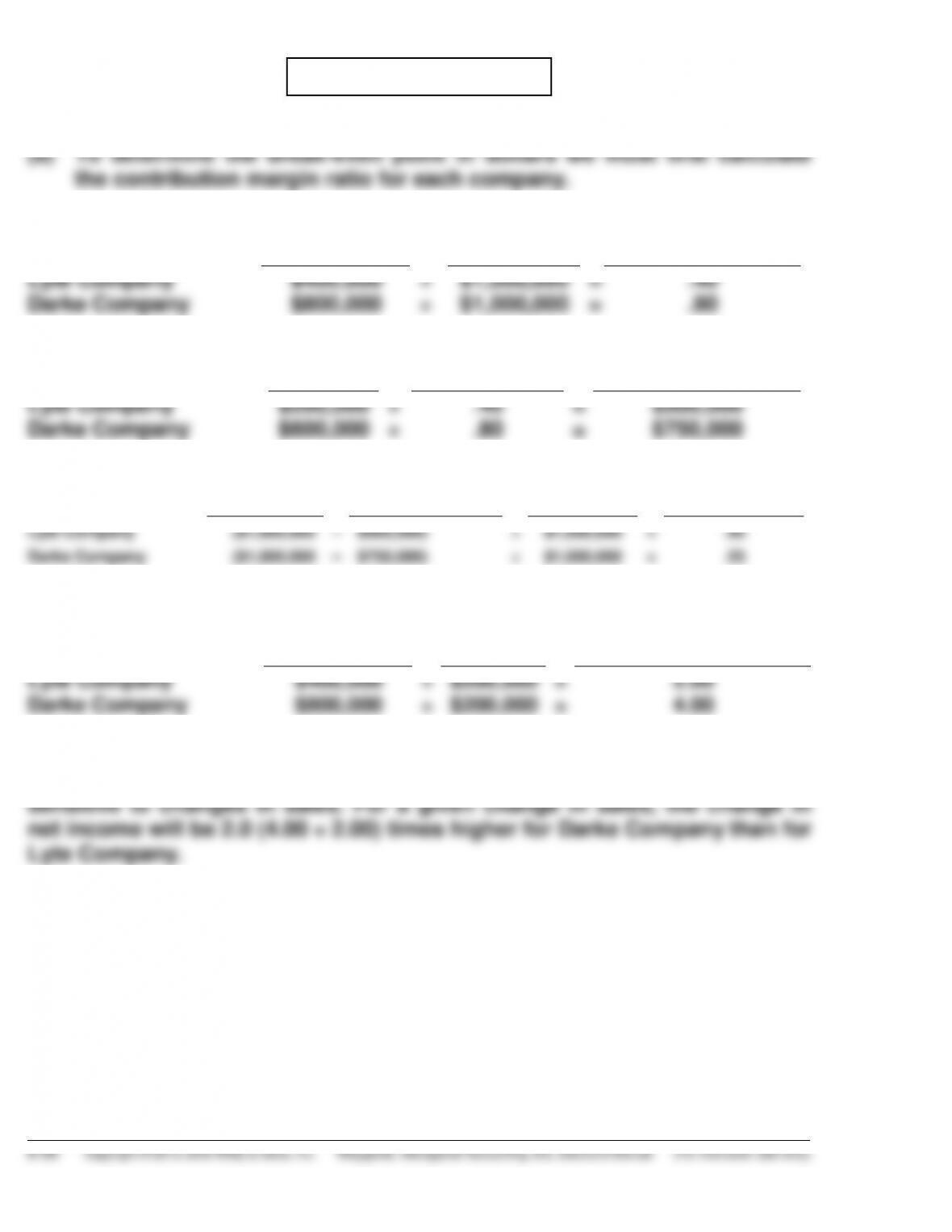
Lyte Company
Darke Company
$400,000
$800,000
÷
÷
$1,000,000
$1,000,000
=
=
.40
.80
Fixed
Costs
÷
Contribution
Margin Ratio
=
Break-even Point
in Dollars
Lyte Company
Darke Company
$200,000
$600,000
÷
÷
.40
.80
=
=
$500,000
$750,000
(Actual Sales
–
Break-even Sales)
÷
Actual Sales
=
Margin of Safety
Ratio
Lyte Company
Darke Company
($1,000,000
($1,000,000
–
–
$500,000)
$750,000)
÷
÷
$1,000,000
$1,000,000
=
=
.50
.25
(b)
Contribution
Margin
÷
Net
Income
=
Degree of Operating
Leverage
Lyte Company
Darke Company
$400,000
$800,000
÷
÷
$200,000
$200,000
=
=
2.00
4.00
Because Darke Company relies more heavily on fixed costs, it has a higher
degree of operating leverage. This means that its net income will be more
PROBLEM 6-5B (Continued)
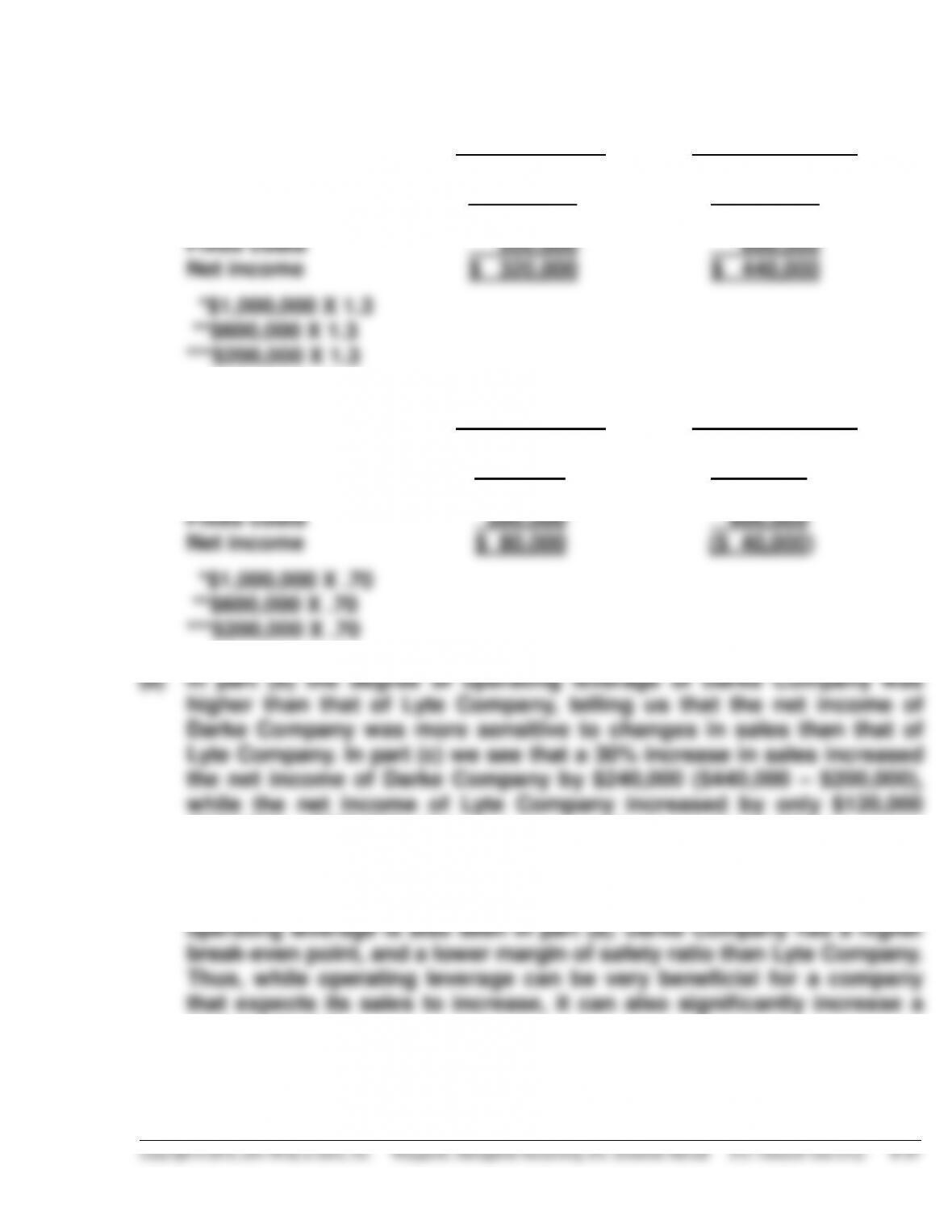
(c)
Lyte Company Darke Company
Sales $1,300,000* $1,300,000
Variable costs 780,000** 260,000***
Contribution margin 520,000 1,040,000
(d)
Lyte Company Darke Company
Sales $700,000* $700,000
Variable costs 420,000** 140,000***
Contribution margin 280,000 560,000
($320,000 – $200,000). However, in part (d) we see that a 30% decrease
in sales resulted in a $240,000 ($40,000 + $200,000) decline in net income
for Darke Company, while Lyte Company’s net income only declined by
$120,000 ($200,000 – $80,000). The increased risk caused by higher
company’s risk.
PROBLEM 6-6B
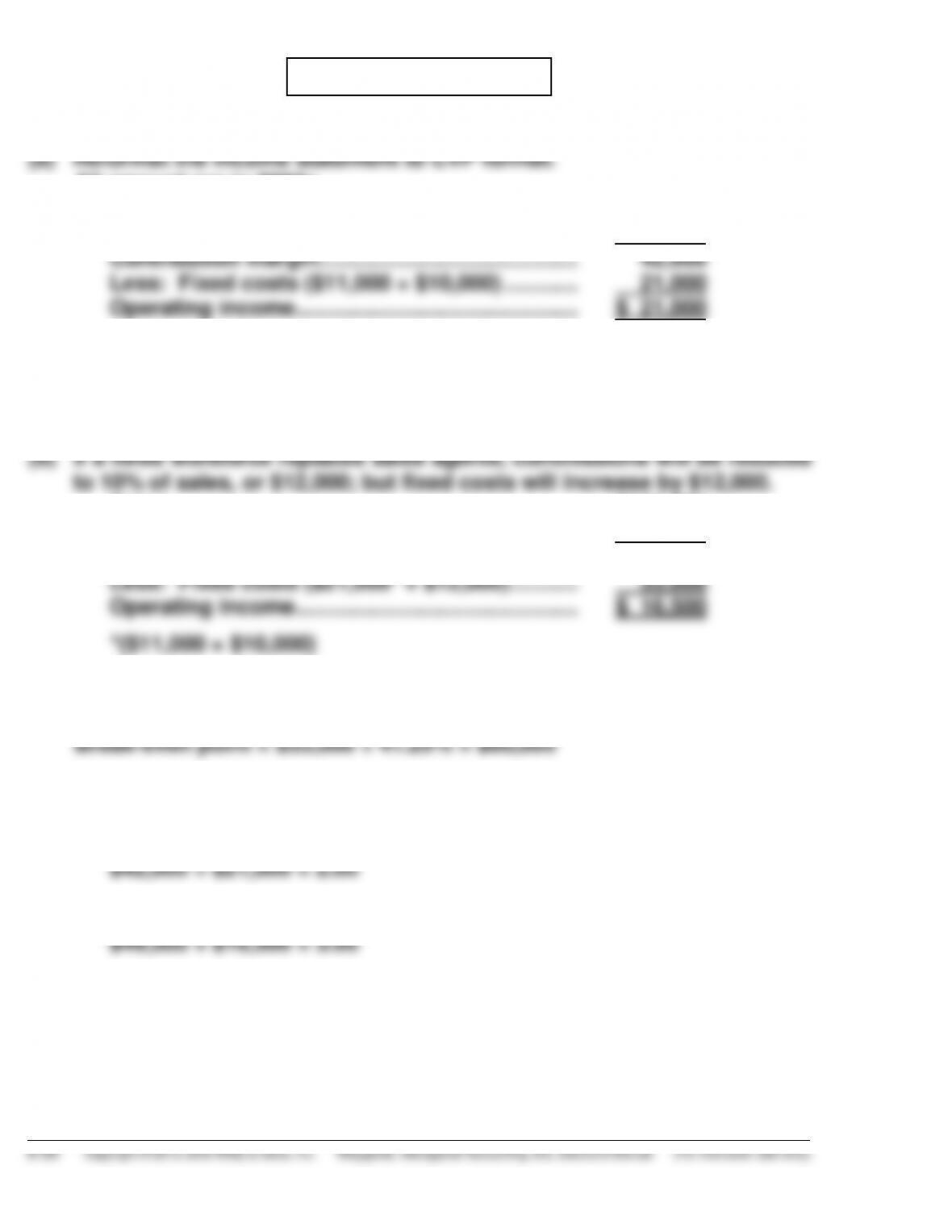
All amount are in $000s.
Sales ………………………………………………………… $120,000
Variable costs ($58,500 + $19,500) ………………. 78,000
Contribution margin ratio = $42,000 ÷ $120,000 = 35%
Break-even point = $21,000 ÷ 35% = $60,000
Sales ………………………………………………………… $120,000
Variable costs ($58,500 + $12,000) ………………. 70,500
Contribution margin …………………………………… 49,500
Contribution margin ratio = $49,500 ÷ $120,000 = 41.25%
(c) Operating leverage = contribution margin ÷ operating income
(1) Current situation: from part (a)
(2) Proposed situation: from part (b)
PROBLEM 6-6B (Continued)
The calculations indicate that at a sales level of $120 million, a percentage
change in sales and contribution margin will result in 2.00 times that
percentage change in operating income if Peaches continues to use
The higher contribution margin per dollar of sales and higher fixed
costs from Peaches employing their own agents gives them more
between alternatives.
Let the sales volume = S
16.25% X S = (10% X S) + $12,000
*PROBLEM 6-7B
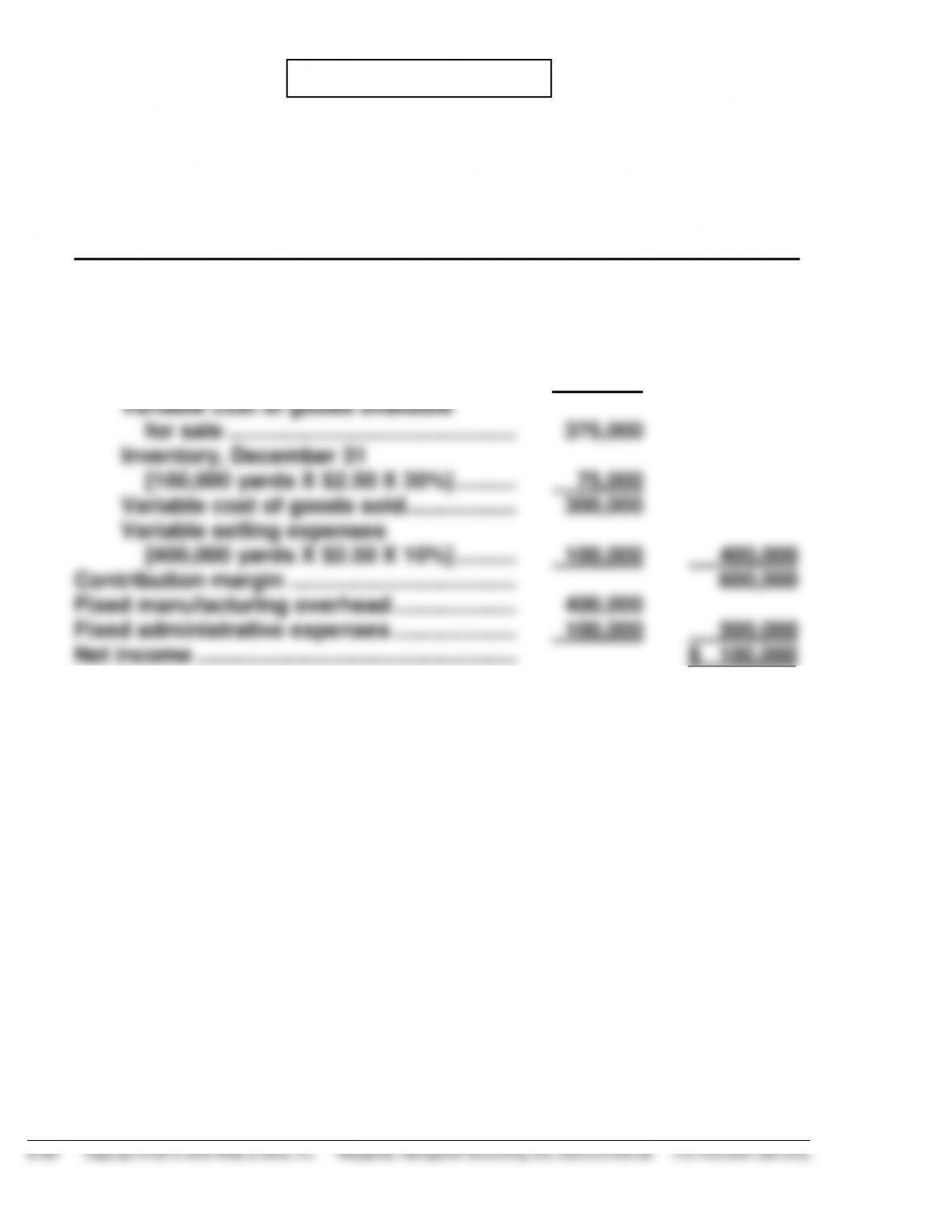
(a) FAB COMPANY
Income Statement
For the Year Ended December 31, 2013
Variable Costing
Sales (400,000 yards X $2.50) ………………….
Variable cost of goods sold
Inventory, January 1 ………………………..
Variable cost of goods manufactured
[500,000 yards X $2.50 X 30%] ……….
Variable cost of goods available
for sale ………………………………………..
Inventory, December 31
[100,000 yards X $2.50 X 30%] ……….
Variable cost of goods sold ………………
Variable selling expenses
[400,000 yards X $2.50 X 10%] ……….
Contribution margin ……………………………….
Fixed manufacturing overhead ………………..
Fixed administrative expenses ………………..
Net income …………………………………………….
$ –0–
375,000
375,000
75,000
300,000
100,000
400,000
100,000
$1,000,000
400,000
600,000
500,000
$ 100,000