SOLUTIONS TO PROBLEMS
PROBLEM 6-1A
$1,035,000
=
$2,300,000
.45
to $31.25 ($25 X 125%). Total sales become $2,500,000 (80,000 X
$31.25). Thus, contribution margin ratio changes to 56%
$1,035,000
=
$1,848,214 (rounded)
.56
2. The effects of this alternative are: (1) fixed costs decrease by
$160,000, (2) variable costs increase by $100,000 ($2,000,000 X 5%),
(3) total fixed costs become $875,000 ($1,035,000 – $160,000), and
$875,000
=
$2,187,500
.40
3. The effects of this alternative are: (1) variable and fixed cost of
goods sold become $734,000 each, (2) total variable costs become
$884,000 ($734,000 + $92,000 + $58,000), (3) total fixed costs are
$1,251,000
=
$2,241,935 (rounded)
.558
Alternative 1 is the recommended course of action using break-even
PROBLEM 6-2A
(a)
(1)
Current Year
Sales
Variable costs
Direct materials
Direct labor
Manufacturing overhead ($350,000 X .70)
Selling expenses ($250,000 X .40)
Administrative expenses ($270,000 X .20)
Total variable costs
Contribution margin
$1,500,000
511,000
290,000
245,000
100,000
54,000
1,200,000
$ 300,000
Current Year
Projected Year
Sales
Variable costs
Direct materials
Direct labor
Manufacturing overhead
Selling expenses
Administrative expenses
Total variable costs
Contribution margin
$1,500,000
511,000
290,000
245,000
100,000
54,000
1,200,000
$ 300,000
X 1.1
X 1.1
X 1.1
X 1.1
X 1.1
X 1.1
X 1.1
X 1.1
$1,650,000
562,100
319,000
269,500
110,000
59,400
1,320,000
$ 330,000
(2)
Fixed Costs
Current Year
Projected year
Manufacturing overhead ($350,000 X .30)
Selling expenses ($250,000 X .60)
Administrative expenses ($270,000 X .80)
Total fixed costs
$105,000
150,000
216,000
$471,000
$105,000
150,000
216,000
$471,000
PROBLEM 6-2A (Continued)
(b) Unit selling price = $1,500,000 ÷ 100,000 = $15
Unit variable cost = $1,200,000 ÷ 100,000 = $12
Break-even point in units
=
Fixed costs
÷
Unit contribution margin
157,000 units
=
$471,000
÷
$3.00
Break-even point in dollars
=
Fixed costs
÷
Contribution margin ratio
$2,355,000
=
$471,000
÷
.20
(c) Sales dollars
required for
=
(Fixed costs
+
Target net income)
÷
Contribution margin ratio
target net income
$3,355,000
=
($471,000
+
$200,000)
÷
.20
(d) Margin of safety
ratio
=
(Expected sales
–
Break-even sales)
÷
Expected sales
29.8%
=
($3,355,000
–
$2,355,000)
÷
$3,355,000
(e)
(1)
Current Year
Sales
Variable costs
Direct materials
Direct labor ($290,000 – $104,000)
Manufacturing overhead ($350,000 X .30)
Selling expenses ($250,000 X .90)
Administrative expenses ($270,000 X .20)
Total variable costs
Contribution margin
$1,500,000
511,000
186,000
105,000
225,000
54,000
1,081,000
$ 419,000
PROBLEM 6-2A (Continued)
Fixed cost
Manufacturing overhead ($350,000 X .70)
Selling expenses ($250,000 X .10)
Administrative expenses ($270,000 X .80)
Total fixed costs
$245,000
25,000
216,000
$486,000
(3) Break-even point in dollars = $486,000 ÷ .28 = $1,735,714 (rounded)
The break-even point in dollars declined from $2,355,000 to $1,735,714.
This means that overall the company’s risk has declined because it
doesn’t have to generate as much in sales. The two changes actually
PROBLEM 6-3A
(a)
Product
Economy
Standard
Deluxe
Selling price
$30
$50
$100
Less: Variable costs
14
15
46
Contribution margin per unit
$16
$35
$ 54
Ignoring the machine time constraint, the Deluxe product should be produced
because it has the highest contribution margin per unit.
(b)
Product
Economy
Standard
Deluxe
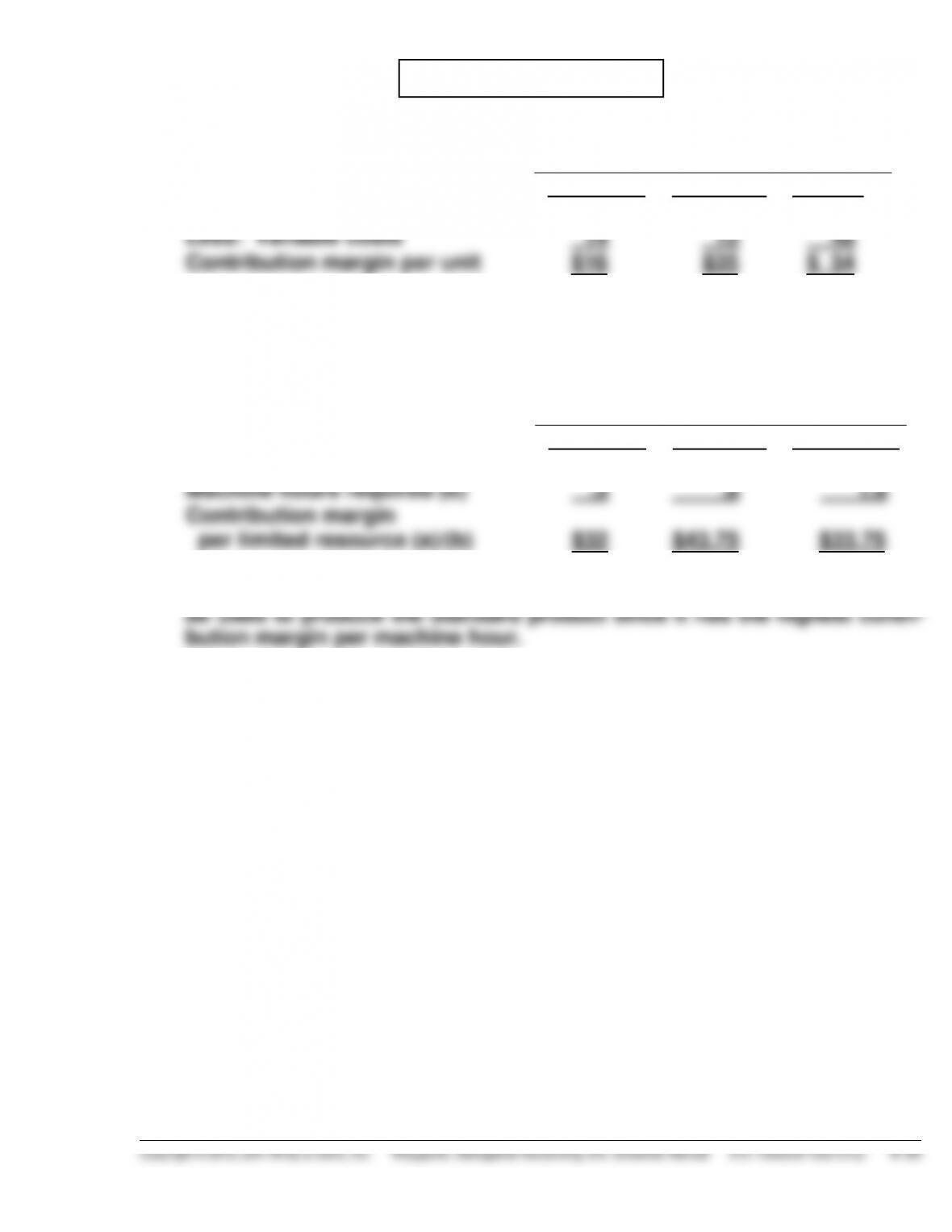
Contribution margin per unit (a)
$16
$ 35
$ 54
Machine hours required (b)
.5
.8
1.6
Contribution margin
per limited resource (a)/(b)
$32
$43.75
$33.75
(c) If additional machine hours become available, the additional time should

PROBLEM 6-4A
(a)
Sales Mix
Percentage
X
Contribution
Margin Ratio
=
Weighted-Average
Contribution
Margin Ratio
Appetizers
Main entrees
Desserts
Beverages
15%
50%
10%
25%
X
X
X
X
50%
25%
50%
80%
=
=
=
=
.075
.125
.050
.200
.450
Total sales required
to achieve target net
Sales Mix
Percentage
X
Total Sales
Needed
=
Sales from
Each Product
Appetizers
Main entrees
Desserts
Beverages
15%
50%
10%
25%
X
X
X
X
$2,600,000
$2,600,000
$2,600,000
$2,600,000
=
=
=
=
$ 390,000
1,300,000
260,000
650,000
$2,600,000
(b)
Sales Mix
Percentage
X
Contribution
Margin Ratio
=
Weighted-Average
Contribution
Margin Ratio
Appetizers
Main entrees
Desserts
Beverages
25%
25%
10%
40%
X
X
X
X
50%
10%
50%
80%
=
=
=
=
.125
.025
.050
.320
.520
Total sales required
to achieve target net
PROBLEM 6-4A (Continued)
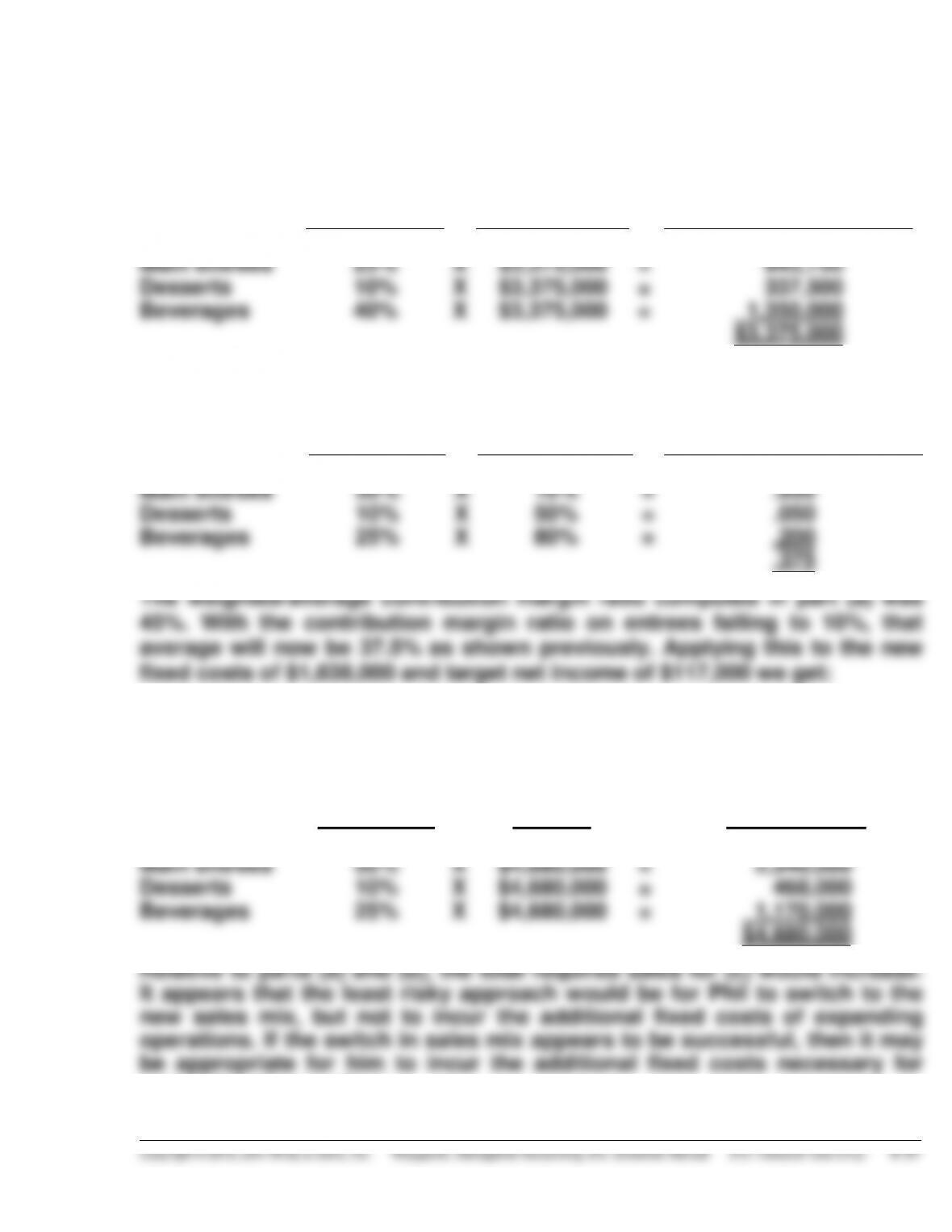
Thus, sales would have to increase by $775,000 ($3,375,000 – $2,600,000) to
achieve the target net income. This increase in sales is driven by the
increase in fixed costs. The sales of each product line would be:
Sales Mix
Percentage
X
Total Sales
Needed
=
Sales from
Each Product
Appetizers
Main entrees
Desserts
Beverages
25%
25%
10%
40%
X
X
X
X
$3,375,000
$3,375,000
$3,375,000
$3,375,000
=
=
=
=
$ 843,750
843,750
337,500
1,350,000
$3,375,000
(c)
Sales Mix
Percentage
X
Contribution
Margin Ratio
=
Weighted-Average
Contribution
Margin Ratio
Appetizers
Main entrees
Desserts
Beverages
15%
50%
10%
25%
X
X
X
X
50%
10%
50%
80%
=
=
=
=
.075
.050
.050
.200
.375
Total sales required
to achieve target net
income = ($1,638,000 + $117,000) ÷ .375 = $ 4,680,000
Sales Mix
Percentage
X
Total Sales
Needed
=
Sales from
Each Product
Appetizers
Main entrees
Desserts
Beverages
15%
50%
10%
25%
X
X
X
X
$4,680,000
$4,680,000
$4,680,000
$4,680,000
=
=
=
=
$ 702,000
2,340,000
468,000
1,170,000
$4,680,000
expansion of operations.
PROBLEM 6-5A
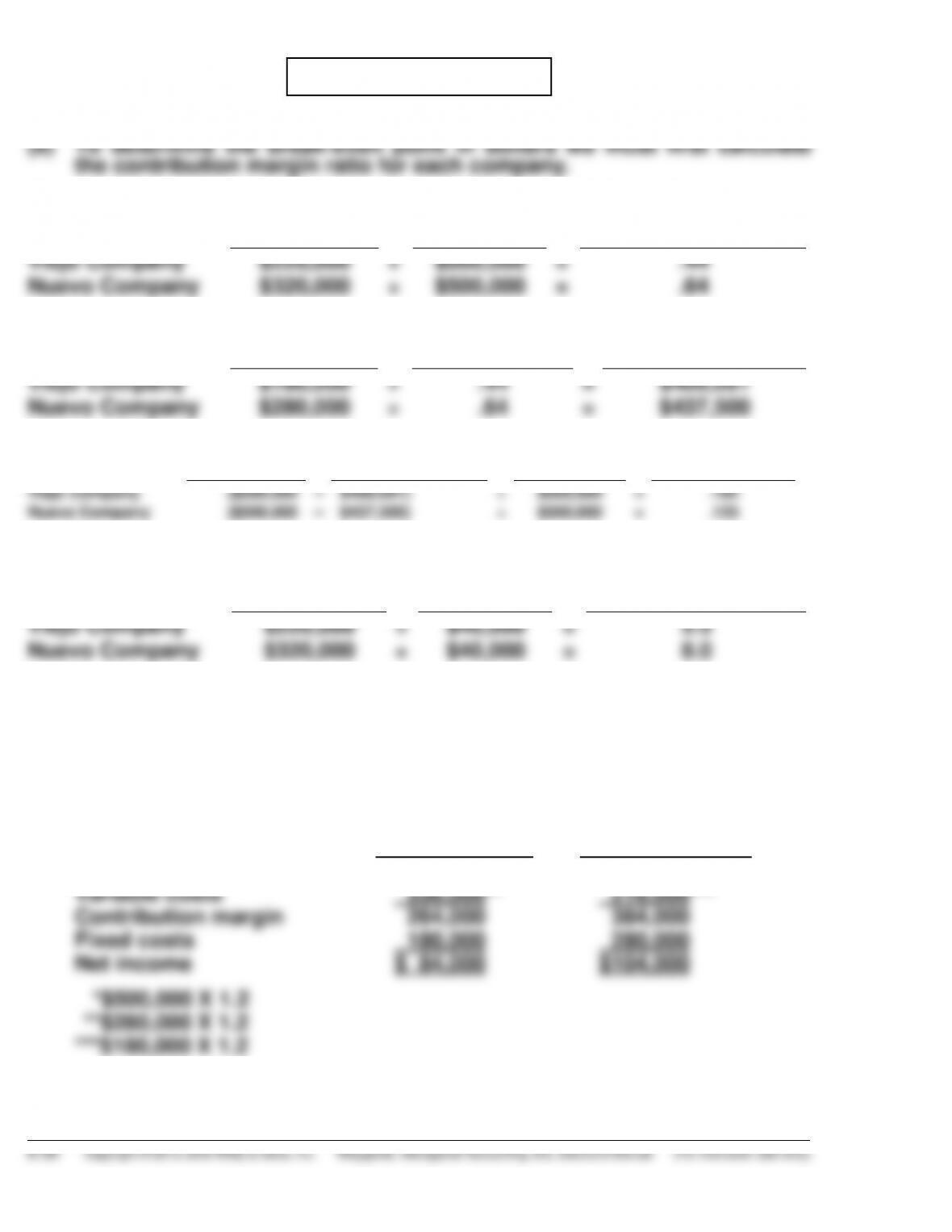
Contribution
Margin
÷
Sales
=
Contribution Margin
Ratio
Viejo Company
Nuevo Company
$220,000
$320,000
÷
÷
$500,000
$500,000
=
=
.44
.64
Fixed
Costs
÷
Contribution
Margin Ratio
=
Break-even Point
in Dollars
Viejo Company
Nuevo Company
$180,000
$280,000
÷
÷
.44
.64
=
=
$409,091
$437,500
(Actual Sales
–
Break-even Sales)
÷
Actual Sales
=
Margin of Safety
Ratio
Viejo Company
Nuevo Company
($500,000
($500,000
–
–
$409,091)
$437,500)
÷
÷
$500,000
$500,000
=
=
.182
.125
(b)
Contribution
Margin
÷
Net
Income
=
Degree of Operating
Leverage
Viejo Company
Nuevo Company
$220,000
$320,000
÷
÷
$40,000
$40,000
=
=
5.5
8.0
Because Nuevo Company relies more heavily on fixed costs, it has a higher
degree of operating leverage. This means that its net income will be more
sensitive to changes in sales. For a given change in sales, the change in
net income will be 1.45 (8.0 ÷ 5.5) times higher for Nuevo Company than for
Viejo Company.
(c)
Viejo Company Nuevo Company
Sales $600,000* $600,000
PROBLEM 6-5A (Continued)
(d)
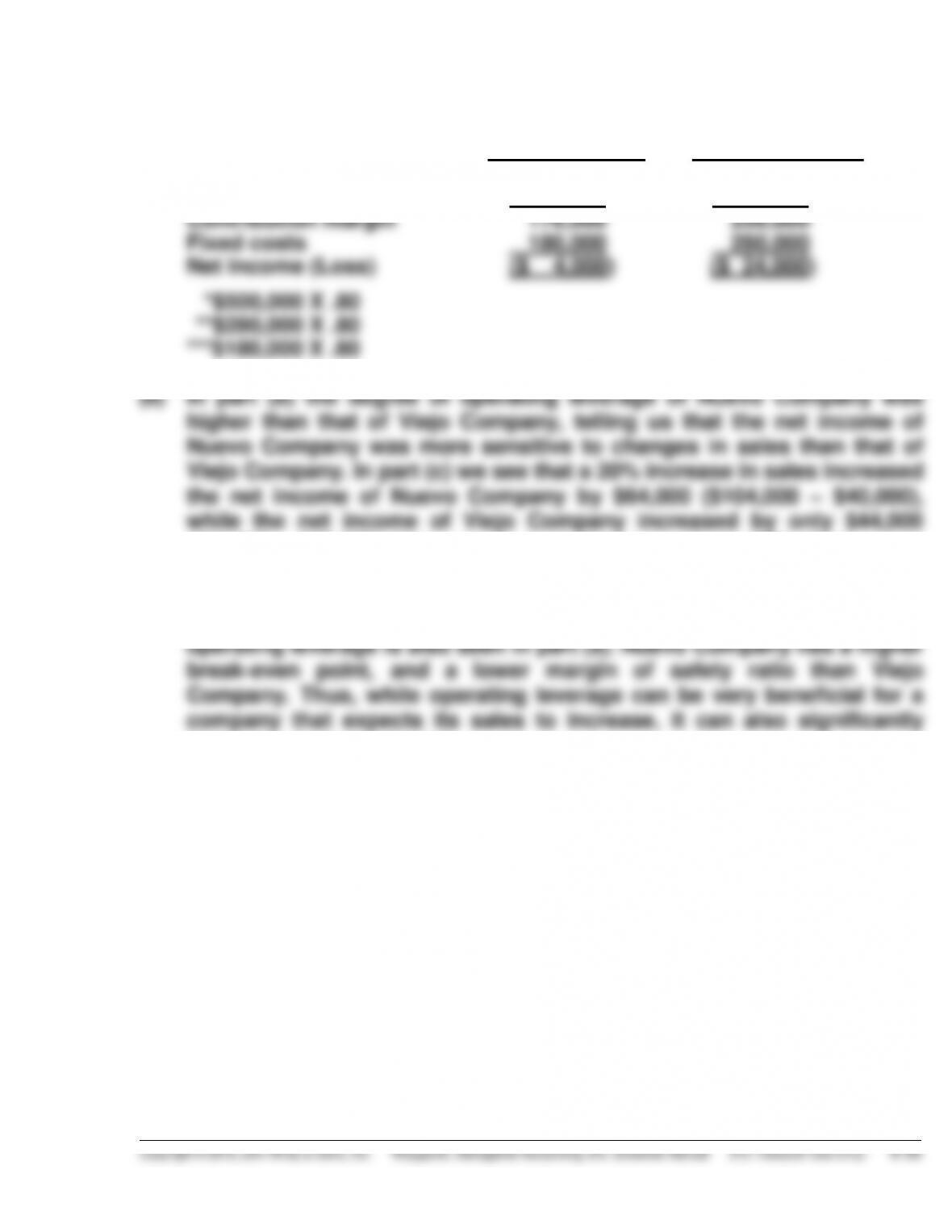
Viejo Company Nuevo Company
Sales $400,000* $400,000
Variable costs 224,000** 144,000***
($84,000 – $40,000). However, in part (d) we see that a 20% decrease in
sales resulted in a $64,000 ($40,000 + $24,000) decline in net income for
Nuevo Company, while Viejo Company’s net income only declined by
$44,000 ($40,000 + $4,000). The increased risk caused by higher
increase a company’s risk.
PROBLEM 6-6A
All amount are in $000s.
Sales ……………………………………………….. $75,000
Variable costs ($31,500 + $13,500) ……… 45,000
Contribution margin ………………………….. 30,000
Sales ……………………………………………….. $75,000
Variable costs ($31,500 + $6,000) ……….. 37,500
Contribution margin ………………………….. 37,500
Contribution margin ratio = $37,500 ÷ $75,000 = 50%
(c) Operating leverage = contribution margin ÷ operating income
(1) Current situation: from part (a)
(2) Proposed situation: from part (b)