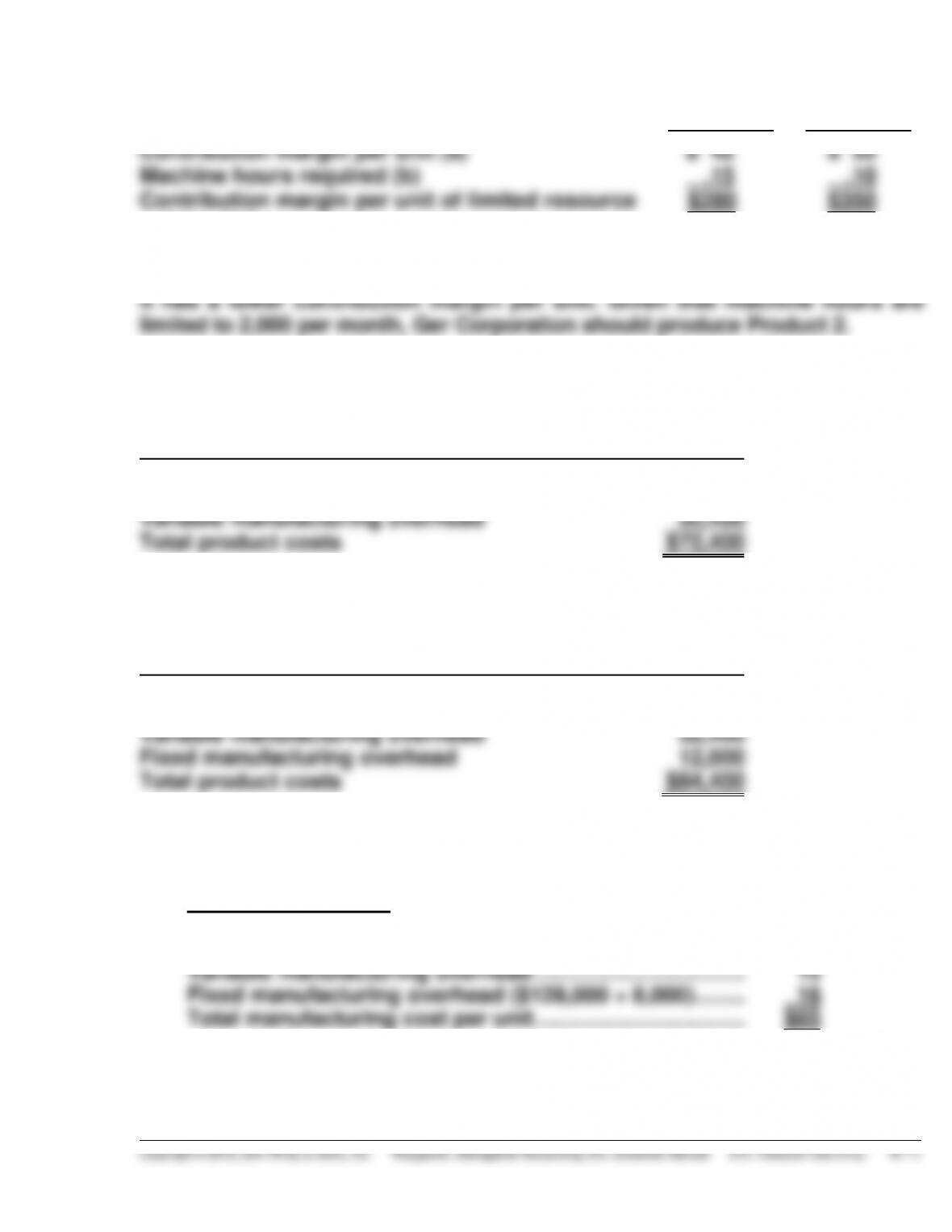
BRIEF EXERCISE 6-15
Product 1
Product 2
Contribution margin per unit (a)
Machine hours required (b)
Contribution margin per unit of limited resource
[(a) ÷ (b)]
$ 42
.15
$280
$ 35
.10
$350
Product 2 has a higher contribution margin per limited resource, even though
*BRIEF EXERCISE 6-16
Variable Costing
Direct materials
$14,400
Direct labor
25,600
Variable manufacturing overhead
32,400
Total product costs
$72,400
*BRIEF EXERCISE 6-17
Absorption Costing
Direct materials
$14,400
Direct labor
25,600
Variable manufacturing overhead
32,400
Fixed manufacturing overhead
12,000
Total product costs
$84,400
*BRIEF EXERCISE 6-18
(a) Absorption Costing
……. Direct materials ………………………………………………………. $20
Direct labor ……………………………………………………………. 14
*BRIEF EXERCISE 6-18 (Continued)
(b) Variable Costing
Direct materials ……………………………………….. $20
*BRIEF EXERCISE 6-19
MEMO
To: Chief financial officer
From: Student
Re: Absorption and variable costing
(expensed as incurred).
Since units produced (50,000) exceeded units sold (48,000) last month, income
under absorption costing will be higher than under variable costing. Some
fixed overhead (2,000 units X $4 = $8,000) will be assigned to ending inventory
SOLUTIONS TO DO IT! REVIEW EXERCISES
DO IT! 6-1
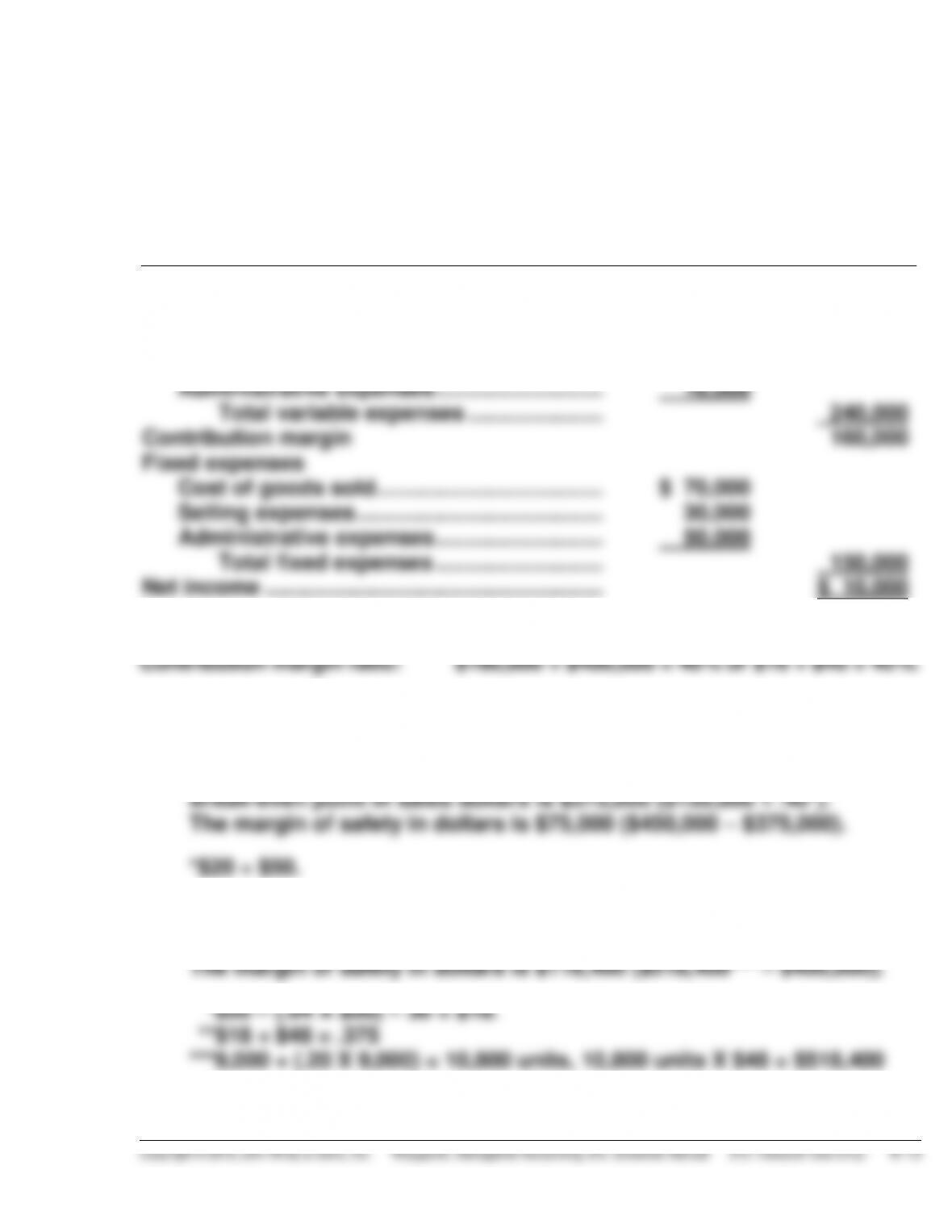
AMANDA INC.
Income Statement
For the Month Ended January 31, 2014
Sales (10,000 units) ……………………………………
$400,000
Variable expenses
Cost of goods sold ……………………………….
$184,000
Selling expenses …………………………..……..
40,000
Administrative expenses ………………………
16,000
Total variable expenses ………………….
240,000
Contribution margin
160,000
Fixed expenses
Cost of goods sold ……………………………….
$ 70,000
Selling expenses …………………………..……..
30,000
Administrative expenses ………………………
50,000
Total fixed expenses ………………………
150,000
Net income ……………………………………………….
$ 10,000
Contribution margin per unit: $160,000 ÷ 10,000 units = $16 per unit.
DO IT! 6-2
(a) Break-even point in units is 7,500 units ($150,000 ÷ $20).
(b) Break-even point in units is 8,333 units (rounded) ($150,000 ÷ $18*).
Break-even point in sales dollars is $400,000 ($150,000 ÷ .375**).
DO IT! 6-2 (Continued)
The increase in the break-even point from $375,000 to $400,000 indi-
cates that management should not implement the proposed change
while the increase in the margin of safety from $75,000 to $118,400
reducing unit prices.
DO IT! 6-3
Basic
Basic Plus
Premium
750 ÷ 1,500 = 50%
450 ÷ 1,500 = 30%
300 ÷ 1,500 = 20%
(b) The weighted-average unit contribution margin is:
(d) The break-even units to produce for each product are:
Basic: 1,200 units X 50% = 600 units
DO IT! 6-4
DO IT! 6-4 (Continued)
Good
Better
Best
Contribution margin per unit
$40
$150
$420
Limited resource consumed per unit
.5 = $80
1.5 = $100
6 = $70
should be used to make Better binoculars.
SOLUTIONS TO EXERCISES
EXERCISE 6-1
(a) 1. Contribution margin per room = $60 – ($8 + $37)
2. Break-even point in dollars = 900 rooms X $60 per room
(b) 1. Margin of safety in dollars:
Planned activity = 50 rooms per day X 30 days
2.
Margin of safety ratio:
$36,000
= 40%
$90,000
EXERCISE 6-2
(a) Contribution margin in dollars: Sales = 4,000 X $30 = $120,000
EXERCISE 6-2 (Continued)
(b) Break-even sales in dollars:
$16,800
25%
= $67,200.
$16,800
$7.50
(c) Margin of safety in dollars: $120,000 – $67,200 = $52,800.
EXERCISE 6-3
1. Increase selling price to $68.20 ($62 X 110%).
2. Reduce variable costs to 58% of sales.
3. Reduce fixed costs to $55,000 ($75,000 – $20,000).
EXERCISE 6-4
(a)
1. Contribution margin ratio is:
$30,000
= 62.5%
$48,000
Break-even point in dollars =
$20,250
= $32,400
62.5%
2. Round-trip fare =
$48,000
= $120
400 fares
Break-even point in fares =
$32,400
= 270 fares
$120
(b) At the break-even point fixed costs and contribution margin are equal.
Therefore, the contribution margin at the break-even point would be
$20,250.
(c)
Fare revenue ($108* X 500**)
$54,000
Variable costs ($18,000 X 1.20)
21,600
Contribution margin
32,400
Fixed costs
20,250
Net income
$12,150
Yes, the fare decrease should be implemented because net income
increases to $12,150.
*$120 – (.10 X $120)
**400 + 100
EXERCISE 6-5
(a) HALL COMPANY
CVP Income Statement
For the Year Ended December 31, 2014
Total
Per Unit
Sales (60,000 X $26) ………………………………..
Variable costs (60,000 X $12) ……………………
Contribution margin (60,000 X $14) …………..
Fixed costs……………………………………………..
Net income ……………………………………………..
$1,560,000
720,000
840,000
500,000
$ 340,000
$26
12
$14
EXERCISE 6-5 (Continued)
(b) HALL COMPANY
CVP Income Statement
For the Year Ended December 31, 2014
Total
Per Unit
Sales [(60,000 X 105%) X $24.50*] …………….
Variable costs (63,000 X $9.00**) ………………
Contribution margin (63,000 X $15.50)………
Fixed costs ($500,000 + $150,000) ……………
Net income ……………………………………………..
$1,543,500
567,000
976,500
650,000
$ 326,500
$24.50
9.00
$15.50
EXERCISE 6-6
Sales Mix
Percentage
Contribution
Margin Per Unit
Weighted-Average
Contribution Margin
Lawnmowers
Weed-trimmers
Chainsaws
20%
50%
30%
$30
$20
$40
$ 6
10
12
$28
Total break-even sales in units = $4,200,000 ÷ $28 = 150,000 units
Sales Mix
Percentage
Total
Break-even Sales
in Units
Sales Units
Needed
Per Product
Lawnmowers
Weed-trimmers
Chainsaws
Total units
20%
50%
30%
X
X
X
150,000
150,000
150,000
=
=
=
30,000 units
75,000 units
45,000 units
150,000 units

EXERCISE 6-7
(a)
Sales Mix
Percentage
Contribution
Margin Ratio
Weighted-Average
Contribution
Margin Ratio
Oil changes
Brake repair
70%
30%
20%
60%
.14
.18
.32
Total break-even sales in dollars = $16,000,000 ÷ .32 = $50,000,000
Sales Mix
Percentage
Total
Break-even Sales
in Dollars
Sales Dollars
Needed
Per Product
Oil changes
Brake repair
Total sales
70%
30%
X
X
$50,000,000
$50,000,000
=
=
$35,000,000
15,000,000
$50,000,000
(b)
Sales to achieve target net income = ($80,000 + $60,000) ÷ .32 = $437,500
Sales Mix
Percentage
Total
Sales Needed
Sales Dollars
Needed Per Product
Per Store
Oil changes
Brake repair
Total sales
70%
30%
X
X
$437,500
$437,500
=
=
$306,250
131,250
$437,500
EXERCISE 6-8
(a)
Sales Mix
Percentage
Contribution
Margin Ratio
Weighted-Average
Contribution
Margin Ratio
Mail pouches
and small boxes
Non-standard
boxes
80%
20%
20%
70%
.16
.14
.30