BYP 5-2 DECISION-MAKING ACROSS THE ORGANIZATION
(a)
(1) Capital-Intensive
(2) Labor-Intensive
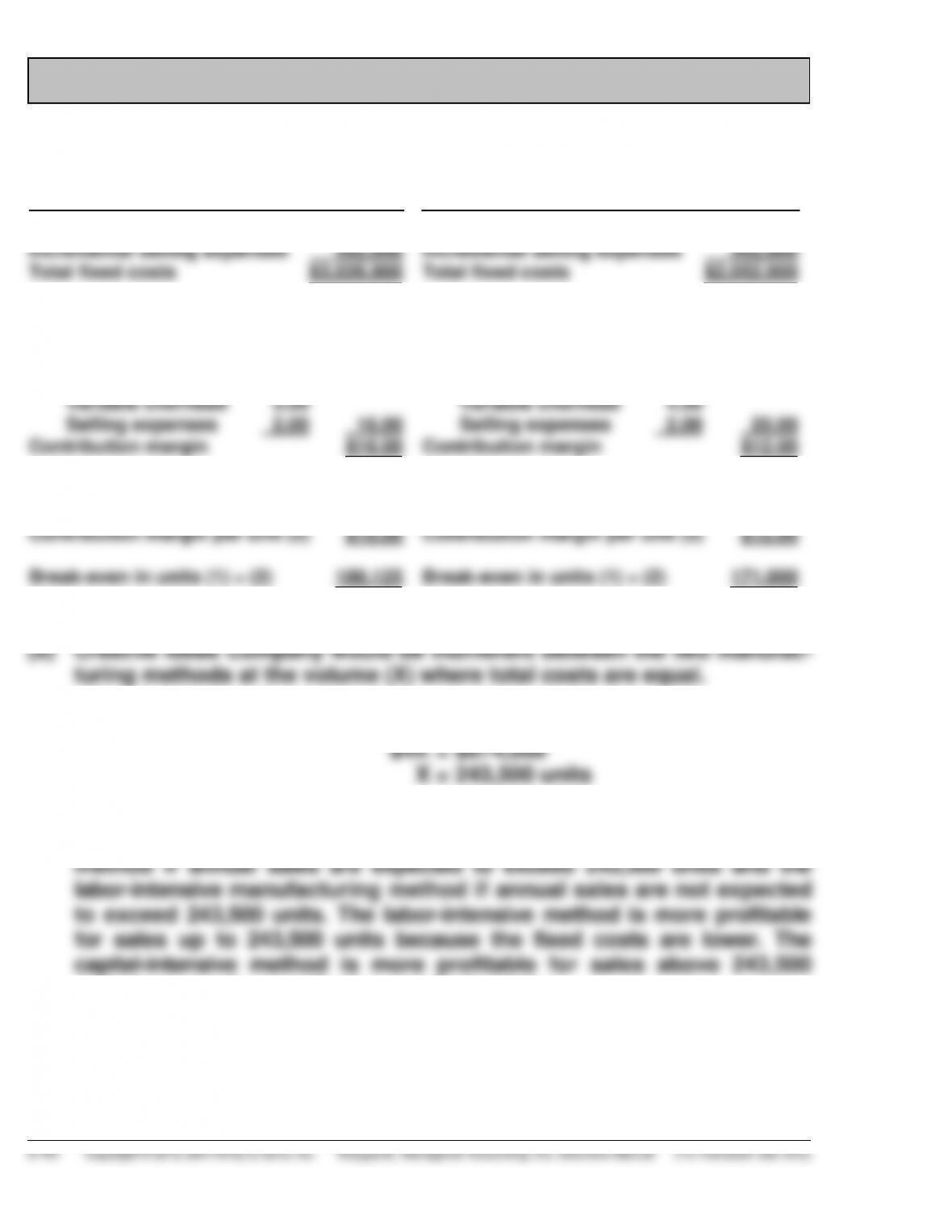
Fixed manufacturing costs $2,524,000
Incremental selling expenses 502,000
Total fixed costs $3,026,000
Fixed manufacturing costs $1,550,000
Incremental selling expenses 502,000
Total fixed costs $2,052,000
Selling price $32.00
Variable costs
Direct materials $5.00
Direct labor 6.00
Variable overhead 3.00
Selling expenses 2.00 16.00
Contribution margin $16.00
Selling price $32.00
Variable costs
Direct materials $5.50
Direct labor 8.00
Variable overhead 4.50
Selling expenses 2.00 20.00
Contribution margin $12.00
Total fixed costs (1) $3,026,000
Total fixed costs (1) $2,052,000
Contribution margin per unit (2) $16.00
Contribution margin per unit (2) $12.00
Break-even in units (1) ÷ (2) 189,125
Break-even in units (1) ÷ (2) 171,000
$16X + $3,026,000 = $20X + $2,052,000
(c) Creative Ideas should employ the capital-intensive manufacturing
units because its contribution margin is higher.
BYP 5-3 MANAGERIAL ANALYSIS
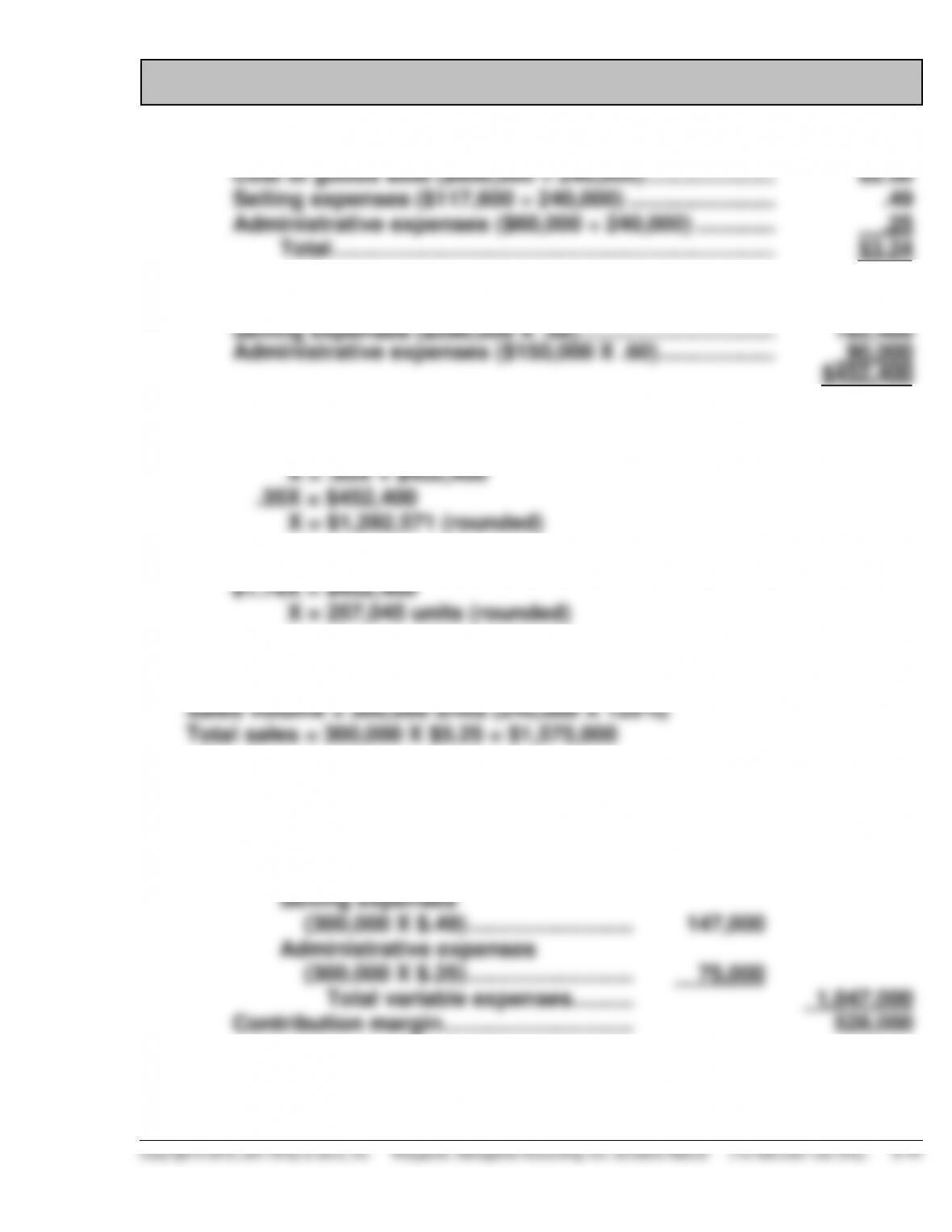
(a) The variable costs per unit are:
Fixed costs are:
Cost of goods sold ($800,000 X .25) ………………………. $200,000
The break-even points are:
X = ($3.24 ÷ $5.00) X + $452,400
$5.00X = $3.24X + $452,400
(b) Variable unit cost of goods sold = $2.75
($600,000 ÷ 240,000 = $2.50; $2.50 + $.25)
Net income computation:
Sales ………………………………………………. $1,575,000
Variable expenses
Cost of goods sold
(300,000 X $2.75) ……………………. $825,000
BYP 5-3 (Continued)
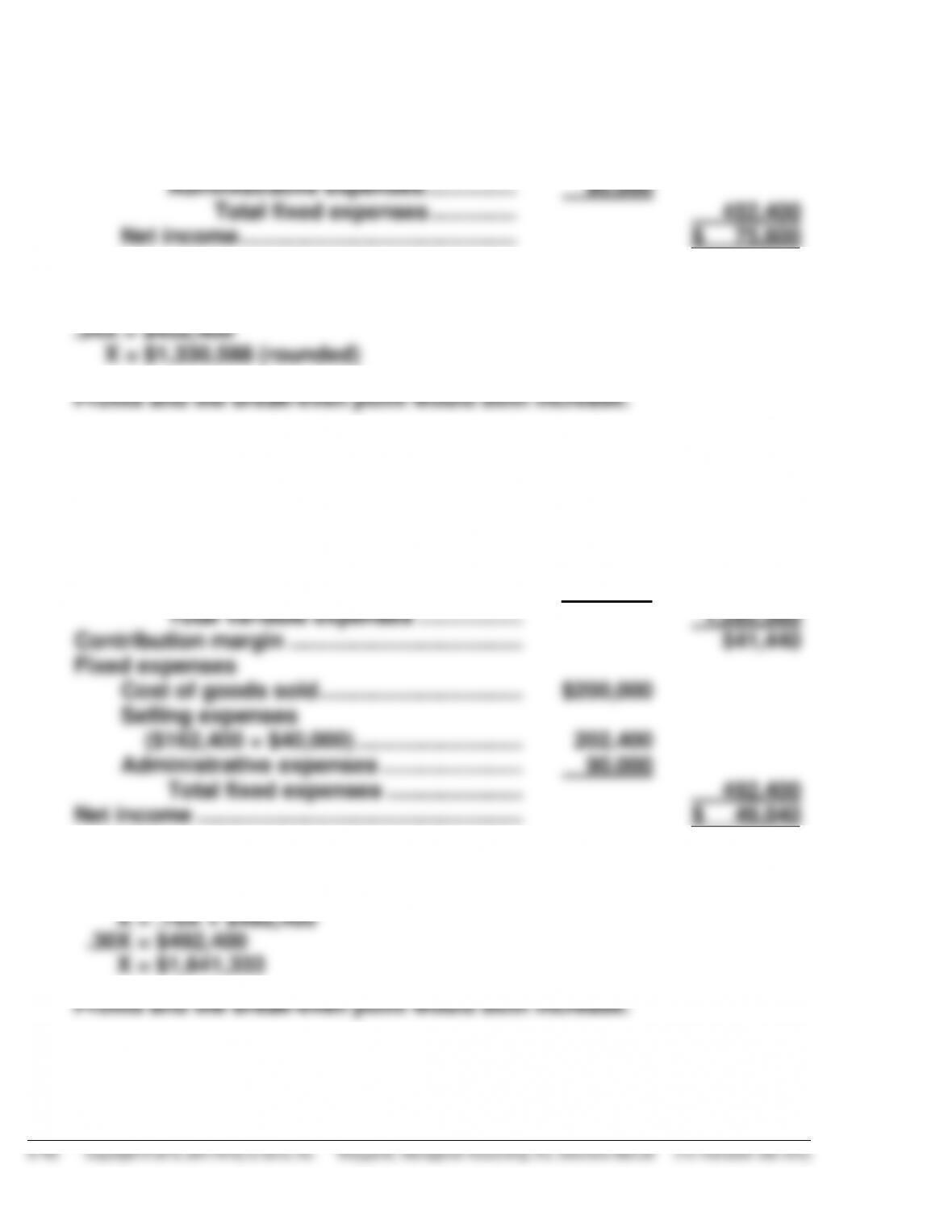
Fixed expenses
Cost of goods sold …………………… $200,000
Selling expenses ………………………. 162,400
X = ($1,047,000 ÷ $1,575,000)X + $452,400
X = .66X + $452,400
(c) Sales [384,000 (1) X ($5.00 – $.25)] …………… $1,824,000
Variable expenses
Cost of goods sold
(384,000 X $2.50) …………………………... $960,000
Selling expenses (384,000 X $.59) ……… 226,560
Administrative expenses
(384,000 X $.25) ……………………………. 96,000
(1) Sales volume = 240,000 X 160% = 384,000
X = ($1,282,560 ÷ $1,824,000)X + $492,400
(d) Peri’s plan should be accepted. It produces a higher net income and
a lower break-even point than Paul’s plan.
BYP 5-4 REAL-WORLD FOCUS
reduce other costs.
(b) This description makes the marketing expenditures sound like they are
a variable cost, since it suggests that they vary with the amount of units
sold. However, unlike variable costs, the relationship of marketing costs
is not directly proportional to sales, since other factors also influence
(c) The first measure, gallon shipments of concentrates and syrups, is the
activity index, since it best reflects the company’s production and sales
activity at the wholesale level, its primary line of business. The second
measure, unit cases of finished product, indicates the amount of
BYP 5-5 REAL-WORLD FOCUS
in an e-book environment.
(b) Barnes and Noble’s big advantage (which enabled it to put lots of
small independent book sellers out of business), was that each of its
(c) The authors say that the arrival of Apple’s iPad has huge implications
can dramatically reduce their fixed costs.
(e) Barnes and Noble was one of the first companies to have an e-reader,
called the Rocket e-book. However, it abandoned its e-reader in 2003
because sales of e-books had been very low. Four years later Amazon
BYP 5-6 COMMUNICATION ACTIVITY
To: My Roommate
From: Your Roommate
Subject: Cost-Volume-Profit Questions
(a) The mathematical formula for break-even sales is:
Break-even Sales = Variable Costs + Fixed Costs
Break-even sales in dollars is found by expressing variable costs as a
be in sales dollars.
Break-even sales in units is found by using unit selling price and unit
variable costs in the formula. For example, if the selling price is $300
ratio differ as shown below:
Unit Selling Price – Unit Variable Costs = Contribution Margin per Unit
Contribution Margin per Unit ÷ Unit Selling Price = Contribution Margin Ratio
(c) When contribution margin is used to determine break-even sales, total
fixed costs are divided by either the contribution margin ratio or contri–

BYP 5-6 (Continued)
The formula for determining break-even sales in dollars is:
Fixed Costs ÷ Contribution Margin Ratio = Break-even Sales in Dollars
I hope this memo answers your questions.
BYP 5-7 ETHICS CASE
(a) The stakeholders in this situation are:
Scott Bestor, accountant of Westfield Company.
The dislocated personnel of Westfield.
The senior management who made the decision.
management with inaccurate data.
(c) Scott’s alternatives are:
Keep quiet.
Confess his mistake to management.
BYP 5-8 ALL ABOUT YOU
traditional car would be $0.12 ($3.60/30).
(b) The savings per mile of driving the hybrid vehicle would be $0.03
($0.12 – $0.09).
(c) In order to break even on your investment, you would need to drive
(d) There are many other factors that you would want to consider in your
analysis. For example, do the vehicles differ in their expected repair
bills, insurance costs, licensing fees, or ultimate resale value. Also, some