PROBLEM 5-1B
(a)
Variable costs (per haircut)
Fixed costs (per month)
Barbers’ commission $3.00
Rent .60
Barber supplies .40
Total variable $4.00
Barbers’ salaries $7,500*
Rent 700
Depreciation 400
Utilities 300
Advertising 100
Total fixed $9,000
*($1,500 X 3) + $3,000
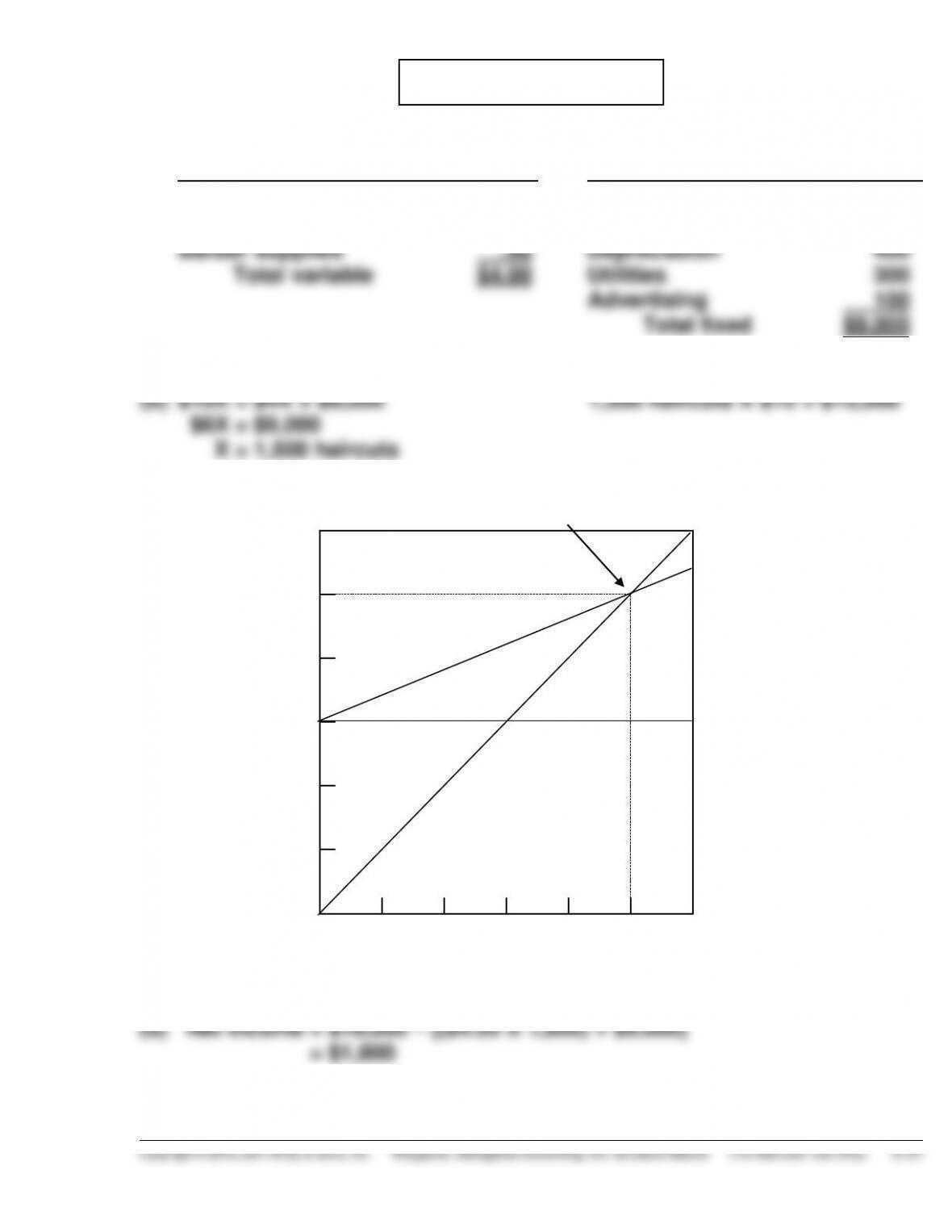
(b)
$10X = $4X + $9,000
$6X = $9,000
X = 1,500 haircuts
1,500 haircuts X $10 = $15,000
(c)
18
Break-even Point
Sales Line
DOLLARS (000)
15
Total Cost Line
12
9
Fixed Cost Line
6
3
300
600
900
1,200
1,500
1,800
Number of Haircuts
PROBLEM 5-2B
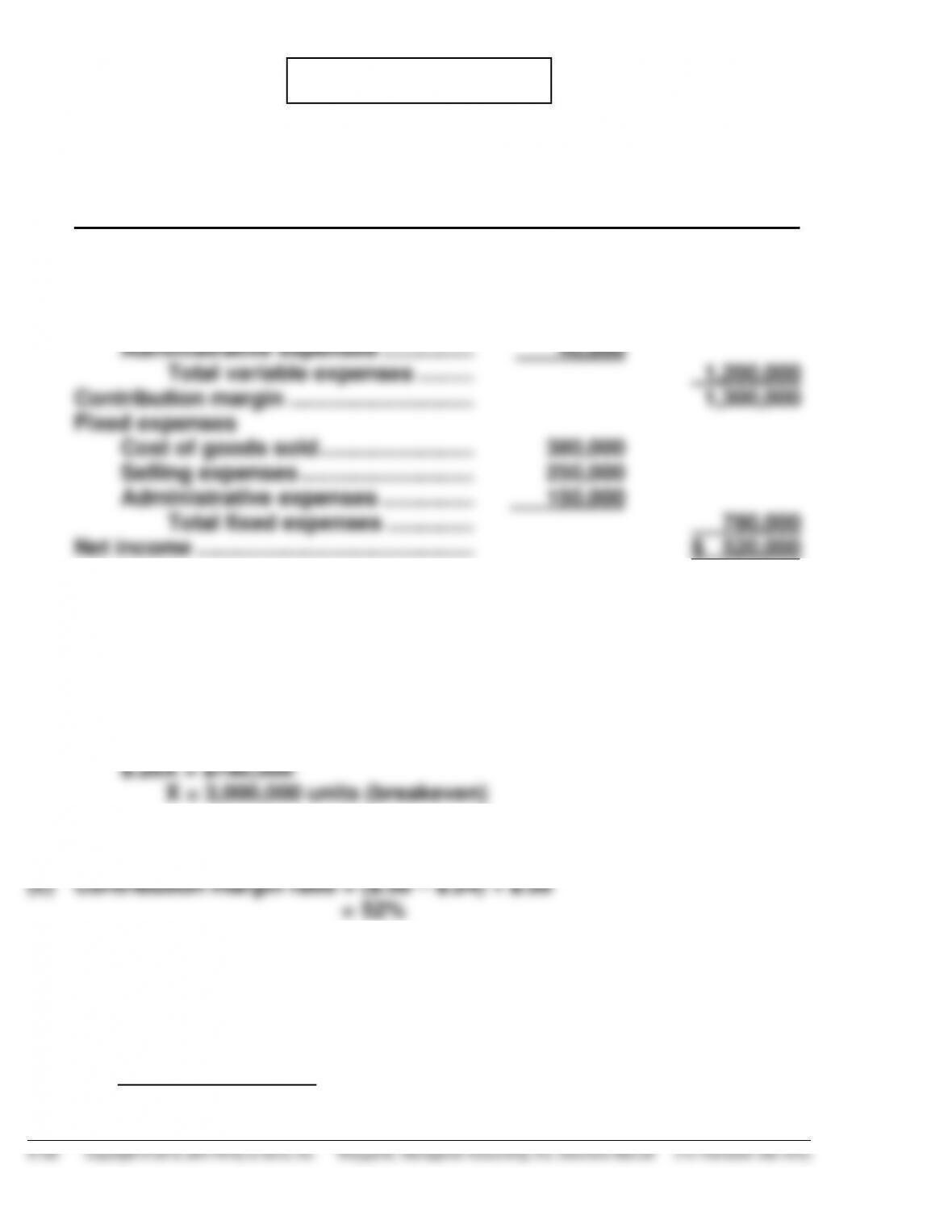
(a) ALL FRUTE COMPANY
CVP Income Statement (Estimated)
For the Year Ending December 31, 2014
Sales ………………………………………………. $2,500,000
Variable expenses
Cost of goods sold ……………………. $1,080,000 (1)
Selling expenses ………………………. 80,000
(1) Direct materials $360,000 + direct labor $450,000 + variable manufac-
turing overhead $270,000.
(b) Variable costs = 48% of sales ($1,200,000 ÷ $2,500,000) or $.24 per
bottle ($.50 X 48%). Total fixed costs = $780,000.
1. $.50X = $.24X + $780,000
2. 3,000,000 X $.50 = $1,500,000
Margin of safety ratio = ($2,500,000 – $1,500,000) ÷ $2,500,000
= 40%
(d) Required sales
X =
$780,000 + $624,000
.52
= $2,700,000
PROBLEM 5-3B
(a) Sales were $1,800,000 and variable expenses were $1,170,000, which
$840,000
.35
to $37.50 ($30 X 125%). Total sales become $2,250,000 (60,000 X
$37.50). Thus, the contribution margin ratio changes to 48%
.48
$660,000 ($840,000 – $180,000) and to change the contribution margin
.30
3. The effects of this alternative are: (1) variable and fixed cost of
goods sold become $675,000 each, (2) total variable costs become
$915,000 ($675,000 + $125,000 + $115,000), and (3) total fixed costs
Alternative 1 is the recommended course of action using breakeven
PROBLEM 5-4B
(a) Current break-even point: $30X = $12X + $216,000
(where X = pairs of shoes)
New break-even point: $27X = $12X + ($216,000 + $18,000)
(b) Current margin of safety ratio =
(20,000 X $30) – (12,000 X $30)
(20,000 X $30)
= 40%
New margin of safety ratio =
(24,000 X $27)* – (15,600 X $27)
(24,000 X $27)
= 35%
*$30 X $90
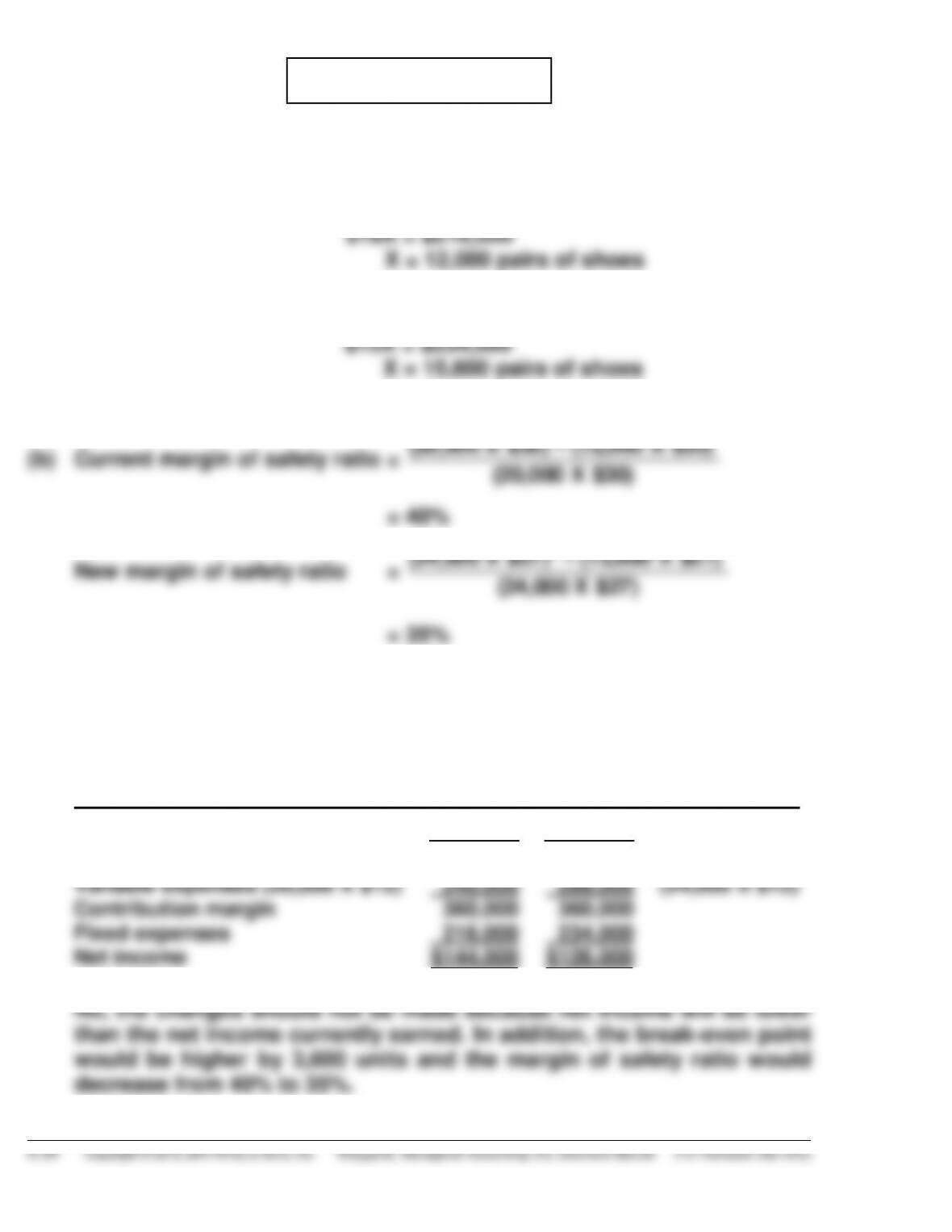
(c) COSTLESS SHOE STORE
CVP Income Statement
Current
New
Sales (20,000 X $30)
Variable expenses (20,000 X $12)
Contribution margin
Fixed expenses
Net income
$600,000
240,000
360,000
216,000
$144,000
$648,000
288,000
360,000
234,000
$126,000
(24,000 X $27)
(24,000 X $12)
PROBLEM 5-5B
(a)
(1)
Current Year
Sales
Variable costs
Direct materials
Direct labor
Manufacturing overhead ($480,000 X .40)
Selling expenses ($400,000 X .30)
Administrative expenses ($484,000 X .50)
Total variable costs
Contribution margin
$1,800,000
456,000
250,000
192,000
120,000
242,000
1,260,000
$ 540,000
Current Year
Projected Year
Sales
Variable costs
Direct materials
Direct labor
Manufacturing overhead
Selling expenses
Administrative expenses
Total variable costs
Contribution margin
$1,800,000
456,000
250,000
192,000
120,000
242,000
1,260,000
$ 540,000
X 1.2
X 1.2
X 1.2
X 1.2
X 1.2
X 1.2
X 1.2
X 1.2
$2,160,000
547,200
300,000
230,400
144,000
290,400
1,512,000
$ 648,000
(2)
Current
Projected
Fixed Costs
Year
Year
Manufacturing overhead ($480,000 X .60)
Selling expenses ($400,000 X .70)
Administrative expenses ($484,000 X .50)
Total fixed costs
$288,000
280,000
242,000
$810,000
$288,000
280,000
242,000
$810,000
PROBLEM 5-5B (Continued)
(b) Unit selling price = $1,800,000 ÷ 100,000 = $18.00
Break-even point in units
=
Fixed costs
÷
Unit contribution margin
150,000 units
=
$810,000
÷
$5.40
Break-even point in dollars
=
Fixed costs
÷
Contribution margin ratio
$2,700,000
=
$810,000
÷
.30
(c) Sales dollars
required for
=
(Fixed costs
+
Target net income)
÷
Contribution margin ratio
target net income
$3,410,000
=
($810,000
+
$213,000)
÷
.30
(d) Margin of safety
ratio
=
(Expected sales
–
Break-even sales)
÷
Expected sales
21*%
=
($3,410,000
–
$2,700,000)
÷
3,410,000
*(Rounded)
(e)
(1)
Sales
Variable costs
Direct materials
Direct labor ($250,000 – $100,000)
Manufacturing overhead ($480,000 X .10)
Selling expenses ($400,000 X .80)
Administrative expenses ($484,000 X .50)
Total variable costs
Contribution margin
$1,800,000
456,000
150,000
48,000
320,000
242,000
1,216,000
$ 584,000
PROBLEM 5-5B (Continued)
(3) Break-even point in dollars = $754,000 ÷ .32 = $2,356,250
Fixed costs
Manufacturing overhead ($480,000 X .90)
Selling expenses ($400,000 X .20)
Administrative expenses ($484,000 X .50)
Total fixed costs
$432,000
80,000
242,000
$754,000
contrast, the purchase of the new equipment increased the company’s
fixed costs (by increasing its equipment depreciation) and reduced its
variable direct labor cost, both of which would increase the break-even
point.
PROBLEM 5-6B
(a) 1. Let variable selling and administrative expenses = VSA
2. Let fixed manufacturing overhead = FMO
Sales – Variable cost of goods sold – FMO = Gross profit
3. Let fixed selling and administrative expenses = FSA
$180,000 = FSA + $100,000
FSA = $80,000
(b) Incremental sales = $2,000,000 X 15% = $300,000
expenditure is increased.
BYP 5-1 DECISION-MAKING AT CURRENT DESIGNS
(a) $250 + $100 + $170 + $420 + $400 = $1,340 total variable costs
(d) ($359,700 + $270,600) ÷ $660 = 955 units
(e) Actual (expected) sales = $2,000 X 1,000 = $2,000,000