EXERCISE 5-14
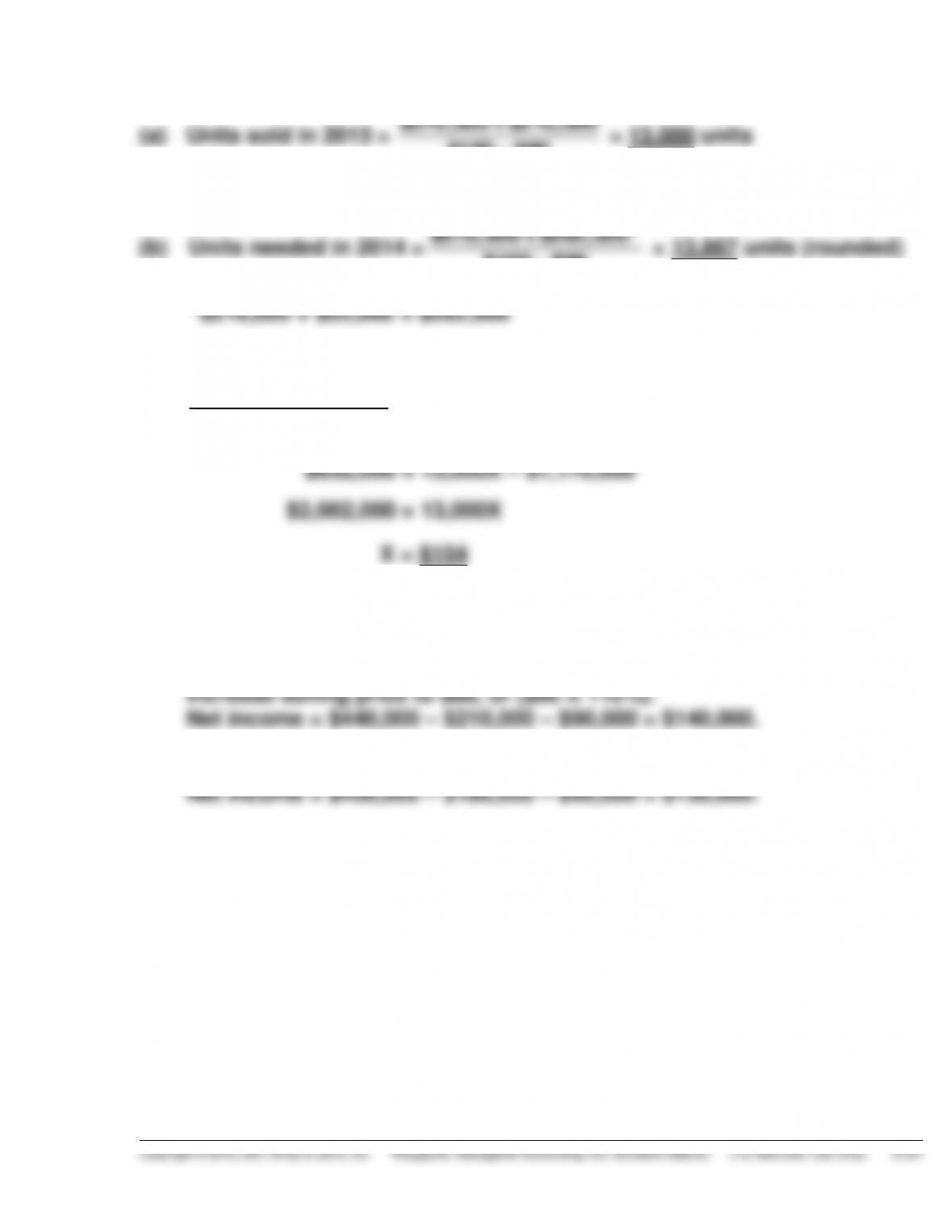
(a) Units sold in 2013 =
$570,000 +$210,000
$150 –$90
= 13,000 units
(b) Units needed in 2014 =
$570,000 + $262,000 *
$150 –$90
= 13,867 units (rounded)
(c)
$570,000 +$262,000
X –$90
= 13,000 units, where X = new selling price
EXERCISE 5-15
1. Unit sales price = $400,000 ÷ 5,000 units = $80
2. Reduce variable costs to 45% of sales.
Alternative 1, increasing selling price, will produce the highest net income.
EXERCISE 5-16
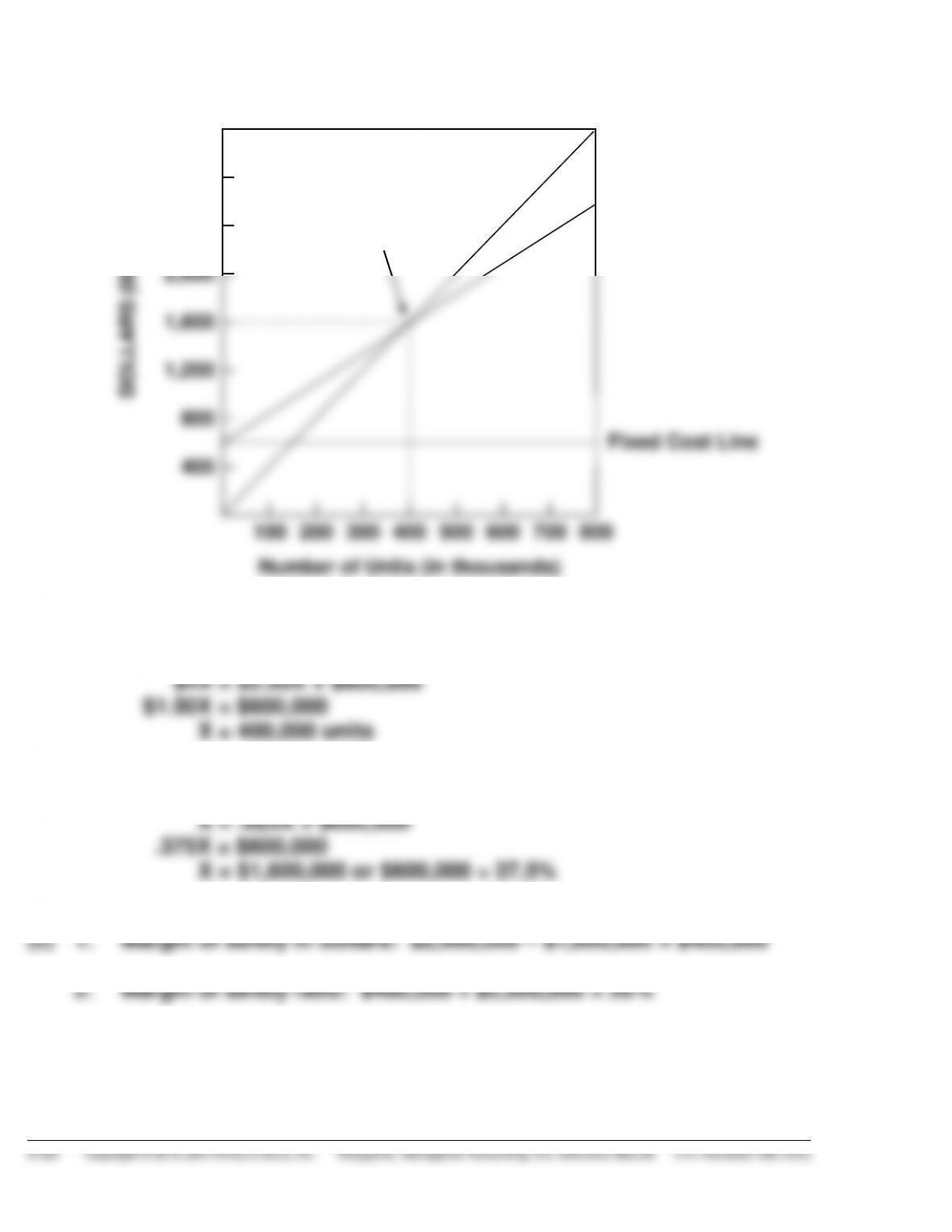
(a)
$3,200
Sales Line
DOLLARS (000)
2,800
2,400
Total Cost Line
Break-even Point
2,000
1,600
1,200
800
Fixed Cost Line
400
100
200
300
400
500
600
700
800
Number of Units (in thousands)
(b) 1. Break-even sales in units:
2. Break-even sales in dollars:
EXERCISE 5-17
(a) Contribution ratio = Contribution margin ÷ Sales
(d) Current contribution margin $40 – $16 = $24
SOLUTIONS TO PROBLEMS
PROBLEM 5-1A
(a)
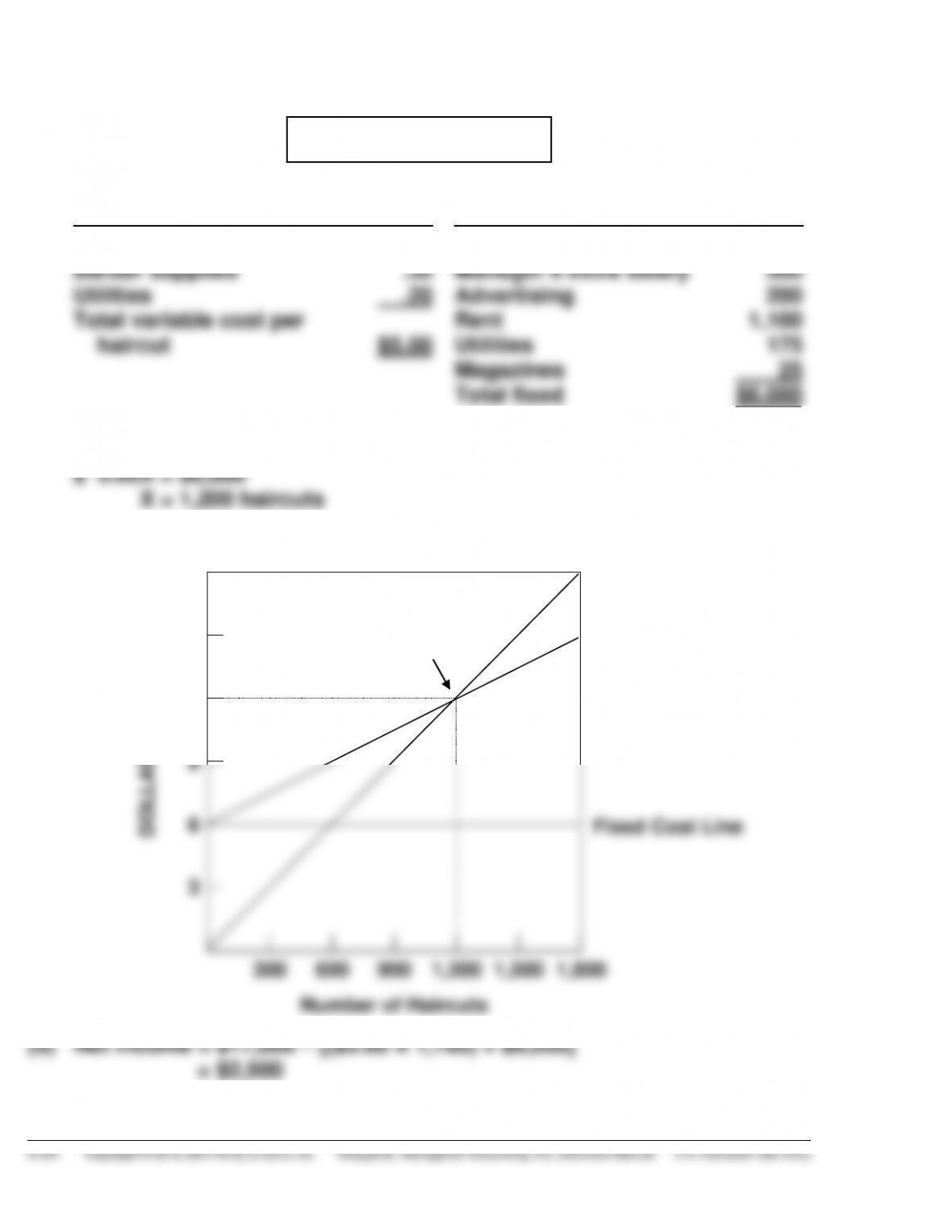
Variable costs (per haircut)
Fixed costs (per month)
Barbers’ commission $4.50
Barber supplies .30
Utilities .20
Total variable cost per
haircut $5.00
Barbers’ salaries $4,000
Manager’s extra salary 500
Advertising 200
Rent 1,100
Utilities 175
Magazines 25
Total fixed $6,000
(b)
$10.00X = $5.00X + $6,000
$ 5.00X = $6,000
X = 1,200 haircuts
1,200 haircuts X $10 = $12,000
(c)
18
Sales Line
DOLLARS (000)
15
Total Cost Line
Break-even Point
12
9
Fixed Cost Line
6
3
300
600
900
1,200
1,500
1,800
Number of Haircuts
PROBLEM 5-2A
(a) JORGE COMPANY
CVP Income Statement (Estimated)
For the Year Ending December 31, 2014
Sales …………………………………………………….. $1,800,000
Variable expenses
Cost of goods sold ………………………….. $1,170,000 *
Selling expenses …………………………….. 70,000
(b) Variable costs = 70% of sales ($1,260,000 ÷ $1,800,000) or $.35 per
bottle ($.50 X 70%). Total fixed costs = $405,000.
1. $.50X = $.35X + $405,000
(c) Contribution margin ratio = ($.50 – $.35) ÷ $.50
= 30% (or 1 – .70)
(d) Required sales
X =
$405,000 + $180,000
.30
= $1,950,000
PROBLEM 5-3A
(a) Sales were $2,500,000, variable expenses were $1,700,000 (68% of sales),
and fixed expenses were $900,000. Therefore, the break-even point in
dollars is:
$900,000
.32
= $2,812,500
(b) 1. The effect of this alternative is to increase the selling price per unit
to $6 ($5 X 120%). Total sales become $3,000,000 (500,000 X $6).
.43
2. The effects of this alternative are to change total fixed costs
to $810,000 ($900,000 – $90,000) and to change the contribution
.27
PROBLEM 5-4A
(a) Current break-even point: $40X = $24X + $270,000
New break-even point: $38X = $24X + ($270,000 + $24,000)
(b) Current margin of safety ratio =
(20,000 X $40) –(16,875 X $40)
(20,000 X $40)
(24,000 X $38) – (21,000 X $38)
(24,000 X $38)
(c) BARGAIN SHOE STORE
CVP Income Statement
Current
New
Sales (20,000 X $40)
Variable expenses (20,000 X $24)
Contribution margin
Fixed expenses
Net income
$800,000
480,000
320,000
270,000
$ 50,000
$912,000
576,000
336,000
294,000
$ 42,000
(24,000 X $38)
(24,000 X $24)
changes.
PROBLEM 5-5A
(a)
(1)
Current Year
Sales
Variable costs
Direct materials
Direct labor
Manufacturing overhead ($350,000 X .70)
Selling expenses ($250,000 X .40)
Administrative expenses ($270,000 X .20)
Total variable costs
Contribution margin
$1,500,000
511,000
290,000
245,000
100,000
54,000
1,200,000
$ 300,000
Current Year
Projected Year
Sales
Variable costs
Direct materials
Direct labor
Manufacturing overhead
Selling expenses
Administrative expenses
Total variable costs
Contribution margin
$1,500,000
511,000
290,000
245,000
100,000
54,000
1,200,000
$ 300,000
X 1.1
X 1.1
X 1.1
X 1.1
X 1.1
X 1.1
X 1.1
X 1.1
$1,650,000
562,100
319,000
269,500
110,000
59,400
1,320,000
$ 330,000
(2)
Fixed Costs
Current Year
Projected year
Manufacturing overhead ($350,000 X .30)
Selling expenses ($250,000 X .60)
Administrative expenses ($270,000 X .80)
Total fixed costs
$105,000
150,000
216,000
$471,000
$105,000
150,000
216,000
$471,000
PROBLEM 5-5A (Continued)
(b) Unit selling price = $1,500,000 ÷ 100,000 = $15
Unit variable cost = $1,200,000 ÷ 100,000 = $12
Break-even point in units
=
Fixed costs
÷
Unit contribution margin
157,000 units
=
$471,000
÷
$3
Break-even point in dollars
=
Fixed costs
÷
Contribution margin ratio
$2,355,000
=
$471,000
÷
.20
(c) Sales dollars
required for
=
(Fixed costs
+
Target net income)
÷
Contribution margin ratio
target net
income
$3,355,000
=
($471,000
+
$200,000)
÷
.20
(d) Margin of safety
ratio
=
(Expected sales
–
Break-even sales)
÷
Expected sales
29.8%
=
($3,355,000
–
$2,355,000)
÷
$3,355,000
PROBLEM 5-6A
(a) 1. Let variable selling and administrative expenses = VSA
2. Let fixed manufacturing overhead = FMO
Sales – Variable cost of goods sold – FMO = Gross profit
3. Let fixed selling and administrative expenses = FSA
$195,000 = FSA + $70,000
FSA = $125,000
(b) Incremental sales = $1,200,000 X 25% = $300,000
diture is increased.