PROBLEM 4-4B
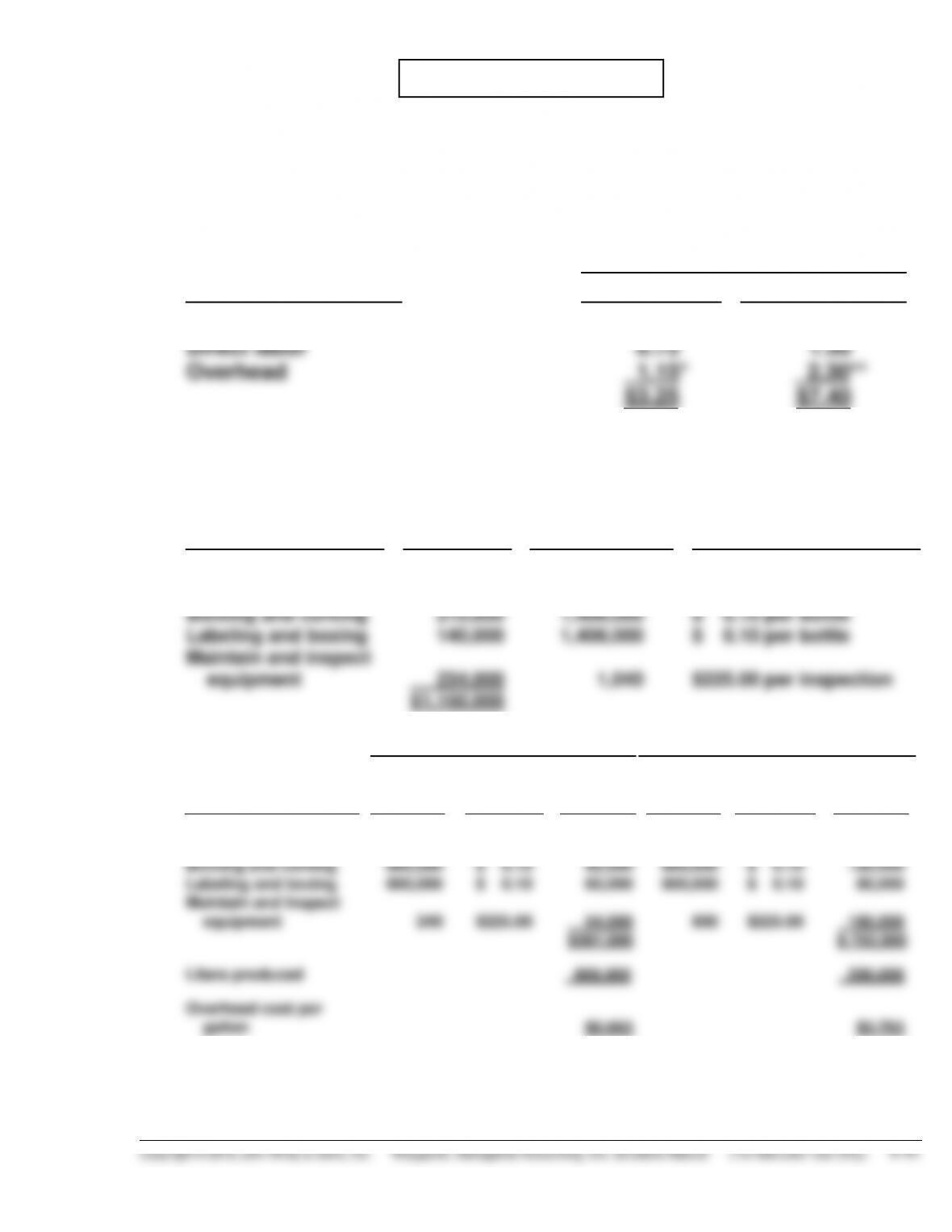
(a) Computation of unit costs—traditional costing
Overhead cost per labor hour is $1,150,000 ÷ (30,000 + 20,000) =$23
Products
Manufacturing Costs
Valley Fresh
Merando Valley
Direct materials
Direct labor
Overhead
$1.35
0.75
1.15*
$3.25
$3.60
1.50
2.30**
$7.40
*$23 X .05 **$23 X .10
(b)
Activity Cost Pools
Estimated
Overhead
Expected Use
of Cost Drivers
Activity-Based
Overhead Rates
Grape processing
Aging
Bottling and corking
Labeling and boxing
Maintain and inspect
equipment
$ 146,000
420,000
210,000
140,000
234,000
$1,150,000
8,000
3,000,000
1,400,000
1,400,000
1,040
$ 18.25 per cart
$ 0.14 per month
$ 0.15 per bottle
$ 0.10 per bottle
$225.00 per inspection
(c)
Valley Fresh
Merando Valley
Activity Cost Pool
Expected
Use of
Drivers
X
Overhead
Rates
=
Cost
Assigned
Expected
Use of
Drivers
X
Overhead
Rates
=
Cost
Assigned
Grape processing
Aging
Bottling and corking
Labeling and boxing
Maintain and inspect
equipment
Total costs assigned (a)
Liters produced (b)
Overhead cost per
gallon [(a) ÷ (b)]
6,000
600,000
600,000
600,000
240
$ 18.25
$ 0.14
$ 0.15
$ 0.10
$225.00
$109,500
84,000
90,000
60,000
54,000
$397,500
600,000
$0.663
2,000
2,400,000
800,000
800,000
800
$ 18.25
$ 0.14
$ 0.15
$ 0.10
$225.00
$ 36,500
336,000
120,000
80,000
180,000
$ 752,500
200,000
$3.763
PROBLEM 4-4B (Continued)
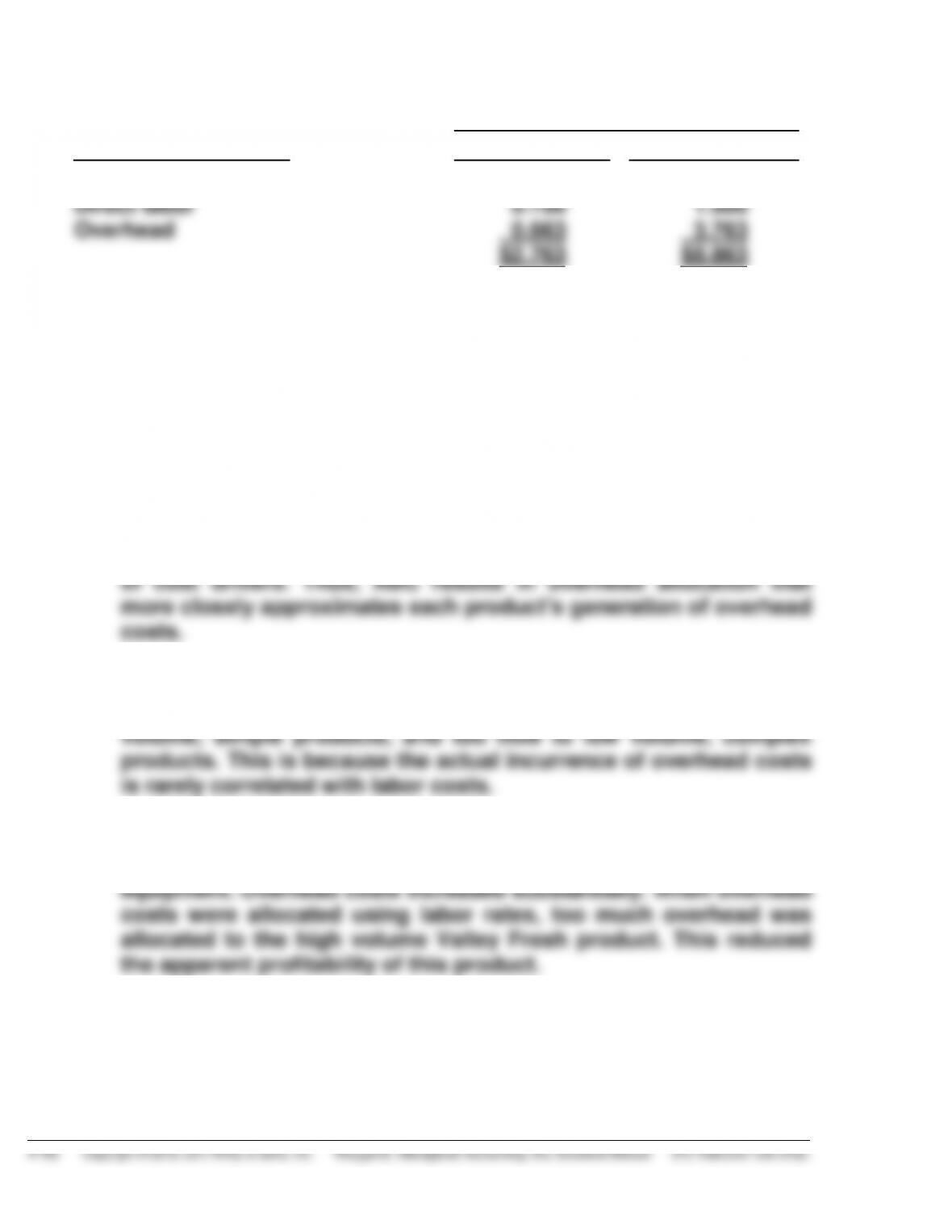
(d)
Products
Manufacturing Costs
Valley Fresh
Merando Valley
Direct materials
Direct labor
Overhead
$1.350
0.750
0.663
$2.763
$3.600
1.500
3.763
$8.863
(e) To: Mr. Frankie Merando
From: Student
Subject: Product costs using traditional approach versus ABC
The memorandum covers the following points:
a. ABC allocates overhead costs as a function of each product’s use
b. Traditional approaches that allocate costs as a function of volume
tend to be biased toward allocating too much overhead to high
c. In the case of the Merando Corporation, the Merando Valley product
required the company to begin using more complex methods and

PROBLEM 4-4B (Continued)
d. The total cost of the two products under the two approaches was
as follows:
Valley Fresh
Merando Valley
Traditional approach
ABC
$3.25
$2.763
$7.40
$8.863
Therefore, the relative profitability of the two products should be
determined using ABC costing.
PROBLEM 4-5B
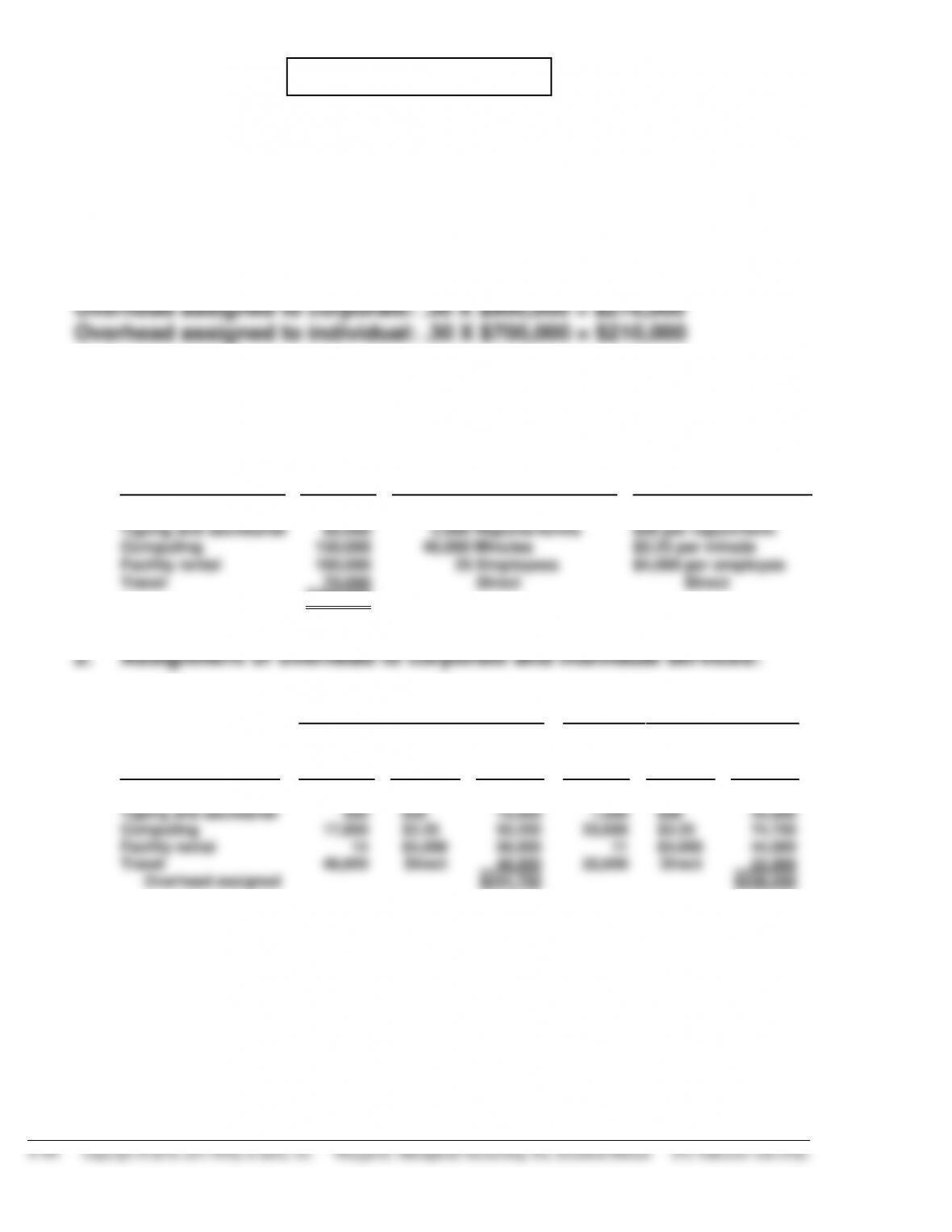
(a) Computation of assigned overhead under traditional costing (“direct
labor dollars” appears in the first line of the schedule of overhead
data):
Predetermined overhead rate X direct labor dollars
(b) 1. Computation of activity-based overhead rates:
Activity Cost Pool
Estimated
Overhead
÷
Total Expected
Use of Cost Drivers
=
Activity-Based
Overhead Rates
Employee training
Typing and secretarial
Computing
Facility rental
Travel
$120,000
60,000
130,000
100,000
70,000
$480,000
$1,600,000 Direct labor dollars
2,000 Reports/forms
40,000 Minutes
25 Employees
Direct
$.075 per DL dollar
$30 per report/form
$3.25 per minute
$4,000 per employee
Direct
Corporate
Individual
Activity Cost Pool
Expected
Use of
Driver
Overhead
Rate
Cost
Assigned
Expected
Use of
Driver
Overhead
Rate
Cost
Assigned
Employee training
Typing and secretarial
Computing
Facility rental
Travel
$900,000
500
17,000
14
48,000
$.075
$30
$3.25
$4,000
Direct
$ 67,500
15,000
55,250
56,000
48,000
$700,000
1,500
23,000
11
22,000
$.075
$30
$3.25
$4,000
Direct
$ 52,500
45,000
74,750
44,000
22,000
Overhead assigned
$241,750
$238,250
PROBLEM 4-5B (Continued)
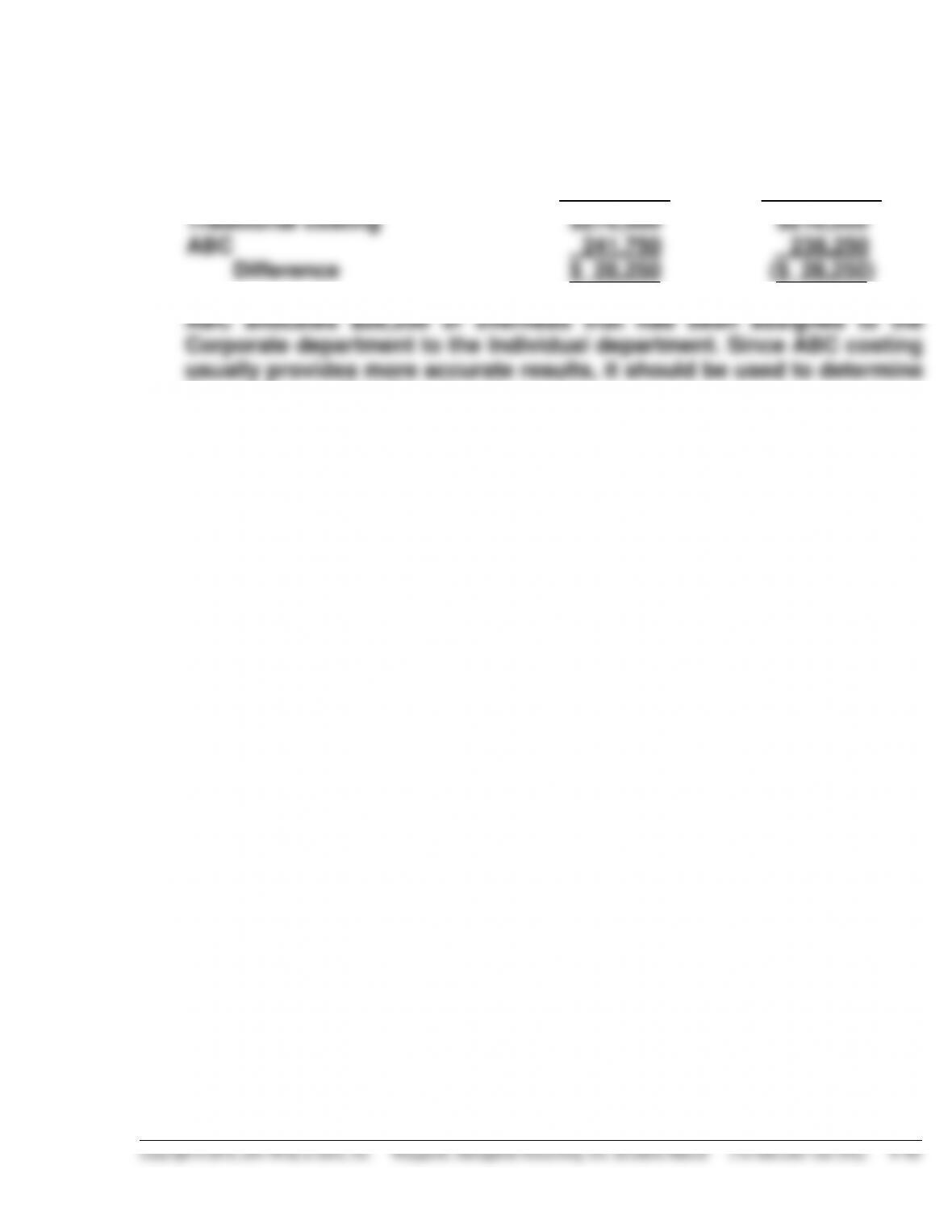
(c) Overhead is assigned to the two service lines as follows:
Corporate
Individual
Traditional costing
ABC
Difference
$270,000
241,750
$ 28,250
$210,000
238,250
($ 28,250)
the relative profitability of each service.
BYP 4-1 DECISION-MAKING AT CURRENT DESIGNS
(a)
Composite
Rotomolded
Directly assigned
$ 28,000
$ 40,000
Remaining amount ($832,000) allocated
50% to each product line
$416,000
$416,000
Total
$444,000
$456,000
Number of units
1,000
4,000
Cost assigned per unit
$ 444.00
$ 114.00
(b)
Composite
Rotomolded
Directly assigned
$ 28,000
$ 40,000
Remaining amount ($832,000) allocated
based on direct labor costs
$374,400*
$457,600**
Total
$402,400
$497,600
Number of units
1,000
4,000
Cost assigned per unit
$ 402.40
$ 124.40
*Overhead rate = $832,000 ÷ ($234,000 + $286,000) = $160% of direct
labor cost
BYP 4-1 (Continued)
(c)
Activity Cost
Pools
Estimated
Overhead
Expected Use of
Cost Drivers
Activity-Based
Overhead Rates
Design
$121,100
4
$30,275 per model
Prototypes
152,000
8
$19,000 per prototype
Molds
188,500
13
$14,500 per mold
Supervision
180,000
24
$7,500 per employee
Curing time
190,400
17,000
$11.20 per day
Activity Cost
Pool
Composite
Rotomolded
Expected
Use of
Drivers
Overhead
Rates
Cost
Assigned
Expected
Use of
Drivers
Overhead
Rates
Cost
Assigned
Design
3
$30,275
$ 90,825
1
$30,275
$ 30,275
Prototypes
6
$19,000
114,000
2
$19,000
38,000
Molds
12
$14,500
174,000
1
$14,500
14,500
Supervision
12
$ 7,500
90,000
12
$ 7,500
90,000
Curing time
15,000
$ 11.20
168,000
2,000
$ 11.20
22,400
Total amount
allocated
636.825
195,175
Directly
assigned
28,000
40,000
Total cost (a)
$664,825
$235,175
Number of
units (b)
÷ 1,000
÷ 4,000
Cost
assigned per
unit (a) ÷ (b)
$ 664.83
$ 58.79
(d) Activity based costing assigns significantly more costs to the composite
kayaks. Since the cost is divided into pools and each pool is allocated
BYP 4-2 DECISION-MAKING ACROSS THE ORGANIZATION
(a) Activities
(b) Cost Drivers
Laundering
Housekeeping
Dietary
Computing information
technology
Nursing care
Surgery
Clinical lab
Imaging (X-ray, etc.)
Pharmacy
Emergency room
Maintenance
Billing and collecting
Pounds of linen
Square footage; number of beds
Number of meals
Minutes of computer usage; or number of
work stations
Number of patients
Number of procedures or operations
Number of tests
Number of images
Number of prescriptions
Number of cases or patients
Square footage
Number of invoices
BYP 4-3 MANAGERIAL ANALYSIS
(a) Computation of activity-based overhead rate:
Activity Cost Pools
Total
Estimated
Overhead
÷
Expected Use of
Cost Drivers
Per Activity
=
Activity-Based
Overhead Rates
Market analysis
Product design
Product development
Prototype testing
$1,050,000
2,350,000
3,600,000
1,400,000
15,000 Hours
2,500 Designs
90 Products
500 Tests
$ 70 per hour
$ 940 per design
$40,000 per product
$ 2,800 per test
(b) Charges to in-house manufacturing department:
In-House Manufacturing Department
Activity Cost Pools
Cost Drivers Used
X
Activity-Based
Overhead Rates
=
Cost Assigned
Market analysis
Product design
Product development
Prototype testing
1,800 Hours
280 Designs
10 Products
92 Tests
$ 70
$ 940
$40,000
$ 2,800
$ 126,000
263,200
400,000
257,600
Total overhead assigned
$1,046,800
(c) Charges to outside R & D contractor:
Outside Contract Costs
Activity Cost Pools
Cost Drivers Used
X
Activity-Based
Overhead Rates
=
Cost Assigned
Market analysis
Product design
Product development
Prototype testing
800 Hours
178 Designs
3 Products
70 Tests
$ 70
$ 940
$40,000
$ 2,800
$ 56,000
167,320
120,000
196,000
Total overhead assigned
$539,320