EXERCISE 4-10
1. Number of engineering change orders; hours of designing
2. Number of orders processed
3. Number of parts in stock
4. Weight of material; number of boxes or cartons
EXERCISE 4-11
(a) The overhead rates are:
Activity Cost Pools
Estimated
Overhead
÷
Expected Use
of Cost Drivers
per Activity
=
Activity-Based
Overhead Rates
Materials handling
Machine setups
Quality inspections
$40,000
27,500
27,000
1,000
500
600
$40
55
45
(b) The assignment of the overhead costs to products is as follows:
Instruments
Gauges
Cost
Assigned
Cost Driver
Number
Cost
Number
Cost
Requisitions ($40)
Machine setups ($55)
Inspections ($45)
Total costs
assigned (a)
Units produced (b)
400
200
200
$16,000
11,000
9,000
$36,000
50
600
300
400
$24,000
16,500
18,000
$58,500
300
$40,000
27,500
27,000
$94,500
Overhead cost per
Unit (a) ÷ (b)
$ 720
$ 195
EXERCISE 4-11 (Continued)
(c) MEMO
To: President, Major Instrument, Inc.
From: Student
Re: Benefits of activity-based costing (ABC)
The primary benefit of ABC is more accurate and meaningful product
costing. This improved cost data can lead to reduced costs as managers
a product.
EXERCISE 4-12
(a) (1) Traditional product costing system:
(2) Activity-based costing system:
Activity Cost Pools
Cost Drivers
Used
X
Activity-
Based
Overhead
Rates
=
Overhead Cost
Assigned
Sales commissions
Advertising—TV/Radio
Advertising—Newspaper
Catalogs
Cost of catalog sales
Credit and collection
Total assigned cost for March
$900,000
250
2,000
60,000
9,000
$900,000
$.05
$300
$10
$2.50
$1.00
$.03
$ 45,000
75,000
20,000
150,000
9,000
27,000
$326,000
understatement.
(c) All six activities, as selling activities, are non-value-added activities.
EXERCISE 4-13
(a) 1. Traditional product costing system:
2. Activity-based costing system:
Activity Cost Pools
Cost Drivers
Used
X
Activity-
Based
Overhead
Rate
=
Overhead Cost
Assigned
Inspections of material received
In-process inspections
FDA certification
Total assigned cost for June
6,000
10,000
420
$ .80
$ .33
$12.00
$ 4,800
3,300
5,040
$13,140
a 15.9% understatement.
(c) All three activities, as quality-control related activities, are non-value-
added activities.
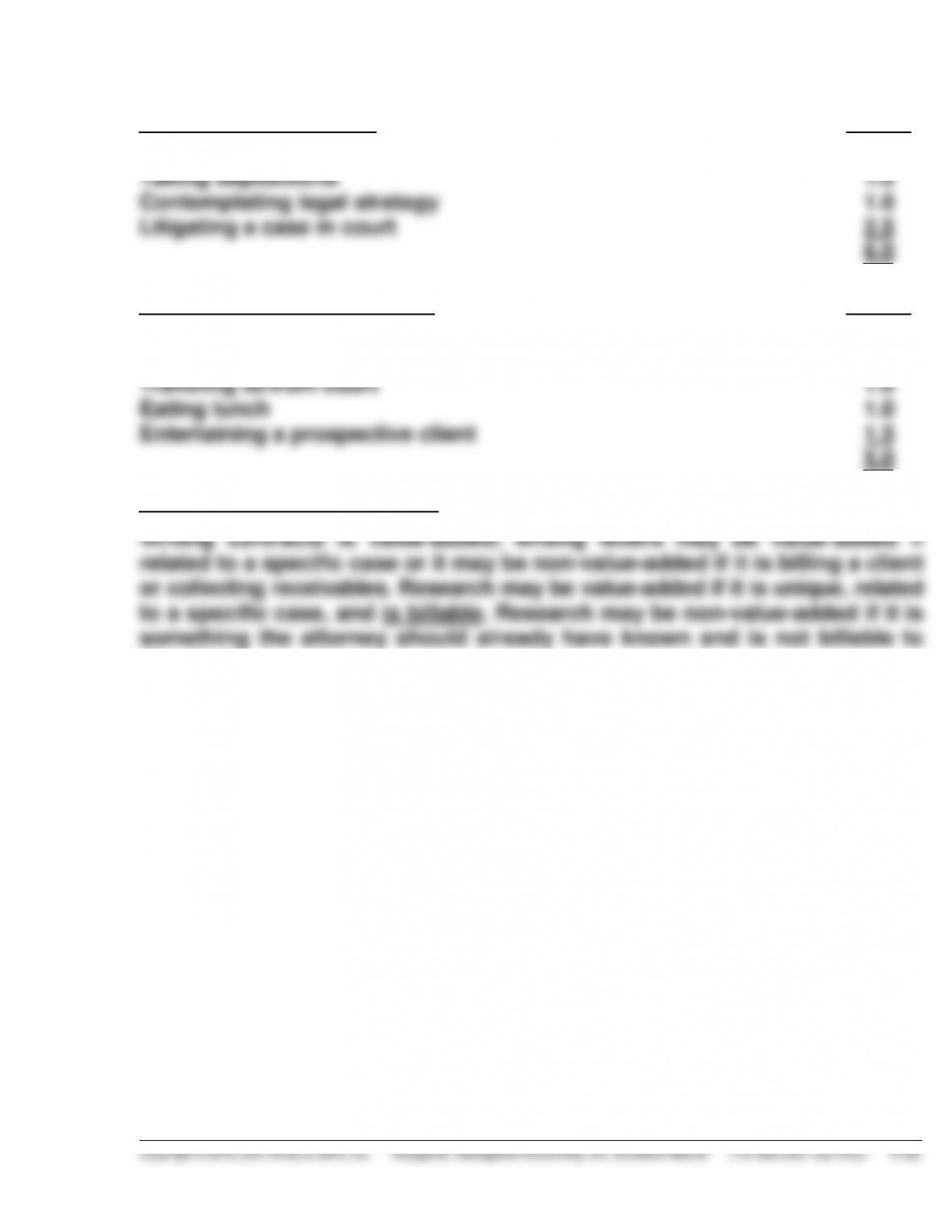
EXERCISE 4-14
Value-Added Activities
Hours
Writing contracts and letters
Taking depositions
Contemplating legal strategy
Litigating a case in court
1.5
1.0
1.0
2.5
6.0
Non-Value-Added Activities
Hours
Attending staff meetings
Doing research
Traveling to/from court
Eating lunch
Entertaining a prospective client
0.5
1.0
1.0
1.0
1.5
5.0
Questionable Classifications
the client.
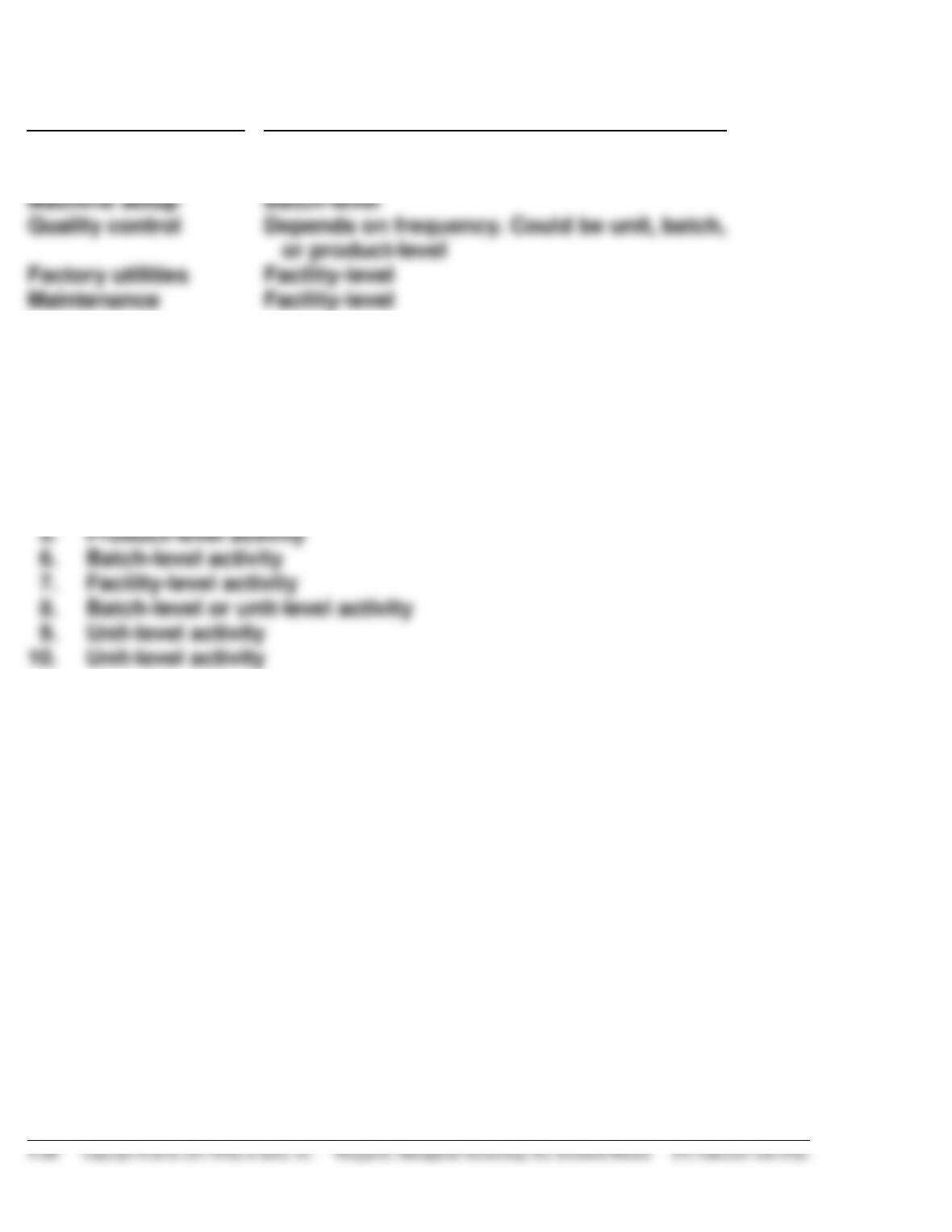
EXERCISE 4-15
Activity Cost Pools
Activity Level
Engineering
Machinery
Machine setup
Quality control
Factory utilities
Maintenance
Product-level
Unit-level
Batch-level
Depends on frequency. Could be unit, batch,
or product-level
Facility-level
Facility-level
EXERCISE 4-16
1. Facility-level activity
2. Product-level activity
3. Batch-level activity
4. Product-level activity
SOLUTIONS TO PROBLEMS
PROBLEM 4-1A
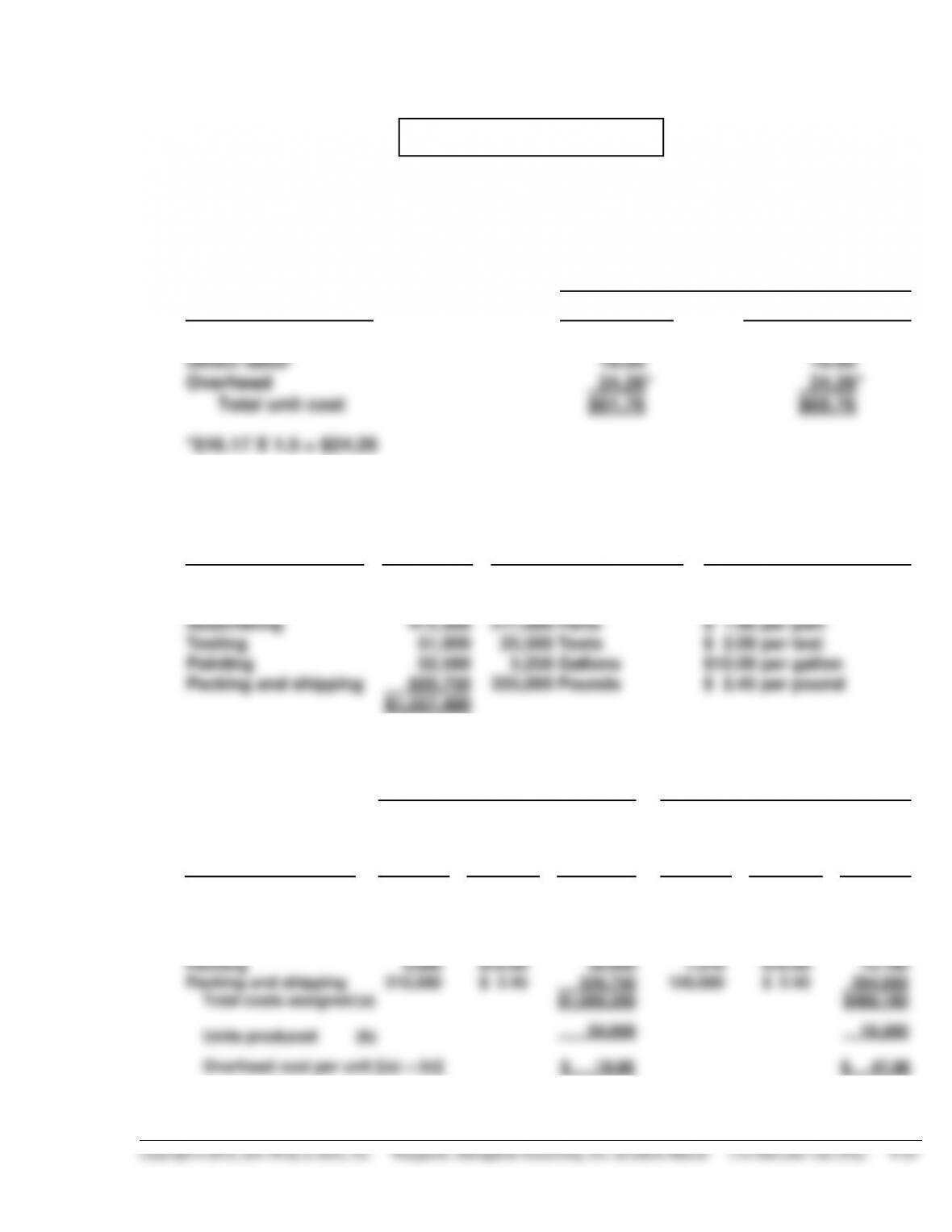
(a) Computation of unit costs—traditional costing.
Products
Manufacturing Costs
Home Model
Commercial Model
Direct materials
Direct labor
Overhead
Total unit cost
$18.50
19.00
* 24.26*
$61.76
$26.50
19.00
* 24.26*
$69.76
*$16.17 X 1.5 = $24.26
(b)
Activity Cost Pool
Estimated
Overhead
÷
Expected
Use of Cost Drivers
=
Activity-Based
Overhead Rate
Receiving
Forming
Assembling
Testing
Painting
Packing and shipping
$ 70,350
150,500
412,300
51,000
52,580
820,750
$1,557,480
335,000 Pounds
35,000 Machine hours
217,000 Parts
25,500 Tests
5,258 Gallons
335,000 Pounds
$ .21 per pound
$ 4.30 per machine hour
$ 1.90 per part
$ 2.00 per test
$10.00 per gallon
$ 2.45 per pound
(c)
Home Model
Commercial Model
Activity Cost Pool
Expected
Use of
Drivers
X
Activity-
Based
Overhead
Rates
=
Cost
Assigned
Expected
Use of
Drivers
X
Activity-
Based
Overhead
Rates
=
Cost
Assigned
Receiving
Forming
Assembling
Testing
Painting
Packing and shipping
Total costs assigned
Units produced
(a)
(b)
215,000
27,000
165,000
15,500
3,680
215,000
$ .21
$ 4.30
$ 1.90
$ 2.00
$10.00
$ 2.45
$ 45,150
116,100
313,500
31,000
36,800
526,750
$1,069,300
54,000
120,000
8,000
52,000
10,000
1,578
120,000
$ .21
$ 4.30
$ 1.90
$ 2.00
$10.00
$ 2.45
$ 25,200
34,400
98,800
20,000
15,780
294,000
$488,180
10,200
Overhead cost per unit [(a) ÷ (b)]
$ 19.80
$ 47.86
PROBLEM 4-1A (Continued)
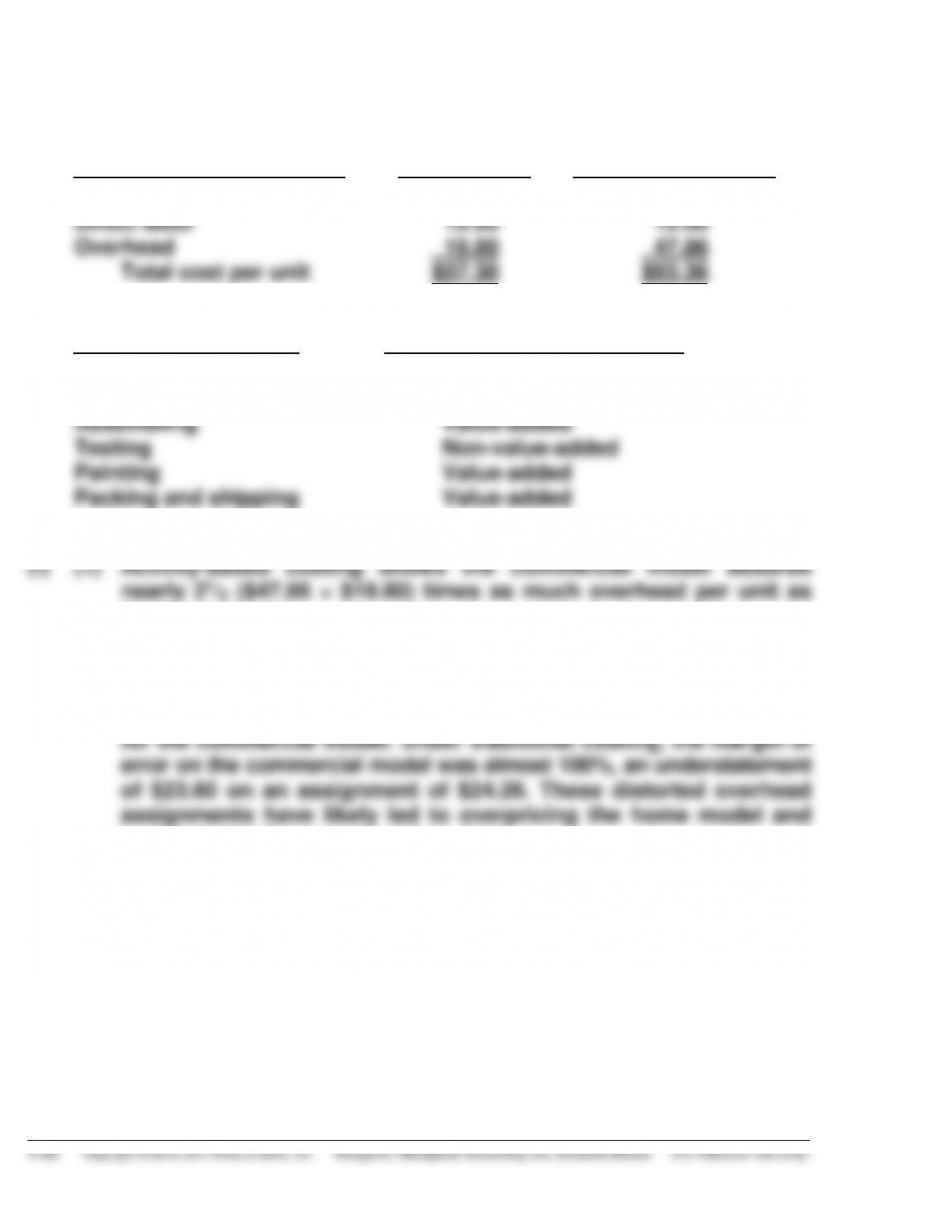
(d)
ABC Manufacturing Costs
Home Model
Commercial Model
Direct materials
Direct labor
Overhead
Total cost per unit
$18.50
19.00
19.80
$57.30
$26.50
19.00
47.86
$93.36
(e)
Activity
Value- vs. Non-Value-Added
Receiving
Forming
Assembling
Testing
Painting
Packing and shipping
Non-value-added
Value-added
Value-added
Non-value-added
Value-added
Value-added
the home model.
(2) The comparison of ABC and traditional costing shows that the
proper amount of overhead assigned to the two products is not
equal at $24.26 but rather $19.80 for the home model and $47.86
underpricing the commercial model.
PROBLEM 4-2A
costing is as follows:
Royale
Majestic
Overhead Rate
Drivers
Used
Cost
Assigned
Drivers
Used
Cost
Assigned
Total
Overhead
Purchase orders @ $30
Machine setups @ $50
Machine hours @ $40
Inspections @ $25
Total assigned costs (a)
Units produced (b)
Cost per unit (a) ÷ (b)
17,000
5,000
75,000
11,000
$ 510,000
250,000
3,000,000
275,000
$4,035,000
25,000
$ 161.40
23,000
13,000
45,000
17,000
$ 690,000
650,000
1,800,000
425,000
$3,565,000
10,000
$ 356.50
$1,200,000
900,000
4,800,000
700,000
$7,600,000
were:
Royale
Majestic
Direct materials
Direct labor
Manufacturing overhead
Total cost per unit
Sales price per unit
Cost per unit
Gross profit
$ 700.00
120.00
161.40
$ 981.40
$1,600.00
981.40
$ 618.60
$ 420.00
100.00
356.50
$ 876.50
$1,300.00
876.50
$ 423.50
PROBLEM 4-3A
(a) Predetermined overhead rate using machine hours:
$852,000 ÷ 100,000 hrs. = $8.52 per machine hour
Direct materials ……………………………………………………… $ 103,600
Direct labor ……………………………………………………………. 112,000
Computation of Activity-Based Overhead Rates
Activity Cost Pools
Estimated
Overhead
÷
Expected Use of Cost
Drivers per Activity
=
Activity-Based
Overhead Rate
Purchasing
Handling materials
Production
Setting up machines
Inspecting
Inventory control
Utilities
$ 69,000
82,000
210,000
95,000
90,000
126,000
180,000
$852,000
600 Orders
8,000 Moves
100,000 D/L Hours
1,250 Setups
6,000 Inspections
168,000 Components
90,000 Sq. ft.
$115 per order
$10.25 per move
$2.10 per D/L hour
$76 per setup
$15 per inspection
$.75 per component
$2.00 per sq. ft.
Assignment of Overhead to Order of 250 Stairs
Activity Cost Pools
Expected Use of
Cost Drivers
X
Activity-Based
Overhead Rates
=
Cost Assigned
Purchasing
Handling materials
Production
Setting up machines
Inspecting
Inventory control
Utilities
60 Orders
800 Moves
5,000 D/L Hours
100 Setups
450 Inspections
16,000 Components
8,000 Sq. ft.
$115
$10.25
$2.10
$76
$15
$.75
$2.00
$ 6,900
8,200
10,500
7,600
6,750
12,000
16,000
Total overhead assigned
$67,950