CHAPTER 3
Process Costing
ASSIGNMENT CLASSIFICATION TABLE
Learning Objectives
Questions
Brief
Exercises
Do It!
Exercises
A
Problems
B
Problems
* 1. Understand who uses
process cost systems.
1, 2, 20
1
1
* 2. Explain the similarities
and differences between
job order cost and
process cost systems.
2, 3, 4, 5
1
1
* 3. Explain the flow of costs
in a process cost system.
6
3
1A
1B
* 4. Make the journal entries
to assign manufacturing
costs in a process
cost system.
6, 7
1, 2, 3
2
2, 4
1A
1B
* 5. Compute equivalent
units.
10, 11,
12, 13
4, 9
3
3, 5, 6, 7, 8,
9, 10, 11, 13,
14, 15
2A, 3A, 4A,
5A, 6A
2B, 3B, 4B,
5B, 6B
* 6. Explain the four steps
necessary to prepare
a production cost report.
8, 9, 14,
15, 18
5, 6, 7, 8
4
3, 5, 6, 7, 8, 9,
10, 11, 13, 14,
15, 16, 17,
18, 19
2A, 3A,
4A, 5A
2B, 3B,
4B, 5B
* 7. Prepare a production
cost report.
16, 17, 19
11
4
7, 12, 13
2A, 3A, 4A,
5A, 6A
2B, 3B, 4B,
5B, 6B
**8. Compute equivalent units
using the FIFO method.
21, 22
10, 11, 12
16, 17, 18,
19, 20
7A
7B
chapter.

ASSIGNMENT CHARACTERISTICS TABLE
Problem
Number
Description
Difficulty
Level
Time
Allotted (min.)
1A
Journalize transactions.
Moderate
20–30
2A
Complete four steps necessary to prepare a production
cost report.
Simple
30–40
3A
Complete four steps necessary to prepare a production
cost report.
Simple
30–40
4A
Assign costs and prepare production cost report.
Moderate
20–30
5A
Determine equivalent units and unit costs and
assign costs.
Moderate
20–30
6A
Compute equivalent units and complete production
cost report.
Moderate
15–25
*7A*
Determine equivalent units and unit costs and assign
costs for processes; prepare production cost report.
Moderate
30–40
1B
Journalize transactions.
Moderate
20–30
2B
Complete four steps necessary to prepare a production
cost report.
Simple
30–40
3B
Complete four steps necessary to prepare a production
cost report.
Simple
30–40
4B
Assign costs and prepare production cost report.
Moderate
20–30
5B
Determine equivalent units and unit costs and
assign costs.
Moderate
20–30
6B
Compute equivalent units and complete production
cost report.
Moderate
15–25
*7B
Determine equivalent units and unit costs and assign
costs for processes; prepare production cost report.
Moderate
30–40
BLOOM’S TAXONOMY TABLE
Copyright © 2012 John Wiley & Sons, Inc. Weygandt, Managerial Accounting, 6/e, Solutions Manual (For Instructor Use Only) 3-3
systems.
Q3-2
Q3–20
* 2. Explain the similarities and differences
between job order cost and process
cost systems.
Q3-2
Q3-3
Q3-4
Q3-5
E3-1
DI3-1
* 3. Explain the flow of costs in a process
cost system.
Q3-6
E3-3
P3–1A
P3–1B
P3–1A
P3–1B
* 4. Make the journal entries to assign
manufacturing costs in a process
cost system.
Q3-6
Q3-7
BE3-1
BE3-2
BE3-3
DI3-2
E3-2
E3-4
P3–1A
P3–1B
P3–1A
P3–1B
* 5. Compute equivalent units.
Q3–10
Q3–11
Q3–12
Q3–13
BE3-4
BE3-9
DI3-3
E3-3
E3-5
E3-6
E3-7
E3-8
E3-9
E3–10
E3–11
E3–13
E3–14
E3–15
P3–2A
P3–3A
P3–4A
P3-5A
P3-6A
P3–2B
P3–3B
P3–4B
P3–5B
P3–6B
P3–2A
P3–3A
P3–2B
P3–3B
* 6. Explain the four steps necessary
to prepare a production cost report.
Q3-8
Q3-9
Q3–14
Q3–15
Q3–18
BE3-5
BE3-6
BE3-7
BE3-8
DI3-4
E3-3
E3-5
E3-6
E3-7
E3-8
E3-9
E3–10
E3–11
E3–13
E3–14
E3–15
E3–16
E3–17
E3–18
E3–19
P3–2A
P3-3A
P3–4A
P3–5A
P3–2B
P3-3B
P3–4B
P3–5B
P3–2A
P3–3A
P3–2B
P3–3B
* 7. Prepare a production cost report.
Q3–16
Q3–17
Q3–19
BE3-11
DI3-4
E3-7
E3–11
E3–13
P3–2A
P3–3A
P3–4A
P3–5A
P3–6A
P3–2B
P3–3B
P3–4B
P3–5B
P3–6B
*8. Compute equivalent units using the
FIFO method.
Q3–21
Q3–22
BE3-10
BE3-11
BE3-12
E3–16
E3–17
E3–18
E3–19
E3–20
P3–7A
P3–7B
Broadening Your Perspective
BYP3-4
BYP3-1
BYP3-2
BYP3-3
BYP3-7
BYP3-5
BYP3-6

ANSWERS TO QUESTIONS
1. (a) Process cost.
(b) Process cost.
(c) Job order.
(d) Job order.
2. The primary focus of job order cost accounting is on the individual job. In process cost accounting, the
3. The similarities are: (1) all three manufacturing cost elements—direct materials, direct labor, and
4. The features of process cost accounting are: (1) separate work in process accounts for each
5. Sam is correct. The flow of costs is the same in process cost accounting as in job order cost
6. (a) (1) Materials are charged to production on the basis of materials requisition slips.
payroll summaries.
(b) The criterion used in assigning overhead to processes is to identify the activity that “drives” or
7. The entry to assign overhead to production is:
July 31 Work in Process—Machining ……………………………………………. 15,000
Work in Process—Assembly …………………………………………….. 12,000
Manufacturing Overhead …………………………………………… 27,000
8. To prepare a production cost report, four steps are followed: (a) compute the physical unit flow,
reconciliation schedule.
9. Physical units to be accounted for consist of units in process at the beginning of the period plus
units started (or transferred) into production during the period. Units accounted for consist of units
Questions Chapter 3 (Continued)
13.
Equivalent Units
Materials
Conversion Costs
Units transferred out
Work in process
500 X 100%
500 X 20%
Total equivalent units
12,000
500
12,500
12,000
100
12,100
14.
Units transferred out were 3,200*
Units to be accounted for
Work in process (beginning)
Started into production
Total units
500
3,000
3,500
Units accounted for
Completed and transferred out
Work in process (ending)
Total units
3,200*
300
3,500
*3,500 – 300
15. (a) The cost of the units transferred out is $112,000, or (14,000 X $8).
16. (a) Ann is incorrect. The report is an internal report for management.
17. The production cost report provides the basis for evaluating: (1) the productivity of a department,
planned objectives.
18. The per unit conversion cost is $11.25. [Conversion costs = $6,000 – $2,400 = $3,600. Equivalent units
for conversion costs are 320 (800 X 40%); $3,600 ÷ 320 = $11.25.]
19. Operations costing is similar to process costing in that standardized methods are used to manufacture
the product. At the same time, the product may have some customized individual features that
require the use of a job order cost system.
20. In deciding which system to use, a cost-benefit tradeoff occurs. In a job order system, detailed
information related to the cost of the product is involved. The cost of implementing this system is
*21. Units transferred out were 2,800 (2,000 + 800).
*22. (a) The cost of the units transferred out is $120,000 (12,000 X $10).
SOLUTIONS TO BRIEF EXERCISES
BRIEF EXERCISE 3-1
Mar. 31 Raw Materials Inventory …………………………... 45,000
Accounts Payable ……………………………… 45,000
BRIEF EXERCISE 3-2
Mar. 31 Work in Process—Assembly Department ….. 24,000
BRIEF EXERCISE 3-3
Mar. 31 Work in Process—Assembly Department
($35,000 X 200%) ………………………………….. 70,000
BRIEF EXERCISE 3-4
Materials
Conversion Costs
January
March
July
45,000 (35,000 + 10,000)
48,000 (40,000 + 8,000)
61,000 (45,000 + 16,000)
39,000 (35,000 + 4,000a)
46,000 (40,000 + 6,000b)
49,000 (45,000 + 4,000c)
a. 10,000 X 40%
b. 8,000 X 75%
c. 16,000 X 25%
BRIEF EXERCISE 3-5
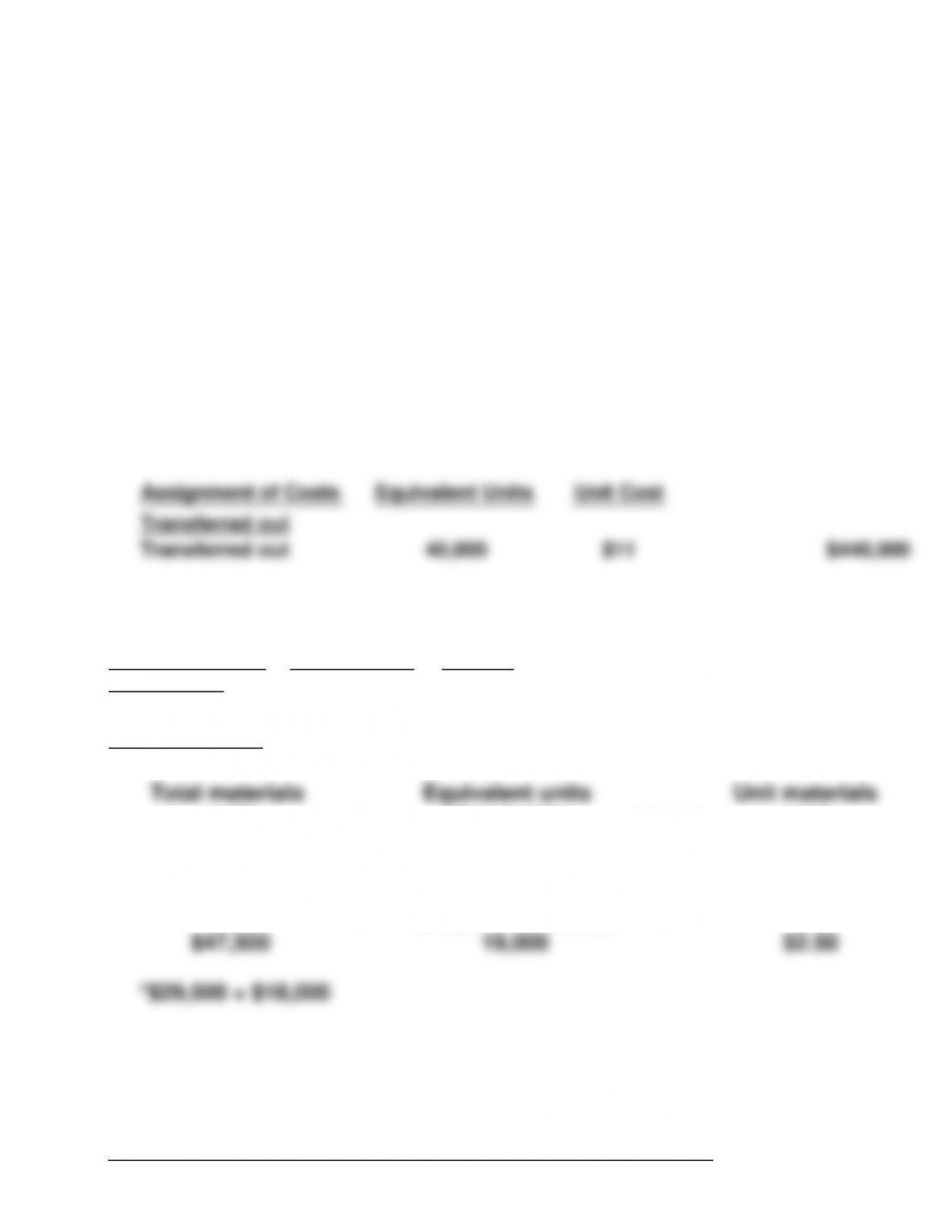
Total materials
costs
$36,000
÷
Equivalent units
of materials
10,000
=
Unit materials
cost
$3.60
Total conversion
costs
$54,000
÷
Equivalent units
of conversion costs
12,000
=
Unit conversion
cost
$4.50
Unit materials
cost
$3.60
+
Unit conversion
cost
$4.50
=
Total manufacturing
cost per unit
$8.10
BRIEF EXERCISE 3-6
Assignment of Costs
Equivalent Units
Unit Cost
Transferred out
Transferred out
40,000
$11
$440,000
Work in process, 4/30
Materials
Conversion costs
Total costs
5,000
2,000
$ 4
$ 7
$20,000
14,000
34,000
$474,000
BRIEF EXERCISE 3-7
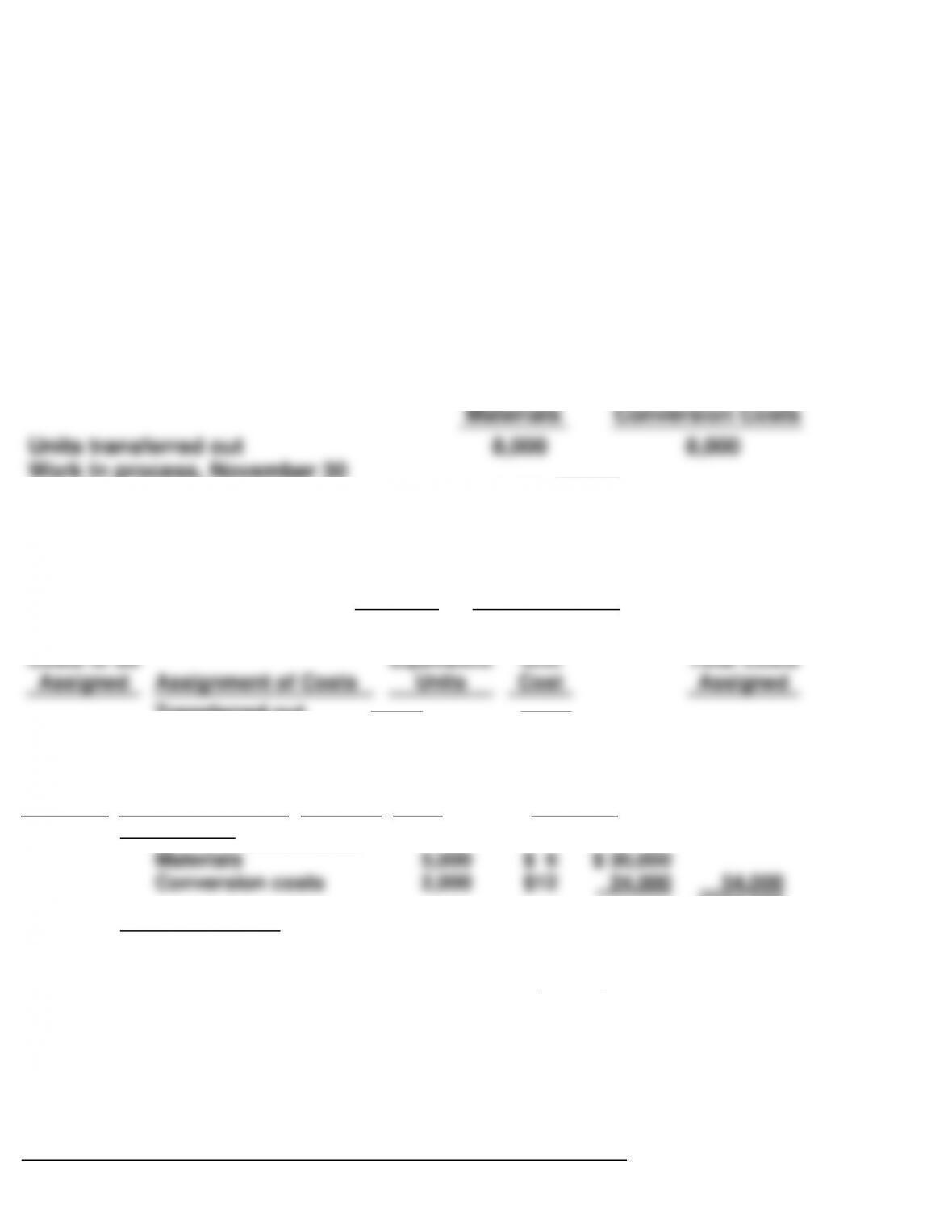
Total materials
costs
$16,000
÷
Equivalent units
of materials
20,000
=
Unit materials
cost
$.80
Total conversion
*costs*
$47,500
÷
Equivalent units
of conversion costs
19,000
=
Unit conversion
cost
$2.50
*$29,500 + $18,000
BRIEF EXERCISE 3-8
Costs accounted for
Transferred out
Work in process
Materials
Conversion costs
Total costs
(18,000 X $3.30)
(2,000 X $.80)
(1,000* X $2.50)
$1,600
2,500
$59,400
4,100
$63,500
*2,000 X 50%
BRIEF EXERCISE 3-9
(a)
Materials
(b)
Conversion Costs
Units transferred out
Work in process, November 30
Materials (7,000 X 100%)
Conversion costs (7,000 X 40%)
Total equivalent units
8,000
7,000
15,000
8,000
2,800
10,800
*BRIEF EXERCISE 3-10
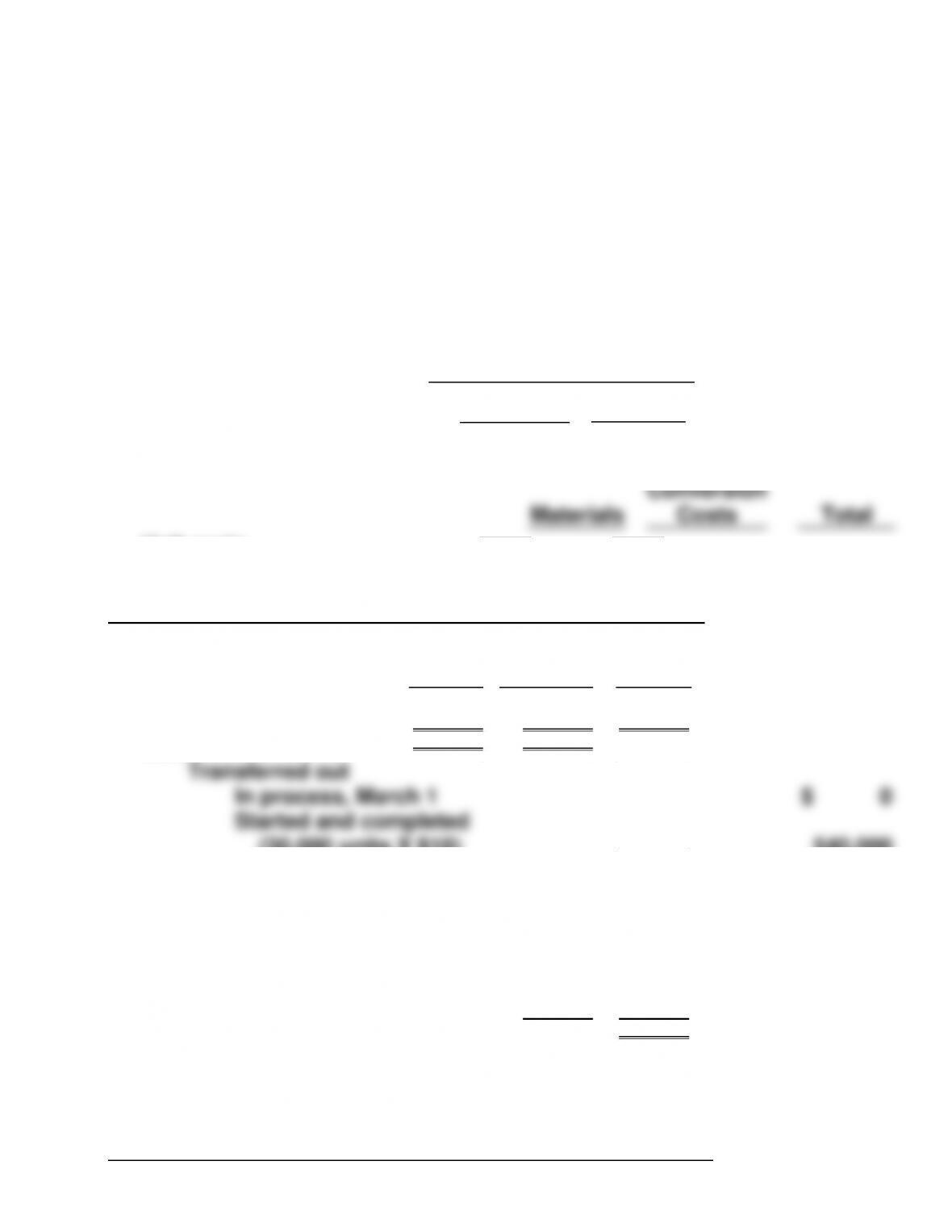
Costs to Be
Assigned
Assignment of Costs
Equivalent
Units
Unit
Cost
Total Costs
Assigned
Transferred out
Work in process, 3/1
Started and completed
0
30,000
$ 0
$18
$ 0
540,000
540,000
$594,000
Work in process, 3/31
Materials
Conversion costs
5,000
2,000
$ 6
$12
$ 30,000
24,000
54,000
$594,000
*BRIEF EXERCISE 3-11
Equivalent Units
Materials
Conversion
Costs
Units accounted for
Completed and transferred out
Work in process, March 1
Started and completed
Work in process, March 31
Total units
-0-
30,000
5,000
35,000
-0-
30,000
2,000
32,000
SANDERSON COMPANY
(Partial) Production Cost Report
For the Month Ended March 31
COSTS
Materials
Conversion
Costs
Total
Unit costs
Total costs (a)
Equivalent units (b)
Unit costs (a) ÷ (b)
Costs to be accounted for
In process, March 1
Costs in March
Total costs
Costs accounted for
Transferred out
In process, March 1
Started and completed
(30,000 units X $18)
$210,000
35,000
$ 6
*
$384,000
32,000
$ 12
**
$594,000
$ 18
$ 0
594,000
$594,000
$ 0
540,000
*35,000 equivalent units X $6 per unit
**32,000 equivalent units X $12 per unit
*BRIEF EXERCISE 3-12
Total materials
costs
1$75,0001
÷
Equivalent units
of materials
20,000
=
Unit materials
cost
$3.75
SOLUTIONS FOR DO IT! REVIEW EXERCISES
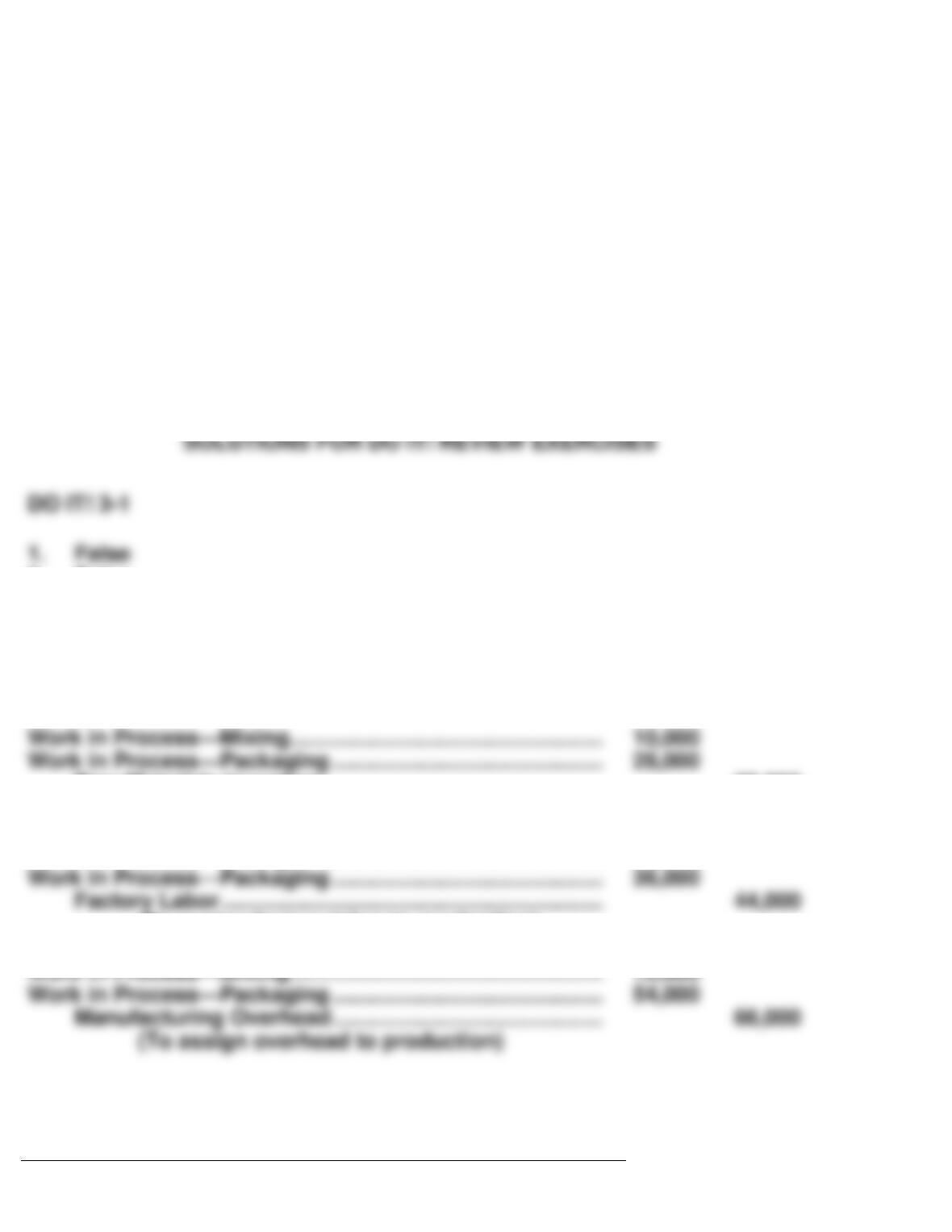
DO IT! 3-1
1. False
DO IT! 3-2
Work in Process—Mixing …………………………………………… 10,000
Work in Process—Mixing …………………………………………… 8,000
Work in Process—Packaging …………………………………….. 36,000