CHAPTER 2
Job Order Costing
ASSIGNMENT CLASSIFICATION TABLE
Learning Objectives
Questions
Brief
Exercises
Do It!
Exercises
A
Problems
B
Problems
1. Explain the characteristics
and purposes of cost
accounting.
1, 2, 3, 4
2. Describe the flow of
costs in a job order
costing system.
5, 6, 7, 8
1, 2
1
1, 2, 3, 4, 6,
7, 8, 9, 11
1A, 2A,
3A, 5A
1B, 2B,
3B, 5B
3. Explain the nature
and importance of
a job cost sheet.
9, 10,
11, 12
3, 4, 5
2
1, 2, 3, 6, 7,
8, 10, 12
1A, 2A,
3A, 5A
1B, 2B,
3B, 5B
4. Indicate how the
predetermined
overhead rate is
determined and used.
13, 14, 15
6, 7
2
2, 3, 5, 6, 7,
8, 11, 12, 13
1A, 2A, 3A,
4A, 5A
1B, 2B, 3B,
4B, 5B
5. Prepare entries for jobs
completed and sold.
16
8, 9
3
2, 3, 6,
7, 8, 9,
10, 11
1A, 2A,
3A, 5A
1B, 2B,
3B, 5B
6. Distinguish between
under– and overapplied
manufacturing overhead.
17, 18
10
4
4, 5, 12, 13
1A, 2A,
4A, 5A
1B, 2B,
4B, 5B
ASSIGNMENT CHARACTERISTICS TABLE
Problem
Number
Description
Difficulty
Level
Time
Allotted (min.)
1A
Prepare entries in a job order cost system and job cost
sheets.
Simple
3040
2A
Prepare entries in a job order cost system and partial
income statement.
Moderate
3040
3A
Prepare entries in a job order cost system and cost of
goods manufactured schedule.
Simple
3040
4A
Compute predetermined overhead rates, apply overhead,
and calculate under– or overapplied overhead.
Simple
2030
5A
Analyze manufacturing accounts and determine missing
amounts.
Complex
3040
1B
Prepare entries in a job order cost system and job cost
sheets.
Simple
3040
2B
Prepare entries in a job order cost system and partial
income statement.
Moderate
3040
3B
Prepare entries in a job order cost system and cost of
goods manufactured schedule.
Simple
3040
4B
Compute predetermined overhead rates, apply overhead,
and calculate under- or overapplied overhead.
Simple
2030
5B
Analyze manufacturing accounts and determine missing
amounts.
Complex
3040
BLOOM’S TAXONOMY TABLE
Copyright © 2012 John Wiley & Sons, Inc. Weygandt, Managerial Accounting, 6/e, Solutions Manual (For Instructor Use Only) 2-3
Correlation Chart between Bloom’s Taxonomy, Learning Objectives and End–of-Chapter Exercises and Problems
Learning Objective
Knowledge
Comprehension
Application
Analysis
Synthesis
Evaluation
1. Explain the characteristics and
purposes of cost accounting.
Q2-1
Q2-2
Q2-3
Q2-4
2. Describe the flow of costs in
a job order costing system.
Q2-5
Q2-7
Q2-8
Q2-6
BE2-1
BE2-2
DI2-1
E2-1
E2-2
E2-3
E2-6
E2-7
E2-8
E2-9
E2–11
P2–1A
P2-3A
P2–1B
P2–3B
E2-4
P2–2A
P2–5A
P2–2B
P2–5B
3. Explain the nature and
importance of a job
cost sheet.
Q2–11
Q2–12
Q2-9
Q2–10
BE2-3
BE2-4
BE2-5
DI2-2
E2-1
E2-2
E2-3
E2-6
E2-7
E2-8
E2–10
E2–12
P2–1A
P2–3A
P2–1B
P2–3B
P2–2A
P2–5A
P2–2B
P2–5B
4. Indicate how the predetermined
overhead rate is determined
and used.
Q2–15
Q2–13
Q2–14
BE2-6
BE2-7
DI2-2
E2-2
E2-3
E2-6
E2-7
E2-8
E2–11
E2–12
E2–13
P2–1A
P2–3A
P2–4A
P2–1B
P2–3B
P2–4B
E2-5
P2–2A
P2–5A
P2–2B
P2–5B
5. Prepare entries for jobs
completed and sold.
Q2–16
BE2-9
BE2-8
DI2-3
E2-2
E2-3
E2-6
E2-7
E2-8
E2-9
E2–10
E2–11
P2–1A
P2–3A
P2–1B
P2–3B
P2–2A
P2–5A
P2–2B
P2–5B
6. Distinguish between under- and
overapplied manufacturing
overhead.
Q2–17
Q2–18
BE2-10
E2–12
E2–13
P2–1A
P2–4A
P2–1B
P2–4B
DI2-4
E2-4
E2-5
P2–2A
P2–5A
P2–2B
P2–5B
Broadening Your Perspective
BYP2-4
BYP2-5
BYP2-6
BYP2-1
BYP2-3
BYP2-2
BYP2-7
BYP2-8
ANSWERS TO QUESTIONS
1. (a) Cost accounting involves the measuring, recording, and reporting of product costs. A cost
general ledger of a company.
(b) An important feature of a cost accounting system is the use of a perpetual inventory system
2. (a) The two principal types of cost accounting systems are: (1) job order cost system and
(2) process cost system. Under a job order cost system, costs are assigned to each job or
special-order manufacturing or servicing while process costing is better suited to similar, large–
volume products and continuous process manufacturing.
3. A job order cost system is most likely to be used by a company that receives special orders, or
motion picture companies, construction contractors, repair shops, accounting and law firms,
hospitals, shipbuilders, and architects.
4. A process cost system is most likely to be used by manufacturing firms with continuous production
5. The major steps in the flow of costs in a job order cost system are: (1) accumulating the manufacturing
6. The three inventory control accounts and their subsidiary ledgers are:
Raw materials inventory—materials inventory records.
8. Disagree. Entries to Manufacturing Overhead are also made at the end of an accounting period.
9. The source document for materials is the materials requisition slip and the source document for
labor is the time ticket. The entries are:
Materials
Labor
Work in Process Inventory
Manufacturing Overhead
Raw Materials Inventory
XX
XX
XX
Work in Process Inventory
Manufacturing Overhead
Factory Labor
XX
XX
XX

Questions Chapter 2 (Continued)
10. The purpose of a job cost sheet is to record the costs chargeable to a specific job and to determine
the total and unit costs of the completed job.
11. The source documents for charging costs to specific jobs are materials requisition slips for direct
overhead.
12. The materials requisition slip is a business document used as an authorization to issue materials
cost sheet.
13. Disagree. Actual manufacturing overhead cannot be determined until the end of a period of time.
total cost of the completed job.
14. The relationships for computing the predetermined overhead rate are the estimated annual overhead
15. At any point in time, the balance in Work in Process Inventory should equal the sum of the costs
cost elements.
16. Jane is incorrect. There is a difference in computing total manufacturing costs. In job order costing,
is used.
17. Underapplied overhead means that the overhead assigned to work in process is less than the
18. Under- or overapplied overhead is not closed to Income Summary. The balance in Manufacturing
SOLUTIONS TO BRIEF EXERCISES
BRIEF EXERCISE 2-1
2-6 Copyright © 2012 John Wiley & Sons, Inc. Weygandt, Managerial Accounting, 6/e, Solutions Manual (For Instructor Use Only)
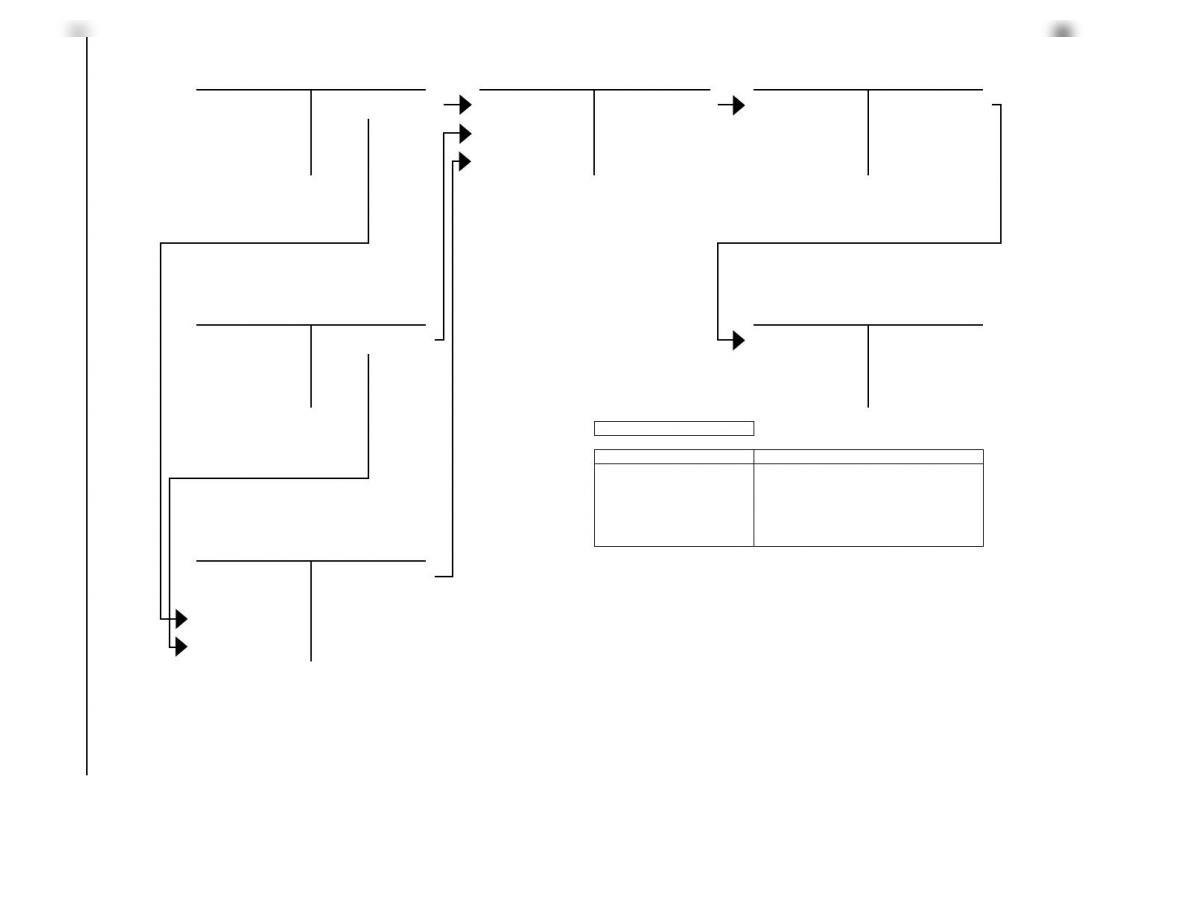
Raw Materials Inventory
Work in Process Inventory
Finished Goods Inventory
(1) Purchases
(4) Materials
used
(4) Direct
materials used
(7) Cost of com-
pleted jobs
(7) Cost of com-
pleted jobs
(8) Cost of goods
sold
(5) Direct labor
used
(6) Overhead
applied
Factory Labor
Cost of Goods Sold
(2) Factory labor
incurred
(5) Factory labor
used
(8) Cost of goods
sold
Key to Entries:
Accumulation
Assignment
1. Purchase raw materials
4. Raw materials are used
2. Incur factory labor
5. Factory labor is assigned
3. Incur manufacturing
6. Overhead is applied
overhead
7. Completed goods are recognized
8. Cost of goods sold is recognized
Manufacturing Overhead
(3) Depreciation
Insurance
Repairs
(6) Overhead
applied
(4) Indirect
materials used
(5) Indirect
labor used
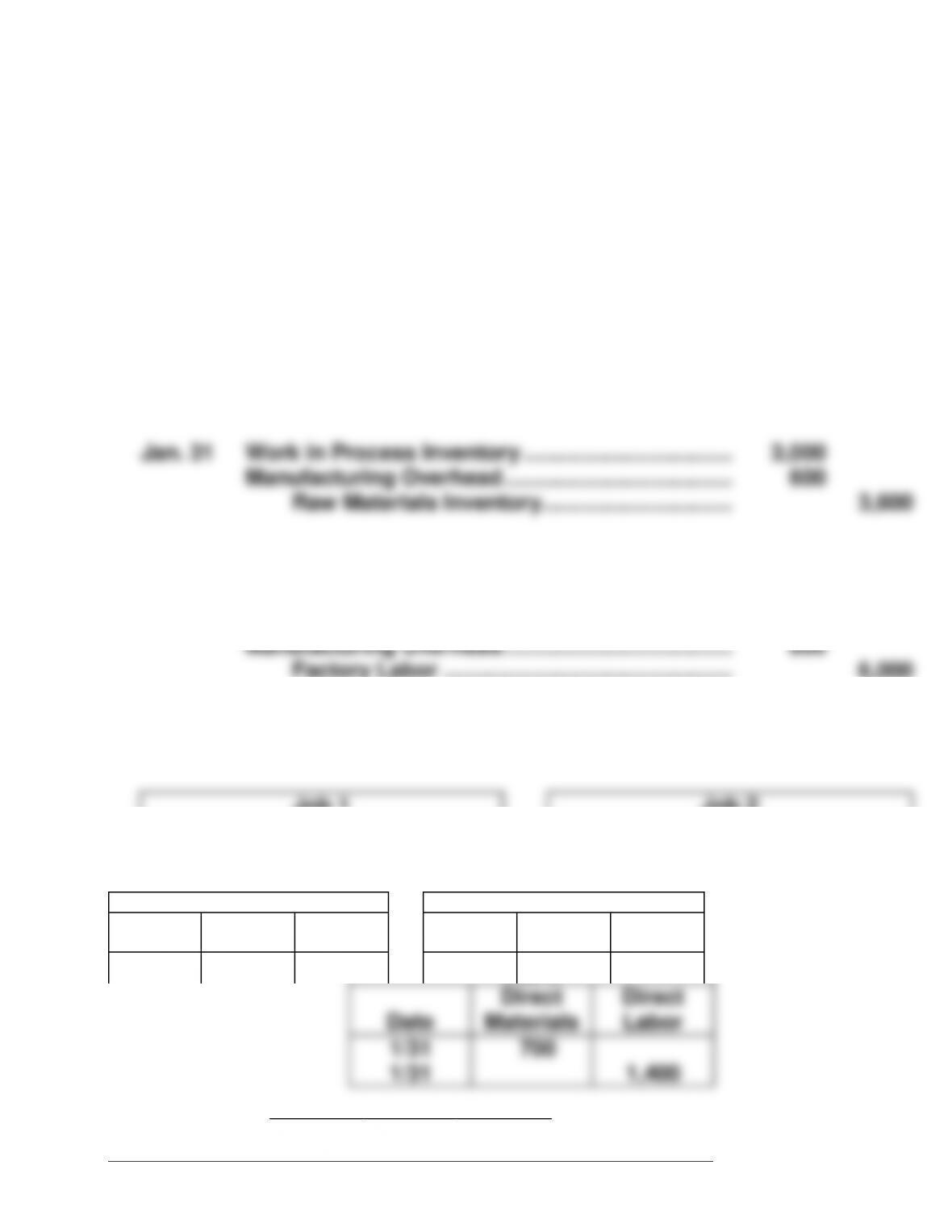
BRIEF EXERCISE 2-2
Jan. 31 Raw Materials Inventory ……………………………….. 4,000
Accounts Payable ………………………………….. 4,000
BRIEF EXERCISE 2-3
Jan. 31 Work in Process Inventory ……………………………. 3,000
BRIEF EXERCISE 2-4
Jan. 31 Work in Process Inventory ……………………………. 5,200
BRIEF EXERCISE 2-5
Job 1
Job 2
Date
Direct
Materials
Direct
Labor
Date
Direct
Materials
Direct
Labor
1/31
1/31
900
2,200
1/31
1/31
1,400
1,600
Job 3
Date
Direct
Materials
Direct
Labor
1/31
1/31
700
1,400
BRIEF EXERCISE 2-6
Overhead rate per direct labor cost is 180%, or ($900,000 ÷ $500,000).
Overhead rate per direct labor hour is $18, or ($900,000 ÷ 50,000).
Overhead rate per machine hour is $9, or ($900,000 ÷ 100,000).
BRIEF EXERCISE 2-7
Jan. 31 Work in Process Inventory ……………………….. 32,000
Manufacturing Overhead
BRIEF EXERCISE 2-8
Mar. 31 Finished Goods Inventory ………………………… 50,000
Work in Process Inventory …………………. 50,000
31 Cash ……………………………………………………….. 35,000
BRIEF EXERCISE 2-9
Service Contracts in Process ……………………. 24,000
BRIEF EXERCISE 2-10
Shimeca Company
Dec. 31 Cost of Goods Sold ………………………………….. 1,200
SOLUTIONS FOR DO IT! REVIEW EXERCISES
DO IT! 2-1
(a) Raw Materials Inventory …………………………………….. 16,000
(b) Factory Labor ……………………………………………………. 40,000
(c) Manufacturing Overhead …………………………………… 15,000
DO IT! 2-2
The three summary entries are:
Work in Process Inventory ($7,200 + $9,000) ……………… 16,200
Raw Materials Inventory …………………………………….. 16,200
DO IT! 2-3
Finished Goods Inventory ………………………………………… 110,000
Work in Process Inventory …………………………………. 110,000
(To record completion of Job 310, costing
DO IT! 2-4
Manufacturing overhead applied = 130% X $85,000 = $110,500