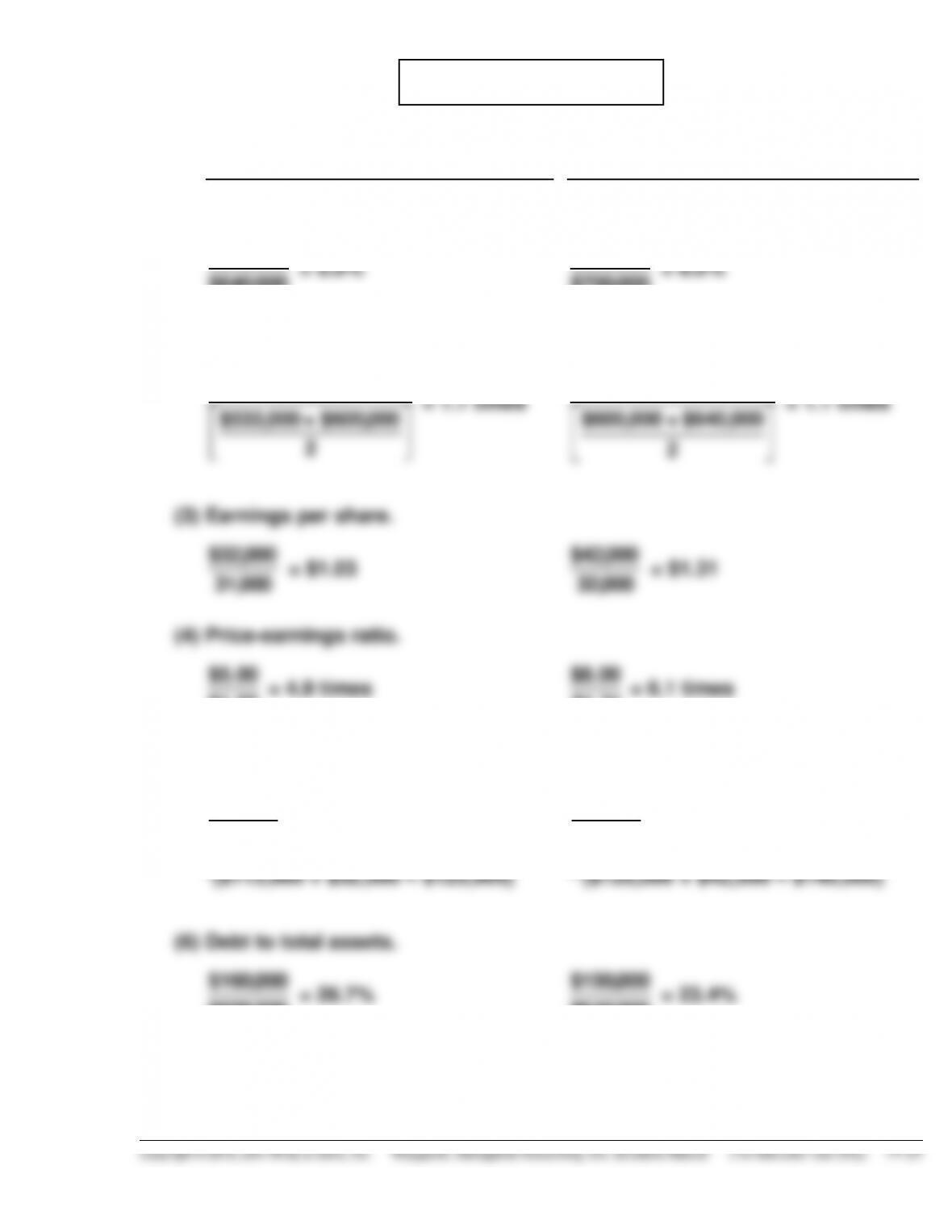
PROBLEM 14-3
(a)
2013
2014
(1)
Profit margin.
$32,000
$640,000
= 5.0%
$42,000
$700,000
= 6.0%
(2)
Asset turnover.
$640,000
$533,000 + $600,000
2
= 1.1 times
$700,000
$600,000 + $640,000
2
= 1.1 times
(3)
Earnings per share.
$32,000
31,000
= $1.03
$42,000
32,000
= $1.31
(4)
Price-earnings ratio.
$5.00
$1.03
= 4.9 times
$8.00
$1.31
= 6.1 times
(5)
Payout ratio.
$20,000
$32,000
*
= 62.5%
*($113,000 + $32,000 – $125,000)
$22,000
$42,000
**
= 52.4%
**($125,000 + $42,000 – $145,000)
(6)
Debt to total assets.
$160,000
$600,000
= 26.7%
$150,000
$640,000
= 23.4%

PROBLEM 14-3 (Continued)
(b) The underlying profitability of the corporation appears to have improved.
For example, profit margin and earnings per share have both increased.
In addition, the corporation’s price-earnings ratio has increased, which
PROBLEM 14-4
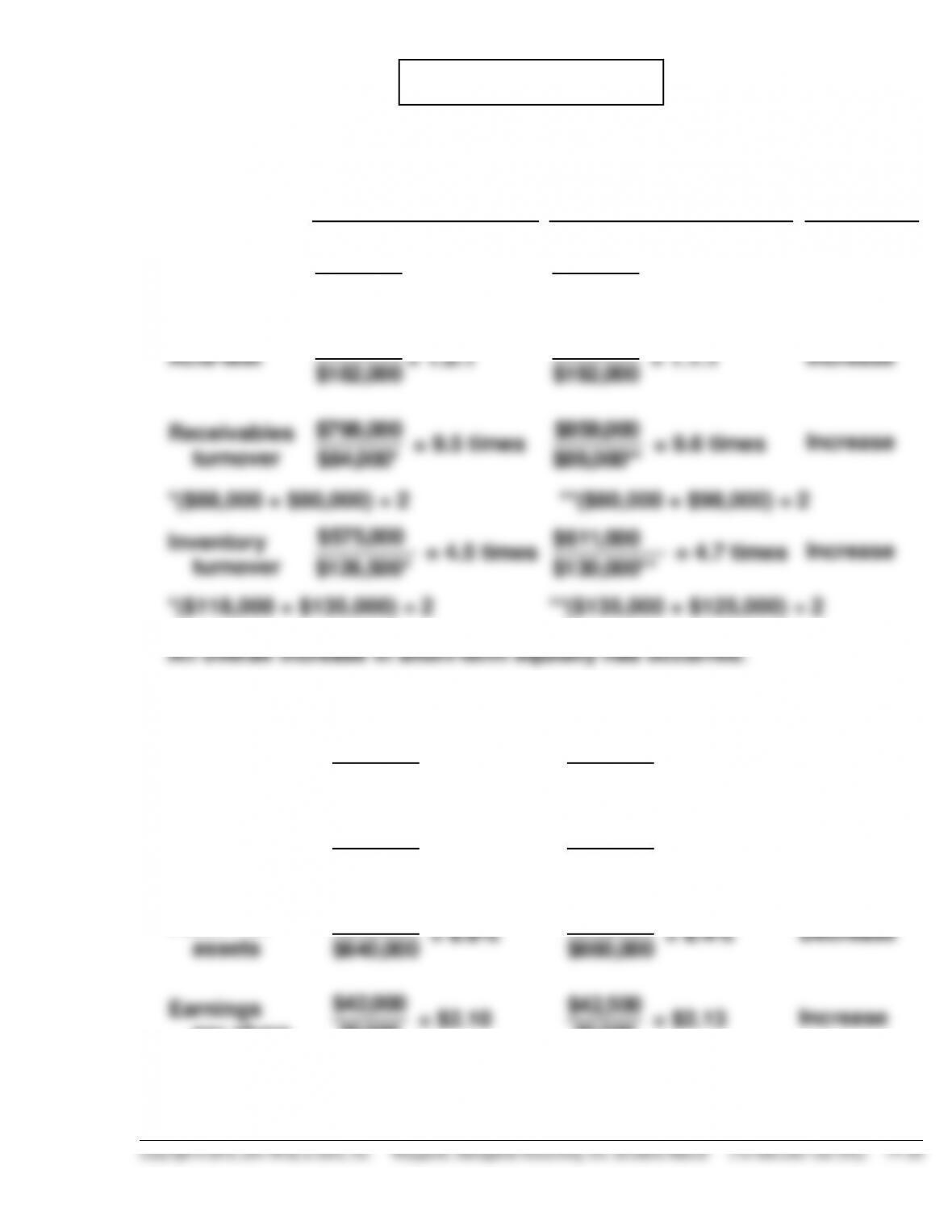
(a) LIQUIDITY
2012
2013
Change
Current
$343,000
$182,000
= 1.9:1
$374,000
$192,000
=1.9:1
No change
Acid-test
$185,000
$182,000
= 1.0:1
$220,000
$192,000
= 1.1:1
Increase
Receivables
turnover
$798,000
$84,000*
= 9.5 times
$858,000
$89,000**
= 9.6 times
Increase
PROFITABILITY
Profit
margin
$42,000
$798,000
= 5.3%
$42,500
$858,000
= 5.0%
Decrease
Asset
turnover
$798,000
$640,000
= 1.2 times
$858,000
$660,000
= 1.3 times
Increase
Return on
assets
$42,000
$640,000
= 6.6%
$42,500
$660,000
= 6.4%
Decrease
Earnings
per share
$42,000
20,000
= $2.10
$42,500
20,000
= $2.13
Increase
Profitability has remained relatively the same.
PROBLEM 14-4 (Continued)
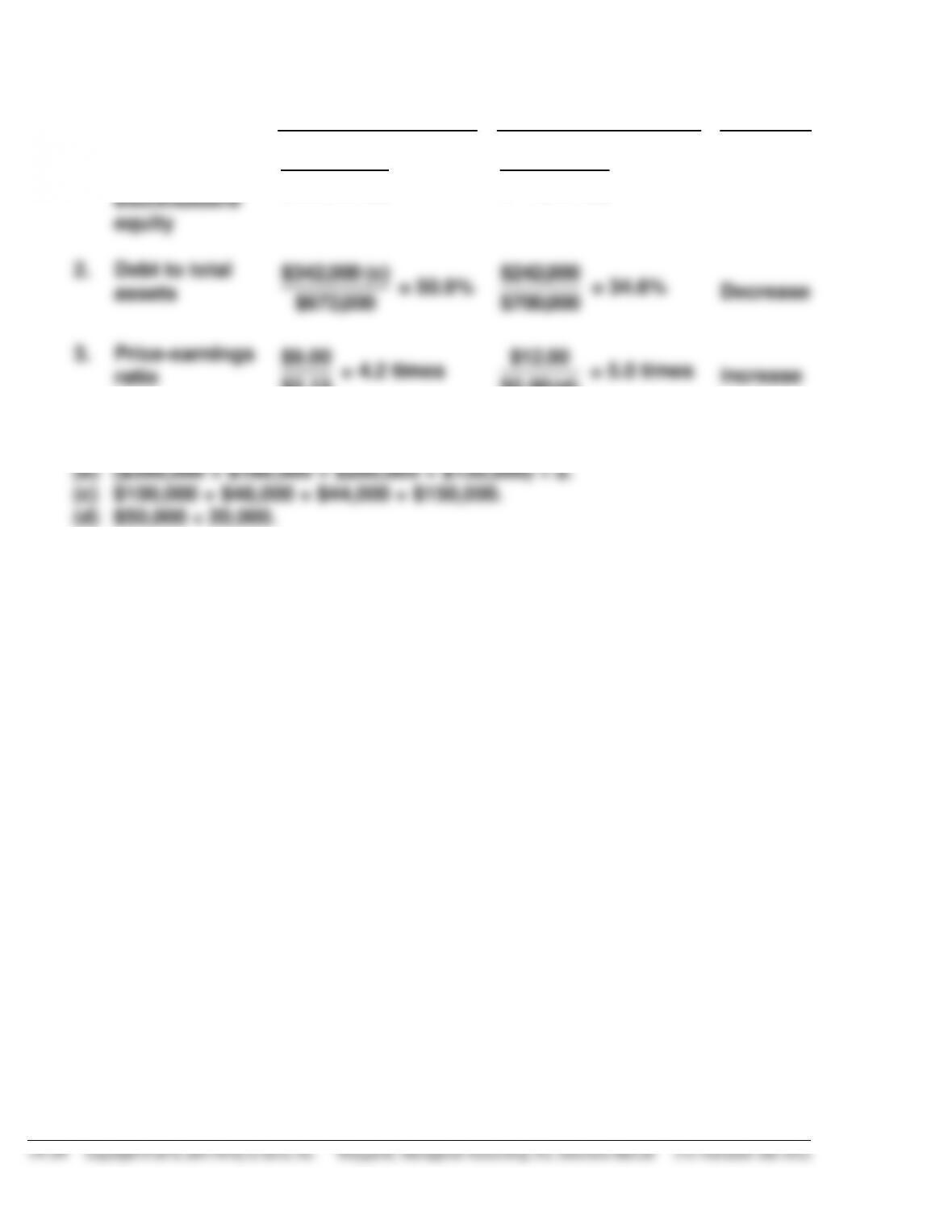
(b)
2013
2014
Change
1.
Return on
common
stockholders’
equity
$42,500
$323,000 (a)
= 13.2%
$50,000
$445,000 (b)
= 11.2%
Decrease
2.
Debt to total
assets
$342,000 (c)
$672,000
= 50.9%
$242,000
$700,000
= 34.6%
Decrease
3.
Price-earnings
ratio
$9.00
$2.13
= 4.2 times
$12.50
$2.50 (d)
= 5.0 times
Increase
(a) ($200,000 + $130,000 + $200,000 + $116,000) ÷ 2.
PROBLEM 14-5
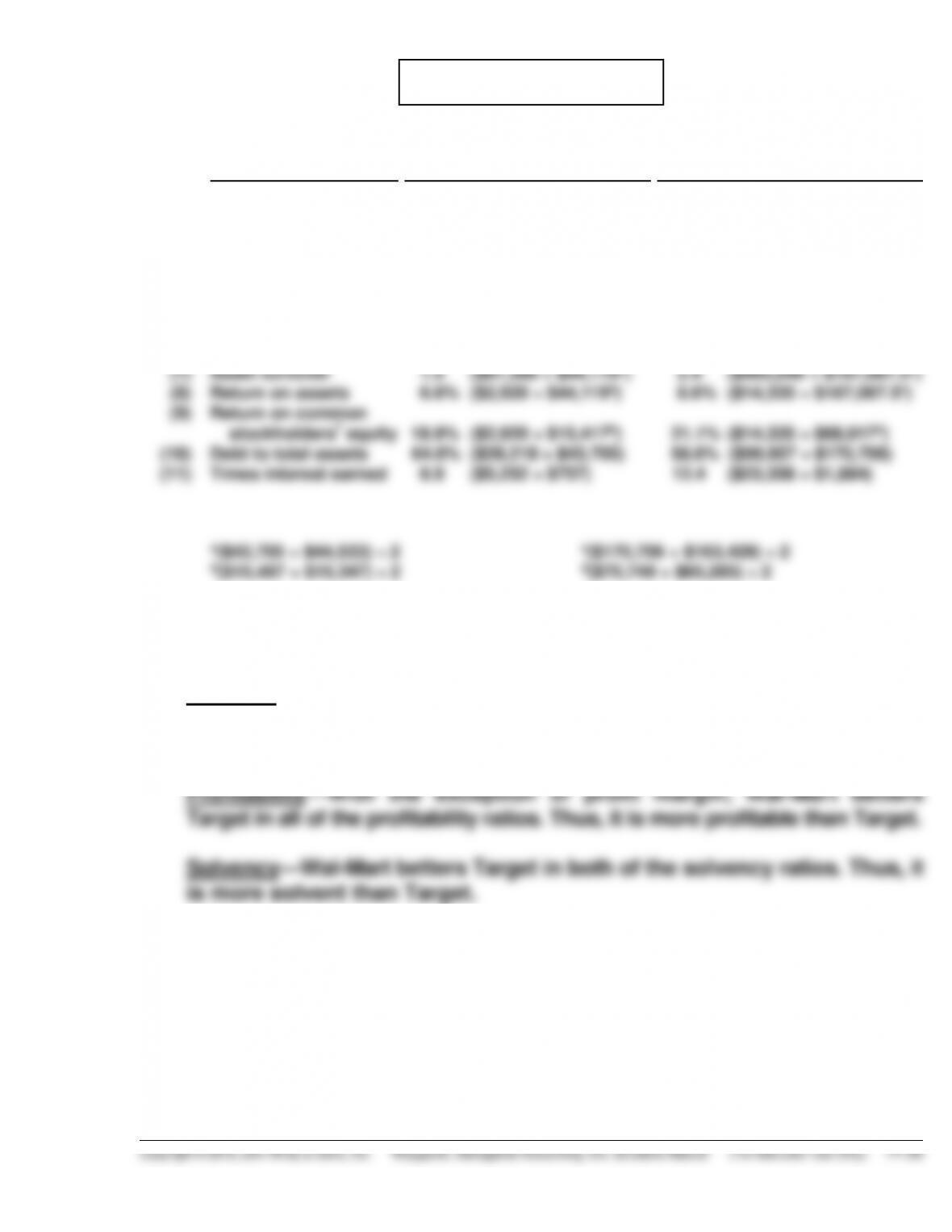
(a)
Ratio
Target
Wal-Mart
(All Dollars Are in Millions)
(1)
(2)
(3)
(4)
(5)
(6)
(7)
(8)
(9)
(10)
(11)
Current
Receivables turnover
Average collection
period
Inventory turnover
Days in inventory
Profit margin
Asset turnover
Return on assets
Return on common
stockholders’ equity
Debt to total assets
Times interest earned
1.7:1 ($17,213 ÷ $10,070)
10.3 ($67,390 ÷ $6,560)
35.4 (365 ÷ 10.3)
6.2 ($45,725 ÷ $7,388)
58.9 (365 ÷ 6.2)
4.3% ($2,920 ÷ $67,390)
1.5 ($67,390 ÷ $44,119a)
6.6 % ($2,920 ÷ $44,119a)
18.9 % ($2,920 ÷ $15,417b)
64.6% ($28,218 ÷ $43,705)
6.9 ($5,252 ÷ $757)
.9:1 ($48,331 ÷ $55,561)
100.6 ($405,046 ÷ $4,025)
3.6 (365 ÷ 100.6)
9.0 ($304,657 ÷ $33,836)
40.6 (365 ÷ 9.0)
3.5% ($14,335 ÷ $405,046)
2.4 ($405,046 ÷ $167,067.5c)
8.6 % ($14,335 ÷ $167,067.5c)
21.1% ($14,335 ÷ $68,017d)
58.6% ($99,957 ÷ $170,706)
12.4 ($23,358 ÷ $1,884)
(b) The comparison of the two companies shows the following:
Liquidity—Target’s current ratio of 1.7:1 is significantly better than
Wal–Mart’s .9:1. However, Wal-Mart has a better inventory turnover ratio
than Target and its receivables turnover is substantially better than Target’s.

PROBLEM 14-6
(a) Current ratio =
$204,000
$134,000
= 1.5:1.
(b) Acid-test ratio =
$21,000 + $18,000 + $85,000
$134,000
= 0.93:1.
$500,000
$80,000 + $60,000
2
(e) Profit margin ratio =
$36,700
$500,000
= 7.3%.
(f) Asset turnover =
$500,000
$627,000 + $551,000
2
= 0.8 times.
$36,700
$627,000 + $551,000
2
$36,700
$373,000 + $350,000
2
PROBLEM 14-6 (Continued)
(i) Earnings per share =
$36,700
30,000 (1)
= $1.22.
(1) $150,000 ÷ $5.00
$13,700 (2)
$19.50
$36,700
(2) $200,000 + $36,700 – $223,000
(l) Debt to total assets =
$254,000
$627,000
= 40.5%.
(m) Times interest earned =
$64,200 (3)
$7,500
= 8.6 times.

PROBLEM 14-7
Receivables turnover = 10 =
$10,500,000
Average receivables
Average receivables =
$10,500,000
10
= $1,050,000
Net receivables 12/31/14 + $950,000
2
= $1,050,000
Net receivables 12/31/14 + $950,000 = $2,100,000
Net receivables 12/31/14 = $1,150,000
Profit margin = 14.5% = .145 =
Net income
$10,500,000
Net income = $10,500,000 X .145 = $1,522,500
Income before income taxes = $1,522,500 + $550,000 = $2,072,500
$1,522,500
2
Assets (12/31/14) = $7,725,000
Total current assets = $7,725,000 – $4,620,000 = $3,105,000
Inventory = $3,105,000 – $1,150,000 – $480,000 = $1,475,000

PROBLEM 14-7 (Continued)
Current ratio = 3.0 =
$3,105,000
Current liabilities
Inventory turnover = 4.2 =
Cost of goods sold
$1,720,000 + $1,475,000
2
Cost of goods sold = $1,597,500 X 4.2 = $6,709,500
PROBLEM 14-8
VIOLET BICK CORPORATION
Condensed Income Statement
For the Year Ended December 31, 2014
Operating revenues
($12,900,000 – $2,000,000) …………………… $10,900,000
Operating expenses
($8,700,000 – $2,500,000) …………………….. 6,200,000
Income from operations …………………………. 4,700,000
Loss from operations of hotel
chain*, net of $150,000 income
tax saving ……………………………………. ($350,000)
Gain on sale of hotels, net of
$90,000 income taxes …………………… 210,000 (140,000)
Income before extraordinary item …………… 3,010,000