
CHAPTER 12
Planning for Capital Investments
ASSIGNMENT CLASSIFICATION TABLE
Learning Objectives
Questions
Brief
Exercises
Do It!
Exercises
A
Problems
B
Problems
1. Discuss capital budgeting
evaluation, and explain
inputs used in capital
budgeting.
1
2. Describe the cash
payback technique.
2, 3
1
1
1, 2, 6, 9,
10, 11
1A, 2A
1B, 2B
3. Explain the net present
value method.
4, 5, 6, 7
2, 3, 4, 5
2
1, 2, 3, 4
10, 11
1A, 2A, 3A,
4A, 5A
1B, 2B, 3B,
4B, 5B
4. Identify the challenges
presented by intangible
benefits in capital
budgeting.
8, 9
4
4A
4B
5. Describe the profitability
index.
10
5
4
3A
3B
6. Indicate the benefits of
performing a post-audit.
11
6
7. Explain the internal rate
of return method.
12, 13, 16
7, 8
3
5, 6, 7
3A, 5A
3B, 5B
8. Describe the annual
rate of return method.
3, 14, 15
9
4
8, 9, 10, 11
1A, 2A
1B, 2B

ASSIGNMENT CHARACTERISTICS TABLE
Problem
Number
Description
Difficulty
Level
Time
Allotted (min.)
1A
Compute annual rate of return, cash payback, and net
present value.
Moderate
30–40
2A
Compute annual rate of return, cash payback, and net
present value.
Complex
30–40
3A
Compute net present value, profitability index, and
internal rate of return.
Moderate
20–30
4A
Compute net present value considering intangible
benefits.
Moderate
20–30
5A
Compute net present value and internal rate of return
with sensitivity analysis.
Moderate
30–40
1B
Compute annual rate of return, cash payback, and net
present value.
Moderate
30–40
2B
Compute annual rate of return, cash payback, and net
present value.
Complex
30–40
3B
Compute net present value, profitability index, and
internal rate of return.
Moderate
20–30
4B
Compute net present value considering intangible
benefits.
Moderate
30–40
5B
Compute net present value and internal rate of return
with sensitivity analysis.
Moderate
30–40

BLOOM’S TAXONOMY TABLE
Copyright © 2012 John Wiley & Sons, Inc. Weygandt, Managerial Accounting, 6/e, Solutions Manual (For Instructor Use Only) 12-3
Learning Objective
Knowledge
Comprehension
Application
Analysis
Synthesis
Evaluation
1. Discuss capital budgeting evaluation,
and explain inputs used in capital
budgeting.
Q12-1
2. Describe the cash payback technique.
Q12-2
Q12-3
BE12-1
DI12-1
E12-9
E12-10
E12-11
E12-1
E12-2
E12-6
P12-1A
P12-2A
P12-1B
P12-2B
3. Explain the net present value method.
Q12-5
Q12-6
Q12-4
Q12-7
BE12-3
E12-8
E12-10
E12-11
BE12-4
P12-5A
P12-5B
BE12-2
BE12-5
DI12-2
E12-1
E12-2
E12-3
E12-4
P12-1A
P12-2A
P12-3A
P12-4A
P12-1B
P12-2B
P12-3B
P12-4B
4. Identify the challenges presented
by intangible benefits in capital
budgeting.
Q12-9
Q12-8
BE12-4
P12-4A
P12-4B
5. Describe the profitability index.
Q12-10
BE12-5
E12-4
P12-3A
P12-3B
6. Indicate the benefits of performing a
post-audit.
Q12-11
BE12-6
7. Explain the internal rate of return
method.
Q12-12
Q12-13
Q12-16
BE12-7
E12-7
P12-5A
P12-5B
BE12-8
DI12-3
E12-6
E12-5
P12-3A
P12-3B
8. Describe the annual rate of return
method.
Q12-14
Q12-15
Q12-3
BE12-9
E12-8
E12-9
E12-10
E12-11
DI12-4
P12-1A
P12-2A
P12-1B
P12-2B
Broadening Your Perspective
BYP12-4
BYP12-5
BYP12-2
BYP12-1
BYP12-9
BYP12-8
BYP12-3
BYP12-6
BYP12-7
ANSWERS TO QUESTIONS
1. The screening of proposed capital expenditures may be done by a capital budgeting committee
2. The cash payback technique is relatively easy to compute and understand. However, it should
3. Tom is not correct. The formula for the cash payback technique is: Cost of the capital investment ÷
average investment.
4. The two tables are:
(2) The present value of an annuity (Table 4 in Appendix A). This table is used when a project
5. The decision rule is: Accept the project when net present value is zero or positive; reject the
project when net present value is negative.
6. The discount rate has two elements, a cost of capital element and a risk element. Many times
discount rate should include a risk element.
7. The following simplifying assumptions were made:
8. Examples of intangible benefits of investment projects would be increased product quality,
9. Two approaches can be taken. Under the first approach, management should ask whether the
value of the intangible benefits exceeds the amount by which the net present value of the project
value should be recalculated.

Questions Chapter 12 (Continued)
10. When trying to choose between competing proposals, simply comparing the net present value of
into the evaluation.
11. A post-audit is a thorough evaluation of how well a project’s actual performance matches the
projects should be continued, and (3) they improve the development of future investment
estimation techniques.
12. When the net annual cash flows are equal each year, the steps are:
Flows.
(2) Use the factor and the present value of an annuity of 1 table to find the internal rate of
return.
13. Under the internal rate of return method, the objective is to find the rate that will make the present
the project when the internal rate of return is less than the required rate.
14. The advantages of this method are the simplicity of its calculation and management’s familiarity
generates.
15. The formula for the annual rate of return technique is: Expected annual net income ÷ Average
investment.
16. Cost of capital is the average rate of return that the company must pay to obtain borrowed and
equity funds. The decision rule is: Accept the project when the internal rate of return is equal to or
greater than the required rate of return (which often is its cost of capital). Reject the project when
the internal rate of return is less than the required rate of return.

SOLUTIONS TO BRIEF EXERCISES
BRIEF EXERCISE 12-1
$450,000 ÷ $50,000 = 9 years
BRIEF EXERCISE 12-2
Present Value
Net annual cash flows – $40,000 X 5.65
Capital investment
Net present value
$226,000
215,000
$ 11,000
The investment should be made because the net present value is positive.
BRIEF EXERCISE 12-3
Cash
Flows
X
10% Discount
Factor
=
Present
Value
Present value of net annual cash flows
Present value of salvage value
Capital investment
Net present value
$25,000
65,000
X
X
3.79079
.62092
=
=
$ 94,770
40,360
135,130
136,000
$ (870)
Since the net present value is negative, the project is unacceptable.
BRIEF EXERCISE 12-4
Cash
Flows
X
9% Discount
Factor
=
Present
Value
Present value of net annual cash flows
Present value of salvage value
Capital investment
Net present value
$34,000
0
X
X
5.53482
.50187
=
=
($188,184)
( 0)
( 188,184)
( 200,000)
($ (11,816)
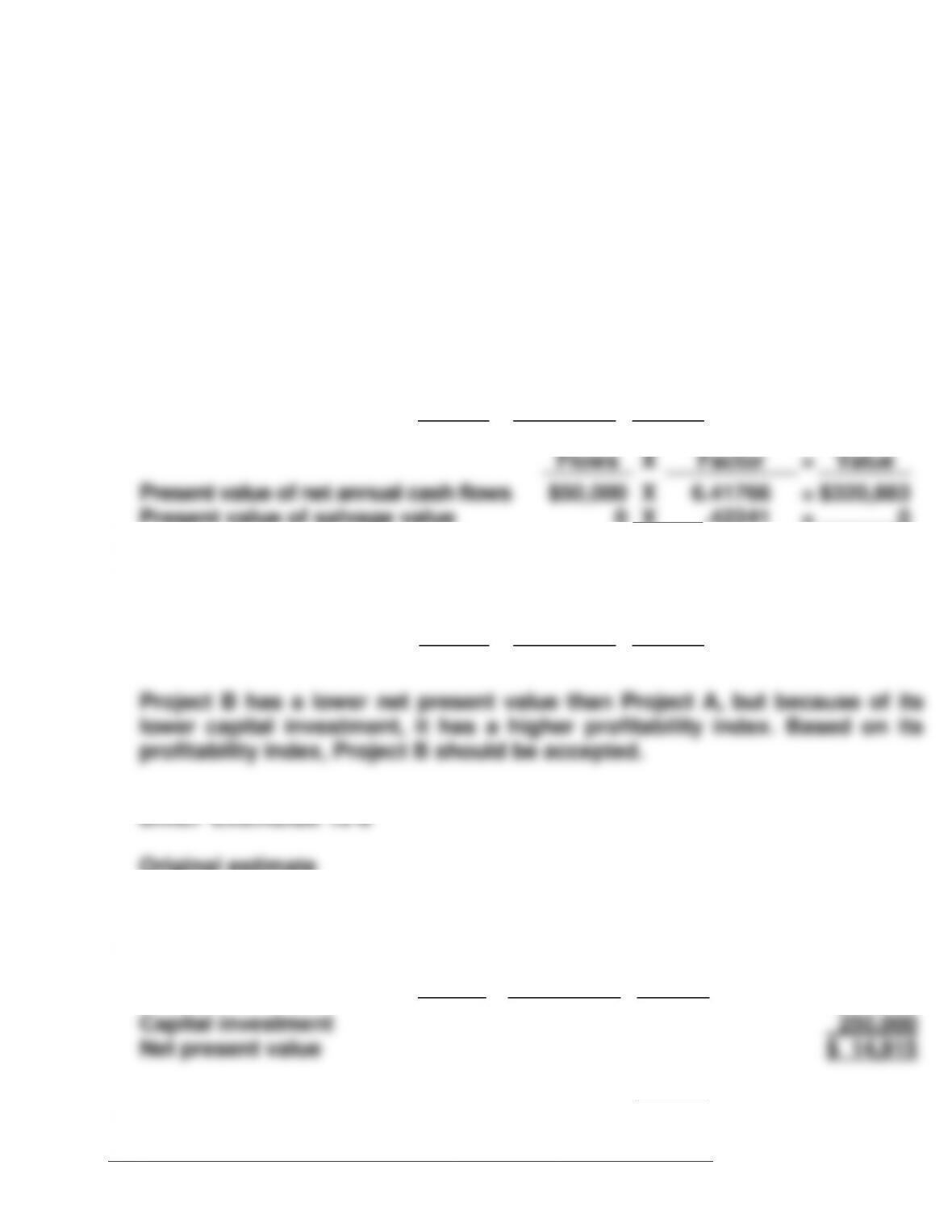
BRIEF EXERCISE 12-5
Project A
Cash
Flows
X
9% Discount
Factor
=
Present
Value
Present value of net annual cash flows
Present value of salvage value
Capital investment
Net present value
$70,000
0
X
X
6.41766
.42241
=
=
$449,236
0
449,236
400,000
$ 49,236
Profitability index = $449,236/$400,000 = 1.12
Project B
Cash
Flows
X
9% Discount
Factor
=
Present
Value
Present value of net annual cash flows
Present value of salvage value
Capital investment
Net present value
$50,000
0
X
X
6.41766
.42241
=
=
$320,883
0
320,883
280,000
$ 40,883
Profitability index = $320,883/$280,000 = 1.15
BRIEF EXERCISE 12-6
Original estimate
Cash
Flows
X
10% Discount
Factor
=
Present
Value
Present value of net annual cash flows
Present value of salvage value
Capital investment
Net present value
$46,000
0
X
X
5.75902
.42410
=
=
$264,915
0
264,915
250,000
$ 14,915

BRIEF EXERCISE 12-6 (Continued)
Revised estimate
Cash
Flows
X
10% Discount
Factor
=
Present
Value
Present value of net annual cash flows
Present value of salvage value
Capital investment
Net present value
$39,000
0
X
X
6.49506
.35049
=
=
($253,307)
( 0)
( 253,307)
( 260,000)
($ (6,693)
success.
BRIEF EXERCISE 12-7
$176,000/$33,740 = 5.21636
By tracing across on the 7-year row we see that the discount factor for 8% is
5.20637. Thus, the internal rate of return on this project is approximately 8%.
BRIEF EXERCISE 12-8
result in a net present value of zero. By experimenting with various rates,
we determined that the net present value is approximately zero when a
discount rate of approximately 9% is used.

BRIEF EXERCISE 12-8 (Continued)
Net annual cash flows = $400,000 – $150,000 = $250,000
Cash
Flows
X
9% Discount
Factor
=
Present
Value
Present value of net annual cash flows
Present value of salvage value
Capital investment
Net present value
$250,000
716,000
X
X
7.16073
.35554
=
=
$1,790,183
254,567
2,044,750
2,045,000
$ (250)
The 9% internal rate of return exceeds the company’s 7% required rate of
return; thus, the project should be accepted.
BRIEF EXERCISE 12-9
The annual rate of return is calculated by dividing expected annual income
by the average investment. The company’s expected annual income is:
Its average investment is:
$470,000 + $10,000
=
$240,000
2
Therefore, its annual rate of return is:
$60,000/$240,000 = 25%

SOLUTIONS FOR DO IT! REVIEW EXERCISES
DO IT! 12-1
Estimated annual cash inflows…………………………... $80,000
Cash payback period = $120,000/$40,000 = 3 years.
DO IT! 12-2
Estimated annual cash inflows…………………………... $80,000
Cash
Flow
12% Discount
Factor
Present
Value
Present value of net annual cash
flows
$40,000
3.03735a
$121,494
Capital investment
120,000
Net present value
$ 1,494
aTable 4, Appendix A.
DO IT! 12-3
Estimated annual cash inflows…………………………... $80,000
and 15%.
Since the project has an internal rate that is more than 12%, the company’s