*PROBLEM 11-7B
Overhead controllable variance:
Actual
Overhead
($68,800 + $50,000)
$118,800
–
–
Overhead
Budgeted
[($50,000 + (19,400* X $3.50)]
$117,900
=
$900 U
Overhead volume variance:
Fixed Overhead
Rate
2.50/hr.
X
X
Normal
Capacity
Hours
(20,000
–
–
Standard
Hours
Allowed
19,400*)
=
$1,500 U
*9,700 X 2
*PROBLEM 11-8B
Overhead controllable variance:
Actual
Overhead
$94,800
–
–
Overhead
Budgeted
$98,400
[(3,600 X $16) + $40,800*]
=
$3,600 F
*3,400 X $12
Overhead volume variance:
Fixed
Overhead
Rate
$12/hr.
X
X
Normal
Capacity
Hours
(3,400
–
–
Standard
Hours
Allowed
3,600)
=
$2,400 F
*PROBLEM 11-9B
Overhead controllable variance:
Actual
Overhead
$169,000
($120,000 + $49,000)
–
–
Overhead
Budgeted
$174,455
[(15,700 X $3.15) + $125,000]
=
$5,455 F
Overhead volume variance:
Fixed Overhead
Rate
$6.25/hr.
X
X
Normal
Capacity
Hours
(20,000
–
–
Standard
Hours
Allowed
15,700)
=
$26,875 U
*PROBLEM 11-10B
Overhead controllable variance:
Actual Overhead
$15,800
[($10,100 + $5,700)
–
–
–
Overhead Budgeted
$16,000
[(1,250* X $8) + $6,000]
=
$200 F
Overhead volume variance:
Fixed
Overhead
Rate
$5.00
X
X
Normal
Capacity
Hours
(1,200**
–
–
Standard
Hours
Allowed
1,250*)
=
$250 F
*2,500 X .5 **$6,000 ÷ $5.00/hour
BYP 11-1 DECISION-MAKING AT CURRENT DESIGNS
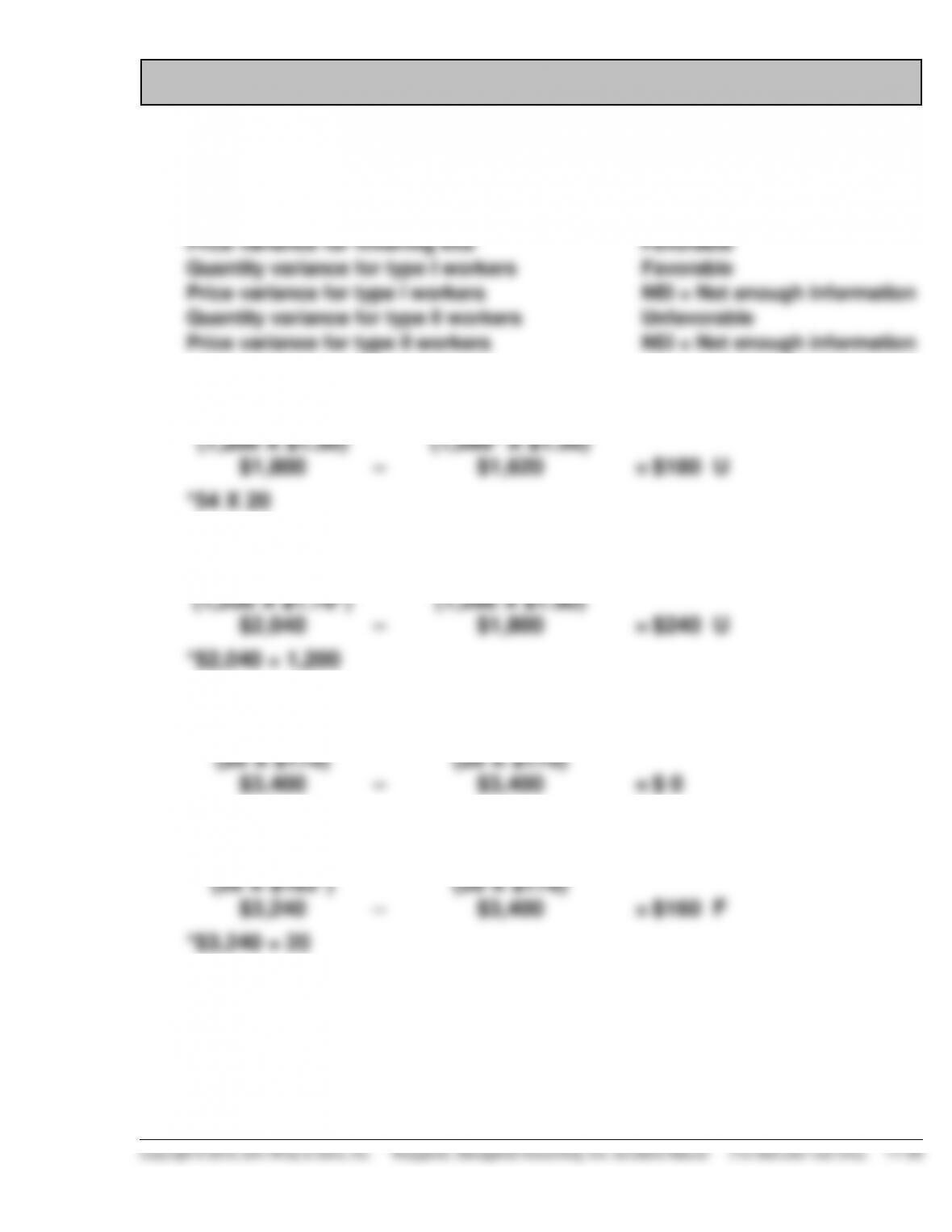
(a) Quantity variance for polyethylene powder Unfavorable
Price variance for polyethylene powder Unfavorable
Quantity variance for finishing kits NEI = Not enough information
(b) Quantity variance for polyethylene powder
( AQ X SP )
(1,200 X $1.50)
$1,800
–
–
( SQ X SP )
(1,080* X $1.50)
$1,620
=
$180 U
*54 X 20
Price variance for polyethylene powder
( AQ X AP )
(1,200 X $1.70*)
$2,040
–
–
( AQ X SP )
(1,200 X $1.50)
$1,800
=
$240 U
*$2,040 ÷ 1,200
Quantity variance for finishing kits
( AQ X SP )
(20 X $170)
$3,400
–
–
( SQ X SP )
(20 X $170)
$3,400
=
$ 0
Price variance for finishing kits
( AQ X AP )
(20 X $162*)
$3,240
–
–
( AQ X SP )
(20 X $170)
$3,400
=
$160 F
*$3,240 ÷ 20
BYP 11-1 (Continued)
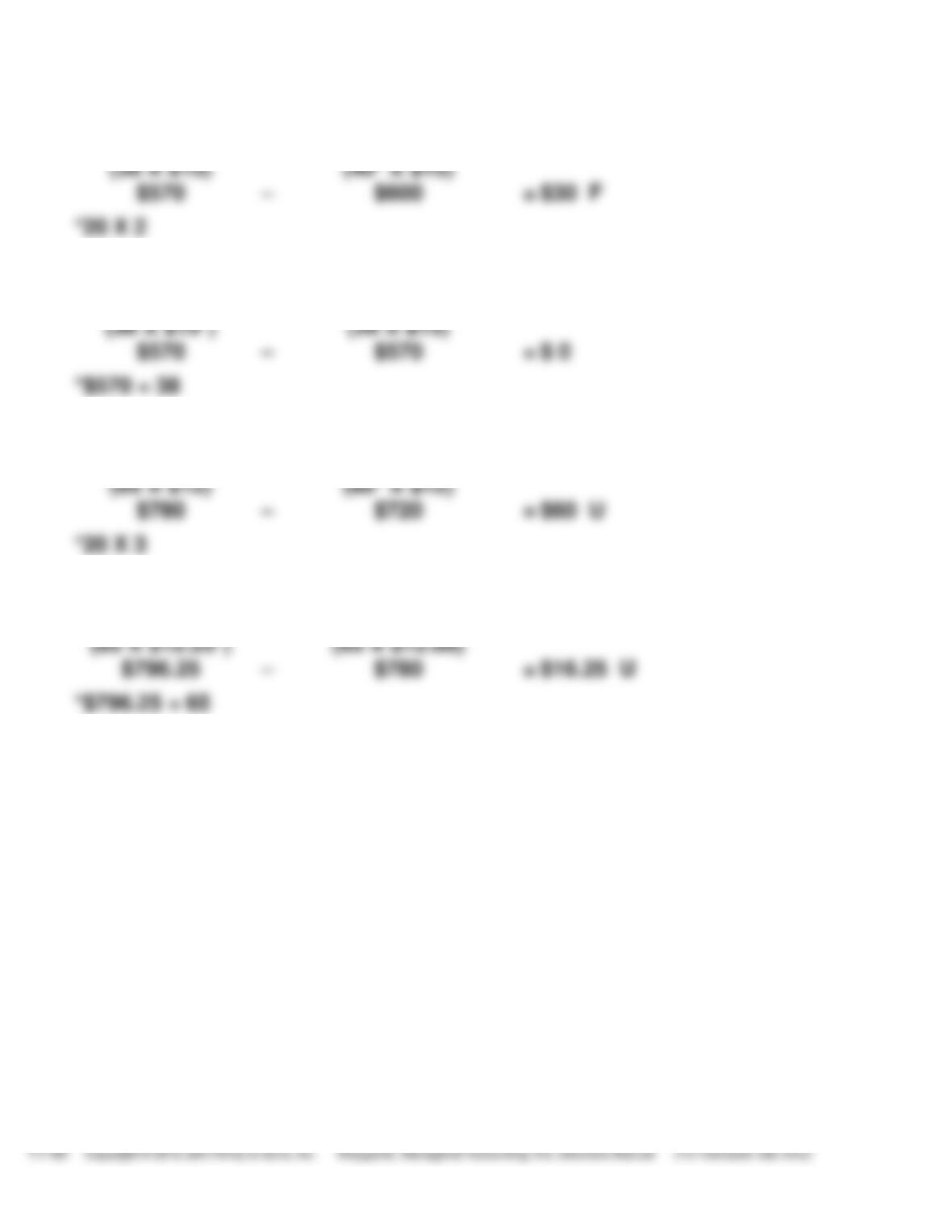
Quantity variance for type I workers
( AH X SR )
(38 X $15)
$570
–
–
( SH X SR )
(40* X $15)
$600
=
$30 F
*20 X 2
Price variance for type I workers
( AH X AR )
(38 X $15*)
$570
–
–
( AH X SR )
(38 X $15)
$570
=
$ 0
*$570 ÷ 38
Quantity variance for type II workers
( AH X SR )
(65 X $12)
$780
–
–
( SH X SR )
(60* X $12)
$720
=
$60 U
*20 X 3
Price variance for type II workers
( AH X AR )
(65 X $12.25*)
$796.25
–
–
( AH X SR )
(65 X $12.00)
$780
=
$16.25 U
*$796.25 ÷ 65
BYP 11-2 DECISION-MAKING ACROSS THE ORGANIZATION
(a) When setting a standard for computer/labor hours usage, Tryon Profes-
sionals should consider the following factors:
1. A standard set conservatively high may discourage clients from
purchasing the model.
2. A standard set too low may encourage sales of the model, but if
be upset at having been misled.
3. Clients are likely to use the standard as an evaluation tool for their
(b) Logical alternatives for the standard include:
1. 34 hours: The average number of hours used for one application
by all five financial institutions.
2. 45 hours: The conservatively high number experienced by one
financial institution.
(c) In light of earlier factors listed, the second and third choices for the
standard should be eliminated (i.e., 45 and 25 hours). The average

BYP 11-2 (Continued)
(d) Standard material cost for one model application:
User Manuals: $320 ÷ 20 manuals = $16/application.
BYP 11-3 MANAGERIAL ANALYSIS
(a) The overhead application rate is $144,000 divided by 5,000 hours, or
$28.80 per direct labor hour.
so the calculation is $28.80 X 4,500, or $129,600.
(c)
Actual Overhead
$150,000
–
Overhead Applied
$129,600
=
=
Total Overhead Variance
$20,400 U
Variable: ($12,000 + $43,000 + $10,000 + $2,500 + $700) ÷ 5,000 = $13.64
The variances are:
Controllable: Actual ($150,000) – Budgeted ($137,180) = $12,820 U
5.8% of applied overhead ($7,580 ÷ $129,600).
caused by underutilizing factory time. To improve performance, manage-
and increase production to 1,000 units.