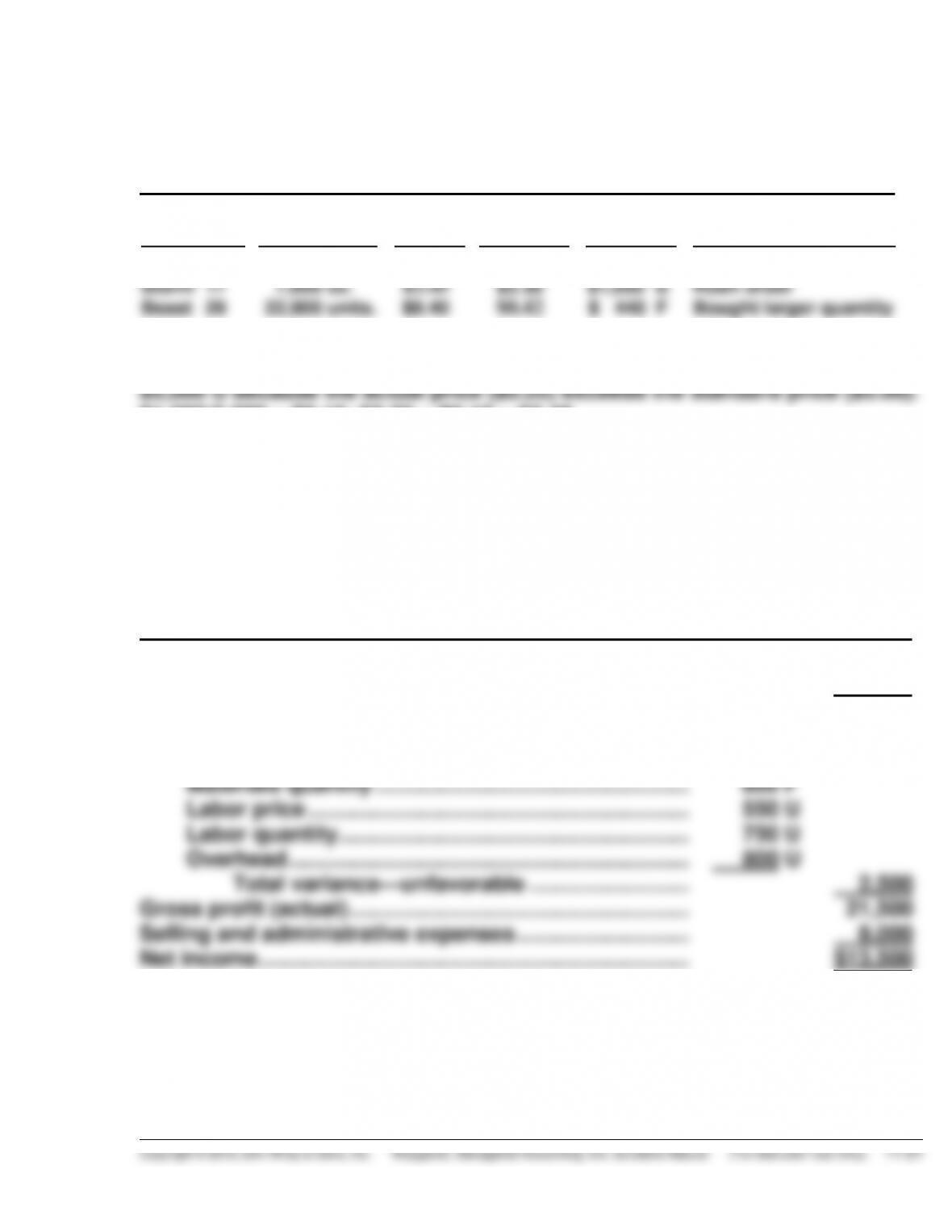
EXERCISE 11-15
BURTE CORPORATION
Variance Report – Purchasing Department
For Week Ended January 9, 2014
Type of
Materials
Quantity
Purchased
Actual
Price
Standard
Price
Price
Variance
Explanation
Rogue 11
Storm 17
Beast 29
25,000 lbs.
7,000 oz.
22,000 units.
$5.20
$3.45
$0.40
$5.00
$3.30
$0.42
$5,000 U
$1,050 U
$ 440 F
Price increase
Rush order
Bought larger quantity
25,000 = $5,000/($5.20 – $5.00).
$1,050/7,000 = $0.15; $3.30 + $0.15 = $3.45
$440/22,000 = $0.02; $0.40 + $0.02 = $0.42
EXERCISE 11-16
FISK COMPANY
Income Statement
For the Month Ended January 31, 2014
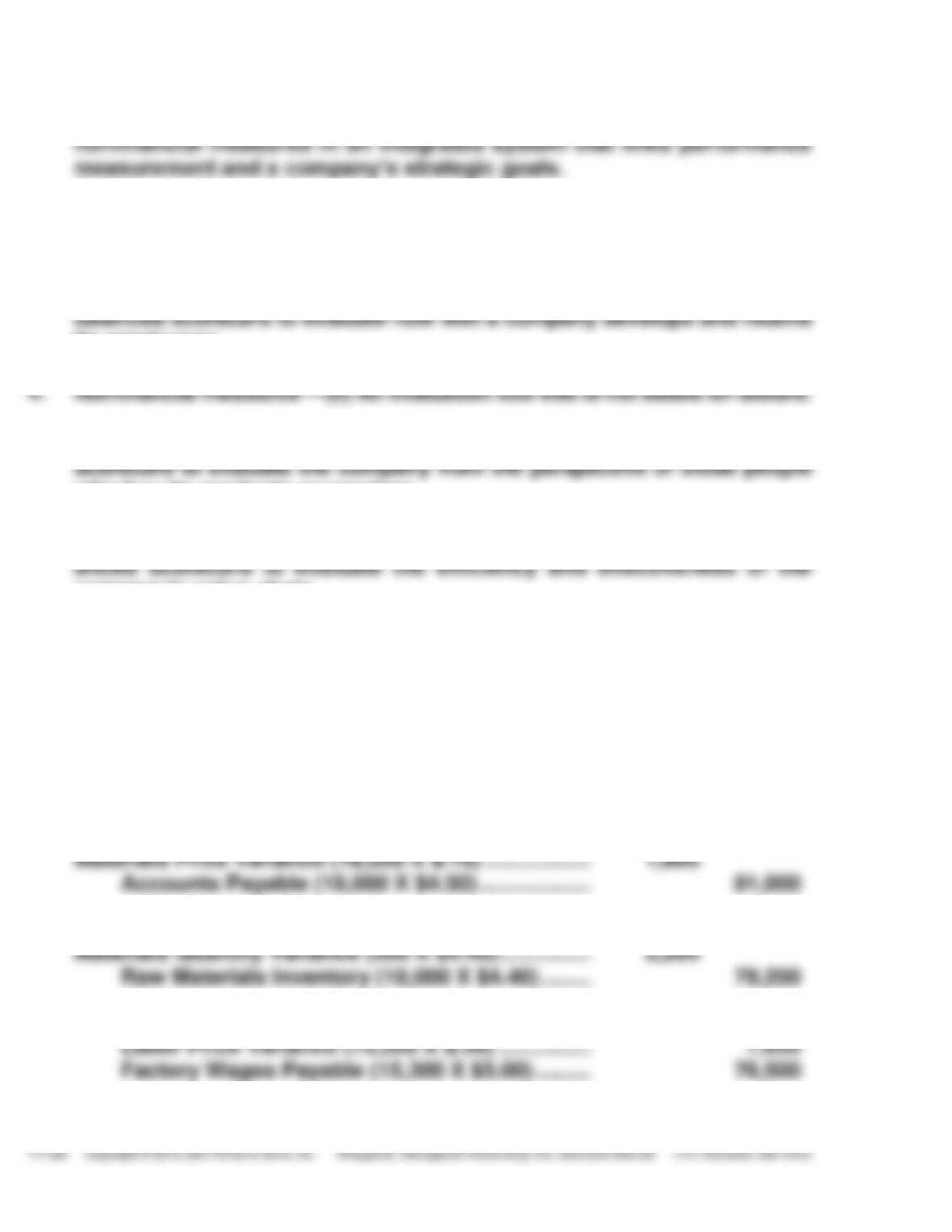
Sales revenue (8,000 X $8) ……………………………………… $64,000
Cost of goods sold (8,000 X $5) ……………………………… 40,000
Gross profit (at standard) ………………………………………. 24,000
Variances
Materials price ……………………………………………….. $1,200 U
EXERCISE 11-17
1. Balanced scorecard—(c) An approach that incorporates financial and
2. Variance—(a) The difference between total actual costs and total stan-
dard costs.
3. Learning and growth perspective—(d) A viewpoint employed in the
its employees.
5. Customer perspective—(f) A viewpoint employed in the balanced
who buy its products or services.
6. Internal process perspective—(h) A viewpoint employed in the bal-
company’s value chain.
7. Ideal standards—(g) An optimum level of performance under perfect oper-
ating conditions.
8. Normal standards—(b) An efficient level of performance that is attainable
under expected operating conditions.
*EXERCISE 11-18
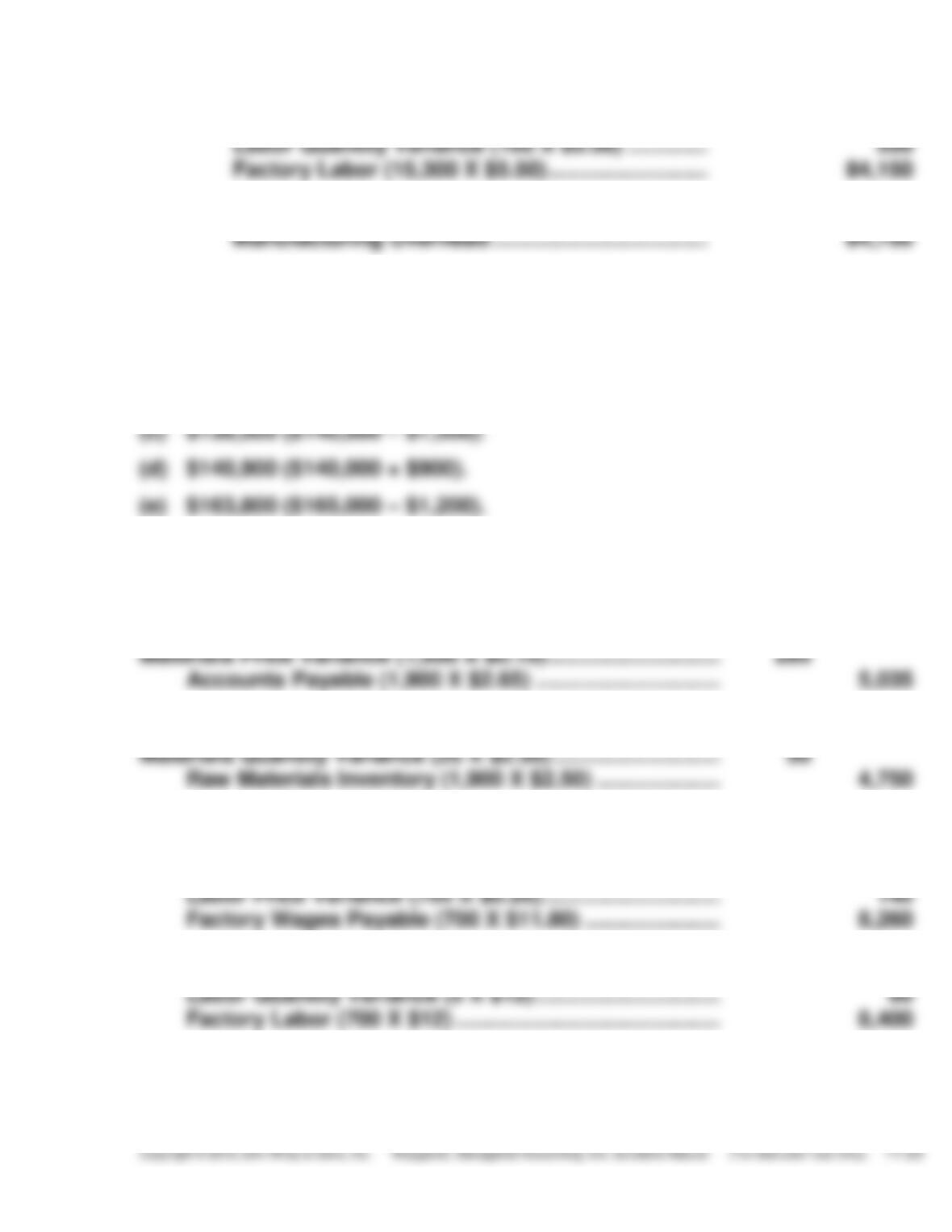
1. Raw Materials Inventory (18,000 X $4.40) ……………. 79,200
2. Work in Process Inventory (17,500 X $4.40) ……….. 77,000
3. Factory Labor (15,300 X $5.50)…………………………... 84,150
*EXERCISE 11-18 (Continued)
4. Work in Process Inventory (15,400 X $5.50) ………… 84,700
5. Work in Process Inventory ($84,700 X 100%) ………. 84,700
*EXERCISE 11-19
(a) $126,000 ($128,000 – $2,000).
(b) $129,000 ($126,000 + $3,000).
*EXERCISE 11-20
Raw Materials Inventory (1,900 X $2.50) ………………………. 4,750
Work in Process Inventory (1,880* X $2.50) …………………. 4,700
*235 X 8
Factory Labor (700 X $12) …………………………………………… 8,400
Work in Process Inventory (705* X $12) ………………………. 8,460
*235 X 3

*EXERCISE 11-21
(a)
Item
Amount
Hours
Rate
Variable overhead ……………………………..
Fixed overhead …………………………………
Total overhead ………………………………….
$34,650
19,800
$54,450
16,500
16,500
16,500
$2.10
1.20
$3.30
(b) Total overhead variance:
Actual Overhead
$55,000
–
–
Overhead Applied
$52,800
(16,000* X $3.30)
=
$2,200 U
*4,000 X 4 hrs. = 16,000 hrs.
Overhead controllable variance:
Actual Overhead
$55,000
–
–
Overhead Budgeted
$53,400
[(16,000 X $2.10) + $19,800]
=
$1,600 U
Overhead volume variance:
Fixed Overhead
Rate
$1.20
X
X
Normal Capacity
Hours
[(16,500
–
–
Standard Hours
Allowed
(4,000 X 4)]
=
$600 U
inefficiency in controlling variable overhead costs.
The overhead volume variance relates to fixed overhead costs. This
*EXERCISE 11-22
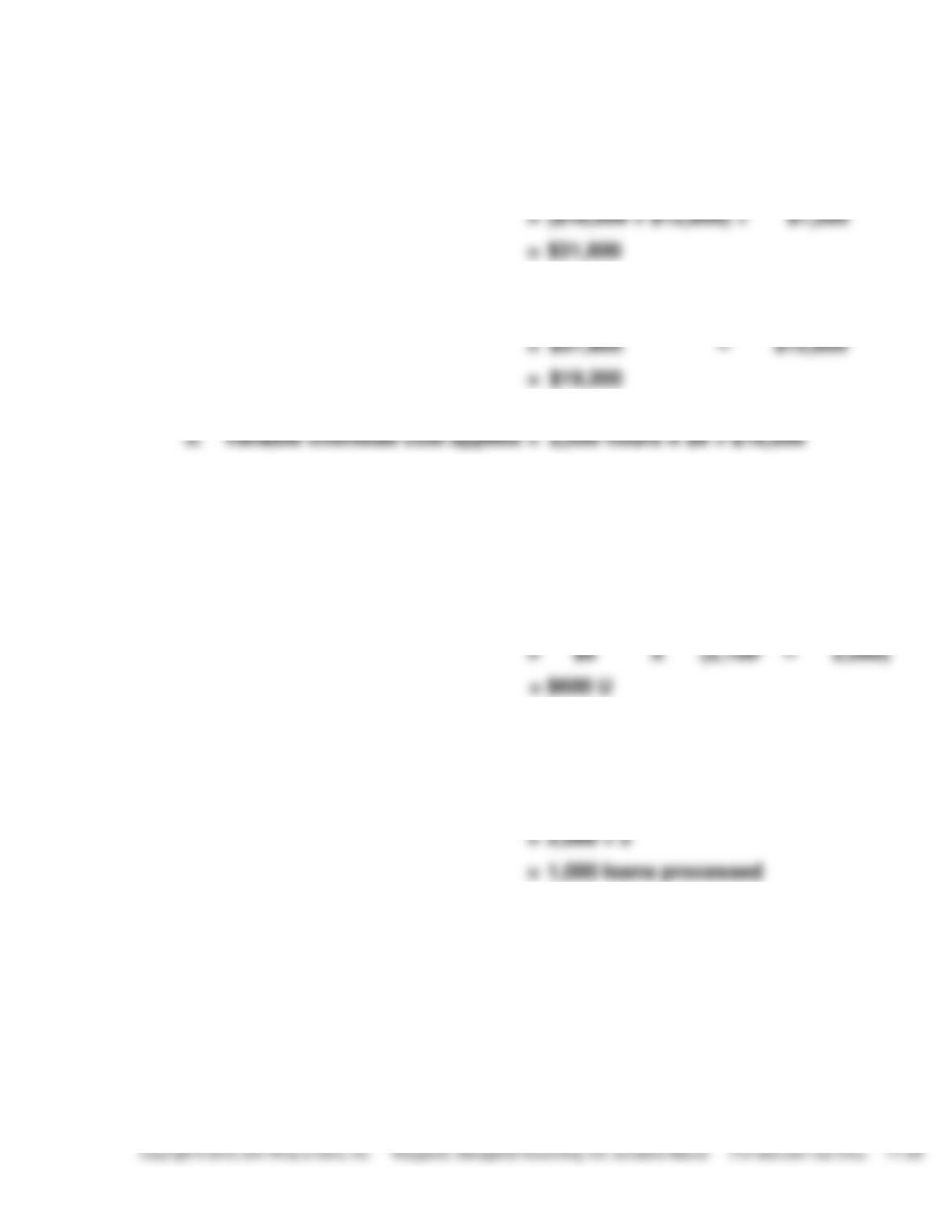
(a)
1.
Total actual overhead cost
=
Overhead
Budgeted +
Overhead
Controllable
Variance
=
($18,000 + $12,600) + $1,200
=
$31,800
2.
Actual variable overhead cost
=
Actual Overhead – Fixed Overhead
=
$31,800 – $12,600
=
$19,200
3.
Variable overhead cost applied
=
2,000 hours X $9 = $18,000
4.
Fixed overhead cost applied
=
2,000 hours X $6 = $12,000
5.
Overhead volume variance
=
Fixed
Overhead
Rate
X
Normal Standard
Capacity –Hours
Hours Allowed
=
$6 X (2,100* – 2,000)
=
$600 U
*$12,600 ÷ $6 per hour = 2,100 hours
(b)
Number of loans processed
=
Standard hours allowed ÷
Standard hours per application
=
2,000 ÷ 2
=
1,000 loans processed
EXERCISE 11-23
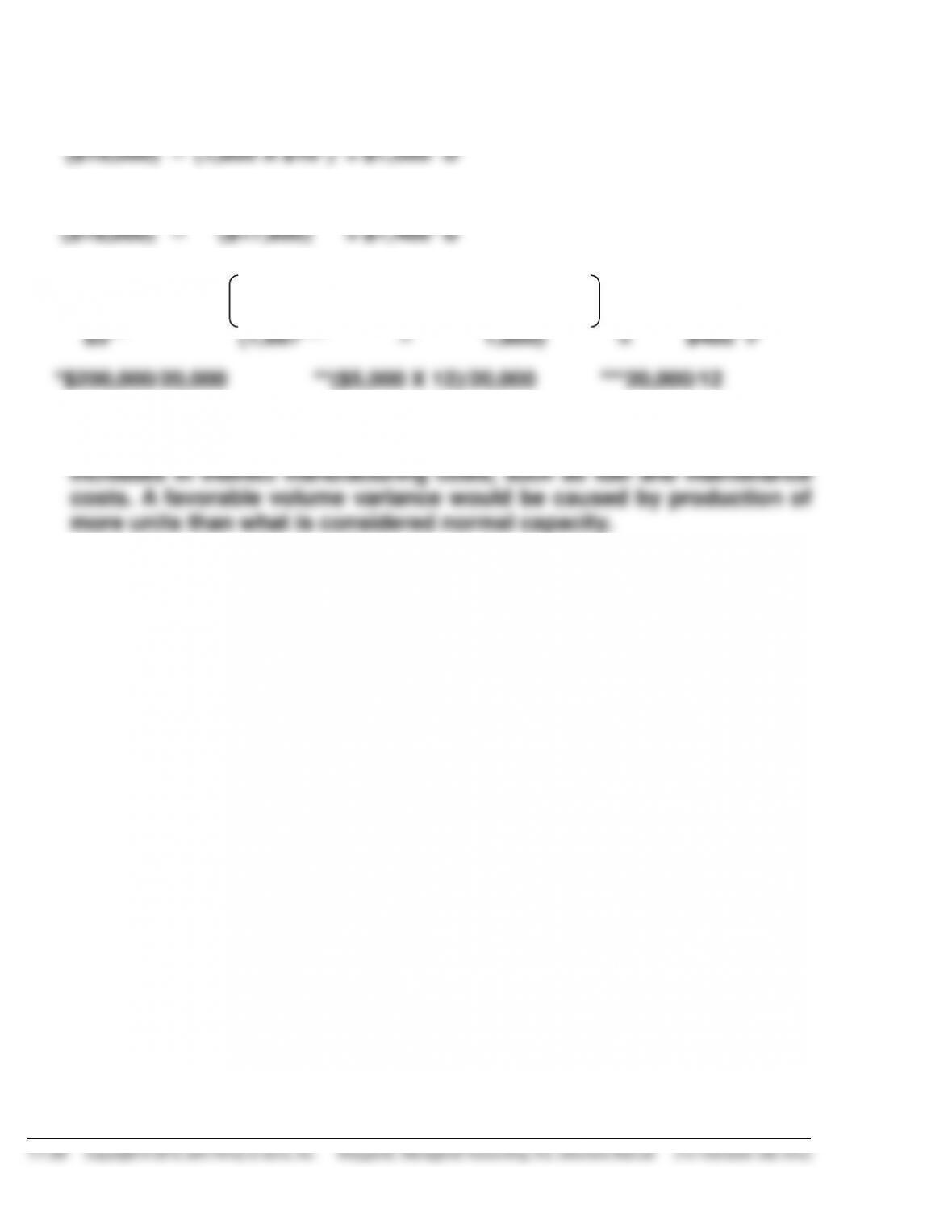
(a)
(Actual)
($19,000)
–
–
(Applied)
(1,800 X $10*)
=
=
Total Overhead Variance
$1,000 U
(Actual)
($19,000)
–
–
(Budgeted)
($17,600)
=
=
Overhead Controllable Variance
$1,400 U
Fixed OH
Rate
$3**
Normal
X Capacity
(1,667***
–
–
Standard Hours
Allowed
1,800)
=
=
Overhead Volume
Variance
$400 F
*$200,000/20,000 **($5,000 X 12)/20,000 ***20,000/12
(b) The cause of an unfavorable controllable variance could be higher than
expected use of indirect materials, indirect labor, and factory supplies, or
SOLUTIONS TO PROBLEMS
PROBLEM 11-1A
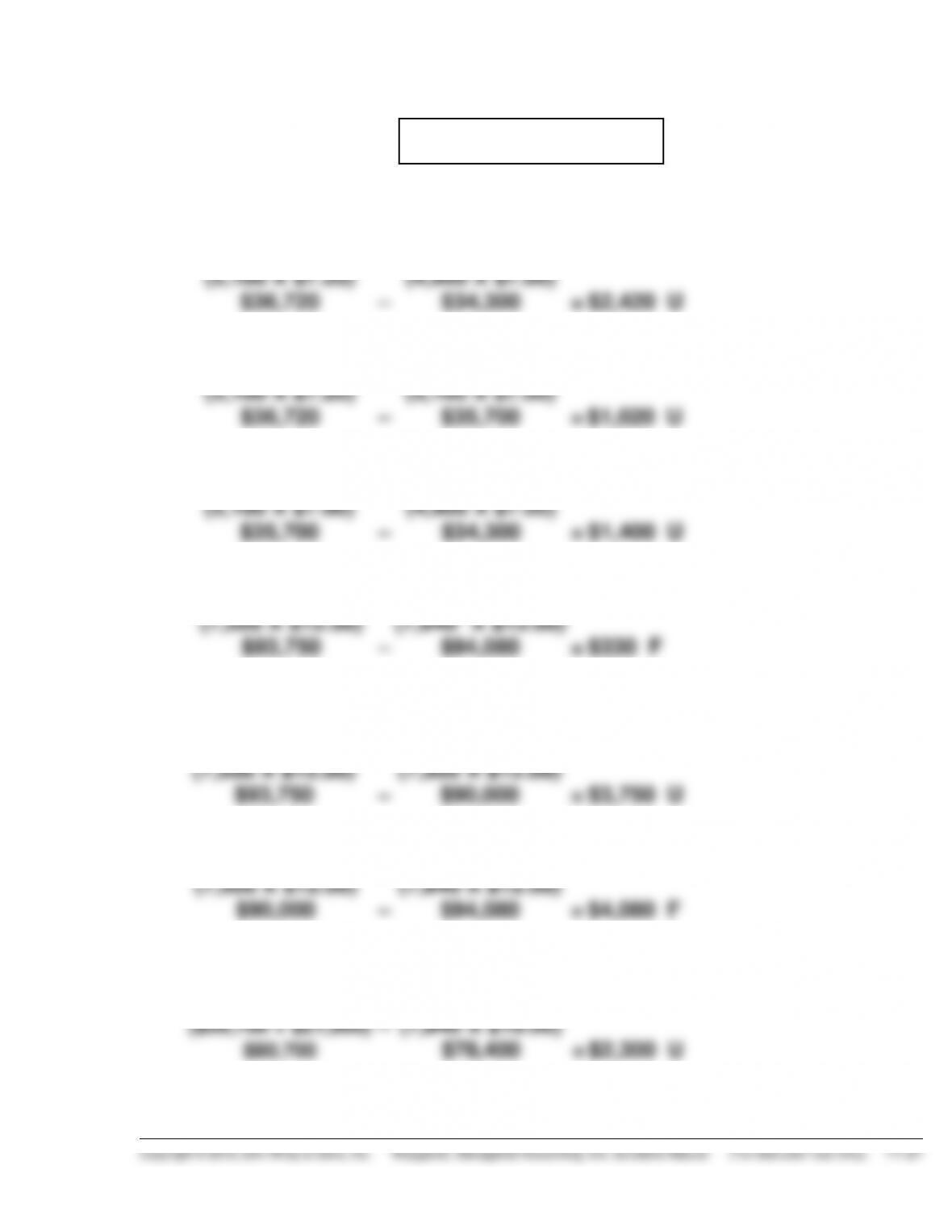
(a) Total materials variance:
( AQ X AP )
(5,100 X $7.20)
$36,720
–
–
( SQ X SP )
(4,900 X $7.00)
$34,300
=
$2,420 U
Materials price variance:
( AQ X AP )
(5,100 X $7.20)
$36,720
–
–
( AQ X SP )
(5,100 X $7.00)
$35,700
=
$1,020 U
Materials quantity variance:
( AQ X SP )
(5,100 X $7.00)
$35,700
–
–
( SQ X SP )
(4,900 X $7.00)
$34,300
=
$1,400 U
Total labor variance:
( AH X AR )
(7,500 X $12.50)
$93,750
–
–
( SH X SR )
(7,840* X $12.00)
$94,080
=
$330 F
*4,900 X 1.6
Labor price variance:
( AH X AR )
(7,500 X $12.50)
$93,750
–
–
( AH X SR )
(7,500 X $12.00)
$90,000
=
$3,750 U
Labor quantity variance:
( AH X SR )
(7,500 X $12.00)
$90,000
–
–
( SH X SR )
(7,840 X $12.00)
$94,080
=
$4,080 F
(b) Total overhead variance:
Actual
Overhead
($59,700 + $21,000)
$80,700
–
–
Overhead
Applied
(7,840 X $10.00)
$78,400
=
$2,300 U
PROBLEM 11-2A
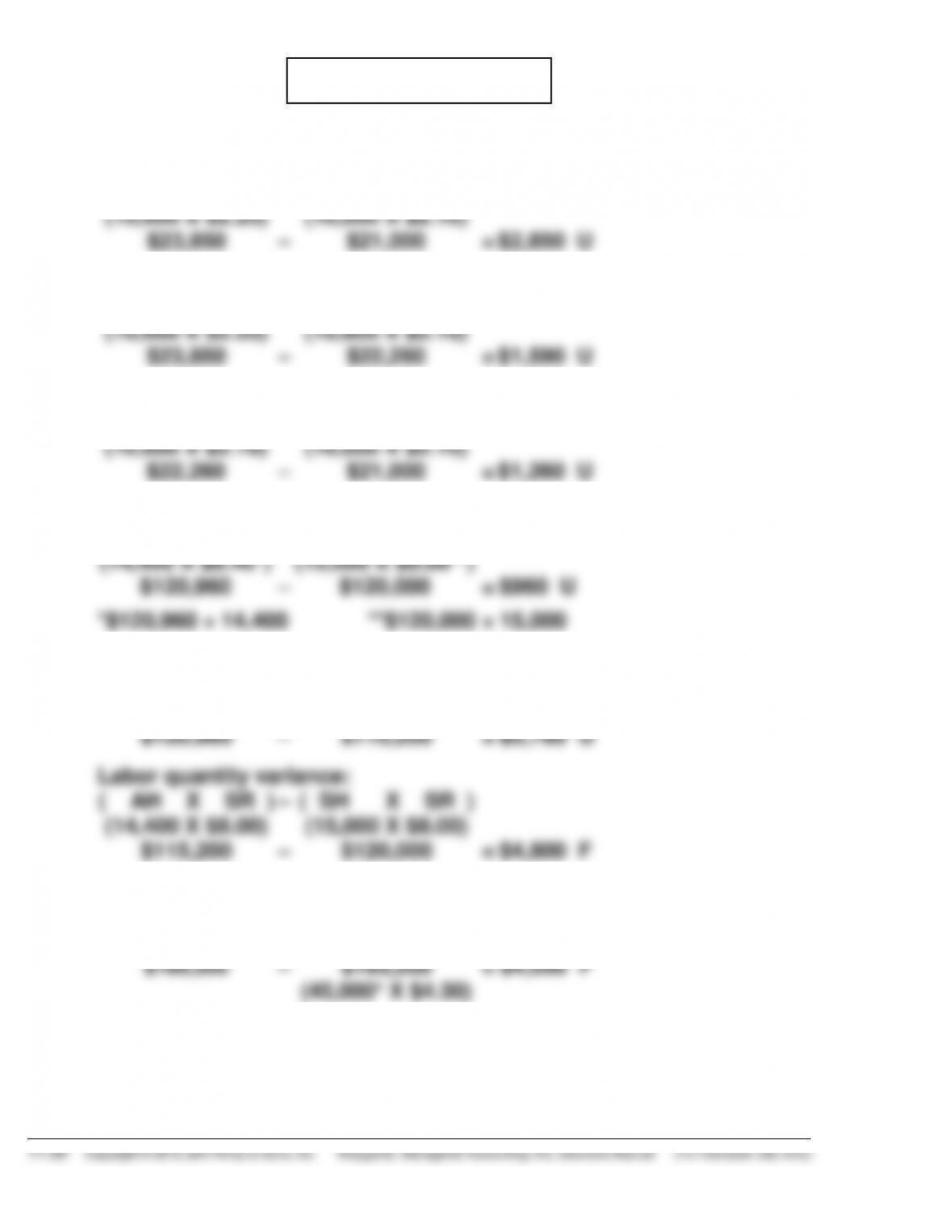
(a) 1. Total materials variance:
( AQ X AP )
(10,600 X $2.25)
$23,850
–
–
( SQ X SP )
(10,000 X $2.10)
$21,000
=
$2,850 U
Materials price variance:
( AQ X AP )
(10,600 X $2.25)
$23,850
–
–
( AQ X SP )
(10,600 X $2.10)
$22,260
=
$1,590 U
Materials quantity variance:
( AQ X SP )
(10,600 X $2.10)
$22,260
–
–
( SQ X SP )
(10,000 X $2.10)
$21,000
=
$1,260 U
2. Total labor variance:
( AH X AR )
(14,400 X $8.40*)
$120,960
–
–
( SH X SR )
(15,000 X $8.00**)
$120,000
=
$960 U
*$120,960 ÷ 14,400 **$120,000 ÷ 15,000
Labor price variance:
( AH X AR )
(14,400 X $8.40)
$120,960
–
–
( AH X SR )
(14,400 X $8.00)
$115,200
=
$5,760 U
Labor quantity variance:
( AH X SR )
(14,400 X $8.00)
$115,200
–
–
( SH X SR )
(15,000 X $8.00)
$120,000
=
$4,800 F
(b) Total overhead variance:
Actual
Overhead
$189,500
–
–
Overhead
Applied
$193,500
(45,000* X $4.30)
=
$4,000 F
*15,000 X 3
PROBLEM 11-2A (Continued)
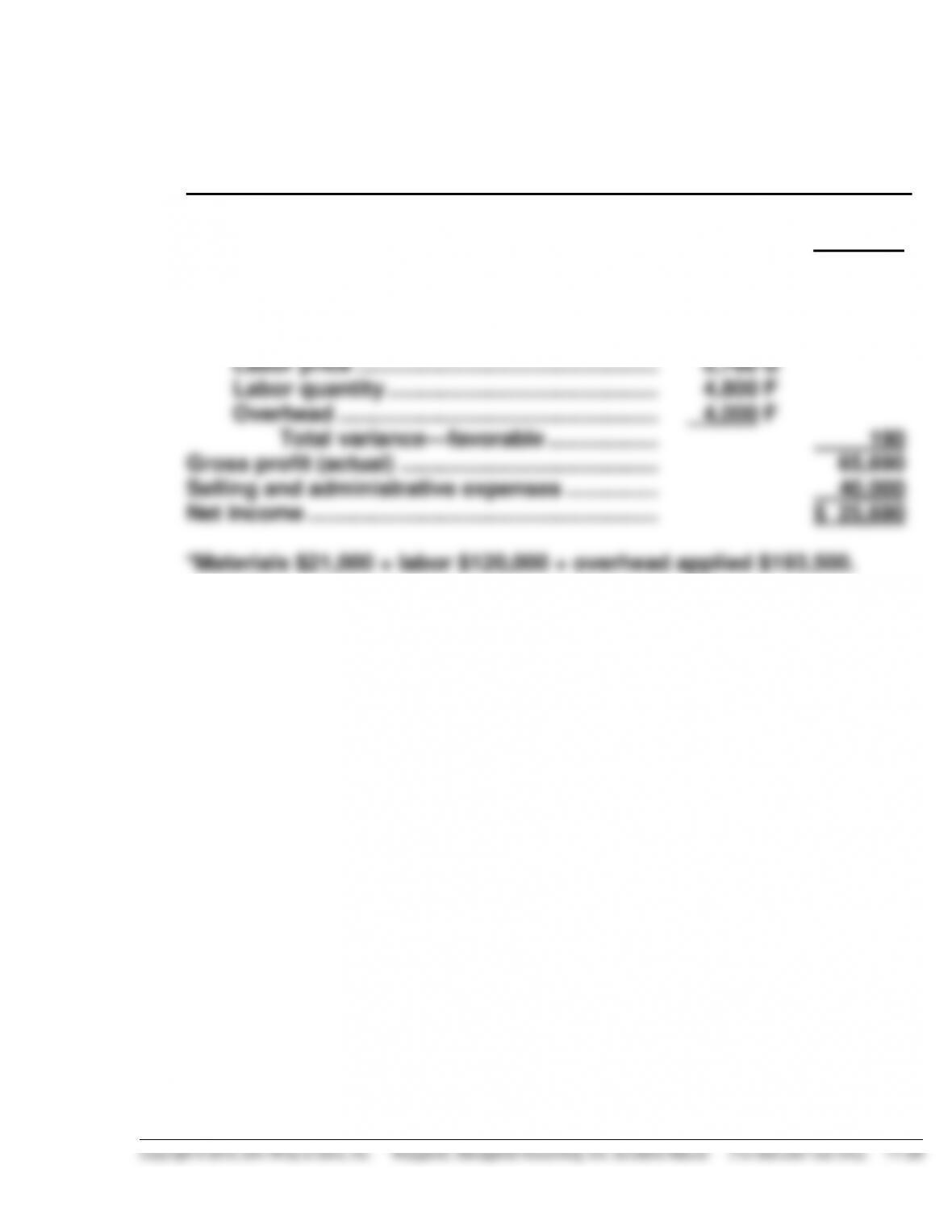
(c) AYALA CORPORATION
Income Statement
For the Month Ended June 30, 2014
Sales revenue ……………………………………………. $400,000
Cost of goods sold (at standard) …………………. 334,500*
Gross profit (at standard) ……………………………. 65,500
Variances
Materials price …………………………………….. $ 1,590 U
Materials quantity ………………………………… 1,260 U
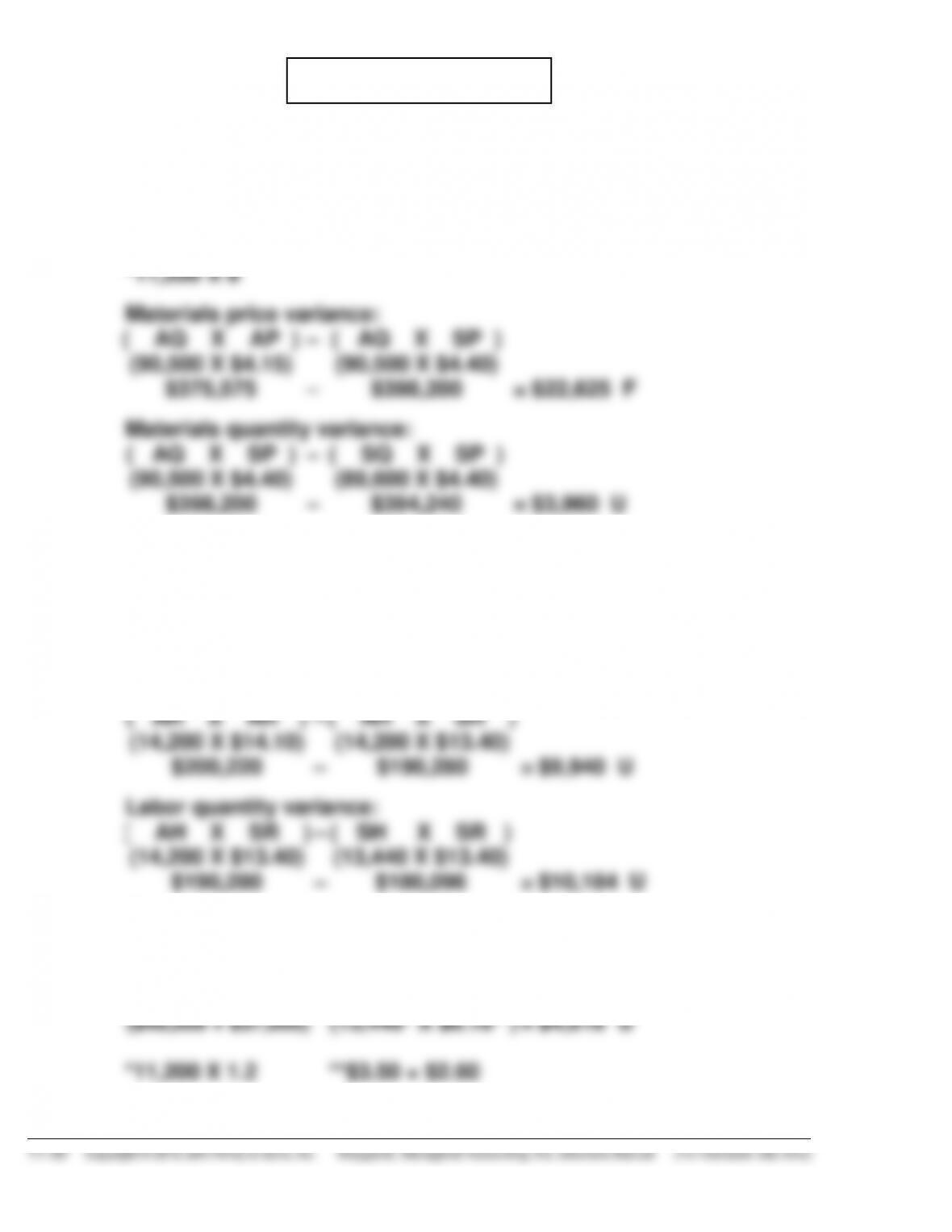
PROBLEM 11-3A
(a) 1. Total materials variance:
( AQ X AP )
(90,500 X $4.15)
$375,575
–
–
( SQ X SP )
(89,600* X $4.40)
$394,240
=
$18,665 F
( AQ X SP )
$200,220
$190,280
=