CHAPTER 10
Budgetary Control and Responsibility Accounting
ASSIGNMENT CLASSIFICATION TABLE
Learning Objectives
Questions
Brief
Exercises
Do It!
Exercises
A
Problems
B
Problems
1. Describe the concept of
budgetary control.
1, 2
1
2. Evaluate the usefulness
of static budget reports.
3, 4, 5
1, 2
1, 2, 8, 10
3A
3B
3. Explain the development
of flexible budgets and
the usefulness of flexible
budget reports.
6, 7, 8, 9,
10, 11, 12
3, 4, 5
1, 2
1, 3, 4, 5,
6, 7, 8, 9,
10, 11, 12
1A, 2A, 3A
1B, 2B, 3B
4. Describe the concept of
responsibility accounting.
13, 14, 15, 16,
17, 18, 24
13
6A
6B
5. Indicate the features of
responsibility reports
for cost centers.
19
6
9, 11, 14
6. Identify the content of
responsibility reports
for profit centers.
20, 21
7
3
15, 16
4A
4B
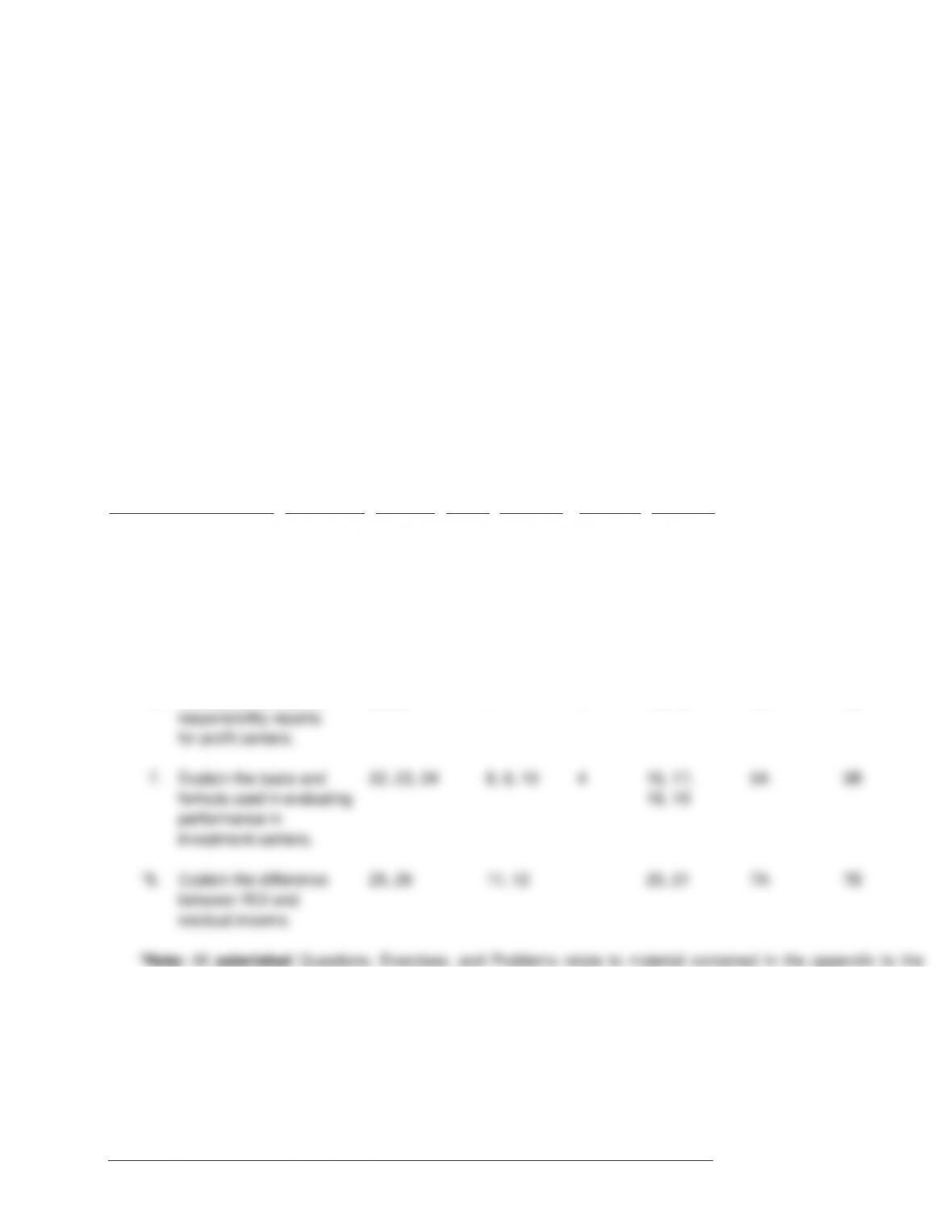
7. Explain the basis and
formula used in evaluating
performance in
investment centers.
22, 23, 24
8, 9, 10
4
16, 17,
18, 19
5A
5B
*8. Explain the difference
between ROI and
residual income.
25, 26
11, 12
20, 21
7A
7B
*Note: All asterisked Questions, Exercises, and Problems relate to material contained in the appendix to the
chapter.
ASSIGNMENT CHARACTERISTICS TABLE
Problem
Number
Description
Difficulty
Level
Time
Allotted (min.)
1A
Prepare flexible budget and budget report for manufacturing
overhead.
Simple
20–30
2A
Prepare flexible budget, budget report, and graph for
manufacturing overhead.
Moderate
30–40
3A
State total budgeted cost formula, and prepare flexible
budget reports for two time periods.
Simple
20–30
4A
Prepare responsibility report for a profit center.
Moderate
20–30
5A
Prepare responsibility report for an investment center,
and compute ROI.
Moderate
40–50
6A
Prepare reports for cost centers under responsibility
accounting, and comment on performance of managers.
Moderate
40–50
*7A
Compare ROI and residual income.
Moderate
25–35
1B
Prepare flexible budget and budget report for manufacturing
overhead.
Simple
20–30
2B
Prepare flexible budget, budget report, and graph for
manufacturing overhead.
Moderate
30–40
3B
State total budgeted cost formula, and prepare flexible
budget reports for two time periods.
Simple
20–30
4B
Prepare responsibility report for a profit center.
Moderate
20–30
5B
Prepare responsibility report for an investment center,
and compute ROI.
Moderate
40–50
6B
Prepare reports for cost centers under responsibility
accounting, and comment on performance of managers.
Moderate
40–50
*7B
Compare ROI and residual income.
Moderate
25–35

BLOOM’S TAXONOMY TABLE
Copyright © 2012 John Wiley & Sons, Inc. Weygandt, Managerial Accounting, 6/e, Solutions Manual (For Instructor Use Only) 10-3
Learning Objective
Knowledge
Comprehension
Application
Analysis
Synthesis
Evaluation
1. Describe the concept
of budgetary control.
E10-1
Q10-1
Q10-2
2. Evaluate the usefulness
of static budget reports.
E10-1
Q10-3
Q10-4
Q10-5
BE10-1
BE10-2
E10-2
E10-10
P10-3A
P10-3B
E10-8
3. Explain the development
of flexible budgets and
the usefulness of flexible
budget reports.
Q10-9
Q10-12
E10-1
Q10-6
Q10-7
Q10-8
Q10-10
Q10-11
BE10-4
DI10-1
DI10-2
E10-3
E10-5
E10-7
E10-9
E10-10
E10-11
E10-12
BE10-5
E10-4
E10-6
P10-1A
P10-3A
P10-1B
P10-3B
BE10-3
E10-8
P10-2A
P10-2B
4. Describe the concept of
responsibility accounting.
Q10-13
Q10-14
Q10-15
Q10-16
Q10-17
Q10-18
Q10-24
E10-13
P10-6A
P10-6B
5. Indicate the features of
responsibility reports
for cost centers.
Q10-19
BE10-6
E10-9
E10-11
E10-14
6. Identify the content of
responsibility reports
for profit centers.
Q10-20
Q10-21
BE10-7
DI10-3
E10-16
E10-15
P10-4A
P10-4B
7. Explain the basis and
formula used in evaluating
performance in investment
centers.
Q10-22
Q10-23
Q10-24
BE10-8
BE10-9
BE10-10
DI10-4
E10-16
E10-17
E10-18
E10-19
P10-5A
P10-5B
*8. Explain the difference
between ROI and
residual income.
Q10-25
Q10-26
BE10-11
BE10-12
E10-20
E10-21
P10-7A
P10-7B
Broadening Your Perspective
BYP10-5
BYP10-4
BYP10-6
BYP10-7
BYP10-2
BYP10-3
BYP10-8
BYP10-9

ANSWERS TO QUESTIONS
1. (a) Budgetary control is the use of budgets in controlling operations.
(b) The steps in budgetary control are:
(1) Develop the planned objectives (budget).
2.
Purpose
Name of Report
Frequency
Primary Recipient(s)
(a)
(b)
(c)
Scrap
Departmental overhead costs
Income statement
Daily
Monthly
Monthly and Quarterly
Production manager
Department manager
Top management
3. The budget report for the second quarter can include year–to-date information as well as data for
the second quarter.
4. There is no justification for Ken’s concern. The sales budget is derived from the sales forecast
sales performance.
5. A static budget is an appropriate basis for evaluating a manager’s effectiveness in controlling
costs when:
7. The performance is unfavorable. The budgeted indirect labor cost in the static budget is $1.35 per
8. The performance is favorable. Factory insurance is a fixed cost. At 50,000 direct labor hours, the
9. The steps in preparing a flexible budget are:
(1) Identify the activity index and the relevant range of activity.
each cost.
(3) Identify the fixed costs, and determine the budgeted amount for each cost.
(4) Prepare the budget for selected increments of activity within the relevant range.
hour [($85,000 – $20,000) ÷ 10,000].
11. (a) At 9,000 hours, total budgeted costs are $86,000, or [$50,000 + ($4 X 9,000)].

Questions Chapter 10 (Continued)
12. Management by exception means that top management’s review of a budget report is focused
13. Responsibility accounting is a method of controlling operations that involves accumulating and
14. Eve should know that the following conditions contribute to the effective use of responsibility
accounting:
responsibility.
(2) The costs and revenues are controllable at the level of responsibility with which they are
associated.
costs and revenues.
15. A cost is controllable at a given level of managerial responsibility if the manager has the power to
16. Responsibility reports differ from budget reports in two respects: (1) a distinction is made between
17. Usually there is a relationship between a responsibility reporting system and a company’s organization
organization chart.
18. There are three types of responsibility centers:
funds available for use.
19. (a) Only controllable costs are included in a performance report for a cost center.
20. Direct fixed costs relate specifically to one center and are incurred for the sole benefit of that
center. An indirect fixed cost relates to the company’s overall activities and is incurred for the
21. Controllable margin is contribution margin less controllable fixed costs in a profit center. The purpose

Questions Chapter 10 (Continued)
22. The primary basis for evaluating the performance of the manager of an investment center is
23. ROI can be improved by: (1) increasing controllable margin and (2) reducing average operating
24. (a) The manager being evaluated should have direct input into the process of establishing budget
*25. ROI fails to indicate the dollar amount of change in residual income. That is, a positive increase
*26. Residual income is the income that remains after subtracting from the controllable margin the
minimum rate of return on a company’s average operating assets. Residual income as a per-

SOLUTIONS TO BRIEF EXERCISES
BRIEF EXERCISE 10-1
MARIS COMPANY
Sales Budget Report
For the Quarter Ended March 31, 2014
Product Line
Budget
Actual
Difference
Garden-Tools
$310,000
$305,000
$5,000 U
BRIEF EXERCISE 10-2
MARIS COMPANY
Sales Budget Report
For the Quarter Ended June 30, 2014
Second Quarter
Year to Date
Product Line
Budget
Actual
Difference
Budget
Actual
Difference
Garden–Tools
$380,000
$384,000
$4,000 F
$690,000
$689,000
$1,000 U
BRIEF EXERCISE 10-3
(a) PAIGE COMPANY
Static Direct Labor Budget Report
For the Month Ended January 31, 2014
Budget
Actual
Difference
Direct Labor
$200,000
(10,000 X $20)
$204,000
$4,000 U
(b) PAIGE COMPANY
Flexible Direct Labor Budget Report
For the Month Ended January 31, 2014
Budget
Actual
Difference
Direct Labor
$208,000
(10,400 X $20)
$204,000
$4,000 F

BRIEF EXERCISE 10-3 (Continued)
The static budget does not provide a proper basis for evaluating performance
because the budget is not based on the hours actually worked. In contrast,
the flexible budget provides the proper basis for evaluating performance
BRIEF EXERCISE 10-4
GUNDY COMPANY
Monthly Flexible Manufacturing Budget
For the Year 2014
Activity level
Finished units
Variable costs
Direct materials ($5)
Direct labor ($6)
Overhead ($8)
Total variable costs ($19)
Fixed costs
Depreciation (1)
Supervision (2)
Total fixed costs
Total costs
80,000
$ 400,000
480,000
640,000
$1,520,000
200,000
100,000
300,000
$1,820,000
100,000
$ 500,000
600,000
800,000
$1,900,000
200,000
100,000
300,000
$2,200,000
120,000
$ 600,000
720,000
960,000
$2,280,000
200,000
100,000
300,000
$2,580,000

BRIEF EXERCISE 10-5
GUNDY COMPANY
Manufacturing Flexible Budget Report
For the Month Ended March 31, 2014
Budget
Actual
Difference
Units produced
Variable costs
Direct materials
Direct labor
Overhead
Total variable costs
Fixed costs
Depreciation
Supervision
Total fixed costs
Total costs
100,000
$ 500,000
600,000
800,000
$1,900,000
200,000
100,000
300,000
$2,200,000
100,000
$ 525,000
596,000
805,000
$1,926,000
200,000
100,000
300,000
$2,226,000
Favorable F
Unfavorable U
$25,000 U
4,000 F
5,000 U
$26,000 U
–0–
–0–
–0–
$26,000 U
BRIEF EXERCISE 10-6
HANNON COMPANY
Assembly Department
Manufacturing Overhead Cost Responsibility Report
For the Month Ended April 30, 2014
Controllable Cost
Budget
Actual
Difference
Indirect materials
$16,000
$14,300
Favorable F
Unfavorable U
$1,700 F
$51,000

BRIEF EXERCISE 10-7
ELBERT COMPANY
Water Division
Responsibility Report
For the Year Ended December 31, 2014
Budget
Actual
Difference
Sales
Variable costs
Contribution margin
Controllable fixed costs
Controllable margin
$2,000,000
1,000,000
1,000,000
300,000
$ 700,000
$2,080,000
1,060,000
1,020,000
305,000
$ 715,000
Favorable F
Unfavorable U
$80,000 F
60,000 U
20,000 F
5,000 U
$15,000 F
BRIEF EXERCISE 10-8
COBB COMPANY
Plastics Division
Responsibility Report
For the Year Ended December 31, 2014
Budget
Actual
Difference
Contribution margin
Controllable fixed costs
Controllable margin
Return on investment
$700,000
300,000
$400,000
20%
$710,000
302,000
$408,000
20.4%
Favorable F
Unfavorable U
$10,000 F
2,000 U
$ 8,000 F
.4% F
($400,000 ÷
$2,000,000)
($408,000 ÷
$2,000,000)
($8,000 ÷
$2,000,000)
BRIEF EXERCISE 10-9
III 26% ($1,300,000 ÷ $5,000,000)