Chapter 18 503
36. EOQ (Face cream) = √ (2QO ÷ C)
EOQ (Lotion) = √ [2 1,000 40) ÷ 1.45]
EOQ (Powder) = √ [(2 × 900 × 15) ÷ 1.25]
37. EOQ = √ (2QO ÷ C)
38. EPR = √ (2QS ÷ C)
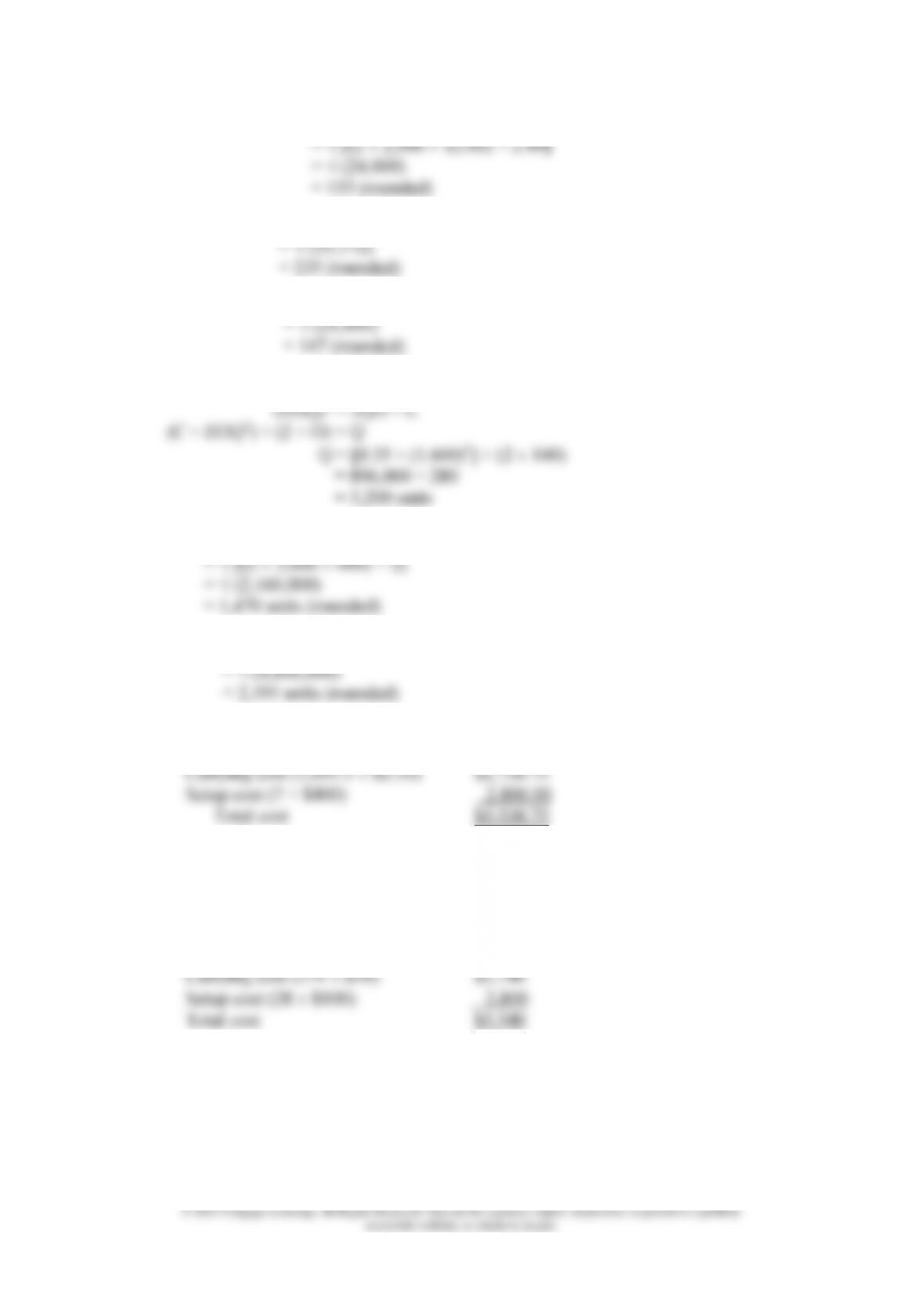
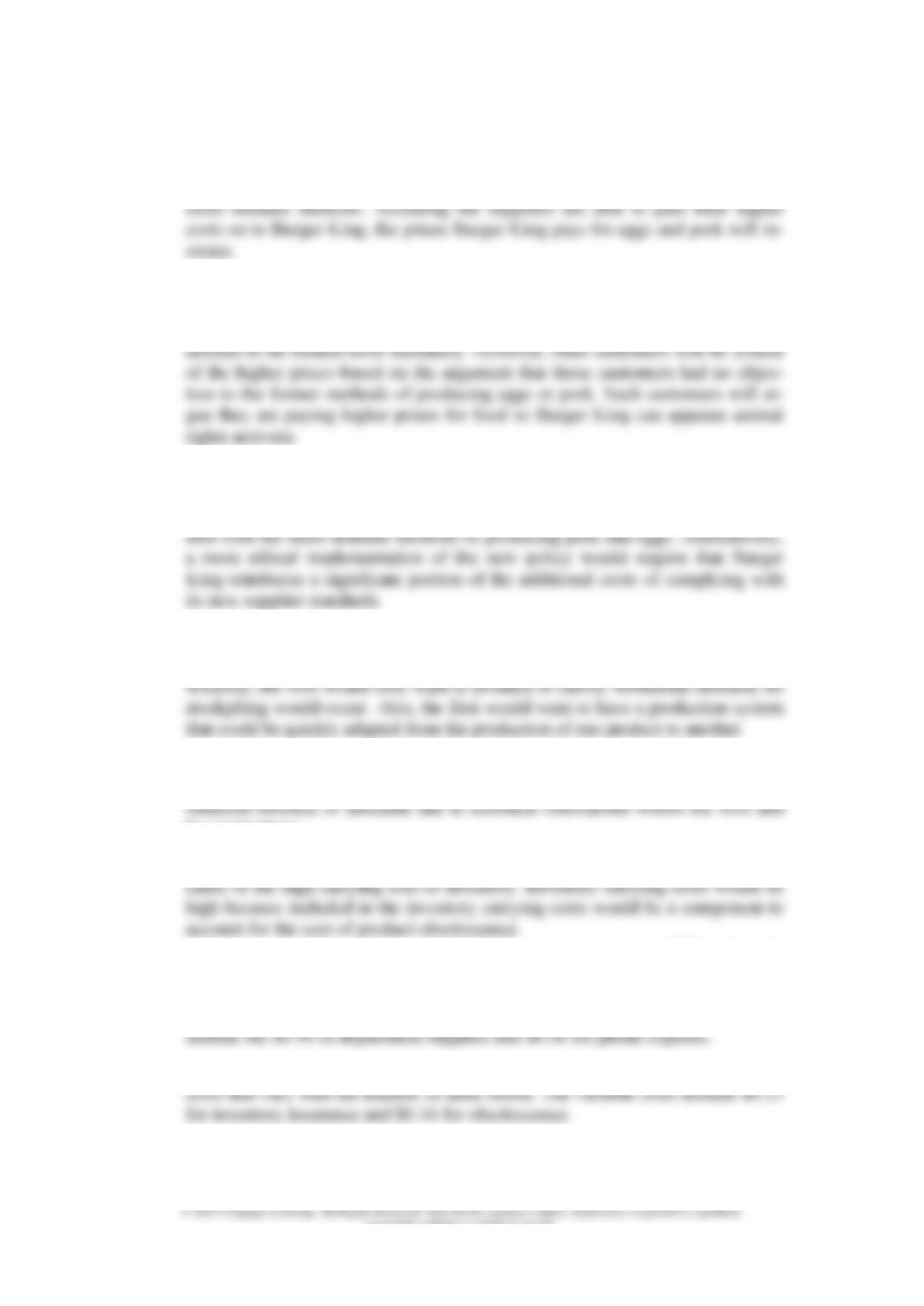
39. a. EPR = √ [(2 15,000 400) ÷ 2.50]
Avg. inventory = 2,191 ÷ 2 = 1,095.5 units
Number of orders per year = 15,000 ÷ 2,191 = 7 (rounded)
b. EPR = √ [(2 15,000 100) ÷ 10]
= √ (300,000)
= 548 units (rounded)
Avg. inventory = 548 ÷ 2 = 274 units (rounded)
Number of orders per year = 15,000 ÷ 548 = 28 (rounded)
504 Chapter 18
accessible website, in whole or in part.
PROBLEMS
40. a. Because it is presumably less costly to produce pork and eggs using traditional
methods, the cost to produce the pork and eggs is likely to be higher using the
b. The Burger King policy is likely to be supported by some Burger King patrons
and opposed by others. Those who support the policy are likely to be willing to
pay higher prices for Burger King food, knowing that the higher prices allow
c. The key ethical issue is the extent to which Burger King imposes unreimbursed
costs on its suppliers because of its new policy. It is ethically questionable for
Burger King to demand that its existing suppliers absorb all of the costs associ-
41. a. A key consideration would be to minimize the probability of having obsolete
products and product components on hand. With the rapid rate of product obso-
b. The firm would want to use a pull-based inventory control system. Such a sys-
tem would avoid the accumulation of materials and components that might be
by competitors.
c. It would have the effect of reducing the EPR. The EPR would be reduced be-
(CMA adapted)
42. a. The controller would want to isolate just the variable costs—those costs that
vary with the number of orders processed. In this case, the relevant costs would
b. Similar to the ordering costs, the controller would only want to include those
Chapter 18 505
43. a. The company produces only two products, so the production setting is likely to
be relatively simple. Because a significant portion of its sales are seasonal, the
company may choose to use a traditional push system. Using a push system, the
company could level production volume throughout the year. Alternatively,
b. The significant variety of products produced along with the high unit costs ar-
gues for a pull system. Using a traditional push system, to accommodate signif-
c. Because the products have a short life cycle, there is significant risk associated
with carrying large inventories; therefore, the firm would prefer not to use a
would be preferred in this case.
e. Because the products have long life cycles, the risk of maintaining larger inven-
tories is minimal. Also, because the product mix is limited, there are only small
gains available to the quick setups and short production runs available with a
44. a. Successfully using JIT to manage inventory requires that a firm be able to
quickly produce the quantity and mix of products ordered by its customers.
b. Because of the difficulty of predicting the product mix, Koss was forced to
maintain excessive inventories of component parts (these inventories were not
parts.
c. A stock outage of a component part creates a problem with a longer lead time to
506 Chapter 18
component. Thus, while Koss was managing finished goods on a JIT basis, the
firm maintained excessive inventories of component parts to avoid a stockout
45. a. Because the new product is described as “innovative,” the CFO would be con-
cerned about an introductory price that is lower than the life cycle average
ductory price should be significantly higher than $60.
price that maximizes life cycle contribution margin.
c. Because the profit on electronic products tends to be highest in the early years
46. a. Yes. The royalties realized from game sales will vary with the number of
PlayStations sold. Thus, if the volume of PlayStation sales is sensitive to price,
b. Setting the price at $599 should result in significantly more sales early in the
product life cycle as well as for the total life cycle. The lower sales price will
c. The practice is more beneficial if the product life cycle is long. A longer life
Chapter 18 507
accessible website, in whole or in part.
47. a. Revenues
Year 1
100,000 $2.50
$ 250,000
Year 2
250,000 $2.40
600,000
Year 3
350,000 $2.30
805,000
Year 4
500,000 $2.10
1,050,000
Year 5
600,000 $2.00
1,200,000
Year 6
450,000 $2.00
900,000
Year 7
200,000 $1.90
380,000
Year 8
130,000 $1.90
247,000
Totals
2,580,000
$ 5,432,000
Profit margin
Target cost
(1,358,000)
$ 4,074,000
Unit target cost $4,074,000 ÷ 2,580,000 = $1.58
b. Total production cost estimate:
Fixed costs ($200,000 8)
$1,600,000
Variable costs ($2.60 2,580,000)
6,708,000
Total
$8,308,000
c. Because the target and expected costs are far apart, the company should strong-
48. Using the data given, the target cost of production can be computed:
Estimated sales price
$215
Projected profit per unit
(35)
Projected selling & administrative costs
(40)
Target cost of production
$140
Estimated cost of production:
Direct material
$ 70
Direct labor
40
Variable overhead
15
Fixed costs [($360,000 5) ÷ 180,000]
10
Total estimated actual cost
$135
additional profit.
508 Chapter 18
accessible website, in whole or in part.
49. a. D
b. U
c. T
d. D, T
50. a. Conversion Cost Control
40,000
Various accounts
40,000
Finished Goods Inventory
64,000
Accounts Payable
24,000
Conversion Cost Control
40,000
Accounts Receivable
116,000
Sales
116,000
Cost of Goods Sold
62,000
Finished Goods Inventory
62,000
b. Raw and In-Process Inventory
24,000
Accounts Payable
24,000
Conversion Cost Control
40,000
Various accounts
40,000
Cost of Goods Sold
62,000
Finished Goods Inventory
2,000
Raw and In-Process Inventory
24,000
Conversion Cost Control
40,000
Accounts Receivable
116,000
Sales
116,000
c. Cost of Goods Sold
62,000
Finished Goods Inventory
2,000
Accounts Payable
24,000
Various accounts
40,000
Accounts Receivable
116,000
Sales
116,000
d. Conversion Cost Control
40,000
Various accounts
40,000
Cost of Goods Sold
64,000
Accounts Payable
24,000
Conversion Cost Control
40,000
Chapter 18 509
Finished Goods Inventory
2,000
Cost of Goods Sold
2,000
Accounts Receivable
116,000
Sales
116,000
51. a. (1) Raw and In-Process Inventory
24,904,000
Material Price Variance
480
Accounts Payable
24,904,480
(2) Conversion Cost Control
3,000,000
Accumulated Depreciation
600,000
Cash
2,200,000
Accounts Payable
200,000
(3) Raw and In-Process Inventory
2,912,000
Conversion Cost Control
(20,800 $140)
2,912,000
(4) No entry
(5) Conversion Cost Control
14,442,000
Accumulated Depreciation
4,000,000
Cash
9,325,000
Accounts Payable
1,117,000
(6) Raw and In-Process Inventory
14,448,000
Conversion Cost Control
(103,200 $140)
14,448,000
f. Actual conversion cost ($3,000,000 + $14,442,000)
$ 17,442,000
Machine hours engineering change
301,000
Revised conversion cost
$ 17,743,000
Applied conversion cost ($2,912,000 + $14,448,000)
(17,360,000)
Underapplied
$ 383,000
g.
Increase in material cost per roll (0.4 $2)
$ 0.80
Decrease in conversion cost per roll [(5 ÷ 60) $35]
(2.92)
Net decrease in cost per roll
$(2.12)
Yes, the changes are cost beneficial.
52. a. Whether this is an ethical practice depends on the rationale for the oil and gas
industry to adopt JIT. Assuming the industry has migrated to JIT because JIT
510 Chapter 18
reduces long-run costs of producing petroleum products, there is no ethical is-
sue. Alternatively, if the industry has embraced JIT because JIT mandates lean
c. Firms that are heavily dependent on oil and gas inputs could do any of the fol-
lowing:
(1) develop alternative and multiple sources of supply;
(2) develop forward contracts for required supplies of oil and gas products;
d. It is certainly true that (collectively) the U.S. government makes more profit per
gallon of gasoline sold than do the oil and gas companies. Assuming a gas tax is
an ethical source of government support, it can be argued that this is an ethical
tax because those who use the most energy (and are contributing most signifi-
government.
53. a. EOQ = √ [(2 7,000 32.00) ÷ 0.50]
b. Average daily usage = 7,000 ÷ 365 = 19.18 lbs.
54. a. EPR = √ (2QS ÷ C)
= √ [(2 30,000 $50) ÷ $0.25]
b. Number of runs = 30,000 ÷ 3,464 = 9 runs (rounded)
c. EOQ (seed) = √ (2QO ÷ C)
EOQ (fertilizer) = √ [(2 30,000 0.25 $8.80) ÷ $0.05]
Chapter 18 511
d. Seed orders = (30,000 2 2) ÷ 10,100 = 12 orders (rounded)
e. Total cost:
Average inventory:
Onions: 3,464 ÷ 2 = 1,732 lbs.
Seeds: 10,100 ÷ 2 = 5,050 seeds
Fertilizer: 1,625 ÷ 2 = 812.5 lbs.
Carrying costs:
Onions: 1,732 $0.25
$433.00
Seeds: 5,050 $0.01
50.50
Fertilizer: 812.50 $0.05
40.63
$ 524.13
Ordering costs:
Seeds: 12 $4.25
$ 51.00
Fertilizer: 5 $8.80
44.00
95.00
Setup costs:
Onions: 9 $50.00
450.00
Total cost
$1,069.13
ther, the yield is likely to vary much more for onions than other production
processes because some of the critical inputs are beyond the control of manag-
ers (sunshine and rain, for example).