Chapter 17 485
42. a. Each student will have a different answer. No solution is provided. Selected ex-
cerpts from the 2008 Genentech 10-K:
p. 16: Additionally, we may be unable to maintain regulatory approval for Raptiva, or
we may be subject to other regulatory requirements or actions that significantly restrict
the use of Raptiva, due to cases of PML in Raptiva patients. On February 19, 2009, the
pp. 36-37: On October 2, 2008, we announced that we issued a Dear Healthcare Pro-
vider letter to inform physicians of a case of progressive multifocal leukoencephalopa-
thy (PML) in a 70-year-old patient who had received Raptiva for more than four years
for treatment of chronic plaque psoriasis. The patient subsequently died. On October 16,
2008, revised prescribing information for Raptiva was approved by the FDA. A boxed
inform physicians of a second case of PML that resulted in the death of a 73-year old pa-
tient who had received Raptiva for approximately four years for treatment of chronic
plaque psoriasis. On February 10, 2009, a Dear Healthcare Provider letter was sent to
physicians to inform them of a third case of PML in a 47-year-old patient who had re-
ceived Raptiva for more than three years for the treatment of chronic plaque psoriasis.
FDA issued a public health advisory regarding Raptiva, which provided warnings
about PML and the use of Raptiva, and advised physicians to periodically re-evaluate
patients treated with Raptiva and to consider other approved therapies to control pa-
tients’ psoriasis. Based on the medical information available for the PML cases, we be-
withdrawal of regulatory approval for Raptiva.
p. 43: As of December 31, 2008, we held approximately $130 million of Raptiva
work-in–process and finished goods inventory. If future FDA actions or other events or
486 Chapter 17
b. Each student will have a different answer. From Thompson ONE (for 2008):
Genentech
Bristol Meyers
Squibb
Eli
Lilly
Merck
Schering-
Plough
Industry
Mean
Net income
$3,427
$5,247
$(2,072)
$511
$1,903
$1,637
GP margin
87%
70%
78%
67%
61%
67%
ROA
17%
21%
(7)%
3%
8%
9%
43. a. Each student will have a different answer. However, most students will indicate
that they do not believe that one of these three goals can be chosen to the exclu-
to repeat sales; increased sales result in higher stock prices and thus greater
shareholder wealth.
achieved.
Assuring customers that the product/service purchased meets its assured
quality level.
quality costs in the long-term. If management sacrificed quality costs, then re-
peat customers would diminish because they would be dissatisfied with the
quality costs.
44. a. The health care and education categories were established in 1999 for the pur-
pose of helping these NFP organizations improve their performance and foster
these organizations improve performance, stimulate communication, share
“best practices,” and promote partnerships.
Chapter 17 487
b. The true difference in the categories is that education has a student and stake-
zations (i.e., NFP versus for-profit). Also, education’s “finished product” is an
educated person (rather than a tangible good of which defects can be more read-
duce a finished product.
c. Each student will have a different answer. No solution is provided.
45. Each student will have a different answer. No solution is provided but the question-
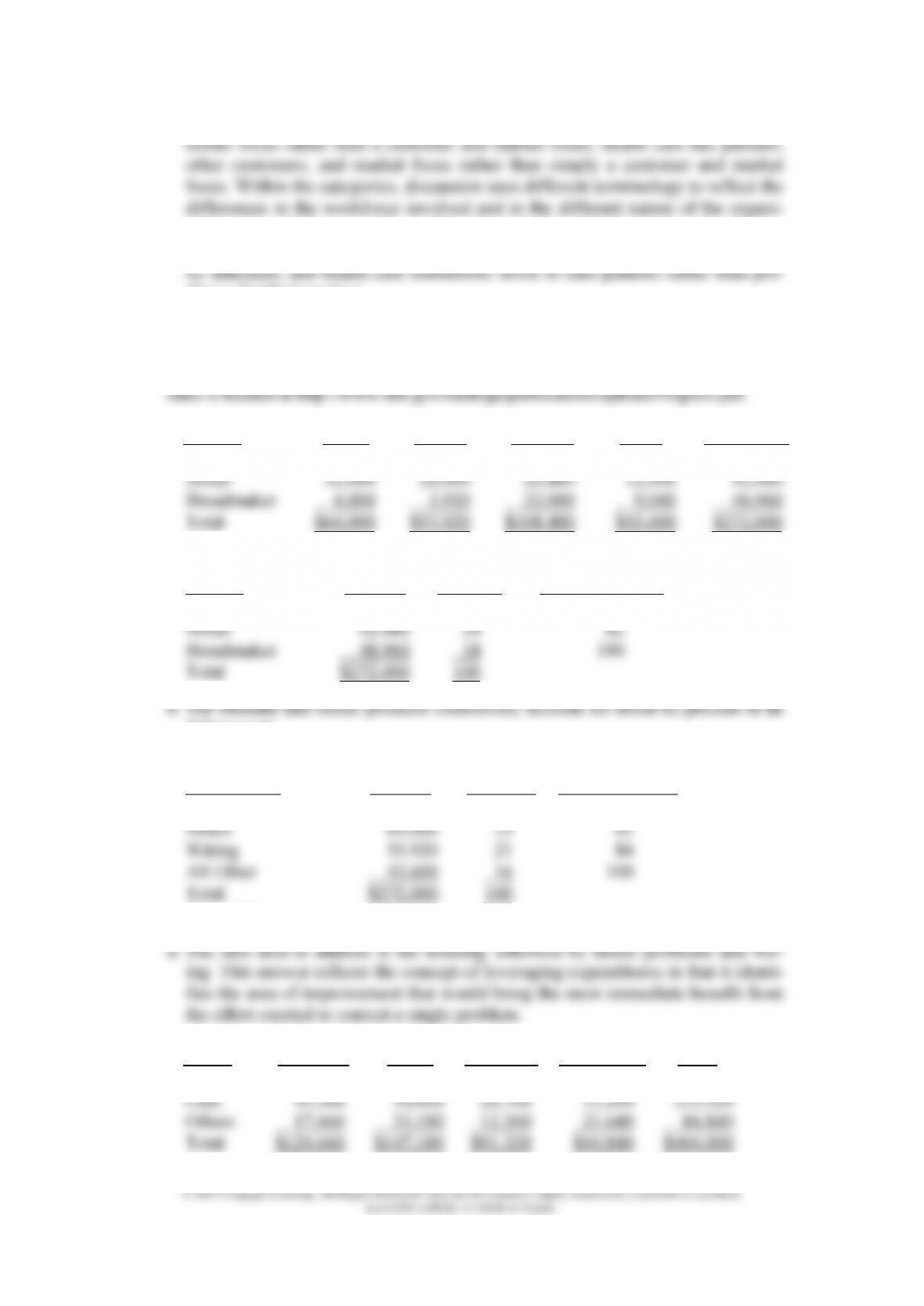
46. a. Product
Motor
Wiring
Housing
Other
Total Costs
Blender
$28,000
$24,000
$ 56,000
$22,560
$130,560
Mixer
32,000
28,000
20,480
12,000
92,480
Breadmaker
4,000
3,920
32,000
9,040
48,960
Total
$64,000
$55,920
$108,480
$43,600
$272,000
Product
Amount
Percent
of Total
Cumulative
Percent of Total
Blender
$130,560
48
48
Mixer
92,480
34
82
Breadmaker
48,960
18
100
Total
$272,000
100
failure costs.
c.
Failure Type
Amount
Percent
of Total*
Cumulative
Percent of Total
Housing
$108,480
40
40
Motor
64,000
23
63
Wiring
55,920
21
84
All Other
43,600
16
100
Total
$272,000
100
*Rounded
47. a. Model
Electrical
Motor
Structural
Mechanical
Total
Elegant
$ 57,640
$ 64,000
$52,200
$12,000
$185,840
Chic
45,360
50,000
26,760
11,200
133,320
Others
17,660
33,180
12,360
21,640
84,840
Total
$120,660
$147,180
$91,320
$44,840
$404,000
488 Chapter 17
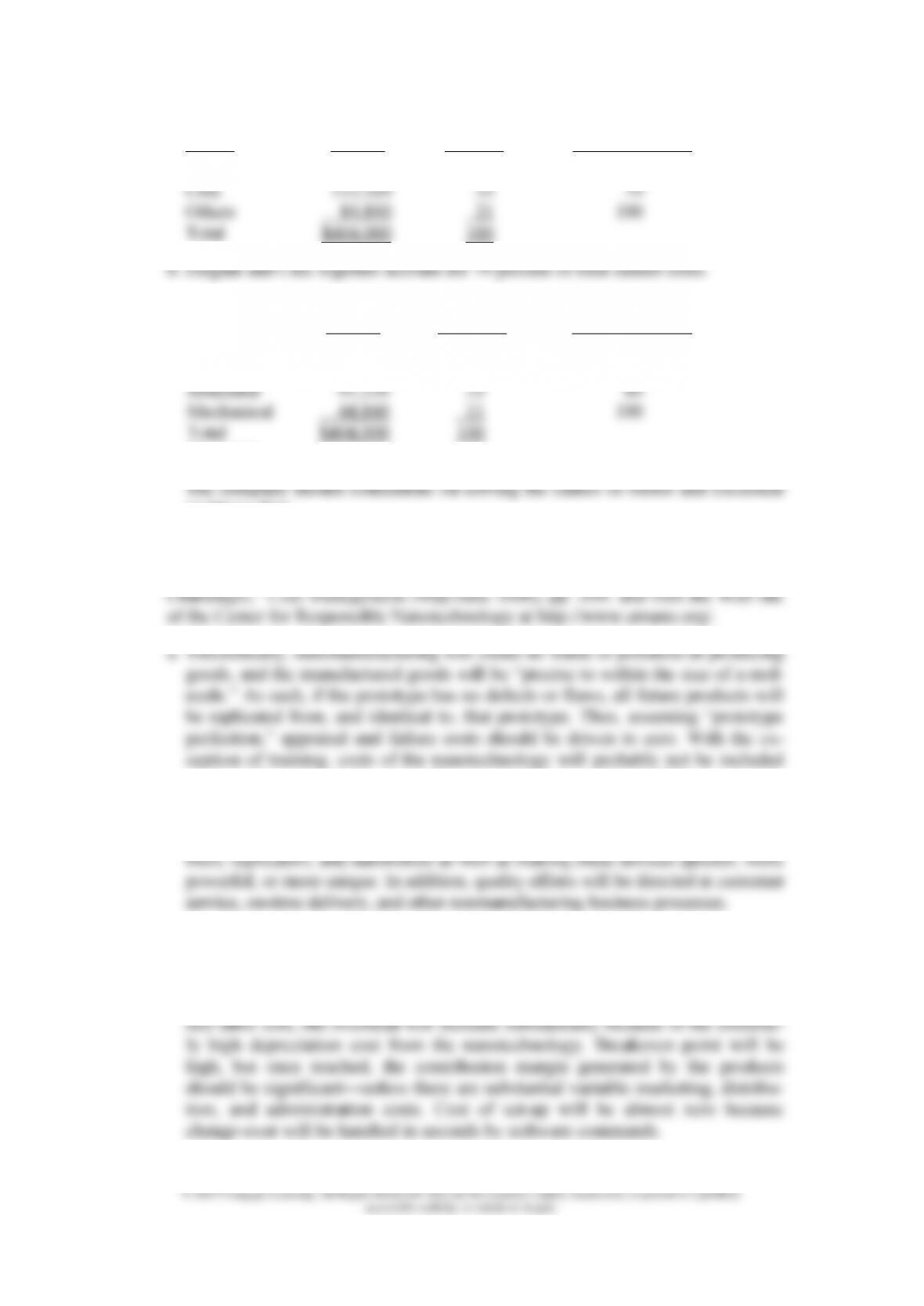
Model
Dollars
Percent
of Total
Cumulative
Percent of Total
Elegant
$185,840
46
46
Chic
133,320
33
79
Others
84,840
21
100
Total
$404,000
100
c.
Dollars
Percent
of Total*
Cumulative
Percent of Total
Motor
$147,180
36
36
Electrical
120,660
30
66
Structural
91,320
23
89
Mechanical
44,840
11
100
Total
$404,000
100
*Rounded
problems first.
48. Prior to assigning and discussing this question, you may want to read Saurave
Dutta and Raef A. Lawson’s “The Coming Nanotech Revolution—Accounting
as prevention costs in the accounting records because of the inability to separate
the part of the technology applicable to quality versus actual production.
Quality efforts will be directed at making certain of the design of the assem-
b. Currently, 80 to 90 percent of total costs are imbedded in a product during the
design phase; this percentage will be even higher when nanotechnology is in-
troduced. Preproduction costs will be extremely high, but production costs as
well as most quality costs will decline dramatically. There will be almost no di-
Chapter 17 489
accessible website, in whole or in part.
the manufacturing process.
49. Each student will have a different answer. No solution is provided.
50. a. Price for scrapped units = $15,750 ÷ 450 = $35
Price for good units = $8,460,000 ÷ 42,300 = $200
b. Profit lost
$310,500
Rework cost incurred
63,000
Total failure cost
$373,500
c. Total failure cost
$360,900
Prevention and appraisal cost
360,000
Total quality cost
$720,900
d. Although the company’s failure costs were slightly more than its prevention
and appraisal costs, the majority of the failure costs were internal. Thus, Elijah
51. a. Price for “seconds” = $56,000 ÷ 400 = $140
Price for good units = $10,244,000 ÷ 39,400 = $260
b. Profit lost
$48,000
Rework cost incurred
21,000
Total failure cost
$69,000
c. Total failure cost
$ 55,000
Prevention and appraisal cost
646,000
Total quality cost
$701,000
praisal costs.
e. No, the costs are not fully reflective of the company’s cost due to the outstand-
490 Chapter 17
warranty work. The estimated cost of warranty work is considered a contingen-
52. a. (1) Lost profits 500 × $160 = $80,000
(2) Lost profit from selling defective units (500 × $160)
$ 80,000
Rework costs
12,000
Scrap and waste
13,000
Waste disposal
4,200
Warranty handling
19,000
Customer reimbursements/returns
15,200
Total failure costs
$143,400
(3) Prevention costs
Quality training
$ 30,000
Quality technology
100,000
Quality circles
64,000
$194,000
Appraisal costs
Quality inspections
$ 36,000
Test equipment
28,000
Procedure verifications
18,000
82,000
Total failure costs
143,400
Total quality costs
$419,400
quality costs.
53. a. (1) 2,400 units × $70 = $168,000
(2) Lost profits from the “swimming pool” units (2,400 × $70)
$168,000
Internal failure costs ($9,000 + $2,800 + $8,000)
19,800
External failure costs ($12,800 + $10,200)
23,000
Total failure cost
$210,800
(3) Total failure cost
$210,800
Prevention costs ($20,000 + $60,000 + $44,000)
124,000
Appraisal costs ($24,000 + $18,000 + $12,000)
54,000
Total quality cost
$388,800
increase appraisal costs.
Chapter 17 491
accessible website, in whole or in part.
54. a. The ethics of the proposed changes are questionable. In trimming the internal
regulations governing the provision of counseling services, the agency is cir-
cumventing needed safeguards. The agency is asking the employees to make
judgments that will critically impact the extent and nature of services to be re-
ically suspect.
Some positive benefits would result from the proposed changes. Namely, the
speed and efficiency of operations would be greatly enhanced. In reducing the
The proposed changes would also have negative impacts. By standardizing the
treatment of constituents, the agency is ignoring the individual differences
among cases that dictate whether a higher or lower level of services is warrant-
ing decisions.
b. Each student will have a different answer. No solution is provided.
55. a. Porsche’s strategy is perceived as product differentiation given the high quality
b. and c. Each student will have a different answer. No solution is provided.
56. Each student will have a different answer. No solution is provided. However, the
following Web sites may provide some useful concepts:
http://www.projectperfect.com.au/info_quality_culture.php
http://www.qualitydigest.com/magazine/2008/aug/article/creating-a-culture-
quality-food-industry.html
492 Chapter 17
57. a. The quality standard is an efficient means for a firm to signal to its customers
advantages such as a lower price if it is the case that higher quality operations
lead to lower costs that, in turn, lead to lower prices for customers.
c. Meeting the registration requirements would be necessary to keep pace with the
industry and with competitors. Those firms failing to meet registration require-
d. Complying with the ISO 9001 series registration standards would provide an in-
ternal quality standard that the firm must meet. By striving to meet the stand-
otherwise not have been made and lead to development of a more quality–
conscious culture.