466
accessible website, in whole or in part.
CHAPTER 17
IMPLEMENTING QUALITY CONCEPTS
QUESTIONS
1. Quality refers to the dimensions or characteristics of a product or service that
make it able to meet the stated or implied needs of the person acquiring it. Quality
product or service meets specified needs.
Both views of quality are valuable. The internal (production) view of quality leads
2. Such activities include reworking defective units, handling waste materials, re-
scribed as non-value-added, as discussed in Chapter 4.
3. The eight characteristics (listed in Exhibit 17.3) are performance, features, relia-
bility, conformance, durability, serviceability, aesthetics, and perceived value. The
The majority of the product quality characteristics are objective, whereas the addi-
tional service quality characteristics are subjective. Thus, a company’s product
as the “product” the company sells.
5. Benchmarking refers to the process of investigating, comparing, and evaluating
one company’s product or services against those of another company. Internal
cess benchmarking investigates, within a particular application or industry, how
something is produced or delivered and focuses on the effectiveness and efficien-
The remaining part of the answer will differ with each student.
Chapter 17 467
6. Total quality management is an organization-wide effort to seek continuous im-
provement in all aspects of operations. The four tenets are that TQM:
sion making.
(2) Requires participation by everyone in the organization.
enhance quality improvements.
7. The Malcolm Baldrige National Quality Award is a competition for U.S. organi-
zations. Congress established the award program in 1987 to recognize U.S. organ-
izations for their achievements in quality and performance and to raise awareness
about the importance of quality and performance excellence as a competitive
share, and improved profitability.
In recent years, the number of applications for the Malcolm Baldrige National
Quality Award has declined, after a high of 86 received in 2006; in 2011, only 69
Applying for the Baldrige Award is an opportunity to critically examine an organ-
ization and identify strengths and opportunities to improve. Some key benefits cit-
ed by Award applicants include the following:
Accelerate improvement efforts.
8. The four points in time are before production, during production, after production,
and after sale. There are interdependencies in which the costs of each phase are in-
quality–related expenditures after production and after sale.
468 Chapter 17
9. Pareto analysis helps identify the areas in which managers should focus their qual-
10. Strategic cost management links information to corporate strategies by allowing
managers to set and communicate organizational goals and objectives throughout
11. Standards are issued for a variety of reasons. Two primary reasons are to ensure
compatibility across systems (e.g., electrical plugs will be compatible with electri-
A common set of global standards levels the playing field for all companies and
should result in lower costs to all consumers. Companies will no longer have to
along to consumers.
12. A quality audit involves a review of product design activities, manufacturing pro-
ISO 9000 registration process.
13. The EFQM Excellence Model differs from the Malcolm Baldrige National Quality
Award Criteria in that it is a European rather that a U.S. framework for quality
Chapter 17 469
accessible website, in whole or in part.
EXERCISES
14. a. Students will discover great diversity in definitions of quality. It should be evi-
dent that the definition varies with perspective. For example, an engineer may
such as quality prevention costs relative to internal and external failure costs.
Different industries may also define quality uniquely; for example, in some in-
protein content (such as corn).
b. A copy store may define quality in terms of customer satisfaction, which could
A blender manufacturer produces a longer-lived product than a copy store and
probably sells to chains or wholesalers rather than to the ultimate customer. Ac-
about the durability, features, warranty coverage, and customer service offered
by the manufacturer.
each dimension.
15. a. True.
b. False. TQM requires quality to be viewed from the customer’s perspective.
d. True.
e. False. SPC charts are used to plot variation in a process so that out–of-control
conditions can be recognized.
long run.
g. False. Traditional accounting systems have quality costs imbedded in a variety
of accounts and, therefore, are generally not separately identifiable.
on quality compliance or quality noncompliance. However, if the benefits of
quality expenditures outweigh their costs, students could answer true as Philip
Crosby would.
470 Chapter 17
16. a. Cost of operator time per call = 6 ÷ 60 × $9 = $0.90
Cost of supervisor time per call = 3 ÷ 60 × $15 = $0.75
1,200,000 calls × $0.90
$1,080,000
1,200,000 calls × 0.4 × $0.75
360,000
Total labor cost
$1,440,000
Cost per call
$1.20
b. Cost of operator time per call = 5 ÷ 60 × $9 = $0.75
Cost of supervisor time per call = 2.5 ÷ 60 × $15 = $0.63 (rounded)
1,200,000 calls $0.75
$ 900,000
1,200,000 calls (0.4 × 0.85) $0.63
257,040
Total labor cost
$1,157,040
Cost per call (rounded)
$0.96
$648,880.
17. a. There are three goals of SPC. It is designed to determine if a process is “in con-
trol” and therefore assess reliability. It is designed to assess whether the process
c. Information on the defects might include:
ID number of item or batch
Date, time, and location (plant, machine number) of defect production
defect
Indication of whether defect is a new or on-going problem
Name of person(s) involved in software design
d. Defects are recorded for four primary purposes:
To ensure the defect is corrected
Chapter 17 471
accessible website, in whole or in part.
18. a.
Lexus
Honda
Acura
Failure rate
73%
86%
89%
Accuracy rate
27%
14%
11%
Current sigma
– 0.
6
1
–1.08
–1.23
LT sigma
0.89
0.42
0.27
c. The “problems per 100” do not provide any information about the nature of the
19. a.
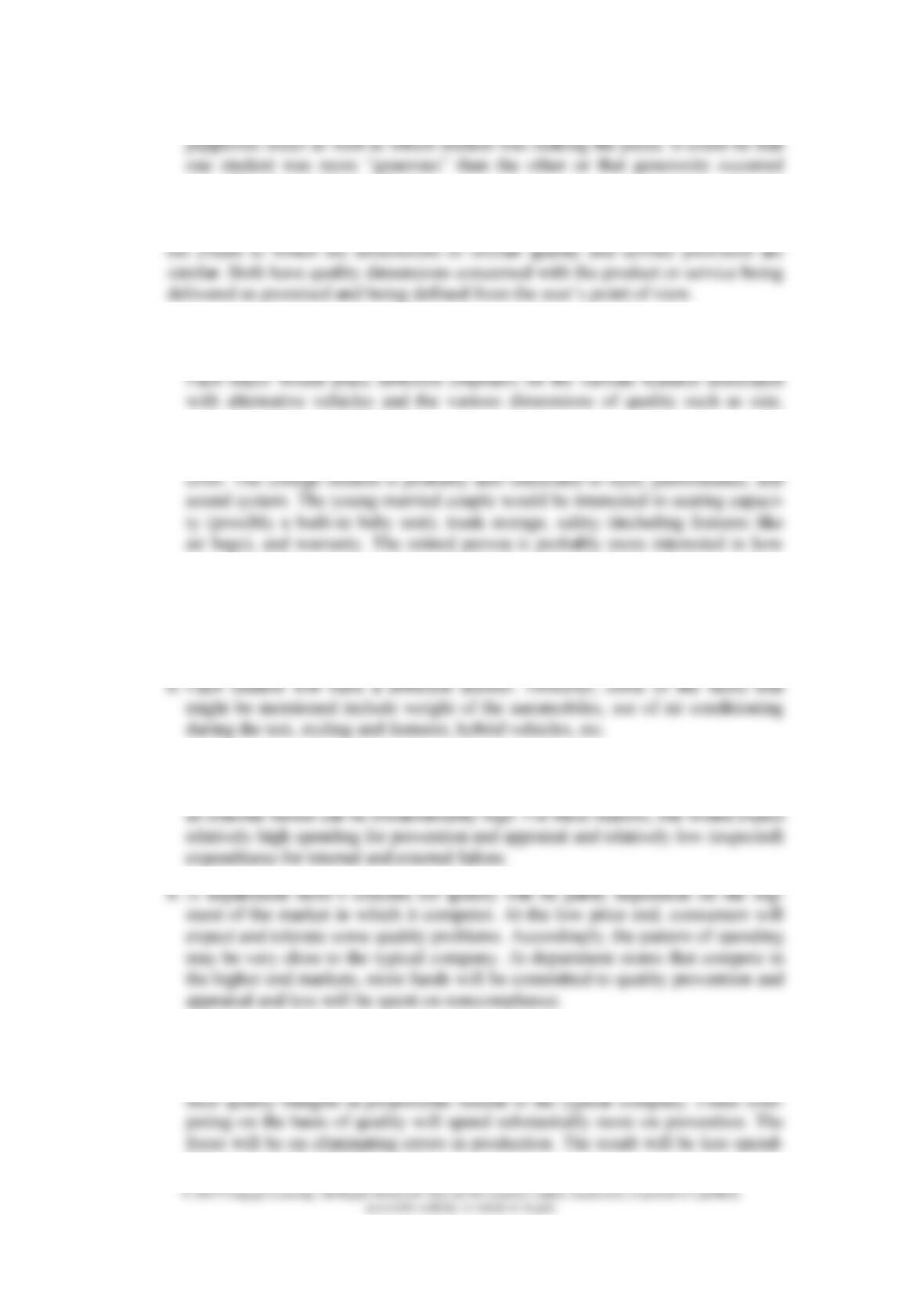
jective is not being achieved. It is also evident that the tendency is to err in the
direction of putting more than the specified number of slices on the pizzas.
472 Chapter 17
Cantalore may have wanted to also gather information on both the number of
when friends were buying the pizzas.
20. Each student will have a different answer. However, the response should present
21. a. Each person would value different characteristics of the automobiles. The val-
ued characteristics would depend on the unique circumstances of each buyer.
economy, safety, and reliability.
b. All buyers would be interested in initial cost, safety, reliability, and operating
easy the vehicles are to get into and out of, comfort (including features such as
air conditioning, cruise control, and adjustable or heated seats), ease of mainte-
nance, and service and warranty provisions.
22. a. Each student will have a different answer. No solution is provided.
23. a. In a pharmaceutical company, an external failure can mean loss of life, permanent
injury, or unnecessary suffering. Further, through malpractice damages, the cost of
c. A computer manufacturer may pursue a strategy of competing on the basis of
price or quality. Consumers will be more tolerant of quality problems for those
firms that compete on the basis of price. Accordingly, such firms may spend
ing on appraisal and failure costs.
Chapter 17 473
accessible website, in whole or in part.
vention and appraisal than other retailers.
e. The lawn service business is very vulnerable to employee and customer injury
and to property damage. Thus, failure costs could be very high. Companies
would probably want to spend a higher percentage on prevention costs (such as
24. Each student’s answer will differ, but the following are some points that will like-
ly be made.
Integrity (and honesty) should guide all that business does. Relative to TQM,
behaving with integrity would require that an organization provide its custom-
Training is essential for employees to be highly productive and effective. With-
out training, employees might not be aware of the proper manner in which to
perform their functions and, as such, would be more likely to make errors and
impair quality. If training is ignored in a TQM program, costs for prevention
and goals consistent with company objectives, methods, and performance
measures. The concept of quality must be ingrained in the organization through
staunch leadership; without leadership, there is no TQM “champion” and the
process is likely to fail before it gets a good start.
communication, errors cannot be fixed and changes cannot be integrated.
474 Chapter 17
25. a. Different functional areas of the university have different customers. Internal
customers include students (graduate and undergraduate), faculty, staff, and
administrators.
use the research output produced by faculty. Potential students and their fami-
lies evaluate the university’s outputs in making choices of where to attend
school.
sions (highly trained staff, computer resources, and office/library facilities).
Administrators might define quality in terms of the resources and personnel
available to execute teaching, research, and support missions.
publication in quality journals, and contributions to public service. Potential
students might use many of the same criteria as existing students.
It is highly possible that some of these measures of quality could conflict in
numerous ways.
26. TQM and sustainability programs have many things in common.
Both have a long-term rather than short-term focus.
Both require substantial communication and leadership efforts.
Both extend beyond organizational boundaries and involve external stakeholders.
Both can be used as opportunities to gain competitive advantage.
Chapter 17 475
Both were likely seen as more “cost,” less “benefit” when first discussed organ-
izationally.
goals.
Both must be integrated into the organizational culture and strategy.
Both require the use of interdisciplinary teams.
27. a. Each student will have a different answer. However, an example follows, giving
html) (accessed 1/24/12):
1. Quality
supplier partners to reduce quality defects and measure performance in parts per
less than 250.
2. Payment Terms
their buys. Terms extended to one division will be assumed to apply to all divisions
that do business with your company.
3. Lead Time
owned inventory within or near our factories or distribution centers is consid-
third-party logistics providers or other methods.
4. Sourced On-Time Delivery
5. Productivity