445
accessible website, in whole or in part.
CHAPTER 16
MANAGING COSTS AND UNCERTAINTY
QUESTIONS
1. The cost control system is an integral part of the cost management system. The cost
evaluation of actual performance.
2. Without first establishing performance targets and benchmarks, control systems
and what its managers want to accomplish.
3. Cost control for any specific event is exerted before, during, and after the event.
performance is compared to planned performance and explanations of differences are
4. Factors potentially causing a cost to change include:
(1) changes in activity level;
(2) changes in inflation/deflation;
(3) technology changes;
factors (e.g., activity levels).
5. Total fixed costs can be dichotomized into two groups, committed and discretionary.
The committed fixed costs are ones that are less susceptible to cost control efforts, at
Costs considered as committed by one firm may be considered discretionary by other
development cost to be discretionary.
446 Chapter 16
6. Many types of discretionary costs do not have outputs for which there is a precise-
making inputs for a period of indefinite duration. Thus, even when outputs occur,
7. Efficiency is a measure of the degree to which the actual yield ratio (Actual output
÷ Actual input) conforms to the desired yield ratio (Planned output ÷ Planned in-
achieved.
Measuring the efficiency of a discretionary cost requires both a measure of input
dence about the strength of the cause-and-effect relationship between input and
output for most discretionary costs.
Actual output ÷ Planned output).
8. Costs that have observable and known relationships to a quantifiable activity base
employee training activities.
9. Firms hold cash balances to liquidate planned transactions as they occur, to cover
cash consequences of unexpected events, and for speculative purposes. Some
10. Technology has allowed automation of many purchasing processes. Because of
the automation, the cost of purchasing transactions has been dramatically reduced.
11. The first approach to dealing with uncertainty is to explicitly consider the effects
of uncertainty in estimating future costs. Uncertainty can be reduced by selecting
tools are best used to deal with price uncertainty for both inputs and outputs. The

Chapter 16 447
12. Uncertainty has two main sources. First, uncertainty is related to one’s inability to
perfectly foresee the future and to understand perfectly cost causality. The second
448 Chapter 16
accessible website, in whole or in part.
EXERCISES
13. Whether the $20 million is excessive depends on several things. First, does the
ther, even if the firm spent more than budgeted, the excess may be explained by
14. a. The proposed maintenance work order system would provide written documenta-
tion for all man hours and materials used in the maintenance department. This sys-
tem would improve cost control by giving operating management (user
departments) the opportunity to review specific maintenance charges for time and
By providing an estimate for each job prior to starting the job, the user department
will have an opportunity to cancel unneeded work or work that appears to be too
expensive. The maintenance department will be able to compare these estimates
with estimates on similar jobs and with the actual costs once the job is completed to
fined.
The maintenance work order system will provide a basis for improved alloca-
tion of costs to user departments. If the work order system is effective and a
buyer/seller relationship is developed between the user department and the
lost production time.
b. The documentation provided by the work order system should provide mainte-
nance department management with statistics to support its request for addi-
tional people. If the maintenance department can develop a meaningful
quired manpower.
(CMA adapted)
15. a. Cost reduction because quantity of work fluctuates and part-time employees
provide services for peak caseload times without full-time cost.
b. Annual salary full-time professional staff ($60,000 1.20) = $72,000;
For 1,500 or fewer hours, point of indifference:
$50X = $72,000
Chapter 16 449
For more than 1,500 hours:
$50X + $4,500 = $72,000
used beyond 1,440 hours.
16. No solution provided.
17. a. CU
b. CR
d. CA
e. CR
f. CA of what would have been an increase in costs with the installation of the
would increase.
18. a. CA: The price has been increased because the OPEC cartel has enough control
over supply to ration the supply and increase prices.
b. CA: Because the supply of the plastic resins has become more concentrated,
prices.
c. CB: Because raw materials are a variable cost, when volume drops the total cost
also drops.
price discount based on volume purchasing.
e. Inflation (I/D): The price of corn syrup rose because the overall demand for
including the cost of direct labor.
g. QP: Because the firm adopted JIT practices, the quantity of steel it purchases
450 Chapter 16
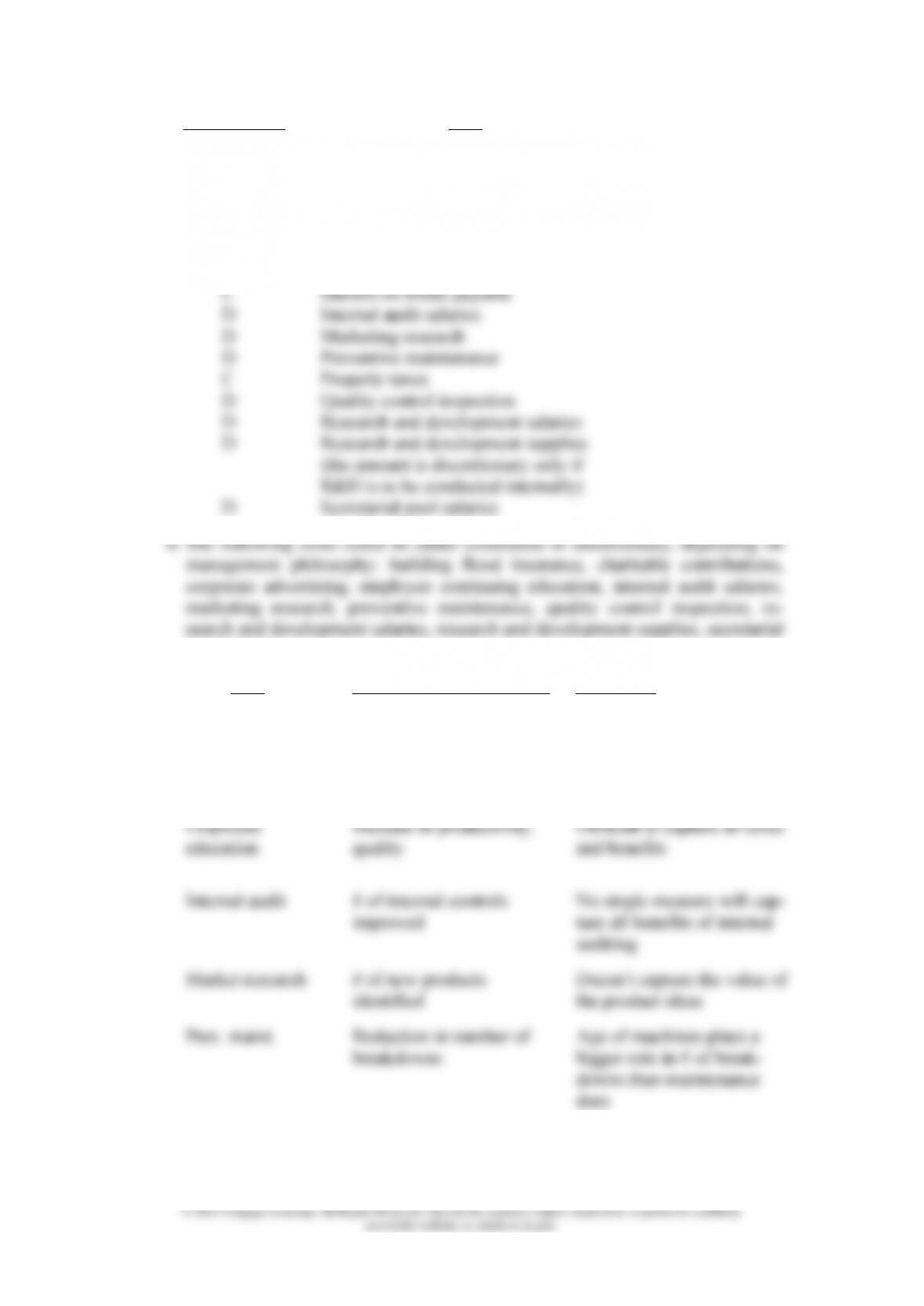
19. a. Classification
Cost
C
Annual audit fees
C
Annual report preparation and printing
C
Building flood insurance
D
Charitable contributions
D
Corporate advertising
D
Employee continuing education
C
Equipment depreciation
C
Interest on bonds payable
D
Internal audit salaries
D
Marketing research
D
Preventive maintenance
C
Property taxes
D
Quality control inspection
D
Research and development salaries
D
Research and development supplies
(the amount is discretionary only if
R&D is to be conducted internally)
D
Secretarial pool salaries
pool salaries.
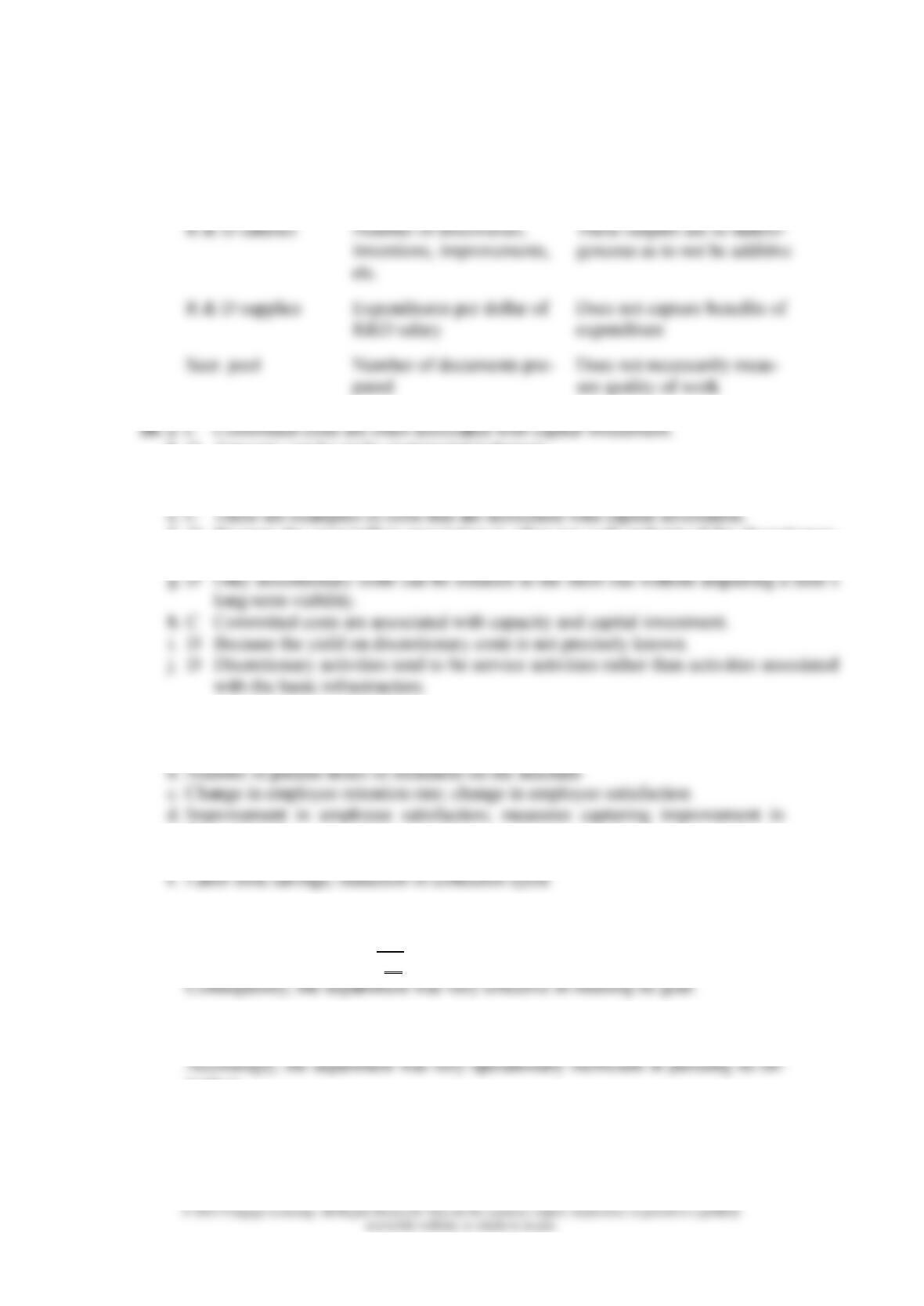
c.
Cost
Surrogate Output Measure
Objections
Charitable contrib.
Improvement in social
welfare
Very difficult to measure
Advertising
Increase in sales
Uncertainty about cause &
effect
Employee
education
Increase in productivity,
quality
Difficult to capture all costs
and benefits
Internal audit
# of internal controls
improved
No single measure will cap-
ture all benefits of internal
auditing
Market research
# of new products
identified
Doesn’t capture the value of
the product ideas
Prev. maint.
Reduction in number of
breakdowns
Age of machines plays a
bigger role in # of break-
downs than maintenance
does
Chapter 16 451
Qual. control
Reduction in # of defective
items returned by
customers
Other factors such as care-
less handling by those mov-
ing product may cause
defects
R & D salaries
Number of discoveries,
inventions, improvements,
etc.
These outputs are so hetero-
geneous as to not be additive
R & D supplies
Expenditures per dollar of
R&D salary
Does not capture benefits of
expenditure
Secr. pool
Number of documents pre-
pared
Does not necessarily meas-
ure quality of work
20. a. C
Committed costs are often associated with capital investment.
b. D
Amounts can be set by managerial judgment.
c. C
Committed costs often cannot be reduced in the short run by managers.
d. D
Hence, the term “discretionary.”
e. C
These are examples of costs that are associated with capital investment.
f. D
Because the cause/effect association is often not well understood for discretionary
costs.
g. D
Only discretionary costs can be reduced in the short run without impairing a firm’s
long-term viability.
h. C
Committed costs are associated with capacity and capital investment.
i. D
Because the yield on discretionary costs is not precisely known.
j. D
Discretionary activities tend to be service activities rather than activities associated
with the basic infrastructure.
21. a. Extent to which ABC has been implemented in the firm; dollars of cost savings
generated by ABC driven prescriptions
flow of people
e. Customers generated from the advertising
22. a. Goal 600 new students
Actual achievement 660 new students
Goal exceeded by 60 new students
b. Yield goal: ($1,600,000 ÷ 600) = 1 student for each $2,667 expended.
Actual efficiency ($1,873,200 ÷ 660) = 1 student for each $2,838 expended.
jectives.
452 Chapter 16
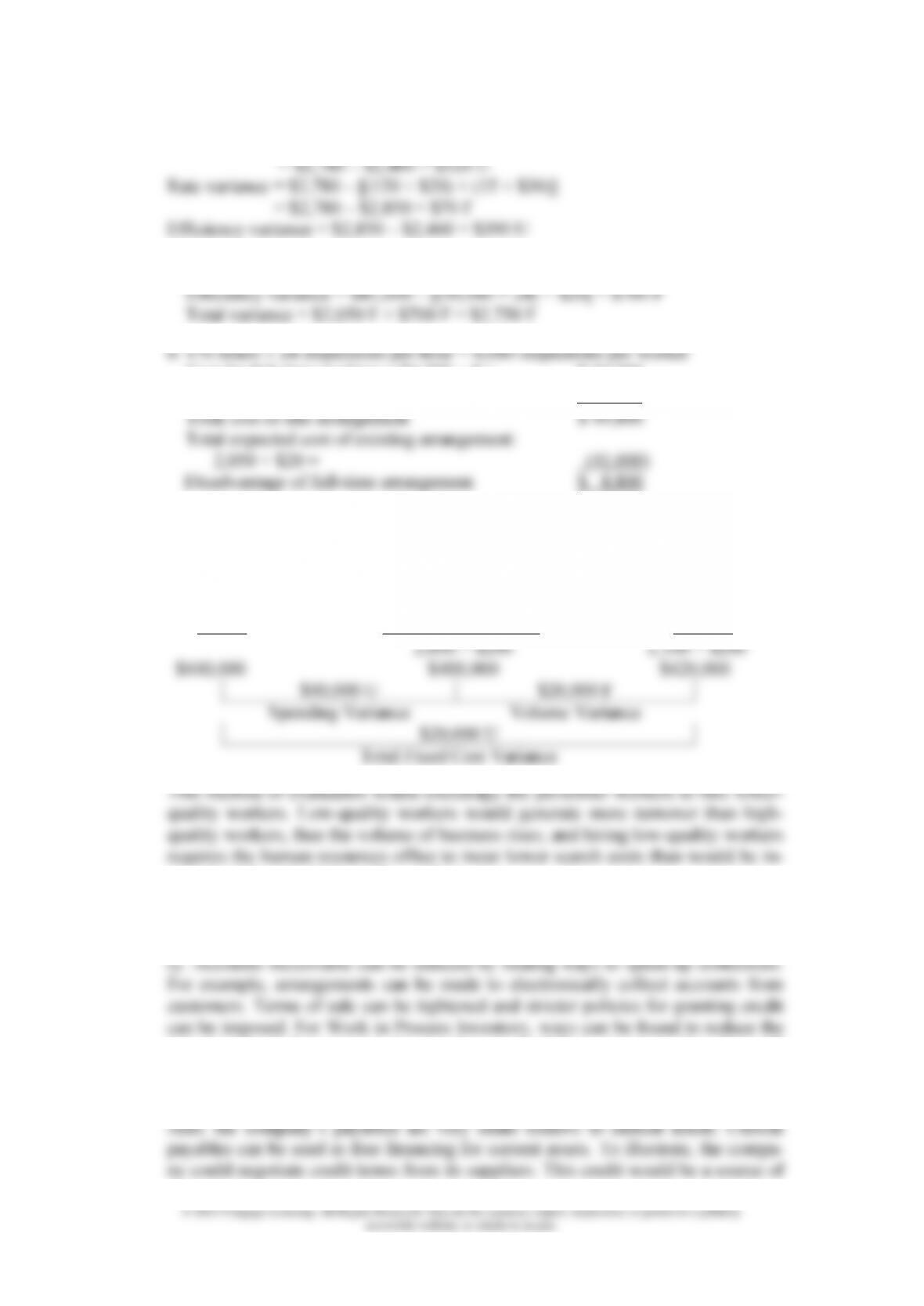
23. Total variance = $2,780 – [(105 × 1 × $20) + (12 × 1 × $30)]
24. a. Rate variance = $38,950 – (2,050 × $20) = $2,050 F
Cost for full-time workers = $4,500 × 8 =
$ 36,000
Part-time work [(2,050 – (170 8)] × $20 =
13,800
Total cost of this arrangement
$ 49,800
Total expected cost of existing arrangement:
2,050 × $20 =
(41,000)
Disadvantage of full-time arrangement
$ 8,800
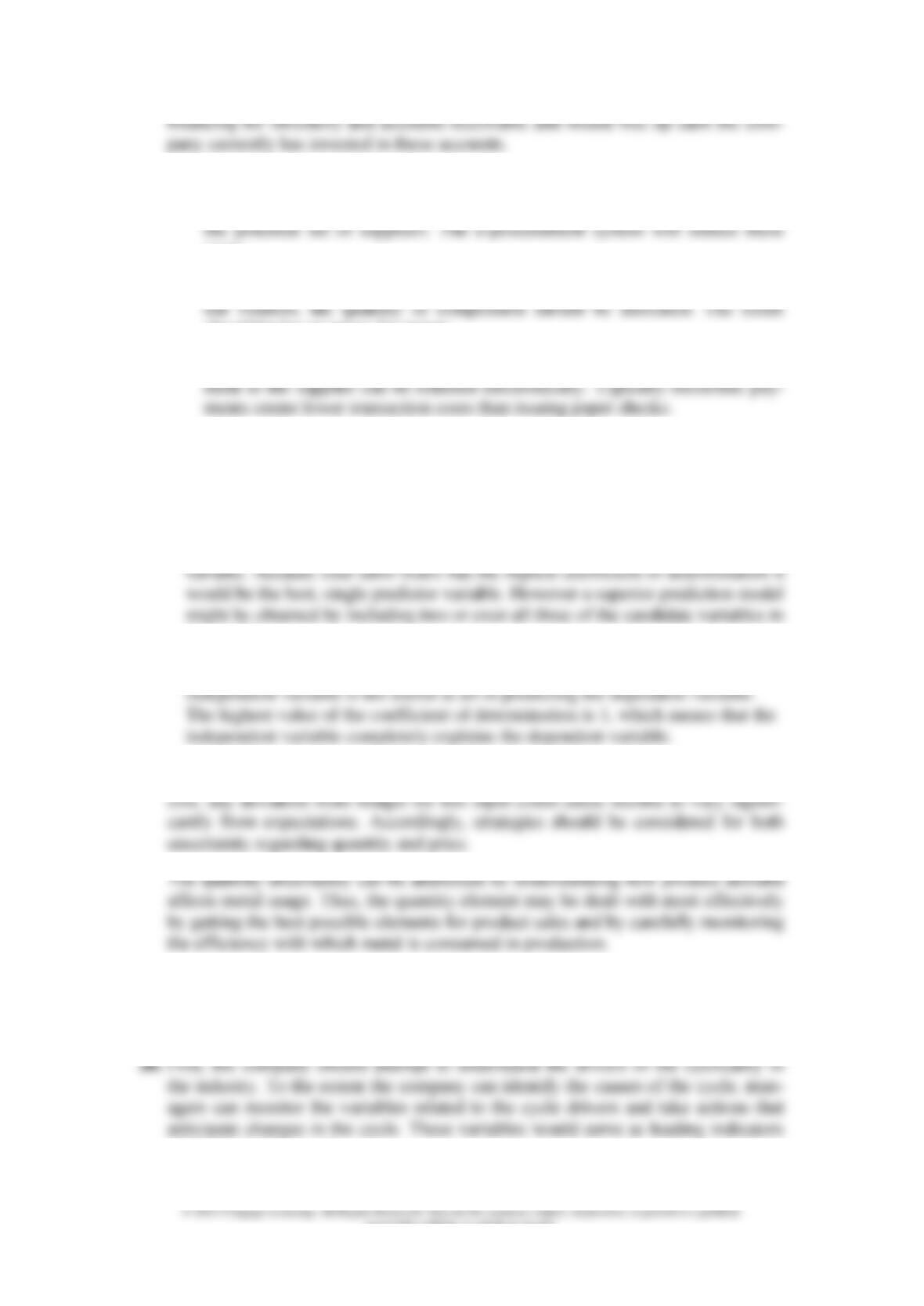
25. Variable cost analysis:
Variance = Actual cost – Flexible budget
= $900,000 – [($800,000 ÷ 2,000) 2,100] = $60,000 U
Fixed cost analysis:
Actual
Budgeted Fixed Cost
Applied
2,000 × $200
2,100 × $200
$440,000
$400,000
$420,000
$40,000 U
$20,000 F
Spending Variance
Volume Variance
$20,000 U
Total Fixed Cost Variance
curred to hire only high-quality workers.
26. The firm may have too much cash invested in working capital. The two accounts
consuming the most cash are Accounts Receivable and Work in Process Invento-
inventory level. For instance, by speeding up production processes, less time will
be consumed from the start to completion of production. Methods such as just-in–
time inventory management would be useful.
Chapter 16 453
accessible website, in whole or in part.
27. Among the benefits you would discuss would be the following:
(1) Reduced search costs. Significant resources can be expended just to identify
costs.
(2) Because the e-procurement system reduces the cost of transacting for poten-
should be lower prices for inputs.
(3) The costs of settling up with suppliers should also be reduced because pay-
(4) Other costs of the purchasing transactions can be reduced. For example, the
costs of issuing paper purchase orders can be eliminated by an e-procurement
system.
28. a. The coefficient of determination is the percentage of variability in the dependent
(predicted) variable explained by the variability of the independent (predictor)
the model.
b. The lowest value for the coefficient of determination is 0, which means that the
29. Because the cost of metal comprises such a high percentage of total production
The price uncertainty can be mitigated by either forward contracting for the metal
and setting the price in the contracts or by hedging the price of the metal by pur-
chasing futures contracts.
of changes in the cycle.

454 Chapter 16
accessible website, in whole or in part.
costs.