Chapter 13 379
accessible website, in whole or in part.
Original
Flexible
Budget
Budget
Actual
Variance
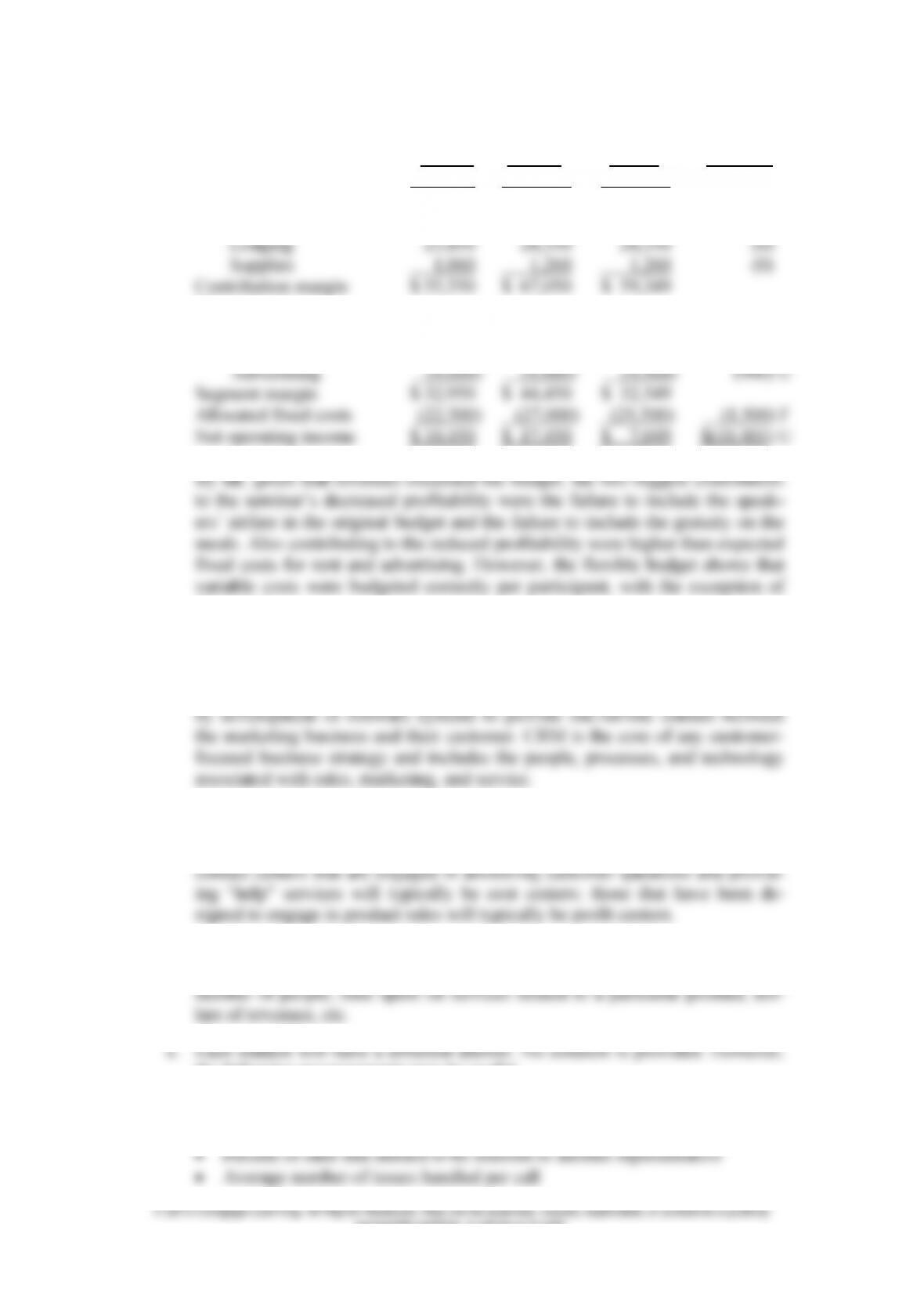
Revenues
$ 90,000
$108,000
$102,000
$ 6,000 U
Variable costs:
Meals
$ 9,540
$ 11,340
$ 13,041
(1,701) U
Lodging
23,850
28,350
28,350
(0)
Supplies
1,060
1,260
1,260
(0)
Contribution margin
$ 55,550
$ 67,050
$ 59,349
Direct fixed costs:
Speakers
(15,000)
(15,000)
(17,700)
(2,700) U
Rent on facilities
(3,600)
(3,600)
(4,200)
(600) U
Advertising
(4,000)
(4,000)
(4,900)
(900) U
Segment margin
$ 32,950
$ 44,450
$ 32,549
Allocated fixed costs
(22,500)
(27,000)
(25,500)
(1,500) F
Net operating income
$ 10,450
$ 17,450
$ 7,049
$(10,401) U
the gratuity.
47. a. CRM is typically defined as the process of finding, getting, and retaining cus-
tomers. CRM is also defined as tracking customer behavior to develop market-
ing and relationship-building programs that bond consumers to a brand often
b. Each student will have a different answer. No solution is provided.
c. Each student will have a different answer. No solution is provided. However,
d. Each student will have a different answer. No solution is provided. However,
contact center costs could be allocated to revenue-producing areas based on
the following measurements may be useful:
Average time to answer calls
Percent of calls abandoned
380 Chapter 13
Average call-handling time
Employee turnover
48. a. Viewing child-care facilities as a cost center could create a negative perspec-
tive of such operations from the company’s standpoint. As such, the company
might try to control or reduce the costs of the child-care facilities by engaging
in one or more of the following actions:
Hiring less-qualified, lower-paid staff personnel
Reducing janitorial and/or maintenance activities
Limiting the number of staff to less-than-necessary
company did not seek to control costs since they would be passed along in the
form of increased charges. It would probably be most beneficial to the em-
cilities.
c. Each student will have a different answer. No solution is provided.
49. a. Footballs: $1,200,000 ÷ $60 = 20,000 units
b. Sales volume variance = $60 (21,000 – 20,000) = $60,000 F
c. Actual volume = 40,000 – ($360,000 ÷ $45) = 40,000 – 8,000 = 32,000
d.
Total sales price variance ($63,000 U + $240,000 F)
$177,000 F
Total sales volume variance ($60,000 F + $360,000 U)
300,000 U
Total sales variance
$123,000 U
Chapter 13 381
accessible website, in whole or in part.
Budgeted revenue exceeded actual revenue by $123,000 for two reasons. First,
footballs were sold at a lower price than budgeted, and second, too few shoul-
50. a. Actual sales volumes
HD radio tuners:
$195,500 ÷ $115 = 1,700 units
Satellite radios:
$141,400 ÷ $70 = 2,020 units
MP3 car decks:
$228,250 ÷ $55 = 4,150 units
Sales price variances
HD radio tuners: 1,700 ($120 – $115) = $ 8,500 U
b. Sales volume variances
HD radio tuners: $120 (1,600 – 1,700) = $ 12,000 F
c. Overall, the sales price variance was $25,210 unfavorable and, approximately
82 percent of this was caused by negative price variance of the MPS car decks.
These results could be attributed to short-term economic pressures or marketing
d. By telling Taub that her performance would only be evaluated on three specif-
ic products, she would tend to ignore other products in her area, which could
have been more appropriate to customers’ needs. Taub might also not have
51. a. Actual sales price = $235,000 ÷ 5,000 = $47
Budgeted sales price = $300,000 ÷ 6,000 = $50
ASP ASV
BSP ASV
BSP BSV
$47 5,000
$50 5,000
$50 6,000
$235,000
$250,000
$300,000
$15,000 U
$50,000 U
Sales Price Variance
Sales Volume Variance
382 Chapter 13
b. The budgeted contribution margin was $120,000 ÷ 6,000 or $20 per unit.
Since the company’s sales volume was 1,000 units less than budgeted, the to-
d. Performance evaluation would be limited, because in most instances, manag-
ers are also responsible for managing some costs in their centers. In Folsom’s
52.
Assets
# of
Hours of
Employed
%
Employees
%
Operation
%
Surgery
$3,948,500
53
20
20
24,850
35
In-patient
2,458,500
33
36
36
28,400
40
Out-patient
1,043,000
14
44
44
17,750
25
$7,450,000
100
71,000
Administration costs:
Surgery: $5,400,000 0.53 = $2,862,000
Public relations cost:
Surgery: $1,100,000 0.20 = $220,000
Maintenance and janitorial cost:
Surgery: $1,700,000 0.35 = $595,000
Surgery
In-Patient
Out-Patient
Administration
$2,862,000
$1,782,000
$ 756,000
Public Relations
220,000
396,000
484,000
Maintenance
595,000
680,000
425,000
Total
$3,677,000
$2,858,000
$1,665,000
53. a. Administration: 45 + 210 + 18 = 273
Commercial = 45 ÷ 273 = 16%; 0.16 $1,500,000 = $240,000
Chapter 13 383
Accounting = $900,000 + $1,440,000 + $540,000 = $2,880,000
Commercial = $900,000 ÷ $2,880,000 = 31%; 0.31 $990,000 = $306,900
Promotion: $10,000,000 + $18,000,000 + $2,000,000 = $30,000,000
Commercial = $10,000,000 ÷ $30,000,000 = 33%; 0.33 $720,000 = $237,600
b. Comm. Res. Prop. Mgmt.
Revenue $ 10,000,000 $18,000,000 $2,000,000
Direct costs (10,490,000) (9,179,000) (398,400)
Allocated costs:
54. a.
Administration costs ($1,500,000)
Base
Allocation
Accounting
15 ÷ 300
$ 75,000
Promotion
12 ÷ 300
60,000
Commercial
45 ÷ 300
225,000
Residential
210 ÷ 300
1,050,000
Property Mgmt.
18 ÷ 300
90,000
Total (rounded)
$1,500,000
Accounting costs ($990,000 + $75,000 = $1,065,000)
Base
Allocation
Promotion
$720,000 ÷ $3,600,000
$ 213,000
Commercial
$900,000 ÷ $3,600,000
266,250
Residential
$1,440,000 ÷ $3,600,000
426,000
Property Mgmt.
$540,000 ÷ $3,600,000
159,750
Total (rounded)
$1,065,000
Promotion ($720,000 + $60,000 + $213,000 = $993,000)
Base
Allocation
Commercial
$10,000,000 ÷ $30,000,000
$331,000
Residential
$18,000,000 ÷ $30,000,000
595,800
Property Mgmt.
$2,000,000 ÷ $30,000,000
66,200
$993,000
Summary of allocations:
Commercial: $225,000 + $266,250 + $331,000 = $822,250
384 Chapter 13
b.
Commercial
Residential
Property Mgmt.
Revenues
$ 10,000,000
$18,000,000
$2,000,000
Direct costs
(10,490,000)
(9,179,000)
(398,400)
Indirect costs
(822,250)
(2,071,800)
(315,950)
Income
$ (1,312,250)
$ 6,749,200
$1,285,650
55. a. Personnel: 72 + 48 = 120
Administration: $480,000 + $800,000 = $1,280,000
Total support costs allocated to Residential = $84,000 + $67,500 = $151,500
b. # of Empl. % Direct Costs %
Administration 30 20%
150
Personnel = $140,000 of costs
Administration = 0.20 × $140,000 = $28,000
Administration = $180,000 + $28,000 = $208,000 of costs
Total support costs allocated to Residential = $67,200 + $78,000 = $145,200
c. (1) Direct Method
Residential = $480,000 + $151,500 = $631,500; $631,500 ÷ 60,000 = $10.53
(2) Step Method
Residential = $480,000 + $145,200 = $625,200; $625,200 ÷ 60,000 = $10.42
56.
ADMINISTRATION
EDITORIAL
Department
Base
%
Base
%
Admin. (A)
N/A
N/A
5
11.11
Editorial (E)
$ 75,000
6.25
N/A
N/A
College Texts
600,000
50.00
25
55.56
Prof. Pubs.
525,000
43.75
15
33.33
Total
$1,200,000
100.00
45
100.00 rounded

Chapter 13 385
A = $225,000 + 0.1111E
A = $225,000 + 0.1111($175,000 + 0.0625A)
E = $175,000 + 0.0625($246,141)
College
Dept.
Admin.
Edit.
Texts
Prof. Pubs.
Direct costs
$ 225,000
$ 175,000
$2,250,000
$ 950,000
Admin.
(246,141)
15,384
123,071
107,687
Edit.
21,152
(190,384)
105,777
63,455
Total
$ 0
$ 0
$2,478,848
$1,121,142
57. a.
Assets Employed
%
# of Employees
%
Adv.
$ 381,200
29
6
32
Cir.
935,150
71
13
68
$1,316,350
100%
19
100%
Adv.
Cir.
Admin. (0.29 × $390,750; 0.71 × $390,750)
$113,318
$277,433
H. Res. (0.32 × $246,350; 0.68 × $246,350)
78,832
167,518
$192,150
$444,951
b.
Adv.: $478,900 + $192,150 =
$ 671,050
Cir.: $676,300 + $444,951 =
1,121,251
$1,792,301 (off due to rounding)
c. Admin. ($390,750):
Base
Allocation
H. Res.
$145,850 ÷ $1,462,200
$ 38,976
Adv.
$381,200 ÷ $1,462,200
101,870
Cir.
$935,150 ÷ $1,462,200
249,904
$390,750
H. Res. ($246,350 + $38,976) = $285,326:
Base
Allocation
Adv.
6 ÷ 19
$ 90,103
Cir.
13 ÷ 19
195,223
$285,326
d.
Adv.: $478,900 + $101,870 + $90,103 =
$ 670,873
Cir.: $676,300 + $249,904 + $195,223 =
1,121,427
$1,792,300

386 Chapter 13
e.
ADMIN.
H. RES.
Department
Base
%
Base
%
Admin. (A)
N/A
N/A
5
21
H. Res. (H)
$ 145,850
10
N/A
N/A
Adv.
381,200
26
6
25
Cir.
935,150
64
13
54
$1,462,200
24
A = $390,750 + 0.21H
A = $390,750 + 0.21($246,350 + 0.10A)
H = $246,350 + 0.10($451,975)
Admin.
H. Res.
Advertising
Circulation
Direct costs
$ 390,750
$ 246,350
$478,900
$ 676,300
Admin.
(451,975)
45,198
117,514
289,264
H. Res.
61,225
(291,548)
72,887
157,436
$ 0
$ 0
$669,301
$1,123,000
58. a. Administrative Costs ($2,130): (000s omitted)
Base
Allocation
Legal/Acctg.
40 ÷ 800
$ 106.50
Maint./Eng.
60 ÷ 800
159.75
Proc.
400 ÷ 800
1,065.00
Finish.
300 ÷ 800
798.75
$2,130.00
Legal/Acctg. ($1,680 + $106.50 = $1,786.50):
Base
Allocation
Maint./Eng.
400 ÷ 4,000
$ 178.65
Proc.
1,600 ÷ 4,000
714.60
Finish.
2,000 ÷ 4,000
893.25
$1,786.50
Maint./Eng. ($2,370 + $159.75 + $178.65 = $2,708.40):
Base
Allocation
Proc.
136 ÷ 340
$1,083.36
Finish.
204 ÷ 340
1,625.04
$2,708.40
Summary of allocation:
Proc.: $1,065 + $714.60 + $1,083.36 + $7,520 = $10,382.96

Chapter 13 387
Factory overhead rates:
Proc.: $10,382.96 ÷ 400 = $25.96 per direct labor hour
b.
Floor Space
%
# of Employees
%
# of Hours
%
Proc.
1,600
44
400
57
136
40
Finish.
2,000
56
300
43
204
60
3,600
700
340
Proc.
Finish.
Admin.
$1,214
$ 916
Legal/Acctg.
739
941
Maint./Eng.
948
1,422
Total
$2,901
$3,279
Factory overhead rates:
Proc.: ($7,520 + $2,901) ÷ 400 = $26.05 per direct labor hour
c.
ADMIN.
LEGAL/ACCTG.
MAINT./ENG.
Department
Base
%
Base
%
Base
%
Admin. (A)
N/A
N/A
800
16.67
30
7.32
Legal/Acctg. (L)
40
5.00
N/A
N/A
40
9.76
Maint./Eng. (M)
60
7.50
400
8.33
N/A
N/A
Proc.
400
50.00
1,600
33.33
136
33.17
Finish.
300
37.50
2,000
41.67
204
49.76
800
4,800
410
A = $2,130 + 0.17L + 0.07M
A = $2,130 + 0.17($1,680 + 0.05A + 0.10M) + 0.07M
M = $2,370 + 0.075A + 0.08($1,680 + 0.05A + 0.10M)
Substituting M:
A = $2,436 + 0.088($2,525 + 0.0796A)
M = $2,525 + 0.0796($2,677)
= $2,088