
Chapter 11 341
53. a.
Total joint cost:
Direct material
Direct labor
Overhead
$37,500
12,000
11,000
$60,500
Sales value of scrap ($0.45 × 3,600 lbs.)
Joint cost to be allocated
(1,620)
$58,880
b.
Robes
Beach Towels
Revenues
$ 20.00
$ 7.00
Separate costs
(6.80)
(1.60)
NRV per unit
$ 13.20
$ 5.40
Multiply by # of units produced
6,000
12,000
Total NRV
$79,200
$ 64,800
NRV %
55%
45%
Joint cost assignable to robes (55% × $58,880)
$32,384
Joint cost assignable to towels (45% × $58,880)
26,496
$58,880
Work in Process Inventory—Robes
32,384
Work in Process Inventory—Towels
26,496
Work in Process Inventory—Cutting
58,880
To allocate joint costs to robes and towels
Finished Goods Inventory—Scrap
1,620
Work in Process Inventory—Cutting
1,620
To record production of scrap
c.
Robes
Beach Towels
Allocated joint cost
$32,384
$26,496
Separate costs:
$6.80 × 6,000
40,800
$1.60 × 12,000
19,200
Total to finished goods
$73,184
$45,696
54. a.
Sales
Units
Sales
Value at
Joint
Allocated
Product
Produced
Price
Split-Off
%
Costs
Joint Costs
Alpha
2,500
$100
$250,000
31.25%
$720,000
$225,000
Beta
5,000
80
400,000
50.00
720,000
360,000
Gamma
7,500
20
150,000
18.75
720,000
135,000
Total
$800,000
100.00%
$720,000
b.
Joint costs of Beta [from (a)]
$360,000
Additional processing costs
150,000
Total cost of Beta
$510,000
c.
Alpha should not be processed further:
Incremental revenue [($150 – $100) $2,500]
$ 125,000
Incremental processing cost
(150,000)
Decline in income if processed further
$ (25,000)
342 Chapter 11
accessible website, in whole or in part.
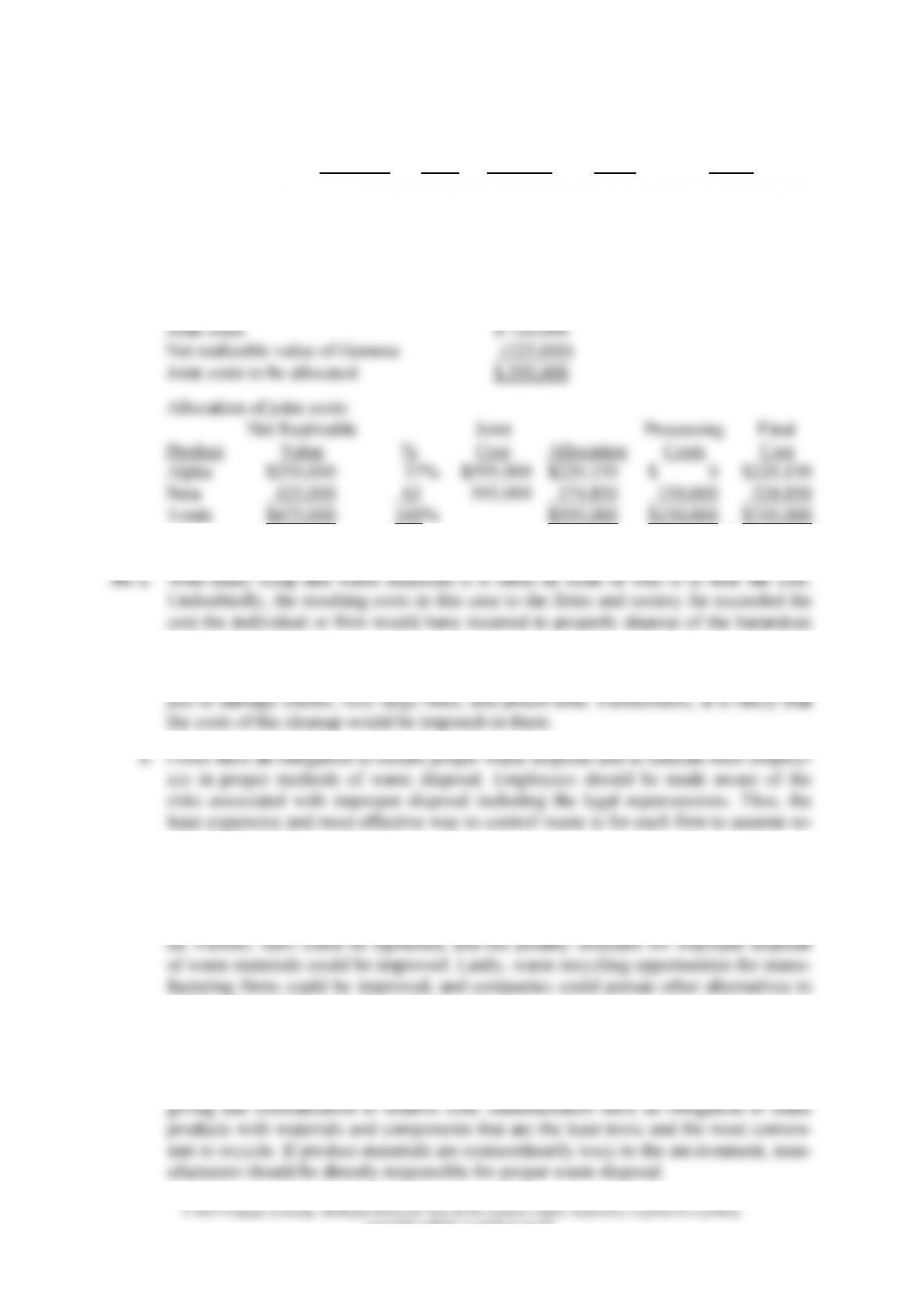
Net realizable value of products:
Units
Selling
Processing
Net Realizable
Produced
Price
Revenue
Costs
Value
Alpha
(sold at split-off)
2,500
$100
$250,000
$ 0
$250,000
Beta
(processed further)
5,000
115
575,000
150,000
425,000
Gamma
(processed further)
7,500
30
225,000
100,000
125,000
Joint costs
$ 720,000
Net realizable value of Gamma
(125,000)
Joint costs to be allocated
$ 595,000
Allocation of joint costs:
Net Realizable
Joint
Processing
Final
Product
Value
%
Cost
Allocation
Costs
Cost
Alpha
$250,000
37%
$595,000
$220,150
$ 0
$220,150
Beta
425,000
63
595,000
374,850
150,000
524,850
Totals
$675,000
100%
$595,000
$150,000
$745,000
(CIA adapted)
waste materials.
If caught, those involved with this type of illegal disposal of materials could be sub-
sponsibility for its own waste.
Beyond internal measures, the larger society can assume a greater oversight role
through increased regulation and monitoring of waste control efforts. Much of this ac-
tivity is currently monitored by the EPA, but the role of this agency could be expand-
reduce the costs of waste disposal.
c. The vendor/manufacturer must bear some of the responsibility for proper use and dis-
posal of its products. Manufacturers should have superior knowledge about chemical
properties and the risks associated with their products’ components. Further, while
Chapter 11 343
accessible website, in whole or in part.
products follows.
Pork By-Products: insulin for the regulation of diabetes; valves for human heart surgery;
suede for shoes and clothing; and gelatin for many food and nonfood uses. Swine by–
product are also important parts of such products as water filters, insulation, rubber, anti-
Wheat/Soybean/Cottonseed By-Products: livestock, poultry, and fish/shrimp feed
Rice By-Products: pet foods; rice flour
Lumber By-Products: animal bedding, sawdust (and particleboard), wood chips, mulch;
slabs and chips produce paper; firewood
Animal By-Products:
Glue made from cow hide is preferred when binding books because animal glue can
withstand high temperatures and has the ability to dissolve in water, making recycling
possible.
fats.
Animal gelatins are an ingredient in a wide range of foods like candies, marshmal-
lows, flavorings and of course Jell-O. Gelatin is also a common food stabilizer in
items such as mayonnaise and ice cream, “lite” products, and frozen foods. Gelatins
are used to clarify beverages like fruit juices, beer and wine.
Laundry detergents and fabric softeners contain animal products, as do many disin-
fectants, household cleaners, and polishes.
Latex surgical gloves contain tallow, x-ray film contains gelatin, and wool grease is
used to make thermometers heat sensitive.
Sheep wool gives baseballs their bounce. Gelatin helps golf balls roll straight.
Leather, foam rubber, and plastics are used in most types of sports equipment.
344 Chapter 11
accessible website, in whole or in part.
products. Animal products are used in brushes, art supplies, and in instruments such
as drums and pianos.
action called for by the program component.
(American Institute of Certified Public Accountants, Statement of Position 98-2: Accounting for Costs of
Activities of Not-for-Profit Organizations and State and Local Governmental Entities That Include Fund
(AICPA adapted)
58. a. The purpose, audience, and content criteria are met, and the entire $24,000 should be
allocated. The activity calls for specific action by the recipient (exercising) that will
help accomplish the entity’s mission. The purpose criterion is met based on the other
help accomplish the entity’s mission (increasing the physical activity of senior citi-
zens), and the need for and benefits of the action are clearly evident (explains the im-
portance of exercising).
c. The content and audience criteria are met. The purpose criterion is not met, however,
because a majority of compensation or fees for the fund-raising consultant varies
based on contributions raised for this discrete joint activity. All costs should be
charged to fund raising, including the costs of the second brochure and any other costs
(American Institute of Certified Public Accountants, Statement of Position 98-2: Accounting for Costs
of Activities of Not-for-Profit Organizations and State and Local Governmental Entities That Include
Fund Raising (March 11, 1998); Section 10,730; http://www.fasb.org/cs/BlobServer?blobcol=urldata&
blobtable=MungoBlobs&blobkey=id&blobwhere=1175820927486&blobheader=application%2Fpdf)
(AICPA adapted)
59. The purpose, audience, and content criteria are not met. All costs should be charged to
fund-raising. The purpose criterion is not met because the activity has no call for specific
action; the program only educates the audience about causes (describing its programs and
showing the needy children). (Although the executive producer will be paid $5,000 if the
Chapter 11 345
accessible website, in whole or in part.
ty’s mission.
(American Institute of Certified Public Accountants, Statement of Position 98-2: Accounting for Costs of
Activities of Not-for-Profit Organizations and State and Local Governmental Entities That Include Fund
(AICPA adapted)
60. a. Yes, it would meet the audience criterion because the attendees were “self-selected”
and were not invited based on their ability or likelihood to contribute.
were all “calls for action.”
c.
Program (0.65 $360,000)
$234,000
Management/general (0.25 $360,000)
90,000
Fund-raising (0.10 × $360,000)
36,000
Total
$360,000
systematic.
e. All of the $430,000 would be allocated to fund-raising because the compensation test
61. Each student will have a different answer. No solution is provided. However, the follow-
ing information may be appropriate:
lower than non-higher education, as higher ed is more capital–campaign intensive. Arts
and culture and non-hospital health are typically raising mostly operating funds and thus
would have the highest fund-raising cost.
62. a. The income statement provided is incomplete if the Center for Entrepreneurship pro-
duces joint products. One of two approaches would make the income statement more
accurate. First, part of the costs shown on the income statement could be assigned to
fundraising using one of the methods discussed in the chapter. The remaining costs
346 Chapter 11
accessible website, in whole or in part.
ment a portion of the proceeds generated by all of the fundraising activities of the col-
lege.
one could effect such an allocation using a monetary measure such as total cash and fair
market value of other assets generated by the center from fund-raising and fees. To pre-
sent a credible argument, the cash and fair market value of other assets derived from
fund-raising would be limited to contributions to the college from parties primarily
ket value of other property raised through fund-raising to the Center. This approach
would require one to credibly demonstrate that a portion of the total value of cash and
property raised for the college from fund-raising should be assigned to the Center.
The Center’s portion of the total value of cash and property raised through college
main in operation.
63. Each student will have a different answer. No solution is provided.