315
accessible website, in whole or in part.
CHAPTER 11
COST ALLOCATION FOR JOINT PRODUCTS AND
BY-PRODUCT/SCRAP
QUESTIONS
1. Joint processing output is classified based on the relative sales value of each type of out-
put. Joint products are those outputs that have the largest sales value. By-products are
tle sales value.
Usually, the output classification is determined before production. Management decides
2. Processing of the outputs of a joint production process does not always stop at the split–
additional costs.
3. Three of the decision points are (1) before the joint process is undertaken, (2) at the split–
whether this particular process is the best use of the facilities; the criteria for this decision
the best alternative facility usage.
4. Cost allocation refers to the assignment of an indirect cost to a cost object using some
reasonable method. Accountants allocate fixed production costs to products produced
Since the production costs incurred in a joint process produce several outputs, those costs
are indirect to the individual output produced and must, because of the cost principle, be
5. The two primary approaches to allocating joint process costs are those using (1) physical
measures and (2) monetary measures. Physical measures (such as tons, barrels, linear feet,
316 Chapter 11
accessible website, in whole or in part.
ate.
6. Use of approximated net realizable values are necessary when some or all of the joint
NRV method, managers must make estimates of final sales prices and incremental sepa-
rate costs.
7. One approach is to ignore by-product/scrap inventory completely until it is sold. At that
point, the revenue generated by the sale of that inventory “acknowledges” the existence of
The second approach is to record the final net realizable value of the by-product/scrap re-
covered at the split-off point. The NRV is credited as a reduction of the joint process
product inventory (especially if it is never sold) and understate the cost of the joint prod-
ucts. Thus, the realizable value method is more likely to raise the potential for misleading
earnings management.
8. If a company using job order costing produces by-product/scrap continuously from nor-
mal production, the net realizable value of that by-product/scrap should be considered in
Overhead.
rise to the by-product/scrap.
9. For a not-for-profit organization to appropriately evaluate the uses of its resources, the
AICPA requires that multipurpose costs be allocated between program and support cate-
gories. Program expenses are those that are directly aimed at the accomplishment of the
Chapter 11 317
accessible website, in whole or in part.
EXERCISES
10. Each student will have a different answer. No solution is provided.
11. a. In a poultry processing plant, the joint input would be chickens and/or turkeys. The
primary questions to be asked follow.
(1) What specific poultry will be used; what customers will be served; and what is the
undertaken at all.
(2) What specific cuts of poultry should be selected from the poultry inputs? The an-
swer to this question will determine how the inputs are cut into salable parts.
the joint cost.
(4) How much processing should be done to the individual cuts? The answer to this
question will determine what specific processes will be necessary beyond the
split-off point and what types of equipment the poultry processing plant must have
processing.
b. In a poultry processing plant, the way joint cost is allocated can affect many deci-
sions. For example, allocating joint cost to by-product/scrap would likely cause it to
be seen as a “money loser,” and as such, it might simply be disposed of as waste. Joint
performed.
c. Four categories of output may be obtained from joint production. Joint products are
the primary products and are distinguished from other outputs by their relatively
greater sales value. At the opposite end of the continuum, waste is incidental output of
greater market value than scrap.
318 Chapter 11
12.
# of
SV at
Products
Units
Split-Off
Total SV
Classification
Boco
1,200
$6.000
$ 7,200
Joint product
Loco
1,000
$1.750
$ 1,750
By-product
Roco
5,000
$2.500
$12,500
Joint product
Soco
3,800
$4.200
$15,960
Joint product
Moco
4,100
$1.900
$ 7,790
Joint product
Coco
200
$0.250
$ 50
Scrap
Doco
300
$1.800
$ 540
Scrap
Joco
1,000
$0.020
$ 20
Scrap
Voco
6,000
$0.001
$ 6
Waste
13. a. Allocation rate = $16,200,000 ÷ 36,000,000 feet = $0.45 per foot
Grade A: $0.45 27,000,000 = $12,150,000
Grade B: $0.45 9,000,000 = $4,050,000
b.
Incremental revenue (27,000,000 $0.80)
$ 21,600,000
Incremental costs (27,000,000 $0.75)
(20,250,000)
Increase in income (27,000,000 $0.05)
$ 1,350,000
lumber further.
14. a.
Sales value of milk
$377,400 (68%)
Sales value of sour cream
177,600 (32%)
Total sales value
$555,000
or $185,000.
b. 190,000 pints = 95,000 quarts of sour cream
Quarts of milk
240,000 (72%)
Quarts of sour cream
95,000 (28%)
Total quarts
335,000
$174,722.
Chapter 11 319
15. Two ounces of each 16 ounces (or 12.5 percent) are lost to waste, leaving 87.5 percent of
total lbs. available.
a.
Joint
Unit
Lbs. of
Allocated
Products
Weight
Total Pounds
Product
Percent
Joint Cost
Fish
0.500
75,000
37,500
57
$ 81,396
Oil
0.250
75,000
18,750
29
41,412
Meal
0.125
75,000
9,375
14
19,992
0.875
65,625
100
$142,800
b.
Joint
Lbs. of
Selling Price
Allocated
Products
Product
per Lb.
Total
Percent
Joint Cost
Fish
37,500
$4.50
$168,750
55
$ 78,540
Oil
18,750
6.50
121,875
39
55,692
Meal
9,375
2.00
18,750
6
8,568
$309,375
100
$142,800
c. Although an unchanging measure, the physical measure of pounds treats all products
as equally valuable. Because of inflation and market price variability, sales value is a
16. a.
# of
Joint
Allocated
Product
Pounds
Proportion
Cost
Joint Cost
Steaks
3,312
24%
$26,400
$ 6,336
Roasts
6,210
45
26,400
11,880
Ground Beef
4,278
31
26,400
8,184
Total
13,800
100%
$26,400
$1.01.
b.
# of
SV at
Total
Allocated
Product
Pounds
Split Off
SV
Percent
Joint Cost
Steaks
3,312
$4.25 per lb.
$14,076
34%
$ 8,976
Roasts
6,210
$3.80 per lb.
23,598
57
15,048
Ground Beef
4,278
$0.90 per lb.
3,850
9
2,376
Total
$41,524
$26,400
c. Selling price $ 2.10
Allocated joint cost (0.56)
320 Chapter 11
Revenues
$ 30,720,000
$ 189,320,000
Separate costs
(31,040,000)
(16,320,000)
(110,720,000)
Allocated costs
(3,120,000)
(2,880,000)
(18,000,000)
Net profit
$ (120,000)
$ 11,520,000
$ 60,600,000
The $0.40 per pound should not be considered a “real” profit amount because the allo-
cated joint cost would change simply based on the allocation method chosen. However,
17. a.
Games
News
Documentaries
Revenues
$ 34,040,000
$ 30,720,000
$ 189,320,000
Separate costs
(31,040,000)
(16,320,000)
(110,720,000)
NRV
$ 3,000,000
$ 14,400,000
$ 78,600,000
% of $96,000,000 total
3%
15%
82%
Joint cost allocation:
Games ($24,000,000 × 0.03)
$ 720,000
News ($24,000,000 × 0.15)
3,600,000
Documentary ($24,000,000 × 0.82)
19,680,000
Total
$24,000,000
Games
News
Documentaries
Revenues
$ 34,040,000
$ 30,720,000
$ 189,320,000
Separate costs
(31,040,000)
(16,320,000)
(110,720,000)
Allocated costs
(720,000)
(3,600,000)
(19,680,000)
Net profit
$ 2,280,000
$ 10,800,000
$ 58,920,000
b.
Games
News
Documentaries
Revenues
$34,040,000
$30,720,000
$189,320,000
% of $254,080,000 total
13%
12%
75%
Joint cost allocation:
Games ($24,000,000 × 0.13)
$ 3,120,000
News ($24,000,000 × 0.12)
2,880,000
Documentaries ($24,000,000 × 0.75)
18,000,000
Total
$24,000,000
Chapter 11 321
accessible website, in whole or in part.
(3) The Games Group could be a start-up division and, as such, may be incurring sub-
stantially higher costs and may not have begun to reach its revenue potential.
18. a. Units of output allocation:
Total bottles = 20,000 + 32,000 + 28,000 = 80,000
Perfume [(20,000 ÷ 80,000) × $1,080,000]
$ 270,000
Eau de Toilette [(32,000 ÷ 80,000) × $1,080,000]
432,000
Body Splash [(28,000 ÷ 80,000) × $1,080,000]
378,000
Total
$1,080,000
Weight-based allocation:
Total weight = (20,000 × 1) + (32,000 × 2) + (28,000 × 3) = 168,000
Perfume = 20,000 ÷ 168,000 = 12%
Eau de Toilette = 64,000 ÷ 168,000 = 38%
Perfume ($1,080,000 × 0.12)
$ 129,600
Eau de Toilette ($1,080,000 × 0.38)
410,400
Body Splash ($1,080,000 × 0.50)
540,000
Total
$1,080,000
Approximated NRV computation:
Perfume [20,000 × ($16.50 – $2.50)]
$280,000
30%
Eau de Toilette [32,000 × ($13.00 – $1.50)]
368,000
40%
Body Splash [28,000 × ($12.00 – $2.00)]
280,000
30%
Total
$928,000
100%
Approximated NRV allocation:
Perfume ($1,080,000 × 0.3)
$ 324,000
Eau de Toilette ($1,080,000 × 0.4)
432,000
Body Splash ($1,080,000 × 0.3)
324,000
Total
$1,080,000
Units of output allocation:
Perfume [$270,000 + ($2.50 × 20,000)]
$ 320,000
Eau de Toilette [$432,000 + ($1.50 × 32,000)]
480,000
Body Splash [$378,000 + ($2.00 × 28,000)]
434,000
Total
$1,234,000
Ending inventory valuation based on units of output:
Perfume [$320,000 × (600 ÷ 20,000)]
$ 9,600
Eau de Toilette [$480,000 × (1,600 ÷ 32,000)]
24,000
Body Splash [$434,000 × (1,680 ÷ 28,000)]
26,040
Total
$59,640
322 Chapter 11
Ending inventory valuation based on weight:
Perfume
($129,600 + $50,000) = $179,600 total cost
$179,600 ÷ 20,000 ounces = $8.98 per ounce
600 bottles 1 ounce $8.98 =
$ 5,388
Eau de Toilette
($410,400 + $48,000) = $458,400 total cost
$458,400 ÷ 64,000 ounces = $7.16 per ounce
1,600 bottles × 2 ounces $7.16 =
22,912
Body Splash
($540,000 + $56,000) = $596,000 total cost
$596,000 ÷ 84,000 ounces = $7.10 per ounce
1,680 3 ounces $7.10 =
35,784
Total
$64,084
Ending inventory valuation based on approximated NRV:
Perfume
($324,000 + $50,000) = $374,000 total cost
$374,000 ÷ 20,000 ounces = $18.70 per ounce
600 bottles 1 ounce $18.70 =
$11,220
Eau de Toilette
($432,000 + $48,000) = $480,000 total cost
$480,000 ÷ 64,000 ounces = $7.50 per ounce
1,600 bottles 2 ounces $7.50 =
24,000
Body Splash
($324,000 + $56,000) = $380,000 total cost
$380,000 ÷ 84,000 = $4.52 per ounce
1,680 3 ounces $4.52 =
22,781
Total
$58,001
19. a.
JP-4539
4,500
0.125 $558,000 =
$ 69,750
JP-4587
18,000
0.500 $558,000 =
279,000
JP-4591
13,500
0.375 $558,000 =
209,250
36,000
1.000
$558,000
b.
JP-4539
4,500 $14 = $ 63,000
0.14 $558,000 = $ 78,120
JP-4587
18,000 $ 8 = 144,000
0.32 $558,000 = 178,560
JP-4591
13,500 $18 = 243,000
0.54 $558,000 = 301,320
$450,000
1.00 $558,000
c. JP-4539
4,500 ($24 – $4) = $ 90,000
0.17 $558,000 = $ 94,860
JP-4587
18,000 ($15 – $5) = 180,000
0.33 $558,000 = 184,140
JP-4591
13,500 ($22 – $2) = 270,000
0.50 $558,000 = 279,000
$540,000
1.00 $558,000
Chapter 11 323
20. a. Final
Sales
Split-Off
Increm.
Increm.
Increm.
Product
Value
Sales Value
Revenue
Cost
Profit
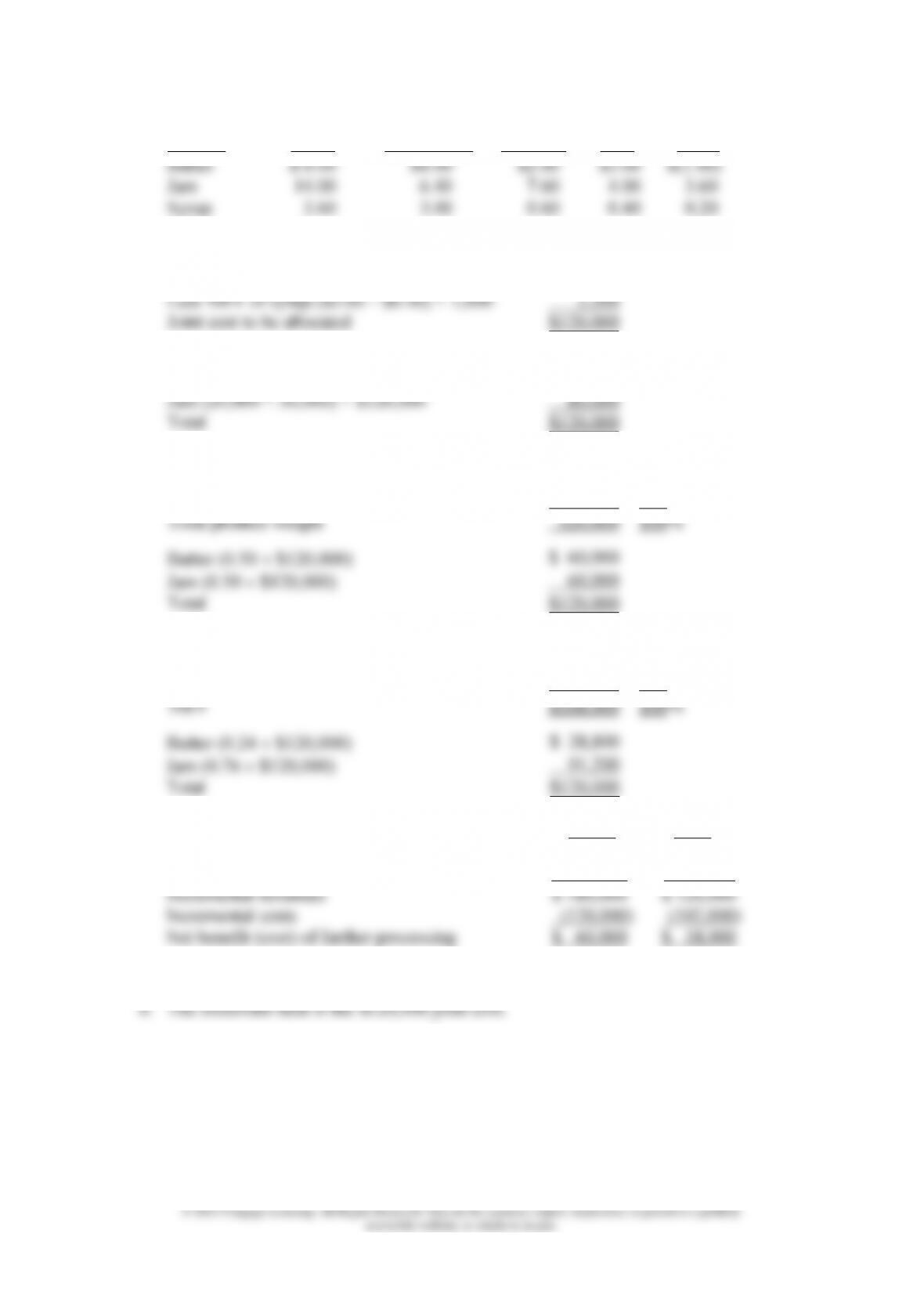
Butter
$ 6.00
$4.00
$2.00
$3.00
$(1.00)
Jam
14.00
6.40
7.60
4.00
3.60
Syrup
3.60
3.00
0.60
0.40
0.20
Only jam and syrup should be processed beyond the split-off point.
b.
Joint cost
$123,200
Less NRV of syrup ($3.60 – $0.40) × 1,000
3,200
Joint cost to be allocated
$120,000
Unit-based allocation:
Butter (10,000 ÷ 30,000) × $120,000
$ 40,000
Jam (20,000 ÷ 30,000) × $120,000
80,000
Total
$120,000
Weight-based allocation:
Butter (10,000 × 16 ounces)
160,000
50%
Jam (20,000 × 8 ounces)
160,000
50%
Total product weight
320,000
100%
Butter (0.50 $120,000)
$ 60,000
Jam (0.50 $120,000)
60,000
Total
$120,000
Sales value at split-off allocation [from (a)]
Butter (10,000 $4.00)
$ 40,000
24%
Jam (20,000 $6.40)
128,000
76%
NRV
$168,000
100%
Butter (0.24 $120,000)
$ 28,800
Jam (0.76 $120,000)
91,200
Total
$120,000
21. a.
Fabric
Yarn
Final revenues
$ 540,000
$ 420,000
Revenues at split-off
(360,000)
(300,000)
Incremental revenues
$ 180,000
$ 120,000
Incremental costs
(120,000)
(102,000)
Net benefit (cost) of further processing
$ 60,000
$ 18,000
Both products should be processed further.
324 Chapter 11
22.
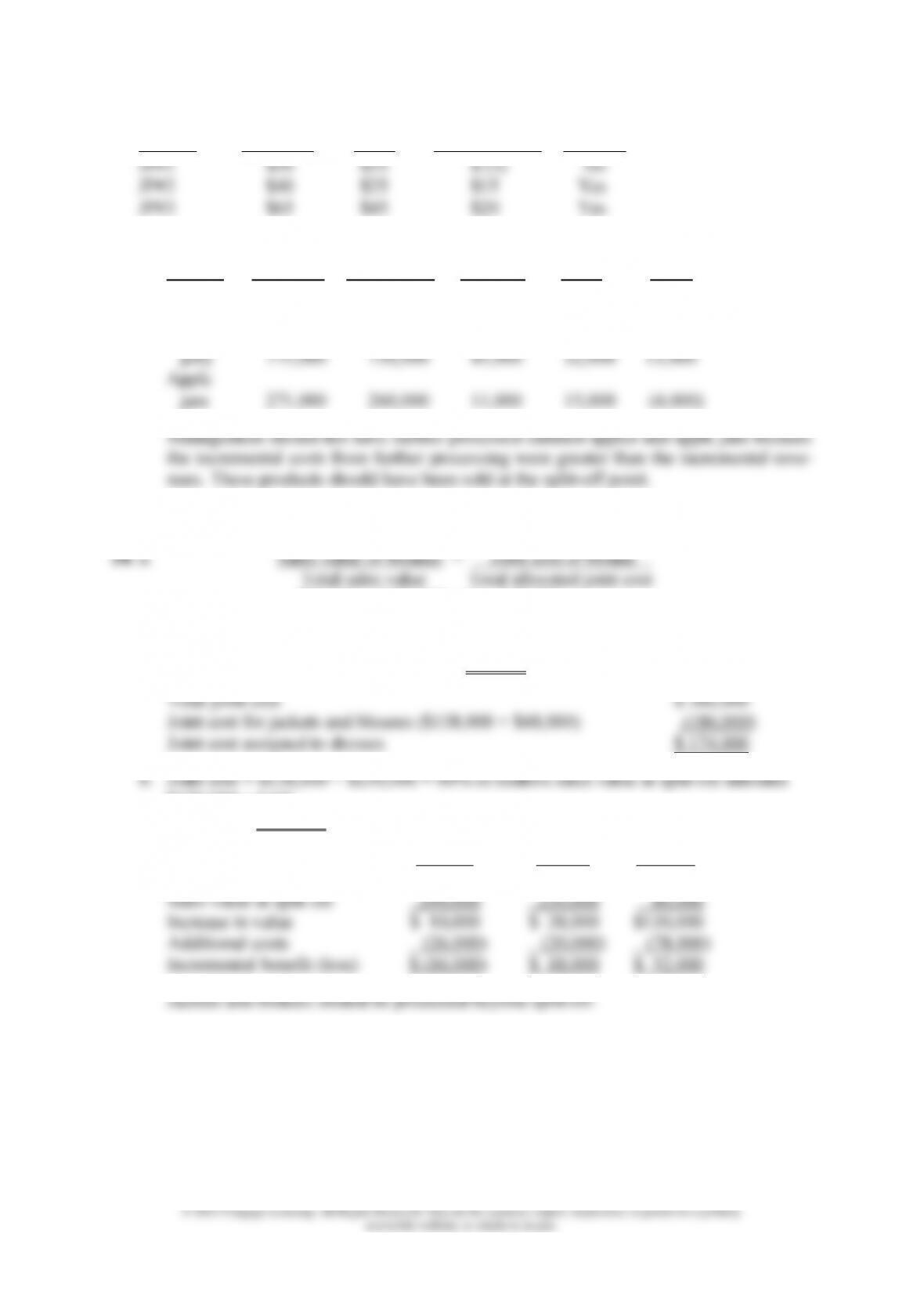
Increm.
Increm.
Process
Product
Revenues
Costs
Benefit/(Loss)
Further?
JP#1
$50
$55
$ (5)
No
JP#2
$40
$25
$15
Yes
JP#3
$65
$45
$20
Yes
23. a.
Final
Split-Off
Increm.
Increm.
Increm.
Product
Revenues
Sales Value
Revenue
Costs
Profit
Candied
apples
$690,000
$670,000
$20,000
$26,000
$(6,000)
Apple
jelly
775,000
730,000
45,000
32,000
13,000
Apple
jam
271,000
260,000
11,000
15,000
(4,000)
b.
Candied apples additional profit
$6,000
$80,000 ÷ $600,000 = X ÷ 360,000
$600,000X = ($80,000)($360,000)
$600,000X = $2,880,000,000,000
X = $48,000 for blouses
Total joint cost
$ 360,000
Joint cost for jackets and blouses ($138,000 + $48,000)
(186,000)
Joint cost assigned to dresses
$ 174,000
$174,000 = 0.6X
X = $290,000 sales value at split-off for dresses
c.
Dresses
Jackets
Blouses
Final sales value
$300,000
$268,000
$210,000
Sales value at split off
290,000
230,000
80,000
Increase in value
$ 10,000
$ 38,000
$130,000
Additional costs
(26,000)
(20,000)
(78,000)
Incremental benefit (loss)
$ (16,000)
$ 18,000
$ 52,000