302 Chapter 10
accessible website, in whole or in part.
by purchasing from this supplier.
ness community and to the socioeconomic balance; damage to the company’s
reputation; possible fines and/or imprisonment if co-conspiracy could be prov-
c. Tate should investigate further the hiring practices of the supplier or allow the
proper authorities to do so. If satisfied that the supplier is following legal prac-
make its own keyboards.
33. a. Relevant costs include:
Variable production costs: ($0.08 + $0.06 + $0.04) or $0.18 per unit
Vendor’s offering price: $0.19 per unit
b.
Production costs saved ($0.18 × 4,000,000)
$ 720,000
Salary savings
50,000
Purchase cost of part ($0.19 × 4,000,000)
(760,000)
Advantage of outsourcing the part
$ 10,000
34. a.
Cost to make:
Direct material
$278.00
Direct labor ($132 0.75)
99.00
Variable overhead ($86 0.75)
64.50
Fixed overhead:
Rental value of production space ($228,000 ÷ 50,000)
4.56
Depreciation on new machine ($10,000,000 ÷ 5) ÷ 50,000
40.00
Total unit cost
$486.06
Cost to buy:
$480.00
b. If 60,000 subassemblies were required annually, the “cost to make” would
change because of the lower fixed costs on a per-unit basis. The depreciation
Chapter 10 303
accessible website, in whole or in part.
c. If 75,000 subassemblies were required annually, the “cost to make” would
again change due to the lower fixed costs on a per-unit basis. The depreciation
would be ($10,000,000 ÷ 5) ÷ 75,000 = $26.67, and the rental value opportunity
d. Qualitative considerations:
Quality control systems in place by potential supplier
Reliability of the supplier
35. The first step is to compute the contribution margin for each product.
Product P
Product Q
Product R
Product S
Sales price per unit
$ 10.00
$ 15.00
$ 7.00
$ 11.00
Variable cost of goods sold
2.50
3.00
6.50
6.00
Variable operating expenses
1.17
1.25
1.00
1.20
Contribution margin per unit
$ 6.33
$ 10.75
$ (0.50)
$ 3.80
Units sold
× 1,000
× 1,200
× 1,800
× 2,000
Total contribution margin
$ 6,330
$ 12,900
$ (900)
$ 7,600
b. Because Product R currently has negative contribution margin of $900, operat-
c. If dropping Product R results in a loss of sales of 200 units of Product Q, the
Impact of dropping Product R
$ 900
Impact of loss sales of Product Q: 200 × $10.75
(2,150)
Impact on income
$(1,250)
Before
After
Selling price
$ 7.00
$ 8.00
Variable cost per unit
7.50
7.50
Contribution margin per unit
$ (0.50)
$ 0.50
Units sold
× 1,800
× 1,500
Total contribution margin
$ (900)
$ 750
Increase in contribution margin: $1,650
304 Chapter 10
accessible website, in whole or in part.
Incremental approach:
Increase in contribution margin ($1.00 × 1,500 units)
$1,500
Increase by avoiding sales of 300 units
at negative CM (300 × 0.50)
150
Increase in total contribution margin
$1,650
e. Poole is mistaken. The decision lacks goal congruence. Although the increase
in total sales will have a beneficial effect on the commissions of the sales staff,
Product S
Product T
Selling price per unit
$ 11.00
$ 14.00
Variable costs per unit
7.20
11.46
Contribution margin per unit
$ 3.80
$ 2.54
Units sold
2,000
2,100
Total contribution margin
$ 7,600
$ 5,334
f. Traditional accounting does not always take into account the relevant costs of
decisions. Since fixed costs are often allocated, the total will not change re-
gardless of changes in volume. This sometimes gives product lines the appear-
ance of “losing money.” However, if a product that provides a positive
(AICPA adapted)
36. a. The out-of-pocket costs per unit will increase by $9,600:
Manufacture
Purchase
Direct material
$ 2,000
$ 0
Direct labor
16,000
0
Variable manufacturing overhead
($24,000 × 1/3)
8,000
0
Component purchase price
30,000
Material handling cost (20% of DM)
400
6,000
Out-of-pocket cost per unit
$26,400
$36,000
b. Total monthly costs would increase $46,000.
Monthly out-of-pocket costs to manufacture:
Manufacture
Purchase
(Requirement a)
$ 26,400
$ 36,000
Number of units
× 10
× 10
Total monthly out-of-pocket costs
$264,000
$360,000
Rental income
0
(50,000)
Total
$264,000
$310,000
the decision.
(CMA adapted)
Chapter 10 305
37. a. Since machine hours are the scarce resource, Callahan should maximize the
total profits by maximizing production of the product with the highest contri-
bution margin per machine hour.
Contribution margin per unit:
Blender
Electric Mixer
Selling price
$20
$38
Direct material
6
11
Direct labor
4
9
Variable overhead*
6
12
Contribution margin per unit
$ 4
$ 6
Machine hours per unit
÷ 1
÷ 2
Contribution margin per machine hour
$ 4
$ 3
Overhead cost per unit
$16
$32
Fixed overhead $10 × 1; $10 × 2
10
20
Variable overhead cost per unit
$ 6
$12
The optimum strategy would be to produce 20,000 blenders and 15,000 elec-
tric mixers and purchase any additional electric mixers from outside suppliers
as needed.
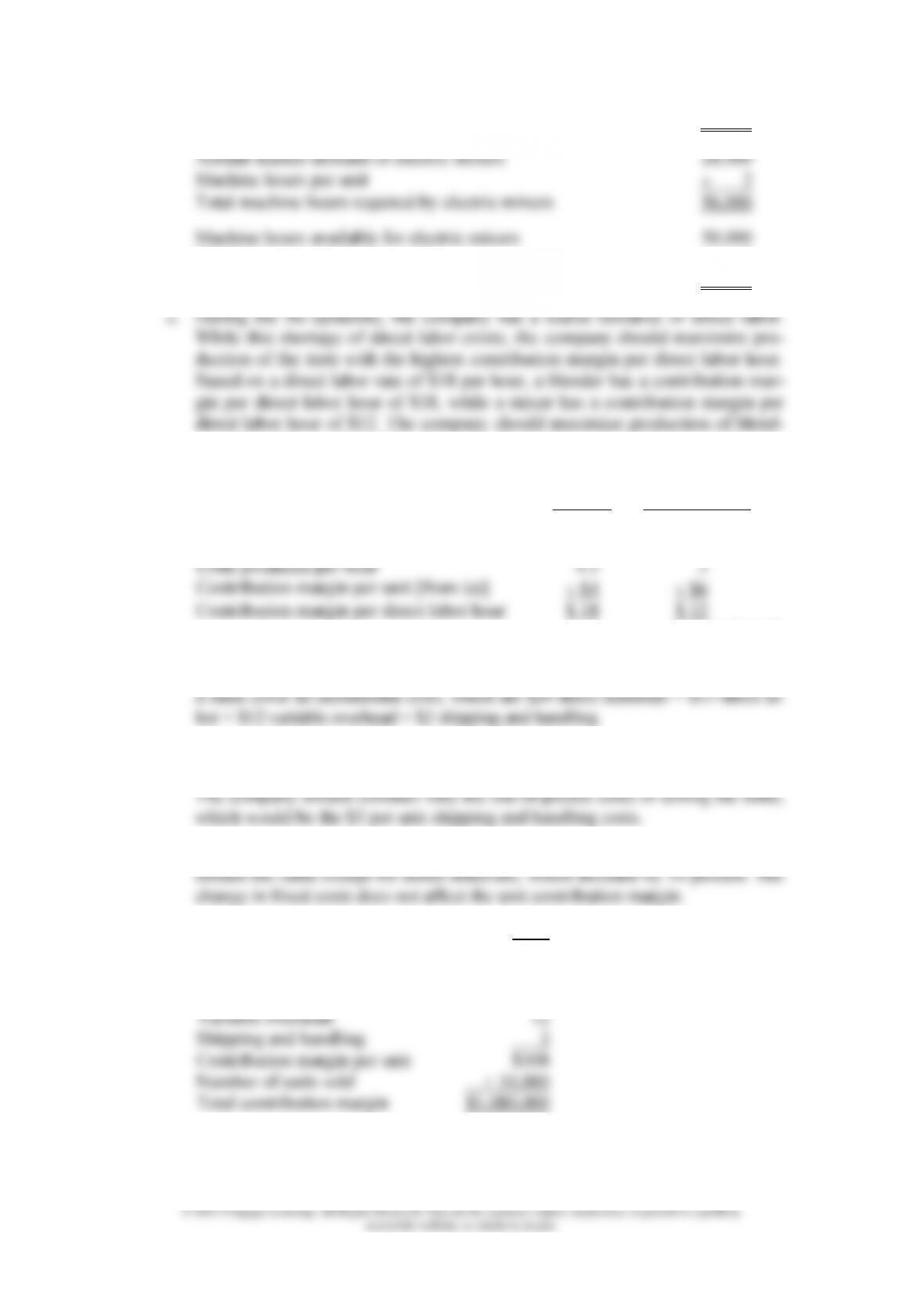
Total available machine hours
50,000
Annual market demand of blenders
20,000
Machine hours per unit
÷ 1
Total machine hours used by blenders
20,000
Machine hours available for electric mixers
30,000
Machine hours per unit
÷ 2
Maximum production of electric mixers
15,000
needed from outside suppliers.
Blender
Electric Mixer
Contribution margin per unit
$4
$12
Machine hours per unit
÷ 1
÷ 2
Contribution margin per machine hour
$4
$ 6
306 Chapter 10
Total available machine hours
50,000
Annual market demand of electric mixers
28,000
Machine hours per unit
2
Total machine hours required by electric mixers
56,000
Machine hours available for electric mixers
50,000
Machine hours required per unit
÷ 2
Annual production of electric mixers
25,000
ers during the month and purchase all other units as needed from outside sup-
pliers.
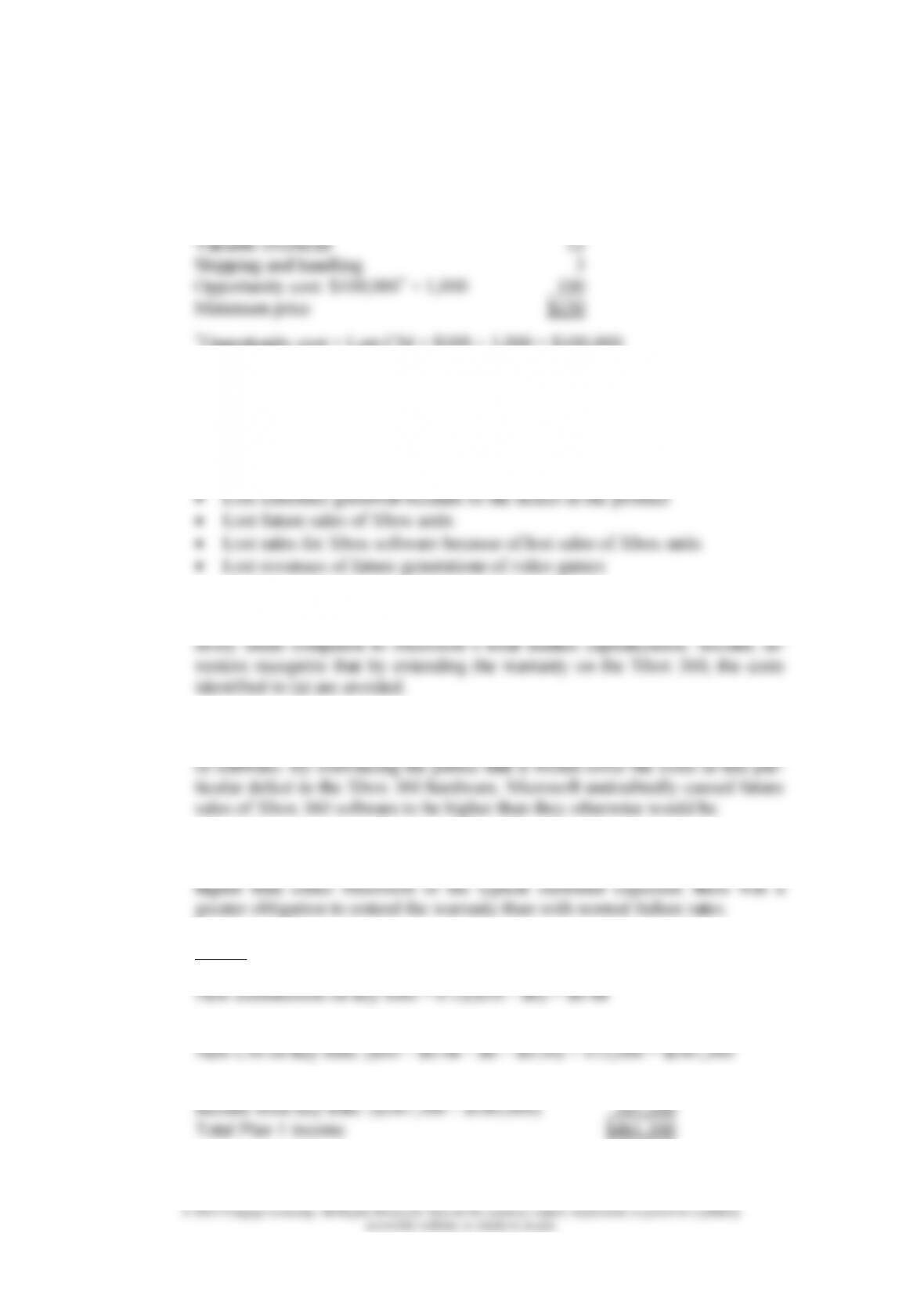
Blender
Electric Mixer
Direct labor cost per hour
$ 18
$ 18
Direct labor cost per unit
÷ $4
÷ $9
Units produced per hour
4.5
2
Contribution margin per unit [from (a)]
$4
$6
Contribution margin per direct labor hour
$ 18
$ 12
(CMA adapted)
38. a. The minimum acceptable price is $50 per unit. The company has excess capacity.
b. The minimum acceptable price is $3 per unit. Because the units are defective
and cannot be sold through regular channels, all historical costs are irrelevant.
c. The total contribution margin will be $1,080,000. All variable costs per unit
Selling price
$160
Variable costs per unit:
Direct material ($20 × 1.1)
$ 22
Direct labor
15
Variable overhead
12
Shipping and handling
3
Contribution margin per unit
$108
Number of units sold
× 10,000
Total contribution margin
$1,080,000
Chapter 10 307
d. Given no excess capacity, the price must cover the incremental costs plus the
opportunity cost of $100,000 for the displaced contribution margin.
Incremental costs:
Direct material
$ 20
Direct labor
15
Variable overhead
12
Shipping and handling
3
Opportunity cost: $100,000* ÷ 1,000
100
Minimum price
$150
*Opportunity cost = Lost CM = $100 × 1,000 = $100,000
(CMA adapted)
39. a. Microsoft likely recognized the following costs in deciding to extend the war-
rant of its Xbox 360.
Costs to handle customer returns
Cost to repair defective units
b. Microsoft’s stock price was virtually unaffected by the announcement. There
are two primary reasons for this mild effect. First, the $1 billion cost is rela-
c. In addition to the Xbox 360 hardware, Microsoft sells software or games for
the Xbox 360. Any factor that affects Xbox 360 sales likely also impacts sales
d. Microsoft likely had an ethical obligation to extend the Xbox 360 warranty
with respect to this specific defect. Because the rate of this defect was much
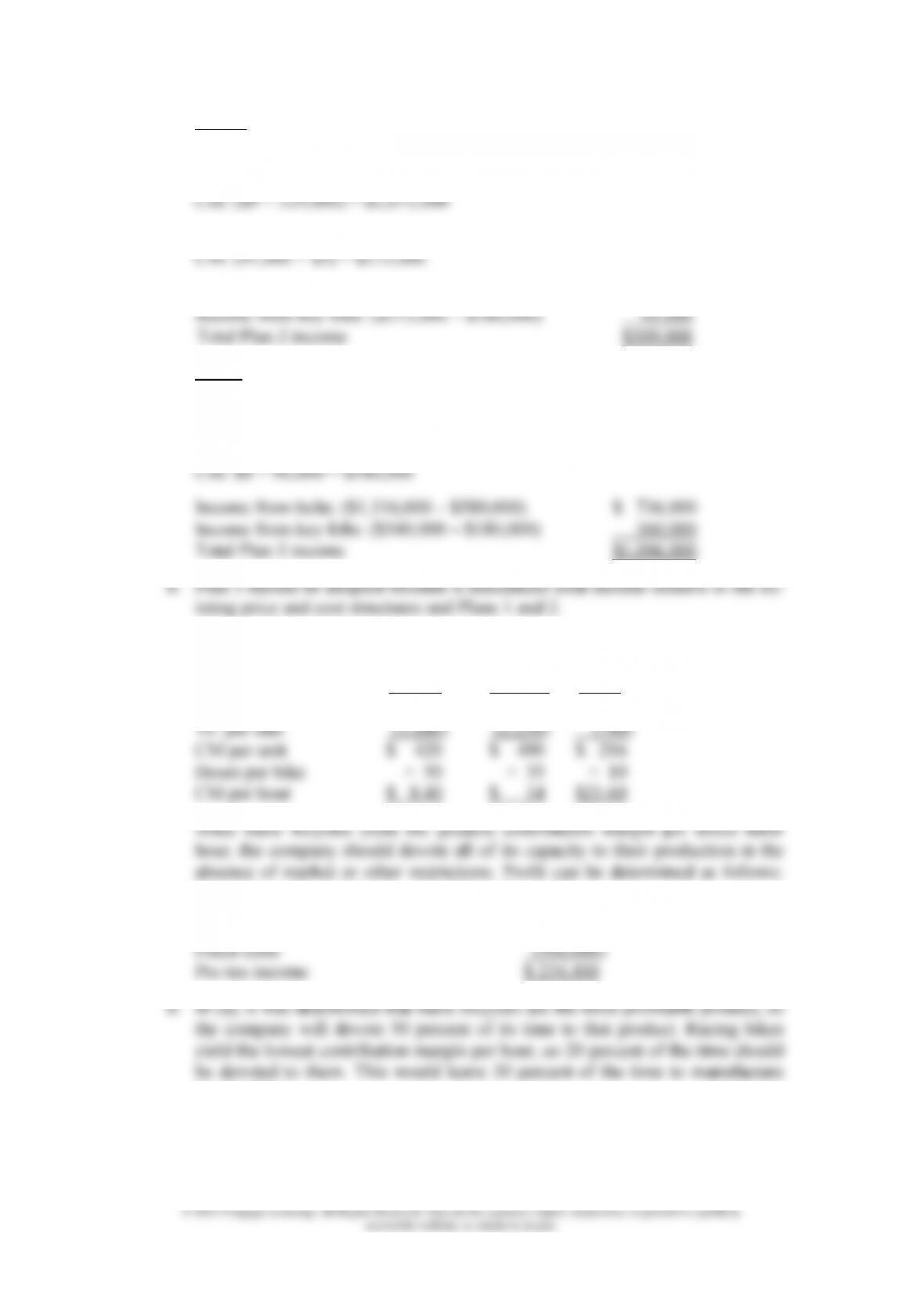
40. a. Plan 1:
New commission on belts = 0.12($40 – $25) = $1.80
New CM on belts: ($40 – $1.80 – $25 – $4) × 95,000 = $874,000
Income from belts: ($874,000 – $580,000)
$294,000
Income from key fobs: ($347,300 – $180,000)
167,300
Total Plan 1 income
$461,300
308 Chapter 10
Plan 2:
New FC for belts: $580,000 + $75,000 = $655,000
New sales for belts: 119,000 units
New sales for key fobs: 91,000 units
Income from belts: ($1,071,000 – $655,000)
$416,000
Income from key fobs: ($273,000 – $180,000)
93,000
Total Plan 2 income
$509,000
Plan 3
New sales for belts: 94,000 units
CM: ($14 × 94,000) = $1,316,000
New sales for key fobs: 90,000 units
Income from belts: ($1,316,000 – $580,000)
$ 736,000
Income from key fobs: ($540,000 – $180,000)
360,000
Total Plan 3 income
$1,096,000
41. a. Maximize the contribution per unit of the scarce resource (direct labor hours):
Racing
Touring
Basic
Sales per unit
$ 3,600
$ 2,720
$ 960
VC per unit
(3,180)
(2,230)
(744)
CM per unit
$ 420
$ 490
$ 216
Hours per bike
÷ 50
÷ 35
÷ 10
CM per hour
$ 8.40
$ 14
$21.60
Production of basic bicycles = 34,000 ÷ 10 = 3,400
Contribution margin 3,400 × $216
$ 734,400
Fixed costs
(500,000)
Pre-tax income
$ 234,400
touring bikes.