Chapter 9 271
accessible website, in whole or in part.
Racine Tire Co.
Income Statement
For the Month XXX
Current
Proposed
Sales $60 (20,000; 23,000)
$1,200,000
$1,380,000
Less variable expense
$30 (20,000; 23,000)
(600,000)
(690,000)
Contribution margin
$ 600,000
$ 690,000
Less fixed costs
(450,000)
(450,000)
Net income
$ 150,000
$ 240,000
28. a. Sales ($7.20 × 125,000)
$ 900,000
Variable costs ($4.32 × 125,000)
(540,000)
Contribution margin
$ 360,000
Fixed costs
(316,600)
Net income
$ 43,400
Break-even point = $316,600 ÷ 0.40a = $791,500 or 109,931 packages
(rounded)
b. $360,000 ÷ $43,400 = 8.295
c. Income will increase by: 8.295 × 30% = 249%
Proof:
Sales ($7.20 × 125,000 × 1.30)
$1,170,000
Variable costs ($4.32 × 125,000 × 1.30)
(702,000)
Contribution margin
$ 468,000
Fixed costs
(316,600)
Net income
$ 151,400
($151,400 $43,400) ÷ $43,400 = 249%
d. Break-even point = ($316,600 + $41,200) ÷ 0.40 = $894,500
Sales ($7.20 × 125,000 × 1.15)
$1,035,000
Variable costs ($4.32 × 125,000 × 1.15)
(621,000)
Contribution margin
$ 414,000
Fixed costs ($316,600 + $41,200)
(357,800)
Net income
$ 56,200
Operating leverage = $414,000 ÷ $56,200 = 7.37
29. Substantial cost structure implications must be considered in selecting from the
alternative production technologies. Machine-based technologies will tend to have
much higher levels of fixed costs and lower levels of variable costs than labor-
272 Chapter 9
accessible website, in whole or in part.
Because higher operating leverage is associated with higher income sensitivity to
volume changes, high operating leverage is desired if future sales are expected to
be increasing. Higher leverage allows net income to grow at a higher rate as sales
In an ideal world, one would desire to have a very low level of fixed costs below
the break-even point and only fixed costs above the break-even point. If the cost
structure contained only fixed costs, then each dollar of revenue above the break-
For a given level of sales, a company with mostly variable costs will have a higher
margin of safety than a similar firm with mostly fixed costs. If a firm had only
30. An issue in the use of CVP analysis is that CVP analysis requires costs to be clas-
sified as either variable or fixed. The outcome of CVP analysis is sensitive to var-
iations in this classification. In making decisions that rely on CVP analyses, it is
important to be mindful of the requirement to dichotomize costs between these
two categories (fixed and variable). Further, it is important to recognize that in the
CVP analysis can be used in long-, medium-, and short-term decision making. The
key is to use a classification of costs that is appropriate for the time horizon. For
longer-term decisions, newer cost control technologies such as activity-based cost-
31. a. Each “bag” contains one unit of liquid and two units of spray. Thus, each bag
generates contribution margin of: (1 × $10) + (2 × $5) = $20.
spray must be sold.
Chapter 9 273
b. At the break-even point, Total CM = Total FC; and the CM per unit would be
c. $10X 0.40($10X) $216,000 = 0.25($10X)
d. In units: 3,200 – 2,800 = 400 units
32. a. Fixed costs that would increase include the additional equipment costs and
salaries for testing, treating, storage, and disposal of treated waste. Increased
b. After determining that the substance is toxic, the president has to consider busi-
ness as usual versus the costs of treatment and/or proper disposal that may make
product prices uncompetitive, preserving the health of humans downriver, the ef-
fects on fish, wildlife and the environment, maintaining the good name and repu-
c. The employees are implying that (1) not addressing the problem is the lesser
of evils because there is no proof that the waste causes cancer; (2) to clean up
the problem may cause the company to become uncompetitive; (3) 10,000
more, the fishermen sell their polluted catches to outside markets, thus spread-
ing the effects of the pollution even further.
Fault is also seen in the rationalization because the company falsified the lev-
tunity to decide whether to remain on their jobs or in the vicinity of the
274 Chapter 9
These rationalizations seem to indicate that unhealthy and unethical acts can
be permitted and tolerated if a large number of directly affected people benefit
without regard for the effects on people or entities that are indirectly affected.
d. The president must take some action to deal with the problem. First, the dump-
ing should be discontinued altogether until the waste is tested to determine if it
is cancer causing. If it is not, obtain information on the environmental effects
If the waste is cancer causing or causes significant environmental damage, the
company should immediately issue a policy statement that no additional
dumping shall take place. Then the costs of treating the waste to neutralize it
should be compared to other alternatives that might exist or could be created
companies are handling the waste in a similar manner, all companies could be
liable for the costs of cleanup, which would disallow any economic advantage
to the other companies. In addition, the company should investigate the costs
33. a. Revenue is constant per unit within the relevant range.
ity will not change.
c. The sales mix remains constant as volume changes within the relevant range.
e. All variable costs are constant per unit within the relevant range and total
fixed cost is constant within the relevant range.
f. Sales and production are equal.
Chapter 9 275
34. Joanna’s calculations assume that the current cost and revenue structure will be
maintained in future periods. Over time productivity can be improved and reve-
recommendation should be taken with skepticism, and Aire should examine her
long-term prospects to enhance revenues and reduce costs.
276 Chapter 9
PROBLEMS
35. a. CM% = ($5,000 $2,800 $200) ÷ $5,000 = 40%
Break-even = $280,000 ÷ 0.40 = $700,000
b. Fixed costs in CGS = $400,000 – (100 × $2,800) = $120,000
$120,000 ÷ $200,000 of units produced = 100 ÷ 0.6 = 167 units (rounded)
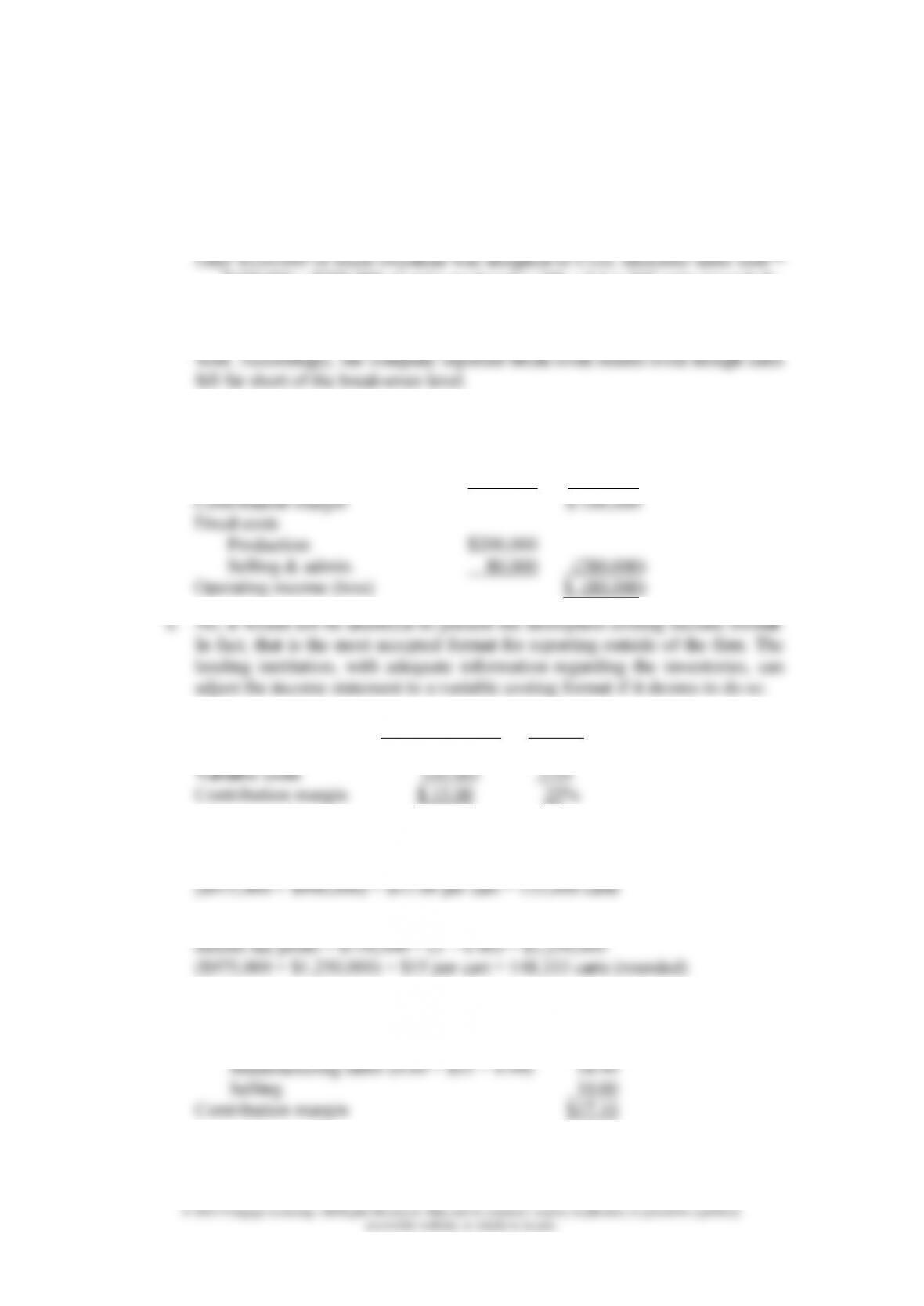
c. Because the company manufactured more units than it sold, $80,000 of fixed
overhead was assigned to ending inventories rather than the Cost of Goods
d.
Sales
$ 500,000
Variable costs
Production
$280,000
Selling
20,000
(300,000)
Contribution margin
$ 200,000
Fixed costs
Production
$200,000
Selling & admin.
80,000
(280,000)
Operating income (loss)
$ (80,000)
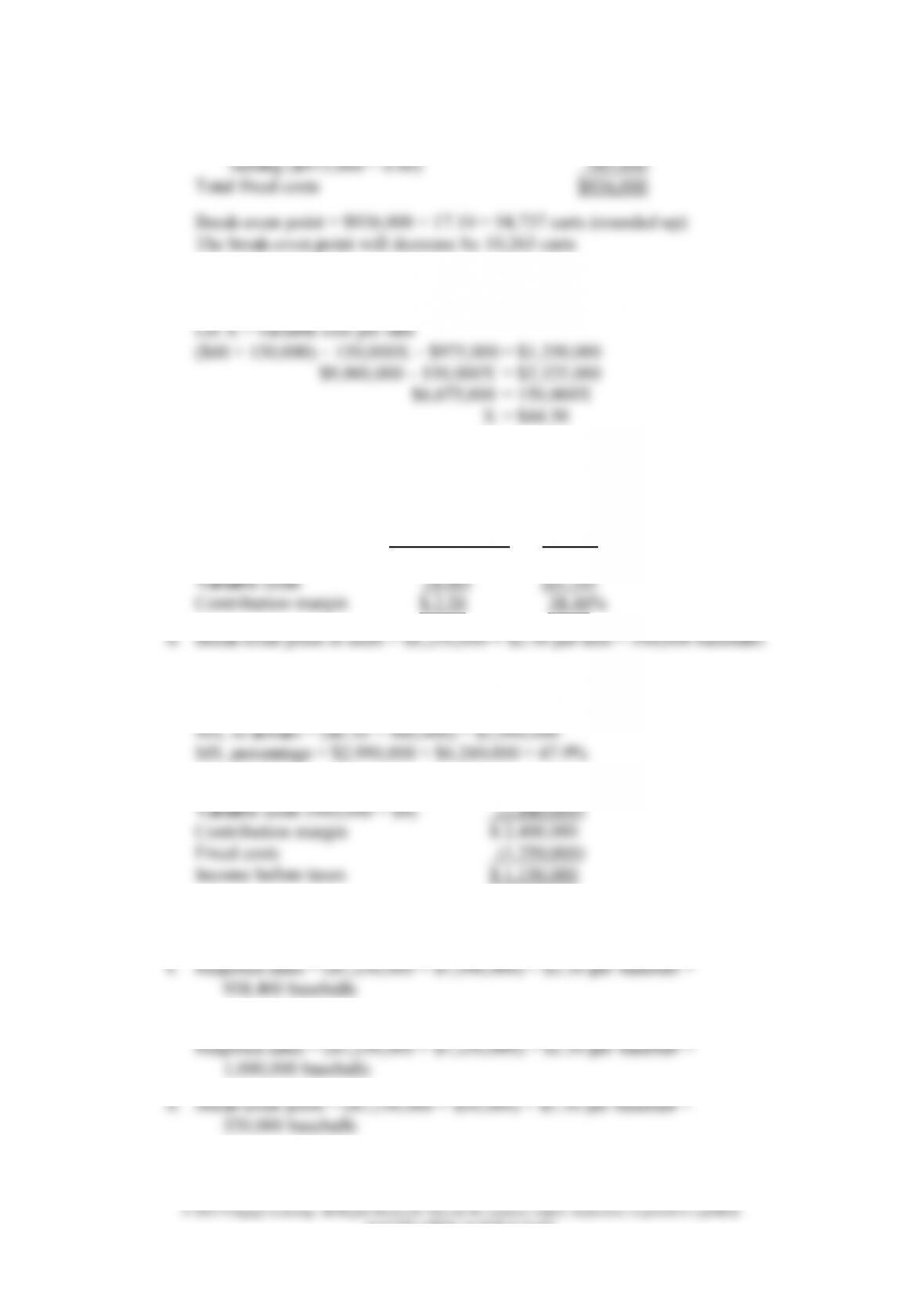
36. a.
Dollars per Unit
Percent
Sales
$ 60.00
100%
Variable costs
(45.00)
(75)
Contribution margin
$ 15.00
25%
b. Break-even point = $975,000 ÷ $15.00 per unit = 65,000 carts
c. Target pre-tax profit of $900,000
d. Target after-tax profit of $750,000
e.
Selling price
$60.00
Variable costs
Manufacturing ($35 × 0.40)
14.00
Manufacturing labor (0.60 × $35 × 0.90)
18.90
Selling
10.00
Contribution margin
$17.10
Chapter 9 277
accessible website, in whole or in part.
Fixed costs:
Manufacturing ($975,000 × 0.40 × 0.90)
$351,000
Selling ($975,000 × 0.60)
585,000
Total fixed costs
$936,000
Break-even point = $936,000 ÷ 17.10 = 54,737 carts (rounded up)
The break-even point will decrease by 10,263 carts
f. Target unit sales 600,000 × 0.25 = 150,000 carts
Sales – VC – FC = $1,350,000
Variable costs will need to be reduced by $0.50 ($45.00 $44.50).
Student answers will vary. No solution provided.
37. a.
Dollars per Unit
Percent
Sales
$ 6.50
100.00%
Variable costs
(4.00)
(61.54)
Contribution margin
$ 2.50
38.46%
c. Break-even point in dollars = $1,250,000 ÷ 0.3846 = $3,250,130
d. MS, in units = 960,000 – 500,000 = 460,000 baseballs
e.
Current sales (960,000 × $6.50)
$ 6,240,000
Variable costs (960,000 × $4)
(3,840,000)
Contribution margin
$ 2,400,000
Fixed costs
(1,250,000)
Income before taxes
$ 1,150,000
Degree of operating leverage = $2,400,000 ÷ $1,150,000 = 2.087
Percentage increase in income = 30% × 2.087 = 62.6%
g. Pre-tax equivalent of $750,000 = $750,000 ÷ (1 0.40) = $1,250,000
278 Chapter 9
Even though normal sales would not be affected, regular customers may find
out about the special deal and become upset because their prices have been
38. a. Total variable cost = $28 + $12 + $8 = $48
Contribution margin per unit = $70 $48 = $22 per unit
Contribution margin ratio = $22 ÷ $70 = 31.4% (rounded)
b. ($40,000 + $34,000) ÷ 0.314 = $235,669 (rounded)
c. Convert after-tax earnings to pre-tax earnings: $40,000 ÷ (1 0.40) = $66,667
Because the CM% is only 31.4%, no level of sales would generate net income
e.
Variable cost savings (5,000 × $6.00)
$ 30,000
Additional fixed costs
(40,000)
Decrease in profit
$(10,000)
f. Existing CM per unit = $22
CM under proposal = ($70 × 0.90) $48 = $15
Total CM under proposal (3,000 × 1.30 × $15)
$ 58,500
Existing CM (3,000 × $22)
(66,000)
Change in CM
$ (7,500)
Change in fixed costs
(10,000)
Change in net earnings before taxes
$ (17,500)
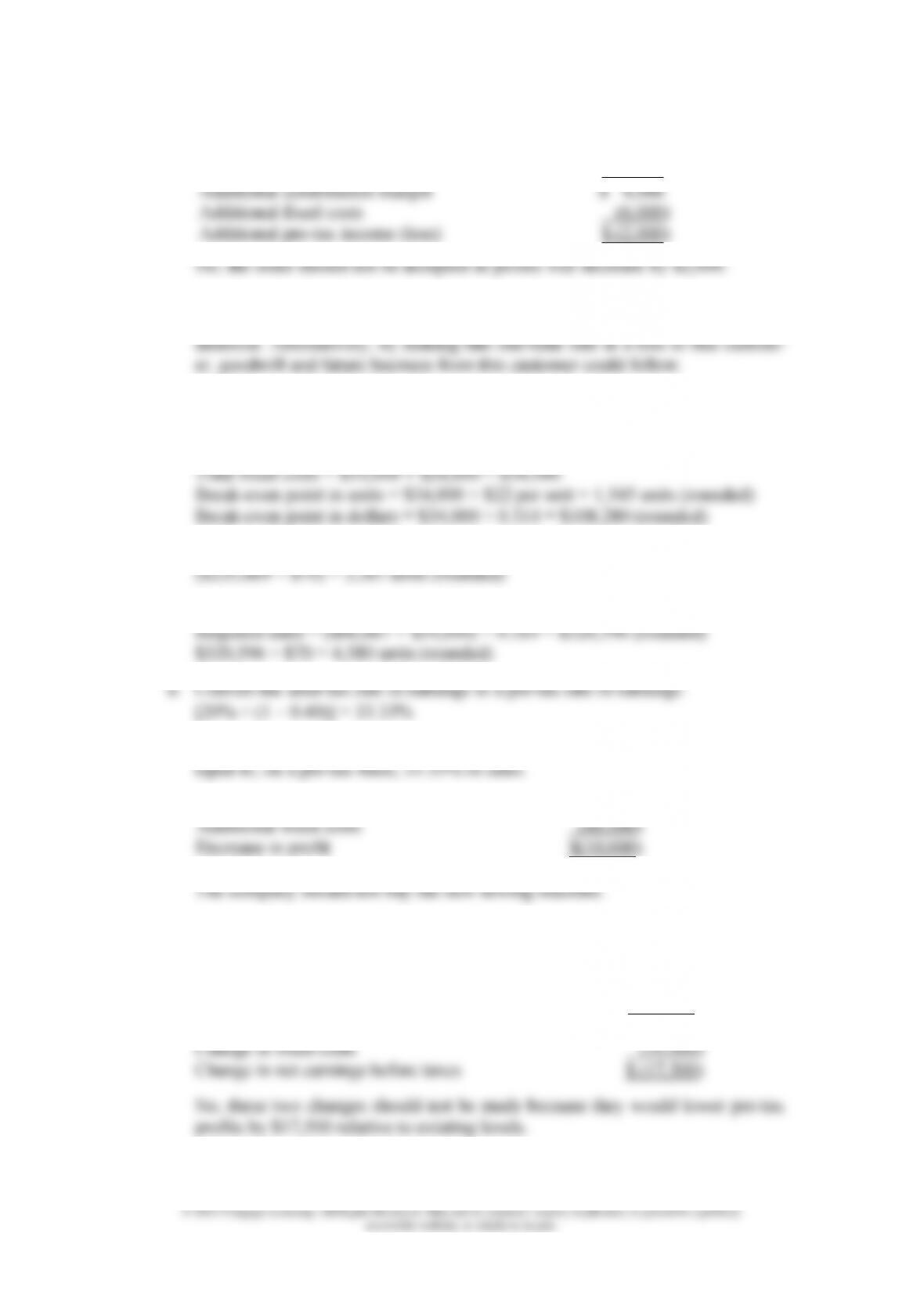
No, these two changes should not be made because they would lower pre-tax
profits by $17,500 relative to existing levels.
i.
Additional sales ($4.40 × 20,000)
$ 88,000
Additional variable costs ($4.20 × 20,000)
(84,000)
Additional contribution margin
$ 4,000
Additional fixed costs
(6,000)
Additional pre-tax income (loss)
$ (2,000)
Chapter 9 279
39. a. Revenues:
Game tickets ($60,000 × 0.08
$4,800
Airline tickets ($9,000 × 0.10)
900
Hotel bookings ($14,000 × 0.20)
2,800
$ 8,500
Costs:
Advertising
$2,200
Rent
1,800
Utilities
500
Other
4,400
(8,900)
Net loss
(400)
b.
Increase in revenue ($9,000 × 0.40 × 0.10)
$ 360
Increase in cost
(1,200)
Increase in profit
$ (840)
No, Weatherby should not incur the $1,200 of advertising expense because it
would cause profit to drop by $840.
c.
Increase in revenues:
Game ticket ($8,000 × 0.08)
$ 640
Airline ticket ($1,500 × 0.10)
150
Hotel booking ($6,000 × 0.20)
1,200
$ 1,990
Increase in costs:
Rusty’s commission ($1,990 × 0.50)
$ 995
Rusty’s wage
400
(1,395)
Increase in profits
$ 595
d.
Increase in revenues:
Airline tickets ($13,000 × 0.10)
$ 1,300
Increase in costs:
Rusty’s commission ($1,300 × 0.50)
$650
Increase in fixed costs
600
(1,250)
Increase (decrease)
$ 50
good decision.
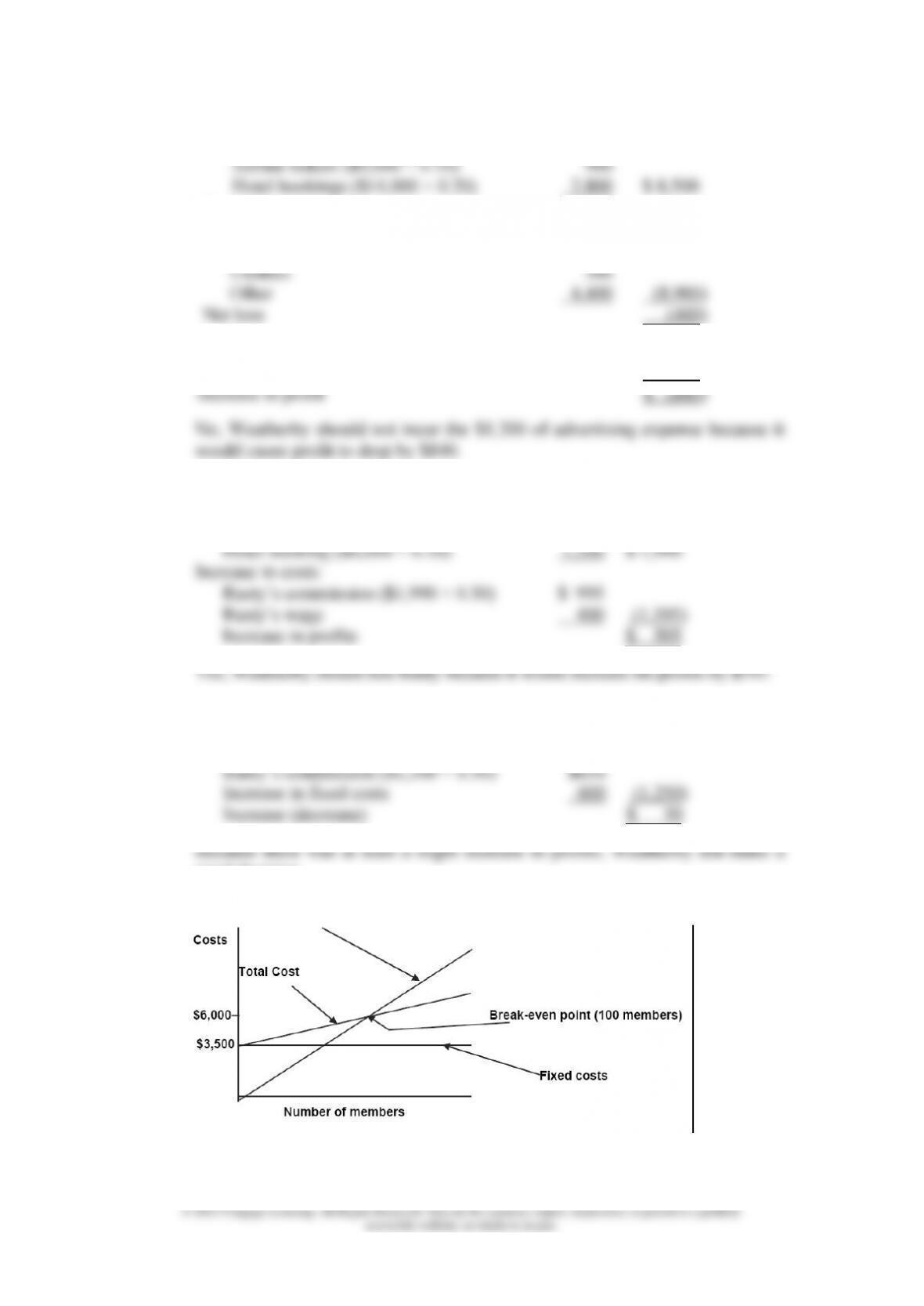
40. a. Total Revenue
280 Chapter 9
b.
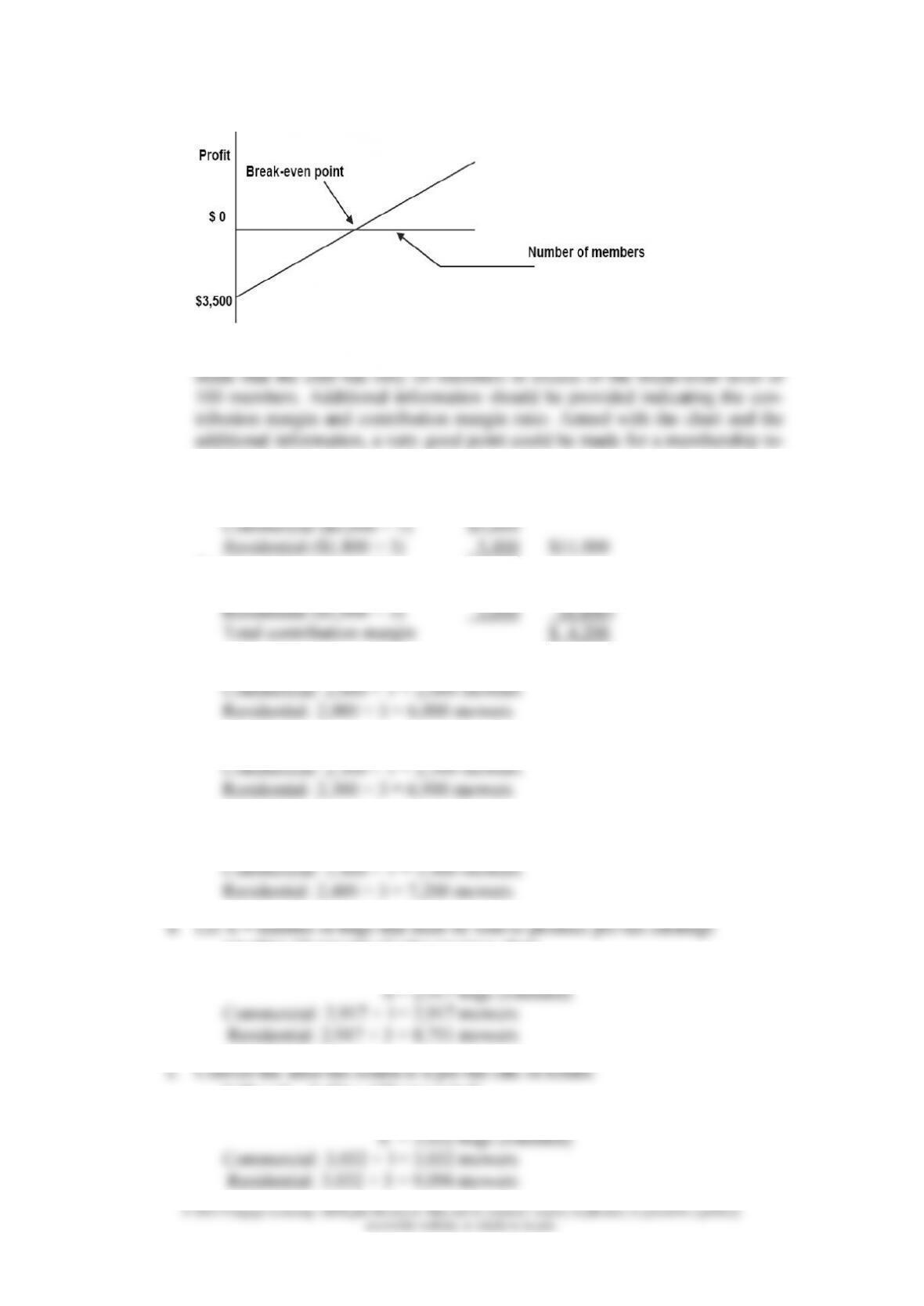
c. The break-even chart would probably be more helpful. The point could be
cruiting project.
41. a.
Total sales price per bag:
Commercial ($5,600 × 1)
$5,600
Residential ($1,800 × 3)
5,400
$11,000
Total variable costs per bag:
Commercial ($3,800 × 1)
$3,800
Residential ($1,000 × 3)
3,000
(6,800)
Total contribution margin
$ 4,200
Break-even point in units = $8,400,000 ÷ $4,200 = 2,000 bags
b. ($8,400,000 + $1,260,000) ÷ $4,200 = 2,300 bags
c. Pre-tax equivalent of $1,008,000 after-tax = $1,008,000 ÷ (1 0.40) = $1,680,000
($8,400,000 + $1,680,000) ÷ $4,200 = 2,400 bags
equaling 12 percent of sales revenue, then:
$4,200X $8,400,000 = 0.12($11,000X)
0.08 ÷ (1 0.40) = 13% (rounded)
$4,200X $8,400,000 = 0.13($11,000X)