188 Chapter 7
accessible website, in whole or in part.
Case A:
Standard hours = 1,000 × 3.5 = 3,500
LRV = AQ (AP – SP)
Actual labor cost = $7.00 × 3,400 = $23,800
LEV = SP (AQ – SQ)
Case B:
Units produced = 900 ÷ 0.9 = 1,000
LEV = SP (AQ – SQ)
LRV = AQ (AP – SP)
–$975 = 975 (AP – $10.20)
Actual labor cost = $9.20 × 975 = $8,970
Case C:
Standard hours = 600 ÷ 240 = 2.5
(AP × AQ) LRV = (SP × AQ)
LEV = SP (AQ – SQ)
Chapter 7 189
Case D:
Actual labor rate = $31,850 ÷ 4,900 = $6.50
LRV = AQ (AP – SP)
LEV = (SP × AQ) (SP × SQ)
Standard hours per unit = 4,500 ÷ 1,500 = 3
30. a. Material price variance = $61,000 ($3 × 20,000)
Standard quantity of material = 3,900 × 4.8 = 18,720 gallons
b. Standard quantity of time = 3,900 × 1/3 hour = 1,300 hours
($9.02 × 1,290)
($9.00 × 1,290)
($9.00 × 1,300)
$11,635.80
$11,610.00
$11,700.00
$25.80 U
$90.00 F
Labor Rate Variance
Labor Efficiency Variance
$64.20 F
Total Labor Variance
c. Raw Material Inventory 60,000.00
Work in Process Inventory 56,160.00
Work in Process 11,700.00
Labor Rate Variance 25.80
31. a. Actual material price = $83,300 ÷ 17,000 = $4.90 per square yard
190 Chapter 7
accessible website, in whole or in part.
b. Raw Material Inventory
85,000
Accounts Payable
83,300
Material Price Variance
1,700
Work in Process Inventory
75,000
Material Usage Variance
7,500
Raw Material Inventory
82,500
c. Actual labor rate = $79,800 ÷ 7,600 = $10.50
Labor rate variance: AQ × (AP – SP) = 7,600 × ($10.50 – $10.00) = $3,800 U
d. Work in Process Inventory
Labor Rate Variance
75,000
3,800
Labor Efficiency Variance
1,000
Wages Payable
79,800
e. The material price variance is favorable. The purchasing agent may have pur-
chased an optimum quantity with a negotiated price. It is also possible that the
materials are of lower quality. This possibility is suggested by both the unfa-
vorable material usage variance and the unfavorable labor efficiency variance.
It is possible that the workers had difficulty working with the materials or that
(CPA adapted)
32. a. Standard quantity of material = 2 yards × 10,000 shirts = 20,000 yards
Standard labor time = 0.7 hours × 10,000 shirts = 7,000 DLHs
b. AP × AQp
SP × AQp
$3 × 30,000
$89,700
$90,000
$300 F
Material Price Variance
SP × AQu
SP × SQ
$3 × 20,120
$3 × 20,000
$60,360
$60,000
$360 U
Material Quantity Variance
Chapter 7 191
AP × AQ
SP × AQ
SP × SQ
$7.50 × 7,940
$7.50 × 7,000
$58,756
$59,550
$52,500
$794 F
$7,050 U
Labor Rate Variance
Labor Efficiency Variance
$6,256 U
Total Labor Variance
d. The favorable labor rate variance is coupled with an unfavorable labor efficien-
cy variance. One explanation is that the firm used, on average, a less skilled
e. Material Price Variance
300
Cost of Goods Sold
60
Material Quantity Variance
360
To dispose of the material variances
Labor Rate Variance
794
Cost of Goods Sold
6,256
Labor Efficiency Variance
7,050
To dispose of the labor variances
33. a. SQ = 4,800 × 0.5 = 2,400 square yards
Material quantity variance = (SP × AQ) – (SP × SQ)
$600 U = $6 (AQ – SQ)
$600 U = $6 AQ – $6(2,400)
192 Chapter 7
d. Labor efficiency variance = SP (AH – SH)
e. Standard prime cost per travel bag:
Material (0.5 × $6)
$ 3.00
Labor (2 × $17)
34.00
Total
$37.00
f. AP = SP – (Labor rate variance ÷ AQ)
Actual cost to produce one bag:
Material ($14,550 ÷ 4,800)
$ 3.03
Labor [$16.85 × (9,760 ÷ 4,800)]
34.26
Total (rounded for both material and labor)
$37.29
g. The actual cost to produce a bag is $37.29; the standard cost is $37 or an unfa-
vorable difference of $0.29. The two primary factors creating the cost overrun
are the unfavorable $0.125 ($600 ÷ 4,800) per unit material quantity variance
34. a. Budgeted machine hours = 144,000 units × 3.5 MHs per unit = 504,000 MHs
b. Standard MHs = 11,900 × 3.5 = 41,650
Actual VOH
VOH Rate × Actual Hours
Applied VOH
$4 × 41,800
$4 × 41,650
$165,000
$167,200
$166,600
$2,200 F
$600 U
VOH Spending Variance
VOH Efficiency Variance
$1,600 F
Total VOH Variance
c. Actual FOH
Budgeted FOH
Applied FOH
$3,528,000 ÷ 12
$7 × 41,650
$294,500
$294,000
$291,550
$500 U
$2,450 U
FOH Spending Variance
Volume Variance
$2,950 U
Total FOH Variance
Chapter 7 193
accessible website, in whole or in part.
company underapplied FOH by (100 × $24.50) or $2,450.
35. a. Calculations begin with fixed overhead. Dividing the $1,000,000 of budgeted
FOH by $40 per hour gives 25,000 budgeted number of machine hours. Adding
Actual FOH
Budgeted FOH
Applied FOH
$40 × 25,000
$40 × 24,500
$1,028,000
$1,000,000
$980,000
$28,000 U
$20,000 U
FOH Spending Variance
Volume Variance
$48,000 U
Total FOH Variance
Standard hours are moved to the VOH prong diagram and are multiplied by the
VOH rate of $20. Subtracting the $41,200F VOH efficiency variance provides
Actual VOH
VOH Rate × Actual Hours
Applied VOH
$20 × 22,440
$20 × 24,500
$414,800
$448,800
$490,000
$34,000 F
$41,200 F
VOH Spending Variance
VOH Efficiency Variance
$75,200 F
Total VOH Variance
b. Standard machine hours is 25,000 budgeted MHs ÷ 20,000 budgeted units =
1.25 MHs per unit
VOH spending variance = $6,000 F
e. The VOH favorable efficiency variance resulted from using 2,060 fewer ma-
f. OH Spending Variance
6,000
VOH Efficiency Variance
41,200
Volume Variance
20,000
Cost of Goods Sold
27,200
To dispose of overhead variances
194 Chapter 7
36. a. Standard hours = 18,800 ÷ 2 cars per hour = 9,400
Variable Overhead:
Actual
Budget
Applied
$27,700
$3 × 9,500 = $28,500
$3 × 9,400 = $28,200
$800 F
$300 U
VOH Spending Variance
VOH Efficiency Variance
$500 F
Total VOH Variance
Total budgeted FOH = $9 × 10,000 = $90,000
Fixed Overhead:
Actual
Budget
Applied
$90,800
$90,000
$9 × 9,400 = $84,600
$800 U
$5,400 U
FOH Spending Variance
Volume Variance
$6,200 U
Total FOH Variance
b.
Actual
Budget at Actual
Budget at Standard
Applied
VOH = $ 27,700
$3 × 9,500 = $ 28,500
$3 × 9,400 = $ 28,200
$3 × 9,400 = $ 28,200
FOH = 90,800
90,000
90,000
$9 × 9,400 = 84,600
$118,500
$118,500
$118,200
$112,800
$0
$300 U
$5,400 U
OH Spending Var.
OH Efficiency Var.
Volume Variance
$5,700 U
Total OH Variance
c.
Actual
Budget
Applied
VOH = $ 27,700
$3 × 9,400 = $ 28,200
$3 × 9,400 = $ 28,200
FOH = 90,800
90,000
$9 × 9,400 = 84,600
$118,500
$118,200
$112,800
$300 U
$5,400 U
Budget Variance
Volume Variance
$5,700 U
Total OH Variance
37. a. Variable overhead rate = $315,000 ÷ 70,000 DLHs = $4.50 per DLH
Fixed overhead rate = $140,400 ÷ 3,900 MHs = $36 per MH
Actual VOH
Budgeted VOH
Applied VOH
$4.50 × 5,900
$4.50 × 5,980
$26,325
$26,550
$26,910
$225 F
$360 F
VOH Spending Variance
VOH Efficiency Variance
$585 F
Total VOH Variance
Chapter 7 195
Actual FOH
Budgeted FOH
Applied FOH
$140,400 ÷ 12 months
$36 × 290
$11,400
$11,700
$10,440
$300 F
$1,260 U
FOH Spending Variance
Volume Variance
$960 U
Total FOH Variance
b. Variable Manufacturing Overhead Control
26,325
Fixed Manufacturing Overhead Control
11,400
Various accounts
37,725
To record actual overhead costs for March 2013
Work in Process Inventory
37,350
Variable Manufacturing Overhead Control
26,910
Fixed Manufacturing Overhead Control
10,440
To apply overhead to work in process for March 2013
Variable Manufacturing Overhead Control
585
Variable Overhead Spending Variance
225
Variable Overhead Efficiency Variance
360
To record variable overhead variances for March 2013
Volume Variance
1,260
Fixed Manufacturing Overhead Control
960
Fixed Manufacturing Overhead Spending Variance
300
To record fixed overhead variances for March 2013
38. Budgeted FOH per month = $250,800 ÷ 12 = $20,900
Standard FOH rate = $250,800 ÷ 264,000 = $0.95 per MH
196 Chapter 7
accessible website, in whole or in part.
Actual
Budget at Actual
Budget at Standard
Applied
($8 × 28,000) + $360,000
$20 × 28,000
$580,000
$596,000
$584,000
$560,000
$16,000 F
$12,000 U
$24,000 U
OH Spending Var.
OH Efficiency Var.
Volume Variance
$16,000 F
Budget at actual hours = (Budgeted VOH at actual hours) + Budgeted FOH
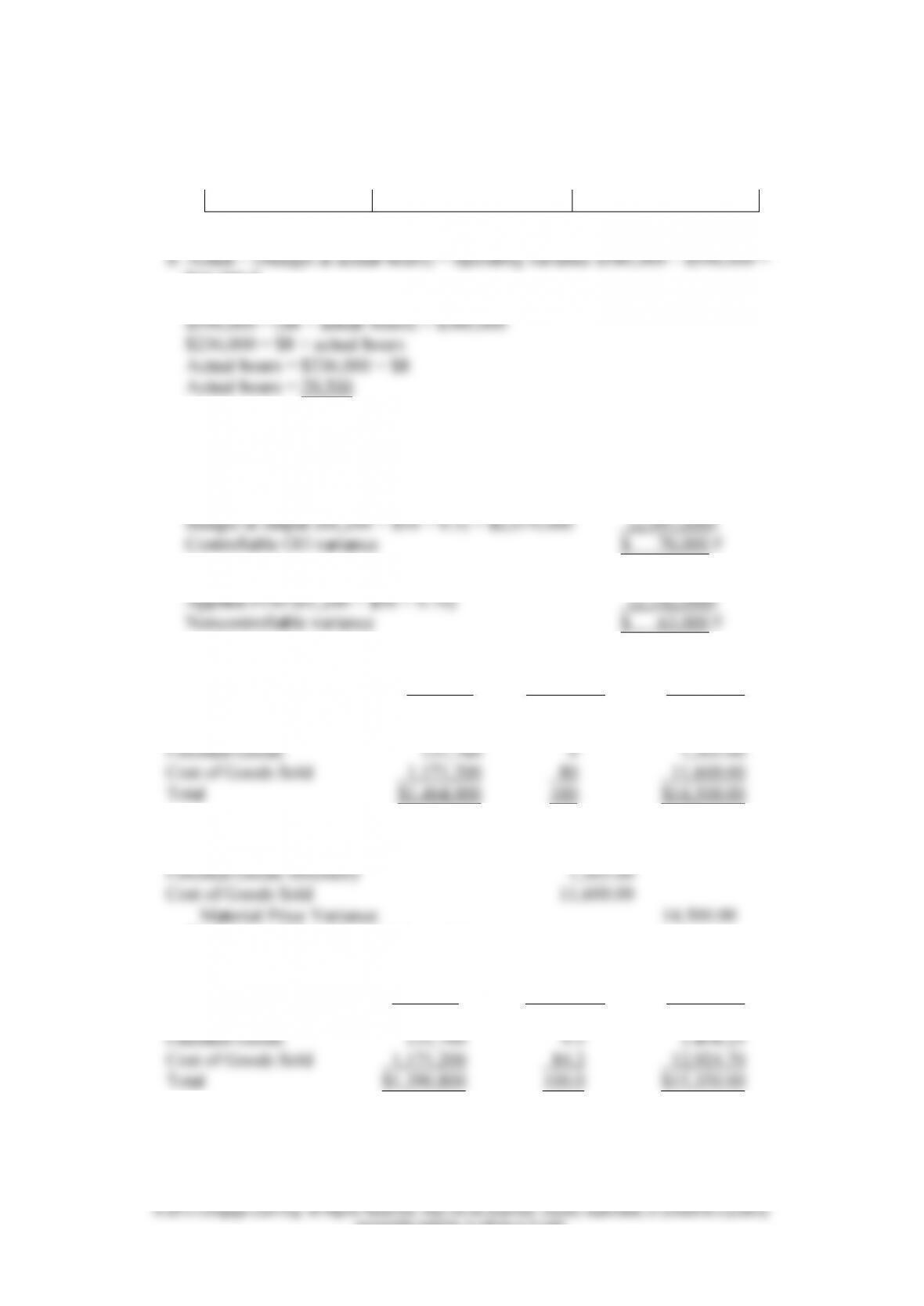
40. a. 5,100 × 12 = 61,200 standard hours
b. 59,400 MHs × $50 × 0.70 fixed = $ 2,079,000 budgeted monthly FOH
c. Actual OH for month
$ 2,927,000
Budget at output (61,200 × $50 × 0.3) + $2,079,000
(2,997,000)
Controllable OH variance
$ 70,000 F
d. Budget per month for FOH
$ 2,079,000
Applied FOH (61,200 × $50 × 0.70)
(2,142,000)
Noncontrollable variance
$ 63,000 F
41. Material Price Variance ($14,500 U):
Balances
% of Total
Allocation
Raw Material
$ 73,200
5
$ 725.00
Work in Process
87,840
6
870.00
Finished Goods
131,760
9
1,305.00
Cost of Goods Sold
1,171,200
80
11,600.00
Total
$1,464,000
100
$14,500.00
Raw Material Inventory
725.00
Work in Process Inventory
870.00
Finished Goods Inventory
1,305.00
Cost of Goods Sold
11,600.00
Material Price Variance
14,500.00
To dispose of the material price variance
All other variances ($15,350 F):
Balances
% of Total
Allocation
Work in Process
$ 87,840
6.3
$ 967.05
Finished Goods
131,760
9.5
1,458.25
Cost of Goods Sold
1,171,200
84.2
12,924.70
Total
$1,390,800
100.0
$15,350.00
.
Chapter 7 197
accessible website, in whole or in part.
Material Quantity Variance
21,930.00
Labor Rate Variance
2,200.00
Labor Efficiency Variance
8,780.00
Work in Process Inventory
967.05
Finished Goods Inventory
1,458.25
Cost of Goods Sold
12,924.70
To dispose of the remaining material and
labor variances
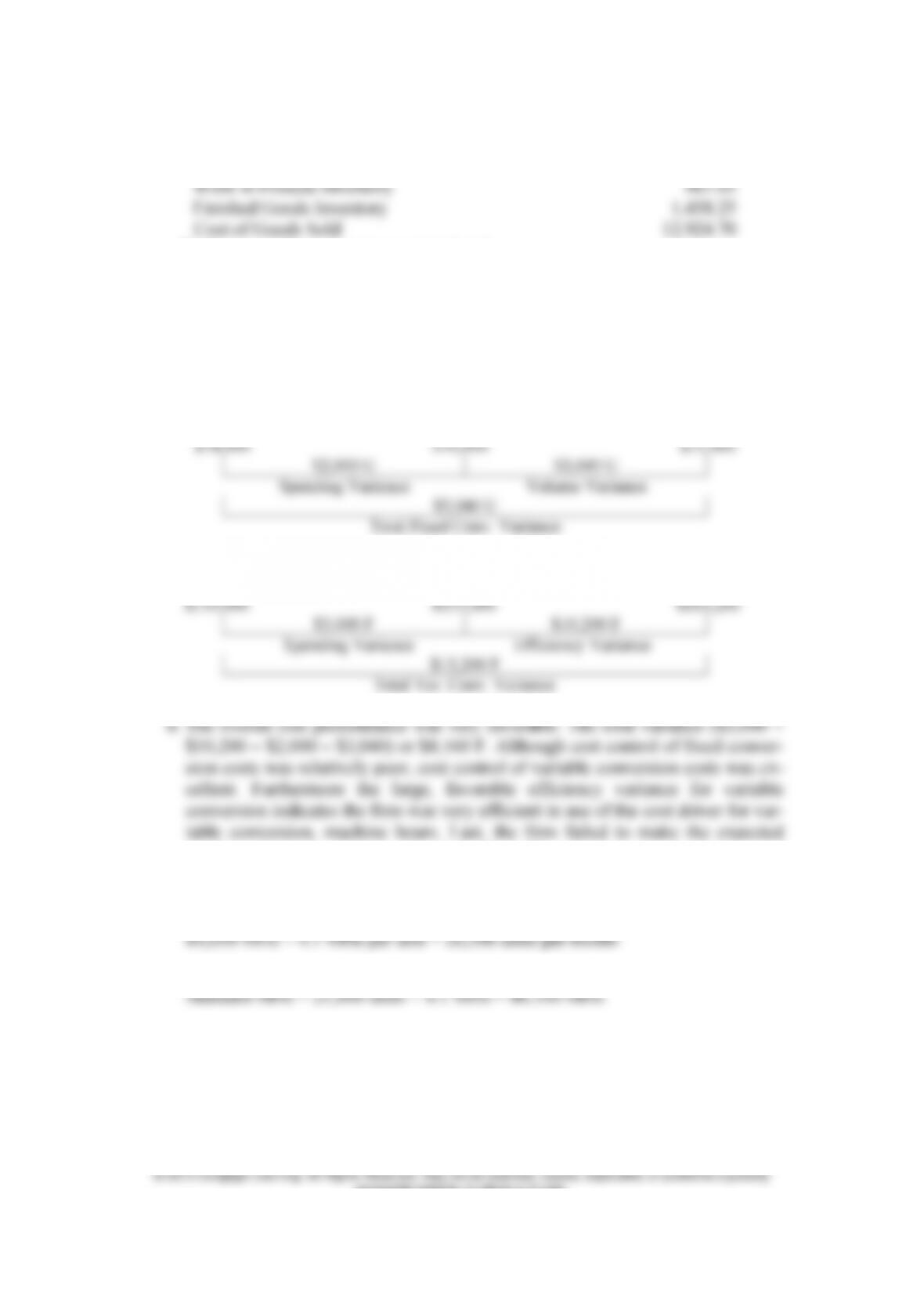
42. a Variable conversion rate = $170,000 ÷ 10,000 MHs = $17 per MH
Fixed conversion rate = $76,000 ÷ 10,000 MHs = $7.60 per MH
Standard quantity per unit = 10,000 MHs ÷ 5,000 units = 2 MHs
Standard hours production = 4,800 units × 2 MHs = 9,600 MHs
Actual Fixed Conv.
Budgeted Fixed Conv.
Applied Fixed Conv.
($7.60 × 9,600)
$78,000
$76,000
$72,960
$2,000 U
$3,040 U
Spending Variance
Volume Variance
$5,040 U
Total Fixed Conv. Variance
Actual Var. Conv.
Budgeted Var. Conv.
Applied Var. Conv.
($17 × 9,000)
($17 × 9,600)
$150,000
$153,000
$163,200
$3,000 F
$10,200 F
Spending Variance
Efficiency Variance
$13,200 F
Total Var. Conv. Variance
number of rotors as indicated by the unfavorable volume variance. Even so, on
balance, the cost control management was commendable.
43. a. 1,008,600 MHs ÷ 12 months = 84,050 machine hours per month
b. Variable conversion rate = $22.50 – $16.00 = $6.50 per MH