136
accessible website, in whole or in part.
CHAPTER 6
PROCESS COSTING
QUESTIONS
1. A company that produces homogeneous goods in mass quantities is likely to use a
process costing system. The company can either have a single department or mul-
tiple departments.
and overhead).
determined on the basis of equivalent units to properly allocate the costs associat-
ed with each cost component to the work that was completed during the period
2. The only difference between weighted average and FIFO equivalent units of pro-
duction is in the treatment of the work that was completed on beginning inventory
during the current period.
od—thus a first-in, first-out flow.
3. An equivalent unit of production is an accounting computation that puts partially
data since fully and partially completed units are different outputs.
4. One EUP calculation is generally not sufficient because each component may be at a
different percentage of completion within a production department. However, if
Chapter 6 137
5. The units started and completed in a period are calculated as the total units com-
pleted during the period minus the units that were in the beginning inventory. This
This calculation is necessary for the FIFO method because work in the prior peri-
od cannot be commingled with work performed in the current period. This calcu-
riod.
6. The term transferred-out cost is the cost amount that is sent from WIP Inventory
to either the next WIP department or to FG Inventory. Under the WA method, the
those that were begun in the current period. Thus, the beginning WIP costs must
attach to those specific units, which must then be completed at current period
includes current period costs.
7. Under either the weighted average or FIFO method, costs are assigned to ending
taled.
8. The only difference between process costing in a multidepartment environment and a
9. The cost per unit transferred out of the first department will always be equal to the
cost per unit transferred in to the second department unless there is a change in the
unit measurement in the second department. For example, the first department might
use pounds of cereal, but the second department might measure units in 24-oz. boxes
10. A hybrid costing system is one in which process costing is used to account for certain
product costs and job order costing is used to account for other product costs. Hybrid
costing is common in environments that have, for example, material costs that vary
substantially from one production run to another (gold versus copper), but require all
138 Chapter 6
accessible website, in whole or in part.
11. Under a standard costing system, the Raw Material, Work in Process, and Fin-
amounts for each cost component. The variances provide information to manage-
expected (standard) and actual costs.
12. The “method of neglect” is used to treat the cost of normal spoilage in a process
method, the good production absorbs the cost of the spoiled production.
13. Normal loss refers to an expected reduction in production quantity based on the
A normal loss creates an expected production cost, and using the “method of ne-
glect,” that cost is inventoriable as part of the cost of good production. The meth-
units.
be expected if lower quality materials are utilized. However, any loss beyond the
expected amount would likely be caused by other factors that are subject to man-
Chapter 6 139
EXERCISES
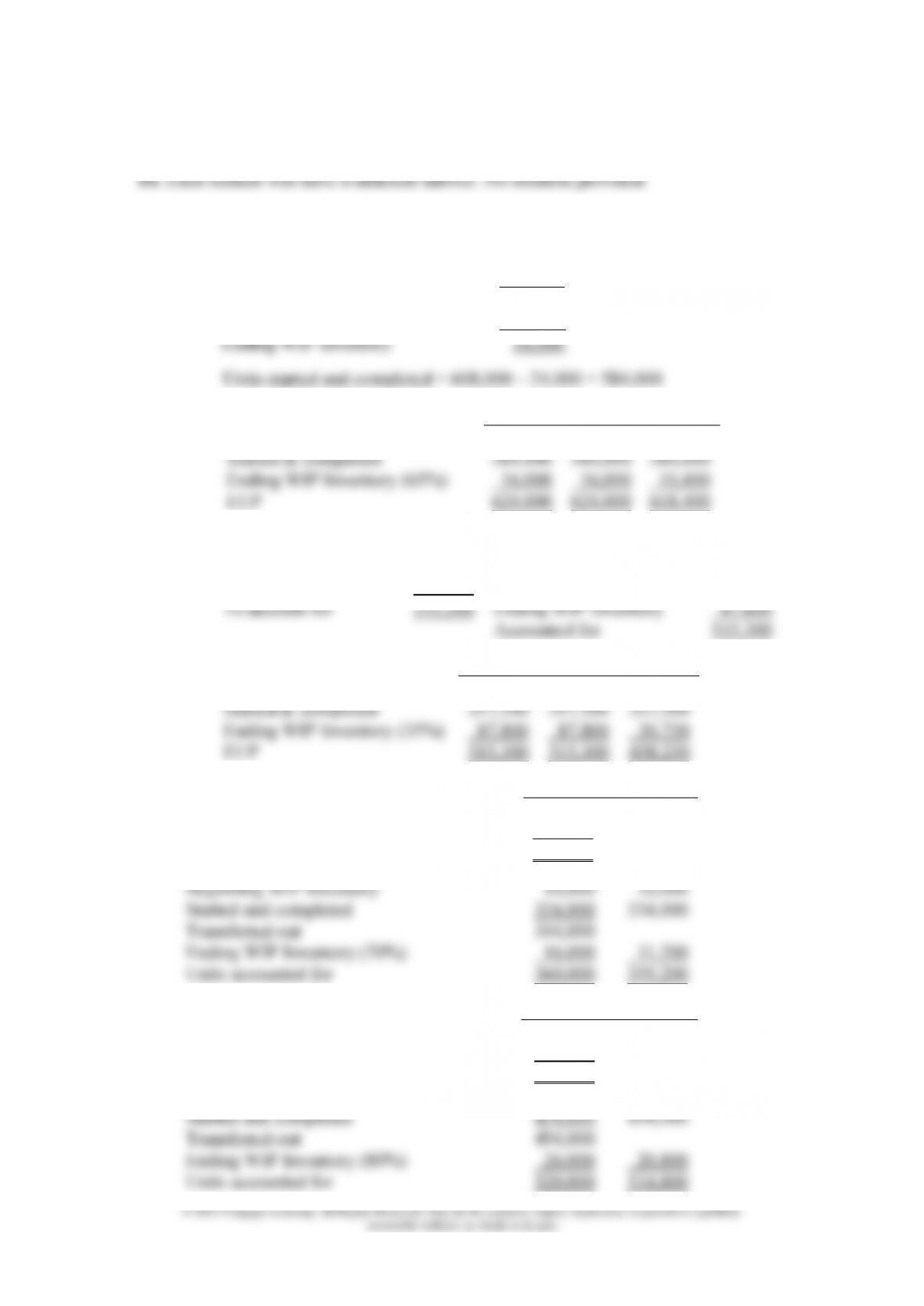
15. a. 24,000 + 600,000 = 624,000 pounds
b. & c. Beginning WIP Inventory
24,000
Started
600,000
To account for
624,000
Completed
(608,000)
Ending WIP Inventory
16,000
Units
DM
CC
Beginning WIP Inventory
24,000
24,000
24,000
Started & completed
584,000
584,000
584,000
Ending WIP Inventory (65%)
16,000
16,000
10,400
EUP
624,000
624,000
618,400
16. a. & b. Beginning WIP
Inventory (30%)
70,000
Beginning WIP
Inventory
70,000
Started
445,300
Started and completed
357,500
To account for
515,300
Ending WIP Inventory
87,800
Accounted for
515,300
Units
DM
CC
Beginning WIP Inventory
70,000
70,000
70,000
Started & completed
357,500
357,500
357,500
Ending WIP Inventory (35%)
87,800
87,800
30,730
EUP
515,300
515,300
458,230
17. a.
Units
CC
Beginning WIP Inventory (40%)
10,000
Started
350,000
Units to account for
360,000
Beginning WIP Inventory
10,000
10,000
Started and completed
334,000
334,000
Transferred out
344,000
Ending WIP Inventory (70%)
16,000
11,200
Units accounted for
360,000
355,200
b.
Units
CC
Beginning WIP Inventory (30%)
40,000
Started
480,000
Units to account for
520,000
Beginning WIP Inventory
40,000
40,000
Started and completed
454,000
454,000
Transferred out
494,000
Ending WIP Inventory (80%)
26,000
20,800
Units accounted for
520,000
514,800
140 Chapter 6
c.
Units
CC
Beginning WIP Inventory (55%)
15,000
Started
405,000
Units to account for
420,000
Beginning WIP Inventory
15,000
15,000
Started and completed
400,800
400,800
Transferred out
415,800
Ending WIP Inventory (90%)
4,200
3,780
Units accounted for
420,000
419,580
d.
Units
CC
Beginning WIP Inventory (35%)
10,800
Started
359,100
Units to account for
369,900
Beginning WIP Inventory
10,800
10,800
Started and completed
340,800
340,800
Transferred out
351,600
Ending WIP Inventory (45%)
18,300
8,235
Units accounted for
369,900
359,835
18. a. Work to be performed = 100% – 45% = 55% for conversion costs only
b. & c. Beginning WIP Inventory
24,000
Started
600,000
Accountable for
624,000
Completed
(608,000)
Ending WIP Inventory
16,000
Units started and completed = 608,000 – 24,000 = 584,000
Units
DM
CC
Beginning WIP Inventory (55%)
24,000
0
13,200
Started & completed
584,000
584,000
584,000
Ending WIP Inventory (65%)
16,000
16,000
10,400
EUP
624,000
600,000
607,600
19. a. & b. Beginning WIP
Inventory
70,000
Beginning WIP
Inventory
70,000
Started
445,300
Started and completed
357,500
To account for
515,300
Ending WIP Inventory
87,800
Accounted for
515,300
Units
DM
CC
Beginning WIP Inventory (70%)
70,000
0
49,000
Started & completed
357,500
357,500
357,500
Ending WIP Inventory (35%)
87,800
87,800
30,730
EUP
515,300
445,300
437,230
Chapter 6 141
20. a.
Units
CC
Beginning WIP Inventory (40%)
10,000
Started
350,000
Units to account for
360,000
Beginning WIP Inventory (60%)
10,000
6,000
Started and completed
334,000
334,000
Transferred out
344,000
Ending WIP Inventory (70%)
16,000
11,200
Units accounted for
360,000
351,200
b.
Units
CC
Beginning WIP Inventory (30%)
40,000
Started
480,000
Units to account for
520,000
Beginning WIP Inventory (70%)
40,000
28,000
Started and completed
454,000
454,000
Transferred out
494,000
Ending WIP Inventory (80%)
26,000
20,800
Units accounted for
520,000
502,800
c.
Units
CC
Beginning WIP Inventory (55%)
15,000
Started
405,000
Units to account for
420,000
Beginning WIP Inventory (45%)
15,000
6,750
Started and completed
400,800
400,800
Transferred out
415,800
Ending WIP Inventory (90%)
4,200
3,780
Units accounted for
420,000
411,330
d.
Units
CC
Beginning WIP Inventory (35%)
10,800
Started
359,100
Units to account for
369,900
Beginning WIP Inventory (65%)
10,800
7,020
Started and completed
340,800
340,800
Transferred out
351,600
Ending WIP Inventory (45%)
18,300
8,235
Units accounted for
369,900
356,055
21. a. Beginning WIP Inventory
(100%; 60%; 75%)
15,000
Beginning WIP
Inventory
15,000
Started
620,000
Started and completed
594,600
To account for
635,000
Ending WIP Inventory
(100%; 35%; 60%)
25,400
Accounted for
635,000
142 Chapter 6
Units
DM
DL
OH
Beginning WIP Inventory
15,000
15,000
15,000
15,000
Started & completed
594,600
594,600
594,600
594,600
Ending WIP Inventory
25,400
25,400
8,890
15,240
Equivalent units
635,000
635,000
618,490
624,840
b.
Units
DM
DL
OH
Beginning WIP Inventory
15,000
0
6,000
3,750
Started & completed
594,600
594,600
594,600
594,600
Ending WIP Inventory
25,400
25,400
8,890
15,240
Equivalent units
635,000
620,000
609,490
613,590
c. Equivalent units (WA)
635,000
618,490
624,840
EUP in beginning WIP
Inventory
(15,000)
(9,000)
(11,250)
Equivalent units (FIFO)
620,000
609,490
613,590
22. a. Beginning WIP Inventory
180,000
Tons started
3,400,000
Total tons to account for
3,580,000
b. Total tons to account for
3,580,000
Tons in ending WIP Inventory
(165,000)
Tons transferred out
3,415,000
Tons in beginning WIP Inventory
(180,000)
Tons started & completed (tons)
3,235,000
c.
Material
Conversion
Beginning WIP Inventory
180,000
180,000
Started & completed
3,235,000
3,235,000
Ending WIP Inventory (100%, 40%)
165,000
66,000
WA EUP
3,580,000
3,481,000
d.
Material
Conversion
Beginning WIP Inventory (0%, 35%)
0
63,000
Started & completed
3,235,000
3,235,000
Ending WIP Inventory (100%, 40%)
165,000
66,000
FIFO EUP
3,400,000
3,364,000
e.
DM
CC
WA EUP
3,580,000
3,481,000
Equivalent units in BI
(180,000)
(117,000)
FIFO EUP
3,400,000
3,364,000
23. a. Beginning Inventory
21,600
Units started
561,000
Units to account for
582,600
b. Units to account for
582,600
Units in BI
(21,600)
Units in EI
(13,700)
Units started & completed
547,300
Chapter 6 143
accessible website, in whole or in part.
c.
DM
DL
OH
BI
21,600
21,600
21,600
Started & completed
547,300
547,300
547,300
EI (75%, 25%, 10%)
10,275
3,425
1,370
EUP (WA)
579,175
572,325
570,270
d.
DM
DL
OH
BI (15%, 40%, 55%)
3,240
8,640
11,880
Started & completed
547,300
547,300
547,300
EI (75%, 25%, 10%)
10,275
3,425
1,370
EUP (FIFO)
560,815
559,365
560,550
e.
DM
DL
OH
EUP (WA)
579,175
572,325
570,270
Equivalent units in BI
(18,360)
(12,960)
(9,720)
EUP (FIFO)
560,815
559,365
560,550
24. a. DL cost = Conversion cost – OH cost = $189,648 – $85,200 = $104,448
b.
DM
DL
Overhead
Beginning WIP Inventory
$ 26,232
$ 19,504
$ 20,640
Current period
158,688
104,448
85,200
Total costs
$184,920
$123,952
$105,840
Divided by EUP
÷ 53,600
÷ 48,800
÷ 42,000
Cost per EUP
$3.45
$2.54
$2.52
25.
DM
DL
Overhead
WA EUP
53,600
48,800
42,000
Beginning WIP EUP
(7,200)
(8,000)
(7,920)
FIFO EUP
46,400
40,800
34,080
Current period cost
$158,688
$104,448
$85,200
Divided by EUP
÷ 46,400
÷ 40,800
÷ 34,080
Cost per EUP
$3.42
$2.56
$2.50
26. a.
DM
DL
OH
Total
Beginning WIP
$ 19,600
$ 6,320
$ 10,020
$ 35,940
Current period
54,000
34,720
84,480
173,200
Total
$ 73,600
$41,040
$ 94,500
$209,140
b. Total costs
$ 73,600
$ 41,040
$ 94,500
$209,140
WA EUP
÷ 160,000
÷ 152,000
÷ 150,000
Cost per EUP
$0.46
$0.27
$0.63
$1.36
c. Current costs
$ 54,000
$ 34,720
$ 84,480
$173,200
FIFO EUP
÷ 120,000
÷ 124,000
÷ 132,000
Cost per EUP
$0.45
$0.28
$0.64
$1.37
d. WA EUP
160,000
152,000
150,000
FIFO EUP
120,000
124,000
132,000
Beg. WIP EUP
40,000
28,000
18,000
Percent complete
100%
70%
45%
144 Chapter 6
27.
Units
Units
Beginning WIP
Inventory
9,800
Beginning WIP
Inventory
9,800
Units started
81,500
Started & completed
76,900
Units to account for
91,300
Ending WIP Inventory
4,600
Accounted for
91,300
Other
Canisters
Materials
DL
OH
Beginning WIP
Inventory
9,800
9,800
9,800
9,800
Started & completed
76,900
76,900
76,900
76,900
EI
4,600
1,840
920
460
EUP
91,300
88,540
87,620
87,160
Costs:
Other
Canisters
Materials
DL
OH
Total
Beginning WIP
$ 6,535
$ 6,174
$ 5,594
$ 1,070
$ 19,373
Current period
61,940
86,793
82,026
160,176
390,935
Total cost
$68,475
$92,967
$87,620
$161,246
$410,308
Divided by EUP
÷ 91,300
÷ 88,540
÷ 87,620
÷ 87,160
Cost per EUP
$0.75
$1.05
$1.00
$1.85
$4.65
28. a.
Units
Beginning WIP Inventory
400
Units started
3,800
Units to account for
4,200
Beginning WIP Inventory
400
Units started & completed
3,500
Total units completed
3,900
Ending WIP Inventory
300
Units accounted for
4,200
Material
Conversion
Beginning WIP Inventory
400
400
Units started & completed
3,500
3,500
Ending WIP Inventory
120
180
EUP
4,020
4,080
b.
Material
Conversion
Total
Beginning WIP
$ 4,349
$ 4,658
$ 9,007
Current costs
60,775
46,750
107,525
Total cost
$65,124
$51,408
$116,532
Divided by EUP (WA)
÷ 4,020
÷ 4,080
Cost per EUP
$16.20
$12.60
$28.80
Chapter 6 145
29.
Units
Units
Beginning WIP
Inventory
9,800
Beginning WIP
Inventory
9,800
Units started
81,500
Started & completed
76,900
Units to account for
91,300
Ending WIP Inventory
4,600
Accounted for
91,300
Other
Canisters
Materials
DL
OH
Beginning WIP
Inventory
0
3,920
5,880
7,840
Started & completed
76,900
76,900
76,900
76,900
EI
4,600
1,840
920
460
EUP
81,500
82,660
83,700
85,200
Costs:
Other
Canisters
Materials
DL
OH
Total
Current period
$61,940
$86,793
$82,026
$160,176
$390,935
Divided by EUP
÷ 81,500
÷ 82,660
÷ 83,700
÷ 85,200
Cost per EUP
$0.76
$1.05
$0.98
$1.88
$4.67
30. a.
Units
Beginning WIP Inventory
400
Units started
3,800
Units to account for
4,200
Beginning WIP Inventory
400
Units started & completed
3,500
Total units completed
3,900
Ending WIP Inventory
300
Units accounted for
4,200
Material
Conversion
Beginning WIP Inventory
120
60
Units started & completed
3,500
3,500
Ending WIP Inventory
120
180
EUP
3,740
3,740
b.
Material
Conversion
Total
Current costs
$60,775
$46,750
$107,525
Divided by EUP (FIFO)
÷ 3,740
÷ 3,740
Cost per EUP
$16.25
$12.50
$28.75
31. a. 390,000 × ($7.50 + $9.00 + $10.20) = 390,000 × $26.70 = $10,413,000
b. DM: $7.50 × (55,500 × 100%)
$416,250
DL: $9.00 × (55,500 × 30%)
149,850
OH: $10.20 × (55,500 × 25%)
141,525
Total of ending inventory
$707,625