41
CHAPTER 3
PREDETERMINED OVERHEAD RATES, FLEXIBLE BUDGETS,
AND ABSORPTION/VARIABLE COSTING
QUESTIONS
1. Although both variable and mixed costs change in total with activity measure
with a variable cost.
2. No, these are not always the best points of observation. First, the points must be
3. There are several reasons for using predetermined overhead rates. First, the company
head rates provide a means to control distortions in product costs caused by changes in
4. Departmental overhead rates are superior to plantwide overhead rates in that over-
head application bases can be identified that more accurately reflect the causes of
Separation of variable and fixed costs allows managers to make decisions that rely
on knowledge of cost behavior. For example, some decisions require that a manager
5. The two differences between absorption and variable costing relate to the treatment
of fixed factory overhead and the presentation of costs/expenses on the income
egories without regard to cost behavior; variable costing presents costs on the in-
come statement first as product or period, secondly by cost behavior (variable or
fixed), and possibly by functional categories.
42 Chapter 3
© 2013 Cengage Learning. All Rights Reserved. May not be scanned, copied, duplicated, or posted to a publicly
accessible website, in whole or in part.
The underlying cause of the difference between absorption and variable costing is
found in the definition of an asset. Asset cost should include all costs necessary to
get an item into place and ready for sale or use. Absorption costing considers fixed
overhead to be inventoriable (part of asset cost) because products could not be made
ments to support them.
6. Functionally classifying a cost refers to classification based on where the cost was
incurred (production, selling, or administrative area) and for what purpose (wages,
range of activity) variable costs will change in a direct relationship with changes in
some underlying activity measure, but fixed costs will remain constant. If variable
changes in activity.
7. Absorption costing is required for external reporting. The rationale is that fixed
sold.
8. Use of monetary, quantitative information varies greatly between external and inter-
nal users. External users emphasize profitability potential; internal users emphasize
Both absorption and variable costing have a place in decision making. Accountants
and decision makers need to understand the applications and limitations of the two
survive in the long run.
The methods of cost accumulation and cost presentation used for reporting are deter–
decision making, and performance evaluations.
Chapter 3 43
9. When production exceeds sales volume, absorption costing income will be higher than
variable costing income because some of the fixed factory overhead incurred during the
period will be deferred into inventory rather than appearing on the income statement.
When production is less than sales volume, some of the fixed overhead deferred in
previous periods will be charged against income as part of cost of goods sold under
10. The regression method has the major advantage of using all points in the data set to
determine the fixed and variable cost elements of the mixed costs. This is in contrast
44 Chapter 3
accessible website, in whole or in part.
EXERCISES
11. a. (1) At any level, the variable cost is $2 per machine hour. Since four hours are
chine hour.
b. (1) Combined rate = $8 + $32.50 = $40.50 per unit
Expected =
Actual
Applied
Under/Over
Applied
VOH (11,000 × $8)
$ 88,000
(11,000 $8) = $ 88,000
$ 0
FOH
325,000
(11,000 $32.50) = 357,500
32,500 overapp.
12. a. Applied VOH = 900 $8 = $7,200
13. a. Expected overhead = ($42,900 12) + ($6 78,000)
Predetermined overhead rate = $982,800 ÷ 78,000 = $12.60 per DLH
Overhead per unit = $12.60 1.5 hours per unit = $18.90
b. Manufacturing Overhead
128,550
Various accounts
128,550
Work in Process Inventory (6,390 $12.60)
80,514
Manufacturing Overhead
80,514
c. 6,390 DLHs ÷ 1.5 = 4,260 units should have been produced
14. a. Jan. $180,000 2.50 = $450,000
b. Jan. Actual – Applied = $440,000 – $450,000 =
$10,000 overapplied
Feb. Actual – Applied = $420,400 – $412,500 =
$ 7,900 underapplied
Mar. Actual – Applied = $421,000 – $425,000 =
$ 4,000 overapplied
Total for quarter
$ 6,100 overapplied
Chapter 3 45
accessible website, in whole or in part.
15. a. ($600,400 + $199,600) ÷ (10,000 + 40,000) = $800,000 ÷ 50,000 = $16.00 per DLH
b. ($600,400 + $199,600) ÷ (76,000 + 4,000) = $800,000 ÷ 80,000 = $10.00 per MH
c. Assembly: $600,400 ÷ 76,000 = $7.90 per MH
d. Overhead assigned using answer from (a): 1 $16.00 = $16.00
WIP
$ 384,000
384,000 ÷ 1,200,000 = 32%
0.32 $66,000 =
$21,120
FG
96,000
96,000 ÷ 1,200,000 = 8%
0.08 $66,000 =
5,280
CGS
720,000
720,000 ÷ 1,200,000 = 60%
0.60 $66,000 =
39,600
Total
$1,200,000
17. a. Predetermined overhead rate = Applied overhead ÷ Actual DLHs
b. Overhead is underapplied by ($121,500 – $120,000) or $1,500
as follows:
18. a. Using the information in the WIP Inventory account, the rate is $20,000 ÷
$10,000 or 200 percent of direct labor cost.
Goods Sold.
46 Chapter 3
c. Work in Process Inventory: $40,000 ($ 50,000 ÷ $520,000) = $ 3,846
of activity upon which the predetermined overhead rate was based, or (4) a com-
bination of the prior three causes.
19. a. The choice of capacity measure affects the amount of under- or overapplied over-
head only for fixed overhead costs. Because the total amount of overhead that is
expected to be incurred is unaffected by the volume of production (as long as it is
within the relevant range), the per–unit cost of fixed overhead varies inversely with
amount of underapplied (overapplied) fixed overhead.
b. Expected capacity would likely result in the least amount of under- or overap-
plied overhead because expected capacity reflects the most likely level of capaci-
ty utilization for 2013.
20. a. VOH rate (can be calculated at either level): $1,250,000 ÷ 100,000 MHs = $12.50
per MH or $1,875,000 ÷ 150,000 MHs = $12.50 per MH
c. Expected capacity = 2/3 180,000 = 120,000 MHs
d. At 110,000 MHs:
Total VOH applied = 110,000 $12.50 = $1,375,000
Total OH applied (practical) ($1,375,000 + $880,000) $ 2,255,000
Total OH applied (expected) ($1,375,000 + $1,320,000) $ 2,695,000
Chapter 3 47
21. a.
MHs
Total Cost
=
Variable Cost
+
Fixed Cost
High activity
34,000
$12,200
$5,440
$6,760
Low activity
31,000
11,720
4,960
6,760
Differences
3,000
$ 480
Variable rate = $480 ÷ 3,000 MHs = $0.16 per MH
High activity variable cost = 34,000 $0.16 = $5,440
22. a.
Shipments Received
Cost of Reports
High activity
60
$202
Low activity
35
142
Differences
25
$ 60
Variable cost = $60 ÷ 25 = $2.40
Fixed cost (high point) = $202 – (60 $2.40) = $58
y = $58 + $2.40X
b. y = $58 + ($2.40 72)
y = $230.80
were used to develop the equation.
23. a.
MHs
Total Cost
=
Variable Cost
+
Fixed Cost
High activity
9,000
$ 880
$(1,620)
$2,500
Low activity
3,000
1,960
(540)
2,500
Differences
6,000
$(1,080)
Variable rate = $(1,080) ÷ 6,000 MHs = $(0.18) per MH
High activity variable cost = 9,000 $(0.18) = $(1,620)
is available to perform maintenance activities.
48 Chapter 3
accessible website, in whole or in part.
c. For a cost prediction formula to work effectively, a positive relationship between
24. a.
MHs
Total
Cost
=
Variable
Cost
+
Fixed
Cost
High activity
1,900
$1,160
$760
$400
Low activity
1,250
900
500
400
Differences
650
$ 260
Variable rate = $260 ÷ 650 MHs = $0.40 per MH
Cost formula: y = $400 + $0.40 MH
b.
1,325
1,500
1,675
Variable utility cost @ $0.40 per MH
$ 530
$ 600
$ 670
Fixed utility cost
400
400
400
Expected total utility cost
$ 930
$1,000
$1,070
25. a. If the purpose is to control costs, the comparison is inappropriate. Actual cost
should be compared with flexible budget cost at the same level of output as that
Fixed amount (a) (given) = $32,000
The flexible budget for 17,600 units is:
Variable (17,600 $4)
$ 70,400
Fixed
32,000
Total
$102,400
A comparison with the budget follows:
Budget
Actual
Variances
Variable
$ 70,400
$ 69,000
$1,400 F
Fixed
32,000
32,800
800 U
Total
$102,400
$101,800
$ 600 F
the budgeted amount.
Chapter 3 49
accessible website, in whole or in part.
26. a.
250
300
350
400
Variable costs:
Supplies @ $4.00 per DLH
$1,000
$1,200
$1,400
$1,600
Direct labor @ $7.00 per DLH
1,750
2,100
2,450
2,800
Utilities @ $5.40 per DLH
1,350
1,620
1,890
2,160
Fixed costs:
Direct labor
500
500
500
500
Utilities
350
350
350
350
Rent
450
450
450
450
Advertising
75
75
75
75
Total cost
$5,475
$6,295
$7,115
$7,935
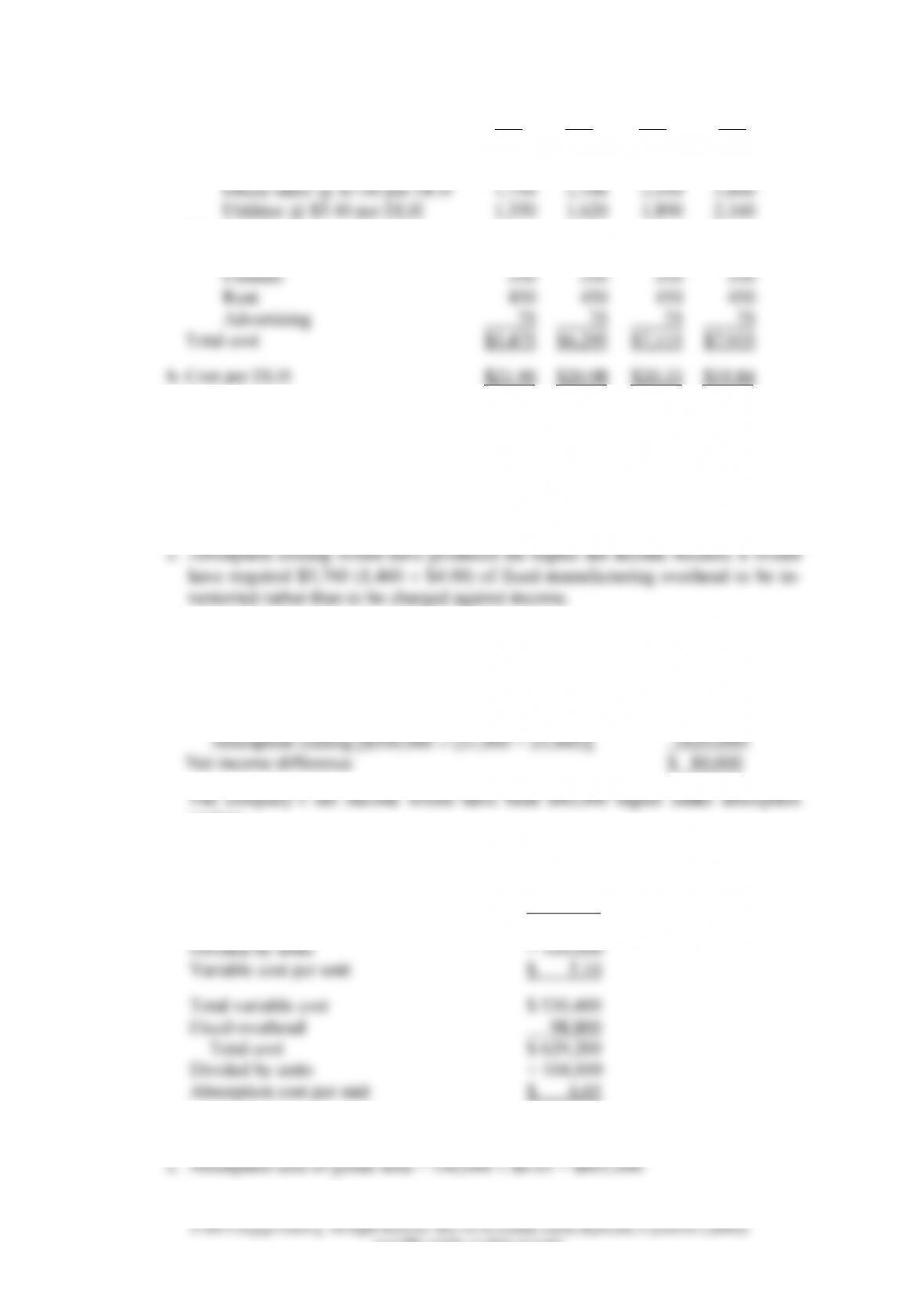
b. Cost per DLH
$21.90
$20.98
$20.33
$19.84
c. $20.33 1.4 = $28.46 hourly charge
$28.46 1.25 hours per repair = $35.58 or $36 per customer repair
27. a. (18,000 – 16,560) $22.00 = 1,440 $22.00 = $31,680
b. (18,000 – 16,560) ($22.00 – $4.00) = 1,440 $18.00 = $25,920
28. The variance between variable and absorption net income is caused by the difference
in treatment of fixed manufacturing overhead.
Fixed overhead expensed:
Variable costing
$ 500,000
Absorption costing [$500,000 (21,000 ÷ 25,000)]
(420,000)
Net income difference
$ 80,000
costing.
29. a. Ingredients $ 228,800
Labor 104,000
Variable overhead 197,600
Total variable cost $ 530,400
b. Variable cost of goods sold = 100,000 $5.10 = $510,000
50 Chapter 3
d. Ending inventory (variable costing) = 4,000 $5.10 = $20,400
e. Fixed overhead charged to expense (variable costing) = $98,800
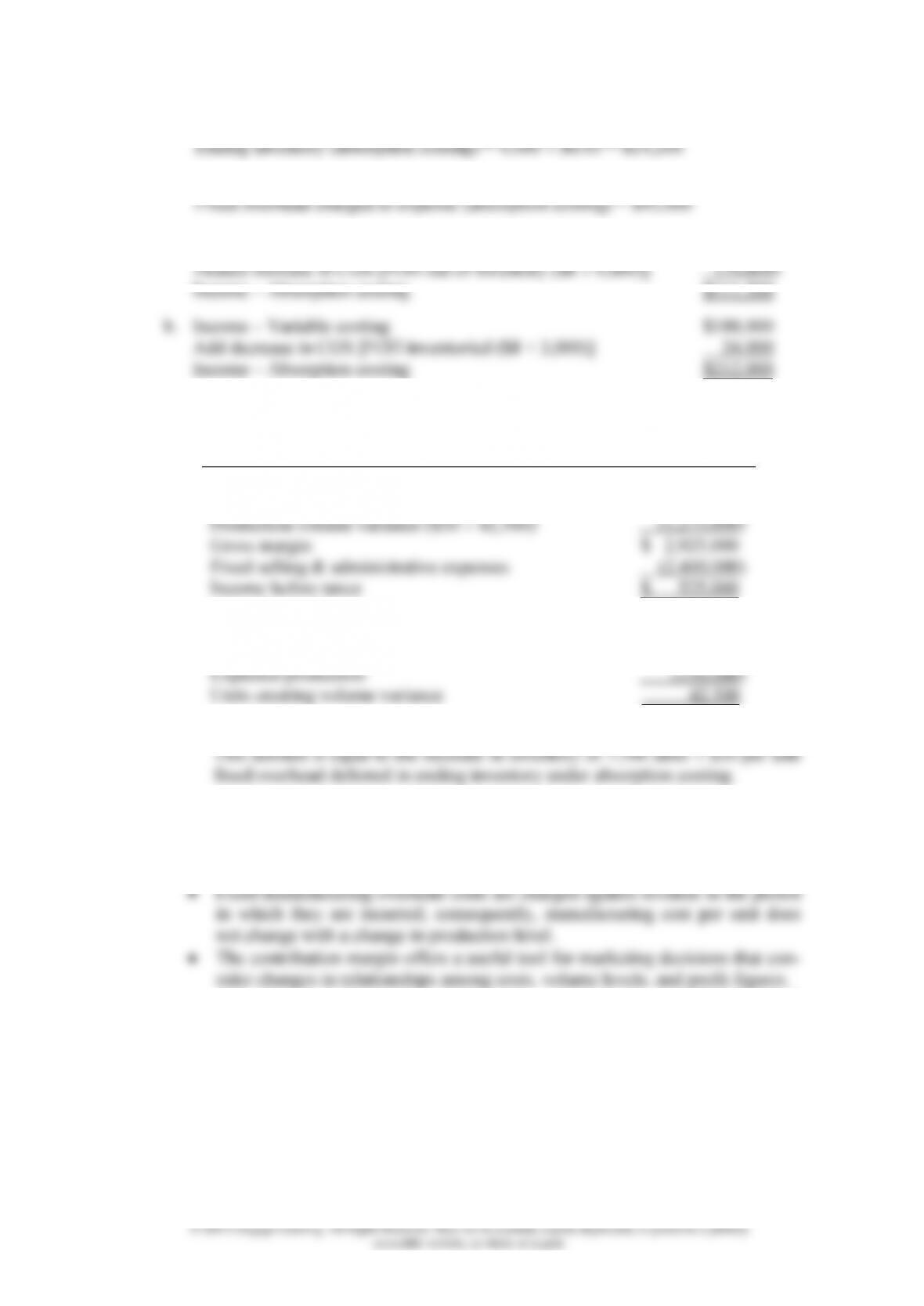
30. a.
Income – Variable costing
$188,000
Deduct increase in CGS [FOH out of inventory ($8 9,600)]
(76,800)
Income – Absorption costing
$111,200
b.
Income – Variable costing
$188,000
Add decrease in CGS [FOH inventoried ($8 × 3,000)]
24,000
Income – Absorption costing
$212,000
31. a. (1) Fabio’s Fashions
Income Statement (Absorption Costing Basis)
For the Month Ended April 30, 2013
Sales ($14,400,000 ÷ $144 = 100,000 units sold)
$ 14,400,000
Cost of goods sold ($102 100,000)
(10,200,000)
Production volume variance ($30 42,500)*
(1,275,000)
Gross margin
$ 2,925,000
Fixed selling & administrative expenses
(2,400,000)
Income before taxes
$ 525,000
*Total production (100,000 units sold + 7,500
units inventoried)
107,500
Expected production
(150,000)
Units creating volume variance
42,500
(2) Differences in incomes = $300,000 – $525,000 = $(225,000)
b. Caffrey should find the variable costing approach to income determination desir-
able for many reasons, including the following:
Variable costing income varies with units sold, not units produced.
(CMA adapted)