32 Chapter 2
accessible website, in whole or in part.
d. Gross profit = 0.35 $1,431,000 = $500,850
S&A expenses = Gross profit – Net income
= $500,850 – $125,000
= $375,850
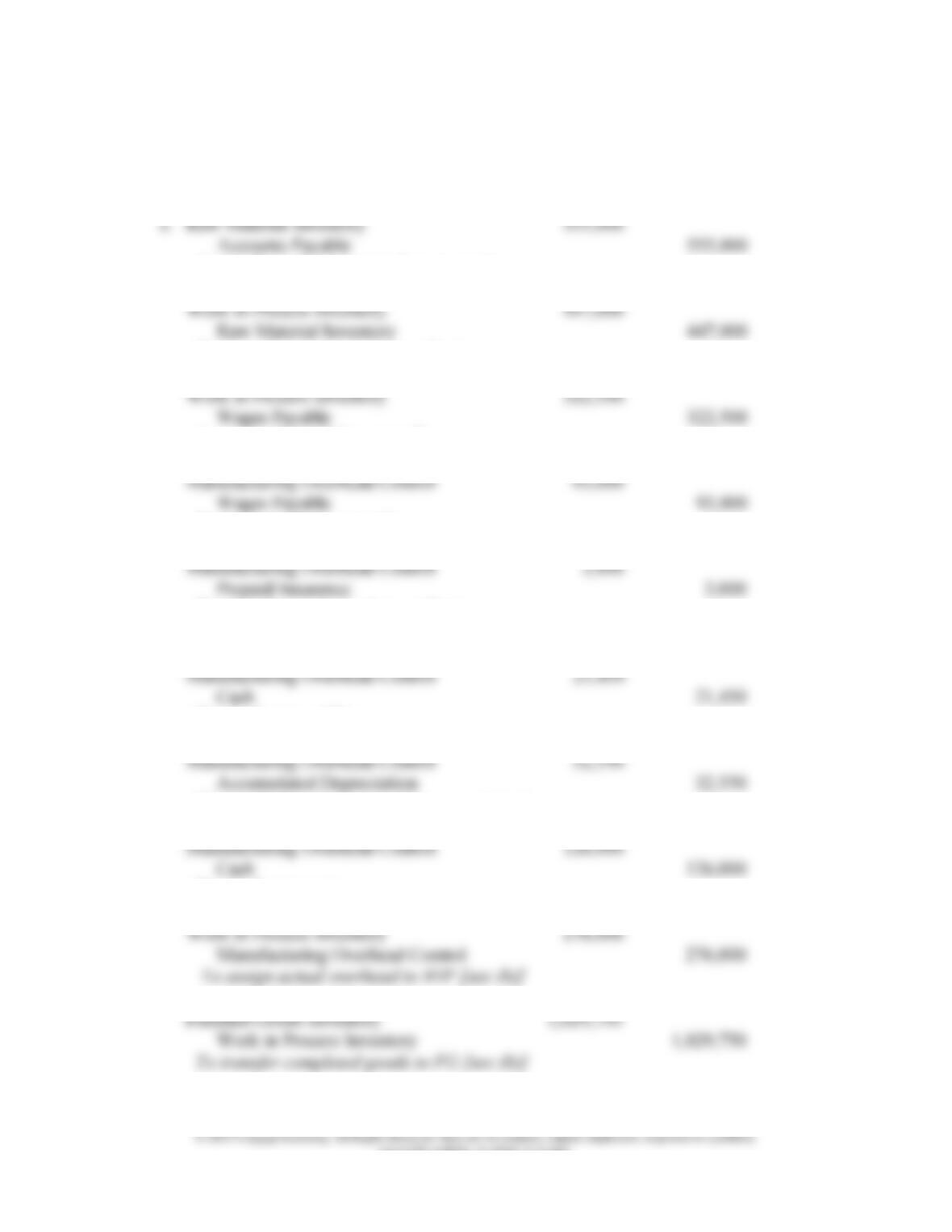
e. Raw Material Inventory
555,000
Accounts Payable
555,000
To purchase direct material on account
Work in Process Inventory
447,000
Raw Material Inventory
447,000
To issue direct material to production
Work in Process Inventory
322,500
Wages Payable
322,500
To accrue direct labor payroll
Manufacturing Overhead Control
93,000
Wages Payable
93,000
To accrue indirect payroll
Manufacturing Overhead Control
3,000
Prepaid Insurance
3,000
To record expiration of prepaid insurance
on factory
Manufacturing Overhead Control
21,450
Cash
21,450
To pay factory utilities
Manufacturing Overhead Control
32,550
Accumulated Depreciation
32,550
To record depreciation on factory equipment
Manufacturing Overhead Control
126,000
Cash
126,000
To pay factory rent
Work in Process Inventory
276,000
Manufacturing Overhead Control
276,000
To assign actual overhead to WIP [see (b)]
Finished Goods Inventory
1,029,750
Work in Process Inventory
1,029,750
To transfer completed goods to FG [see (b)]
Chapter 2 33
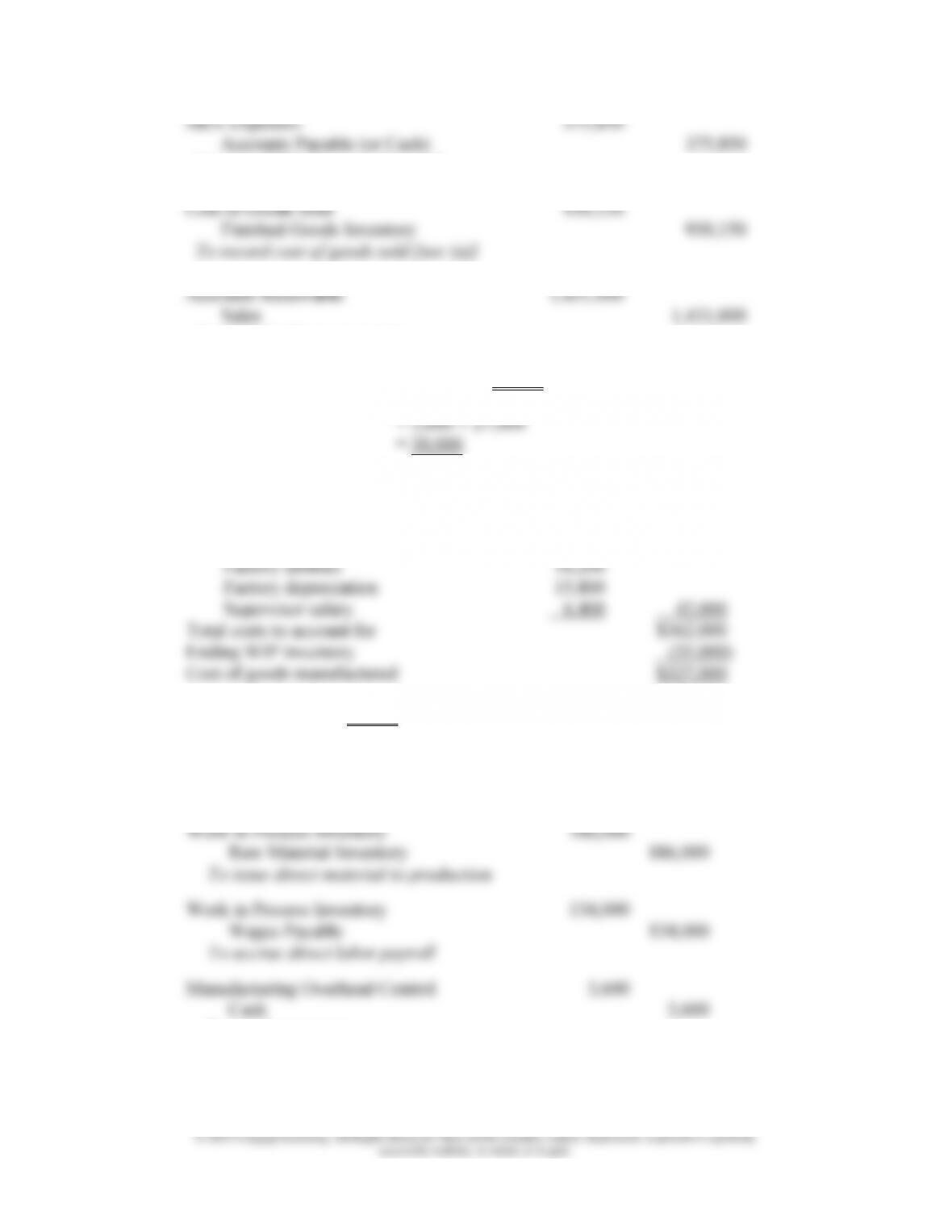
S&A Expenses
375,850
Accounts Payable (or Cash)
375,850
To record S&A expense [see (c)]
Cost of Goods Sold
930,150
Finished Goods Inventory
930,150
To record cost of goods sold [see (a)]
Accounts Receivable
1,431,000
Sales
1,431,000
To record sales on account
48. a. Number of units sold = 648,000 ÷ $24 = 27,000
Number of units completed = Units in FG inventory + Units sold
b. Direct material used
$186,000
Direct labor
134,000
Overhead:
Factory rent
$ 3,600
Factory utilities
16,200
Factory depreciation
15,800
Supervisor salary
6,400
42,000
Total costs to account for
$362,000
Ending WIP inventory
(35,000)
Cost of goods manufactured
$327,000
c. $327,000 ÷ 30,000 = $10.90 per unit
d. Raw Material Inventory
248,000
Accounts Payable
248,000
To purchase direct material on account
Work in Process Inventory
186,000
Raw Material Inventory
186,000
To issue direct material to production
Work in Process Inventory
134,000
Wages Payable
134,000
To accrue direct labor payroll
Manufacturing Overhead Control
3,600
Cash
3,600
To pay factory rent
34 Chapter 2
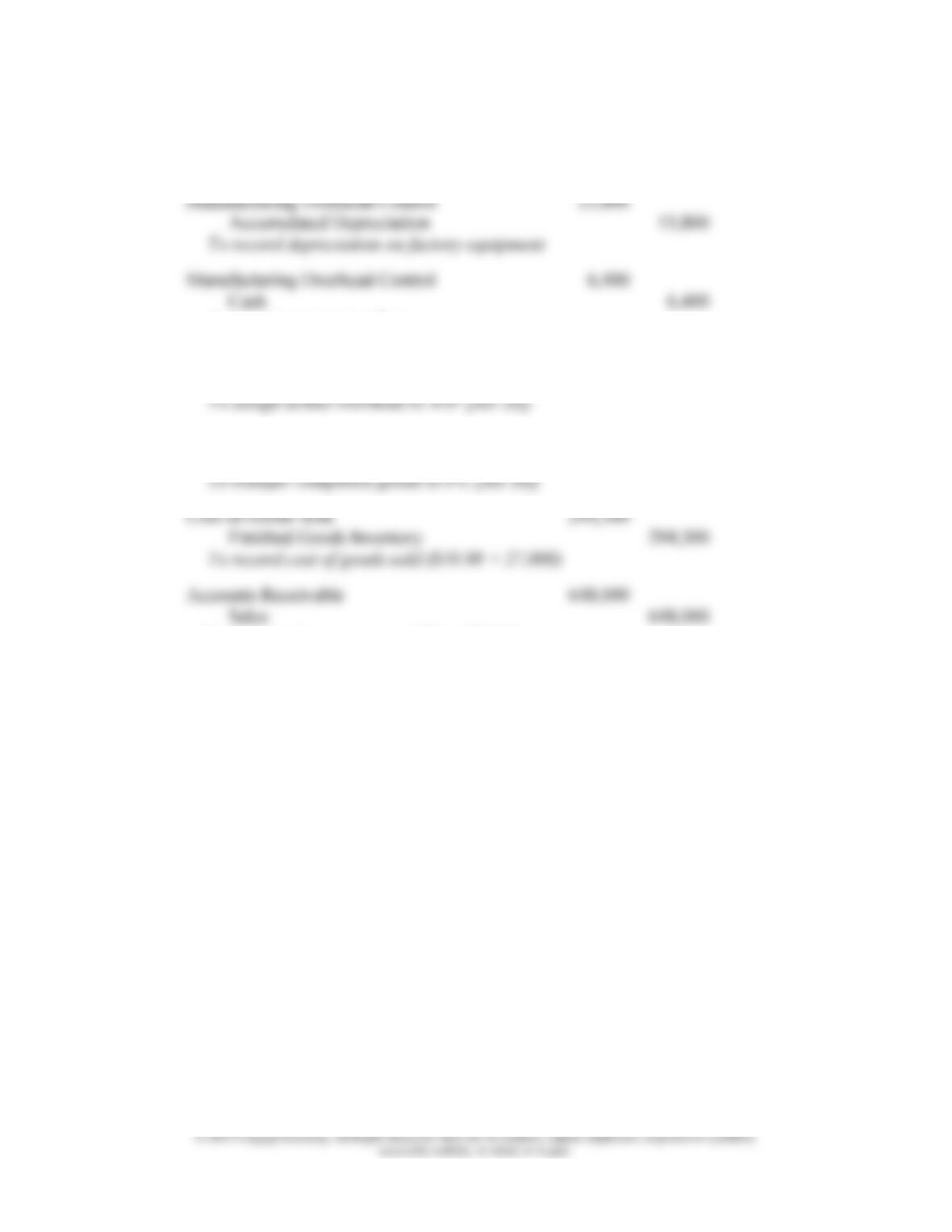
Manufacturing Overhead Control
16,200
Utilities Payable
16,200
To accrue factory utilities
Manufacturing Overhead Control
15,800
Accumulated Depreciation
15,800
To record depreciation on factory equipment
Manufacturing Overhead Control
6,400
Cash
6,400
To pay supervisor’s salary
Work in Process Inventory
42,000
Manufacturing Overhead Control
42,000
To assign actual overhead to WIP [see (b)]
Finished Goods Inventory
327,000
Work in Process Inventory
327,000
To transfer completed goods to FG [see (b)]
Cost of Goods Sold
294,300
Finished Goods Inventory
294,300
To record cost of goods sold ($10.90 × 27,000)
Accounts Receivable
648,000
Sales
648,000
To record sales on account ($24 27,000)
Chapter 2 35
49.
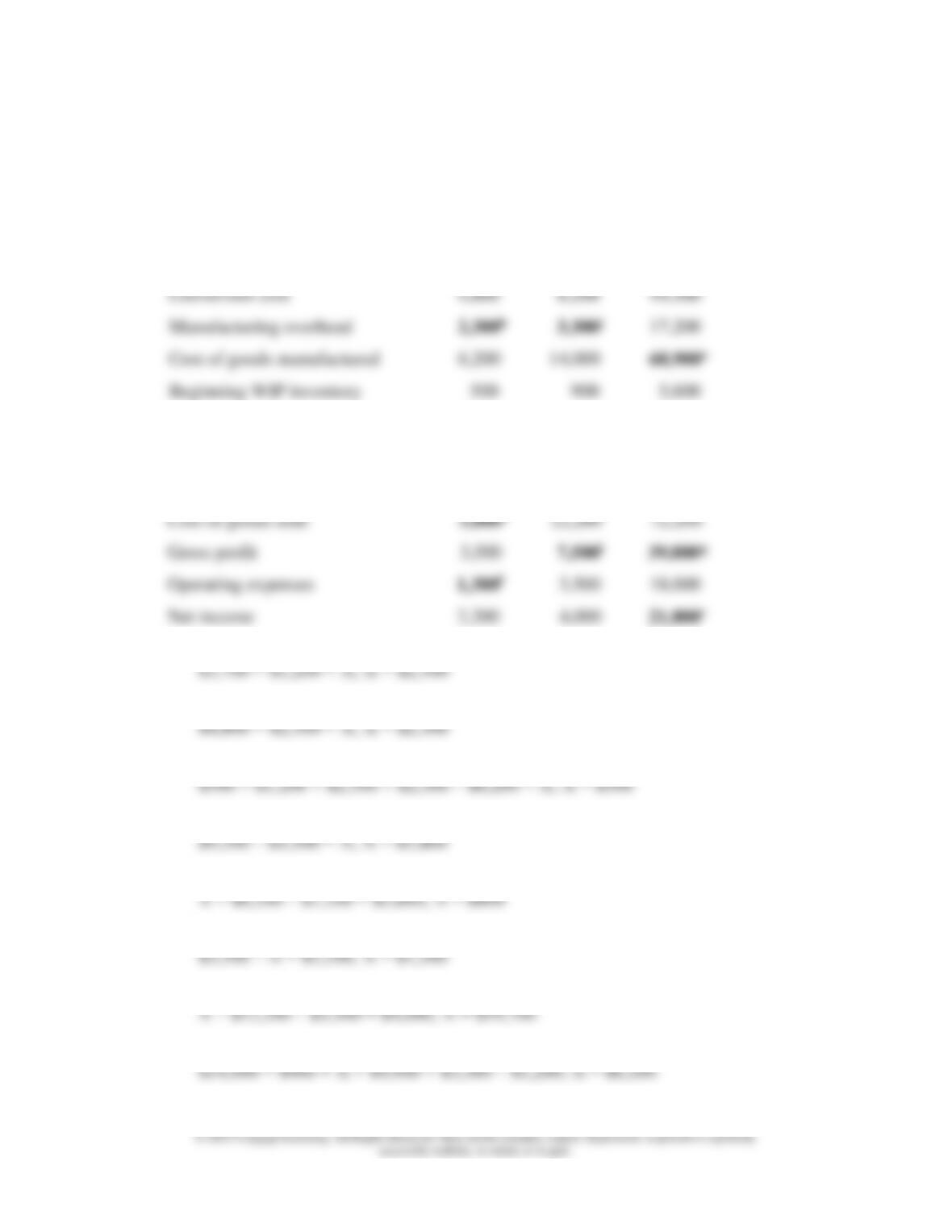
Case 1
Case 2
Case 3
Sales
$9,300
$19,700g
$112,000
Direct material used
1,200
6,100h
18,200
Direct labor
2,500a
4,900
32,100m
Prime cost
3,700
11,000i
50,300n
Conversion cost
4,800
8,200
49,300
Manufacturing overhead
2,300b
3,300j
17,200
Cost of goods manufactured
6,200
14,000
68,900o
Beginning WIP inventory
500
900
5,600
Ending WIP inventory
300c
1,200
4,200
Beginning FG inventory
800d
1,900
7,600
Ending FG inventory
1,200
3,700k
4,300p
Cost of goods sold
5,800e
12,200
72,200
Gross profit
3,500
7,500l
39,800q
Operating expenses
1,300f
3,500
18,000
Net income
2,200
4,000
21,800r
aPrime cost = DM + DL
bConversion cost = DL + OH
cBeg. WIP + DM + DL + OH – CGM = End. WIP
eSales – Gross profit = CGS
dBeg. FG + CGM – End. FG = CGS
fGross profit – Operating expenses = NI
gSales – CGS – Operating expenses = NI
hCGM = Beg. WIP + DM + DL + OH – End. WIP
36 Chapter 2
accessible website, in whole or in part.
iPrime cost = DM + DL
jConversion cost = DL + OH
kBeg. FG + CGM – End. FG = CGS
lSales – CGS = Gross profit
mConversion cost = DL + OH
nPrime cost = DM + DL
oCGM = Beg. WIP + DM + DL + OH – End. WIP
pBeg. FG + CGM – End. FG = CGS
qSales – CGS = Gross profit
rGross profit – Operating expenses = NI
50. a. Under GAAP, product cost consists of all amounts that are necessary to manufac-
ture a product. Although direct material and direct labor are clearly traceable to a
product and thus should be considered part of product cost, a product could also
not be produced without the costs of overhead. In a manufacturing plant, employ-
b. It does not seem reasonable to allocate the depreciation overhead cost of the new
equipment to the dog carriers because that equipment is not required for the pro-
Chapter 2 37
accessible website, in whole or in part.
c. A normal cost system uses a predetermined charge for overhead rather than using
the actual amounts that are incurred. One primary component of overhead is utility
cost. In Michigan, the utility cost for winter operations could be substantially
51. a. Beginning inventory of direct material
$ 12,300
Direct material purchased
196,300
Materials available for use
$208,600
Ending inventory of direct material
X
Direct material used
$195,800
X= $208,600 – $195,800
X = $12,800
b. Direct material used
$195,800
Direct labor
182,400
Factory overhead
205,700
Total product costs
$583,900
c. Petersham Company
Schedule of Cost of Goods Manufactured
For the Month Ended August 31, 2013
Beginning WIP inventory
$ 25,900
Direct material used
195,800
Direct labor
182,400
Overhead
205,700
Total costs to account for
$609,800
Ending WIP inventory
(33,300)
Cost of goods manufactured
$576,500
d. Petersham Company
Cost of Goods Sold Schedule
For the Month Ended August 31, 2013
Beginning FG inventory
$ 62,700
Cost of goods manufactured
576,500
Goods available for sale
$639,200
Ending FG inventory
(55,500)
Cost of goods sold
$583,700
38 Chapter 2
e. Petersham Company
Income Statement
For the Month Ended August 31, 2013
Sales
$ 985,000
Cost of goods sold
(583,700)
Gross profit
$ 401,300
Selling and administrative expenses
(171,200)
Income before income taxes
$ 230,100
Income tax expense ($230,100 0.40)
(92,040)
Net income
$ 138,060
52. a. $1,040,000 ÷ $5,200 = 200 units sold
b. Flex-Em
Schedule of Cost of Goods Manufactured
For the Month Ended July 31, 2013
Beginning WIP inventory
$ 0
Direct material used
$377,000
Direct labor
126,800
Overhead:
Indirect labor
$ 40,600
Insurance
6,000
Utilities
17,800
Depreciation
230,300
294,700
798,500
Total manufacturing costs
$798,500
Ending WIP inventory
(51,000)
Cost of goods manufactured
$747,500
= 200 + ($97,500 ÷ $3,250)
= 200 + 30
= 230 units completed
d. $747,500 ÷ 230 units = $3,250
Chapter 2 39
53. a. and b.
Raw Material Inventory
BB
72,000
(2) DM and IM issued
136,200
(1) Purch.
570,000
EB
505,800
Work in Process Inventory
BB
108,000
CGM 532,140
(2) DM
121,200
(2) IM
15,000
(3) DL
180,000
(3) IL
42,000
(5) Util.
28,140
(6) Depr.
48,000
(7) Rent
39,600
EB
49,800
Finished Goods Inventory
BB
24,000
CGS 502,740
EB
53,400
Total product cost = Cost of goods manufactured = $532,140
Office salaries expense (4)
$144,600
Utilities expense (5)
12,060
Depreciation expense (6)
12,000
Rent expense (7)
26,400
Total period cost
$195,060
54. a. Cost of goods sold for the first 18 days of June: $230,000 (1 – 0.40)
= $138,000
Cost of goods sold for the first 18 days of June:
Beginning FG inventory
$ 29,000
Cost of goods manufactured
151,500b
Goods available for sale
$180,500a
Ending FG inventory
(42,500)
Cost of goods sold
$138,000
40 Chapter 2
Cost of goods manufactured for the first 18 days of June:
Beginning WIP inventory
$ 48,000
Direct material used
76,000
Direct labor
44,000
Manufacturing overhead
42,000
Total cost to account for
$210,000
Ending WIP inventory
(58,500)c
Cost of goods manufactured
$151,500
tained from industry publications and the unit data might be obtained from
production records or internal receiving and shipping documents.