13
CHAPTER 2
COST TERMINOLOGY AND COST BEHAVIORS
QUESTIONS
1. The term cost is used to refer to so many different concepts that an adjective must be
opportunity costs, to name just a few.
2. A cost object is anything for which management wants to collect or accumulate costs.
direct costs. For example, if multiple products are made in the same production area,
ic manner to the cost object.
3. The assumed range of activity that reflects the company’s normal operating range is
linear graph is more indicative of reality, it is not as easy to use in planning or con-
sent an approximation of reality.
4. It is not necessary for a causal relationship to exist between the cost predictor and the
cost. All that is required is that there is a strong correlation between movement in the
costs to be incurred.
The distinction between cost drivers and predictors is important because it relates to
5. A product cost is one that is associated with inventory. In a manufacturing company,
product costs would include direct material, direct labor, and overhead. In a merchan-
14 Chapter 2
In all three types of organizations, a period cost is any cost that is not a product cost.
These costs are noninventoriable and are incurred in the nonfactory or nonproduction
6. Conversion costs are all production costs other than direct material costs; thus, con-
into a salable product.
7. Factory overhead has been growing most rapidly because of the costs of technology.
8. The only difference between the two systems is in their treatment of overhead. Under
an actual cost system, actual overhead is added to production. Because actual over-
apply overhead to products as production occurs.
The major advantage of using a normal cost system is that it allows a product’s cost
els of production and sales.
9. The cost of goods manufactured is the total production cost of the goods that were
completed and transferred to Finished Goods Inventory during the period. This
Chapter 2 15
accessible website, in whole or in part.
EXERCISES
10. a. Direct
b. Direct
c. Direct
d. Indirect
11.
COST OBJECT
Notebook
Plant
Touch pad and buttons
Direct
Direct
Glue
Indirect
Direct
Network connector
Direct
Direct
Battery
Direct
Direct
Paper towels used by line employees
Indirect
Direct
AC adapter
Direct
Direct
CD drive
Direct
Direct
Motherboard
Direct
Direct
Screws
Indirect
Direct
Oil for production machinery
Indirect
Direct
12.
COST OBJECT
Kennedy
Tax Services
Firm
a. Four hours of Perkins’s time
Direct
Unrelated
Direct
b. Six hours of assistant’s time
Direct
Direct
Direct
c. Three hours of Morris’s time
Indirect
Indirect
Direct
d. Eight hours of CPE for Tompkin
Indirect
Direct
Direct
e. One hour at lunch
Unrelated
Unrelated
Unrelated
f. Two hours of Perkins’s time
Direct
Unrelated
Direct
g. One-half hour of Tompkin’s time
Direct
Direct
Direct
h. Janitorial wages
Indirect
Indirect
Direct
i. Seven hours of Tompkin’s time
Direct
Direct
Direct
13. a. Cardboard, $0.40; cloth, $1; plastic, $0.50; depreciation, $0.60; superviors’ sala-
sors’ salaries, fixed; and utilities, mixed.
c. If the company produces 10,000 caps this month, the total cost per unit will in-
16 Chapter 2
accessible website, in whole or in part.
14. a. and b.
Per Unit
Per Set
Cardboard boxes ($1,000 2,000)
$0.50
$ 0.50
Mallets ($12,000 4,000)
3.00
6.00
Croquet balls ($9,000 12,000)
0.75
4.50
Wire hoops ($3,600 24,000)
0.15
1.80
Production worker wages ($8,400 2,000)
?
4.20
Supervisor’s salary ($2,600 2,000)
?
1.30
Building and equipment rental ($2,800 2,000)
?
1.40
Utilities ($1,300 2,000)
?
0.65
Total
$20.35
c. Estimated cost per set in March is
Cardboard boxes ($1,000 2,000)
$ 0.50
Mallets ($12,000 4,000; $3 2)
6.00
Croquet balls ($9,000 12,000; $0.75 6)
4.50
Wire hoops ($3,600 24,000; $0.15 12)
1.80
Production worker wages ($8,400 2,000)
4.20
Supervisor’s salary ($2,600 2,500)
1.04
Building and equipment rental ($2,800 2,500)
1.12
Utilities ($1,400 2,500)
0.56
Total
$19.72
15. a. Total fixed cost $ 37,500
b. Total cost $187,500
Desired profit margin (15,000 tickets $8) 120,000
c. Total revenue (5,000 tickets $20.50) $102,500
Total cost:
Chapter 2 17
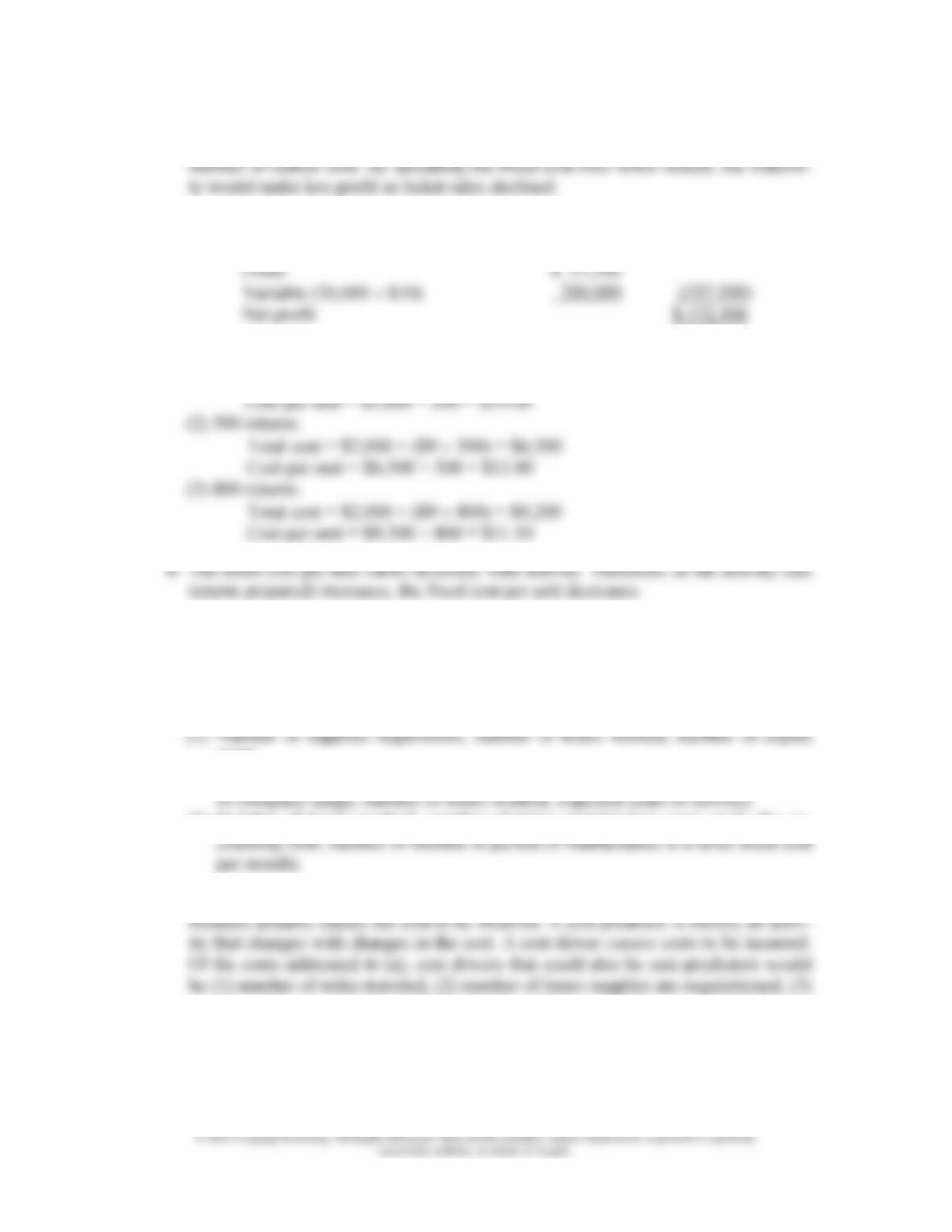
c. The assumption made was that 15,000 tickets would be sold. The fraternity should
have been informed that the fixed cost per ticket would vary, depending on the
e. Total revenue (20,000 tickets $20.50)
$ 410,000
Total cost:
Fixed
$ 37,500
Variable (20,000 $10)
200,000
(237,500)
Net profit
$ 172,500
16. a. (1) 200 returns:
Total cost = $2,000 + ($9 200) = $3,800
c. $15,000 ÷ 200 = $75; $75 + $19 = $94 fee to charge per return
$94 800 = $75,200 total fees; $75,200 – $9,200 = $66,000
17. a. (1) Number of clients contacted, number of new clients generated, number of
miles traveled (if driving), number of nights away from home.
made
(3) Purchase price of computers and depreciation method chosen (number of hours
(4) Number of hours worked, number of times maintenance crew visits the ac-
b. The distinction between a cost predictor and a cost driver is whether the activity
number of hours worked, and (4) number of times maintenance visited the ac-
counting firm.
18. a. Number of patients processed
b. Number of patients scheduled
18 Chapter 2
c. Number of surgeries scheduled
d. Number of surgeries scheduled
e. Number of tests ordered
multiple tests)
g. Number of lab tests administered
h. Number of patients moved
l. Number of patients moved
19. a. V, PT (could be mixed)
b. V, PD
c. F, PD
d. V, PT
e. F, PT
20. a. F, OH
b. V, DM
c. V, DM
d. V, OH (assuming cost is insignificant)
e. V, DM
f. F, OH
Chapter 2 19
21. a. $600,000 – $60,000 = $540,000 depreciable cost
$540,000 ÷ 10 years = $54,000 depreciation per year
20 Chapter 2
25. a. Rivets and aluminum = $12,510 + $1,683,000 = $1,695,510
b. Aluminum cutters and welders = $56,160 + $156,000 = $212,160
26. a. Stainless steel, plastic, and wood blocks =
b. $500,000 (equipment operators)
c. $6,000 indirect material (equipment oil and grease)
27. Direct material:
Mulch
$ 320
Landscaping rock
1,580
Plants and pots
1,950
$3,850
Direct labor:
Trumble’s salary ($3,000 ÷ 20 = $150 per day;
$150 2 days to design)
$ 300
Gardeners’ wages ($3,840 ÷ 20 = $192 per day;
$192 5 days to complete)
960
$1,260
Overhead:
Allocated depreciation ($200 ÷ 20 work days)
$ 10
Construction permit
95
Allocated rent (150 ÷ 3,000 = 5%; $2,400 0.05
= $120; $120 ÷ 30 = $4 per day 2 days)
8*
Allocated utility bills ($1,800 0.05 = $90;
$90 ÷ 30 =$3 per day 2 days)
6*
$ 119
*Note: The rent and utility bills were allocated only because of the designer’s use of
space in the company offices. Given the immaterial amount of these allocations,
Carolyn Gardens may simply want to treat these costs as period costs rather than at-
tempting to trace them to individual jobs. Thus, an answer of $105 for overhead
would also be reasonable.
28. a. 6,000 total hours – 5,000 regular hours = 1,000 overtime hours
b. Direct labor: 5,000 hours $9 per hour = $45,000
Chapter 2 21
c. Shift premiums:
Overhead costs:
29. a. 32,000 total hours – 27,000 regular hours = 5,000 overtime hours
b. Direct labor: 32,000 hours $12 per hour = $384,000
c. Shift premiums:
Second-shift premium: 8% $12 = $0.96
Manufacturing overhead costs:
Second-shift premium: 9,000 hours $0.96 = $8,640
30. a. Property tax overhead cost for February = $48,000 ÷ 12 = $4,000
b. February OH cost per unit = $443,000 ÷ 50,000 = $8.86
variations over an annual period.
31. Direct material used
$ 24,000
Direct labor
126,000
Overhead
42,000
Current manufacturing costs
$192,000
Less increase in work in process inventory
(23,000)
Cost of goods manufactured
$169,000
22 Chapter 2
32. a. Beginning WIP inventory
$ 372,000
Raw material used
$612,000
Direct labor
748,000
Manufacturing overhead
564,000
1,924,000
Total cost to account for
$ 2,296,000
Ending WIP inventory
(436,000)
Cost of goods manufactured
$ 1,860,000
b. Beginning FG inventory
$ 224,000
Cost of goods manufactured
1,860,000
Cost of goods available for sale
$2,084,000
Ending FG inventory
(196,000)
Cost of goods sold
$1,888,000
33. a. Irresistible Art
Schedule of Cost of Goods Manufactured
For the Month Ended July 31, 2013
Beginning WIP inventory
$ 146,400
Beginning RM inventory
$ 93,200
Raw material purchased
656,000
Raw material available
$ 749,200
Ending RM inventory
(69,600)
Raw material used
$ 679,600
Indirect material used (plugged)
(175,600)
Direct material used (given)
504,000
Direct labor ($788,000 × 0.75)
591,000
Overhead:
Various (given)
$ 600,000
Indirect material (from above)
175,600
Indirect labor ($788,000 × 0.25)
197,000
972,600
Total cost to account for
$2,214,000
Ending WIP inventory
(120,000)
Cost of goods manufactured
$2,094,000
b. Irresistible Art
Schedule of Cost of Goods Sold
For the Month Ended July 31, 2013
Beginning FG inventory
$ 72,000
Cost of goods manufactured
2,094,000
Goods available for sale
$2,166,000
Ending FG inventory
(104,800)
Cost of goods sold
$2,061,200