Exercise 7-33 Name:
Insert your answers in the gray-shaded cells. If an answer is
incorrect, the word “wrong” will appear.
a. November production 4,800
Standard materials per bag
×0.50
Total square yards 2,400
b. November production 4,800
Standard labor per bag
×2.00
Total labor hours
9,600
c. AQ = SQ + (Material quantity variance ÷ SP)
Material quantity variance 600$
÷ Standard price 6.00$
100
+ Standard quantity 2,400
Actual quantity used (AQ) 2,500
Total actual cost 14,550$
÷ Actual quantity 2,500
Actual price (AP) 5.82$
Material price variance = AQ x (AP – SP)
Actual price (AP) 5.82$
– Standard price (SP) 6.00
(0.18)$
x Actual quantity used (AQ) 2,500
Material price variance (450)$ Favorable
d. Labor efficiency variance = SP x (AH – SH)
Actual hours (AH) 9,760
Standard hours (SH) 9,600
160
Standard price (SP)
×17.00$
Labor efficiency variance 2,720$ Unfavorable
Solution
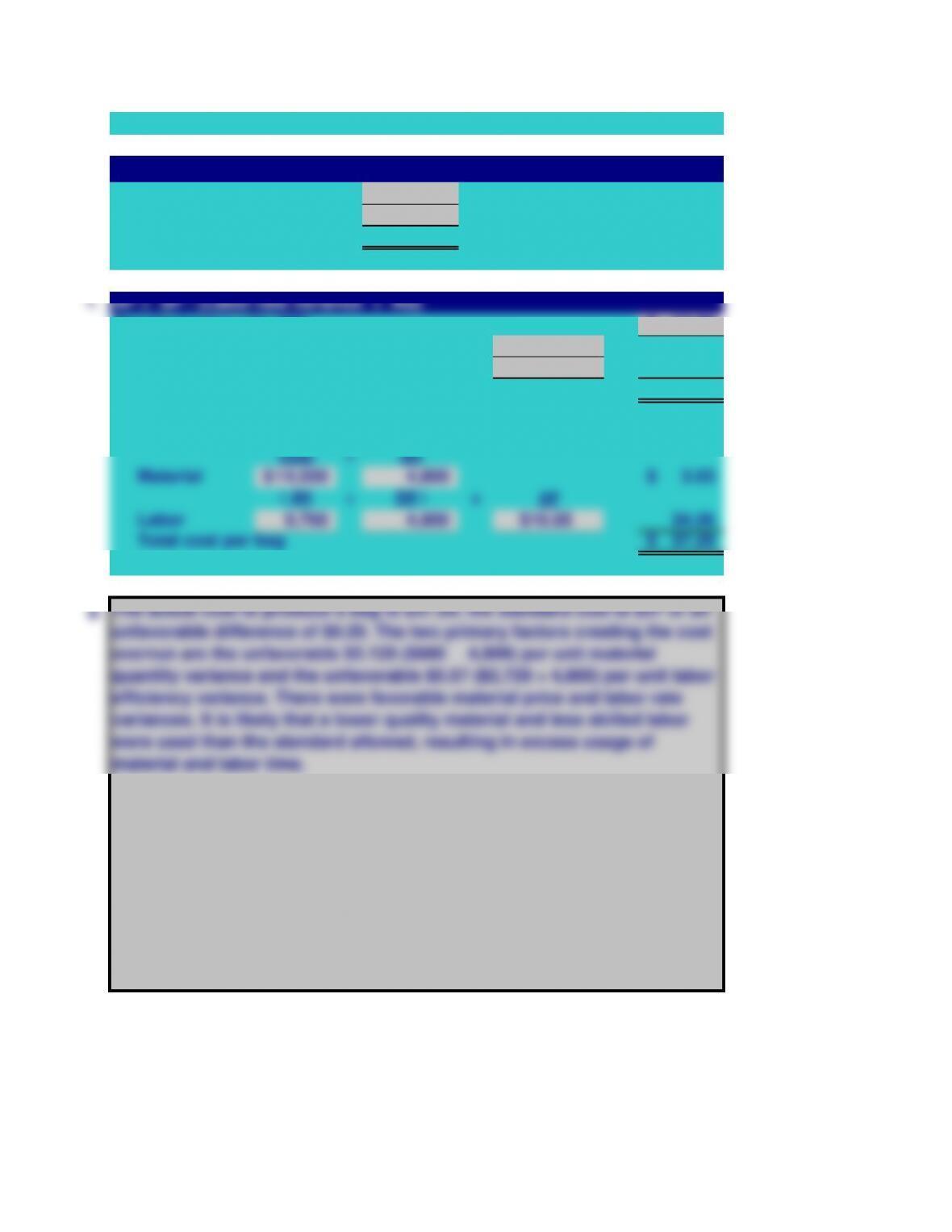
e. Standard prime cost per travel bag:
Material 3.00$
Labor 34.00
Standard prime cost 37.00$
f. AP = SP – (Labor rate variance ÷ AQ)
Standard labor rate (SP) 17.00$
Labor rate variance 1,464.00$
÷ Actual quantity (AQ) labor hrs. 9,760 0.15
Actual price (AP) 16.85$
Actual cost to produce one bag:
Cost
÷SH
Material 14,550$ 4,800 3.03$
( AH ÷SH ) xAP
Labor 9,760 4,800 $16.85 34.26
Total cost per bag 37.29$
g.
The actual cost to produce a bag is $37.29; the standard cost is $37 or an
unfavorable difference of $0.29. The two primary factors creating the cost
quantity variance and the unfavorable $0.57 ($2,720 ÷ 4,800) per unit labor
efficiency variance. There were favorable material price and labor rate
variances. It is likely that a lower quality material and less skilled labor
were used than the standard allowed, resulting in excess usage of
material and labor time.