Problem 6-55 Name:
Insert your answers in the gray-shaded cells of columns B, C, E, G, and I. If an answer is
incorrect, an asterisk will appear.
a.
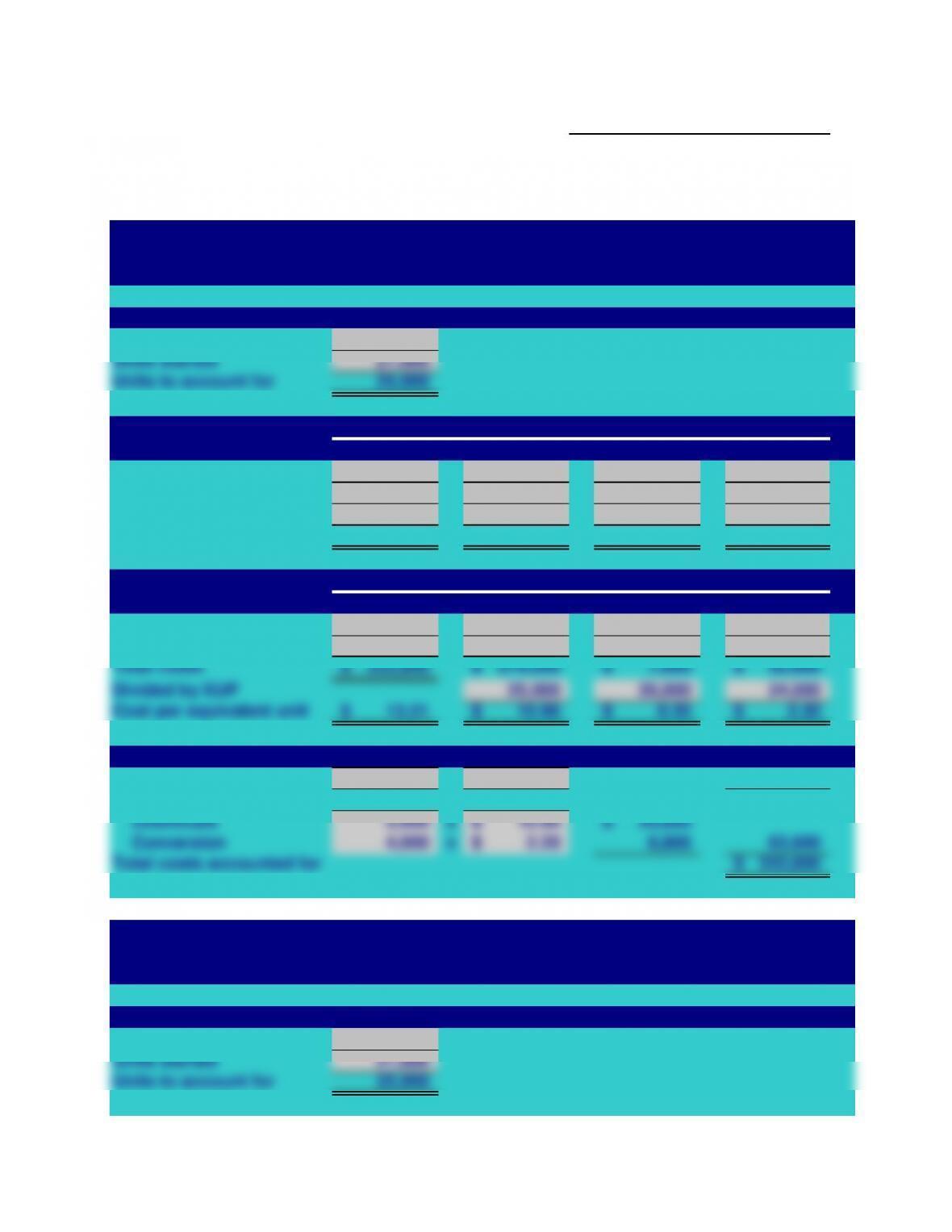
Production Data: Units
Beginning inventory 4,000
Units started 21,000
Units to account for 25,000
Units Chemicals Cans Conversion
Beginning WIP inventory 4,000 4,000 4,000 4,000
Started & completed 16,000 16,000 16,000 16,000
Ending WIP inventory 5,000 5,000 – 4,000
Equivalent units 25,000 25,000 20,000 24,000
Cost Data: Total Chemicals Cans Conversion
Beginning inventory 51,900$ 45,100$ –$ 6,800$
Current cost 281,900 228,900 7,000 46,000
Total costs 333,800$ 274,000$ 7,000$ 52,800$
Divided by EUP 25,000 20,000 24,000
Cost per equivalent unit 13.51$ 10.96$ 0.35$ 2.20$
Cost Assignment: Units Cost
Transferred out 20,000 x 13.51$ 270,200$
Ending WIP:
Chemicals 5,000 x 10.96$ 54,800$
Conversion 4,000 x 2.20$ 8,800 63,600
Total costs accounted for 333,800$
b.
Production Data: Units
Beginning WIP inventory 4,000
Units started 21,000
Units to account for 25,000
Direct Materials
Cost of Production Report
For the Month of May 31, XXXX
Springtime Paints
Solution
Springtime Paints
Cost of Production Report
For the Month of May 31, XXXX
Direct Materials
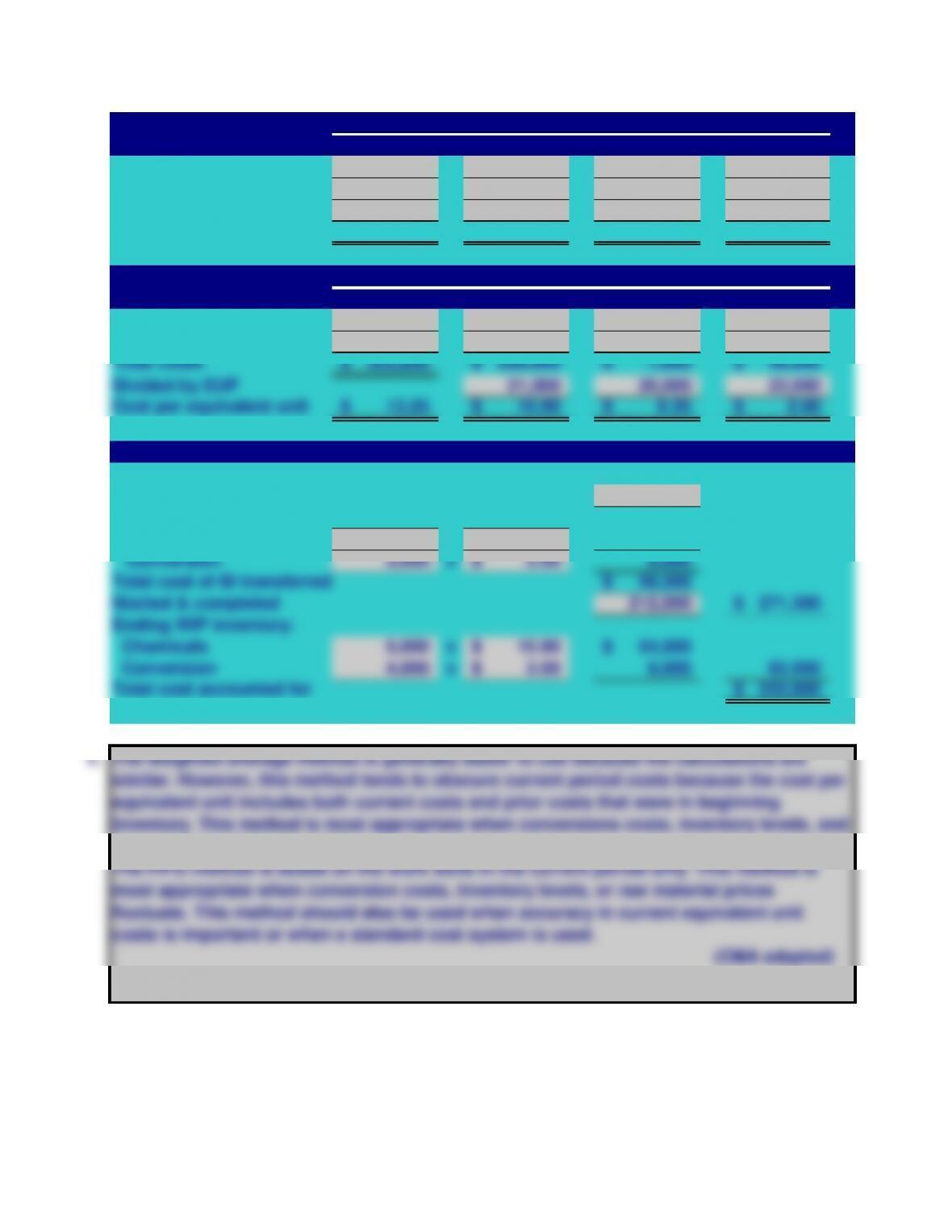
Units Chemicals Cans Conversion
Beginning WIP 4,000 – 4,000 3,000
Started & completed 16,000 16,000 16,000 16,000
Ending WIP inventory 5,000 5,000 – 4,000
Units accounted for 25,000 21,000 20,000 23,000
Cost Data: Total Chemicals Cans Conversion
Beginning inventory 51,900$ –$ –$ –$
Current cost 281,900 228,900 7,000 46,000
Total costs 333,800$ 228,900$ 7,000$ 46,000$
Divided by EUP 21,000 20,000 23,000
Cost per equivalent unit 13.25$ 10.90$ 0.35$ 2.00$
Cost Assignment Units Cost
Transferred out:
Beginning WIP inventory 51,900$
Complete beginning WIP:
Cans 4,000 x 0.35$ 1,400
Conversion 3,000 x 2.00$ 6,000
Total cost of BI transferred 59,300$
Started & completed 212,000 271,300$
Ending WIP inventory:
Chemicals 5,000 x 10.90$ 54,500$
Conversion 4,000 x 2.00$ 8,000 62,500
Total cost accounted for 333,800$
c.
The weighted average method is generally easier to use because the calculations are
similar. However, this method tends to obscure current period costs because the cost per
equivalent unit includes both current costs and prior costs that were in beginning
inventory. This method is most appropriate when conversions costs, inventory levels, and
raw material prices are stable.
The FIFO method is based on the work done in the current period only. This method is
most appropriate when conversion costs, inventory levels, or raw material prices
fluctuate. This method should also be used when accuracy in current equivalent unit
costs is important or when a standard cost system is used.
(CMA adapted)
Direct Materials
Direct Materials