Problem 4-47 Name:
Insert your answers in the gray-shaded cells. If an answer is incorrect,
the word “wrong” will appear.
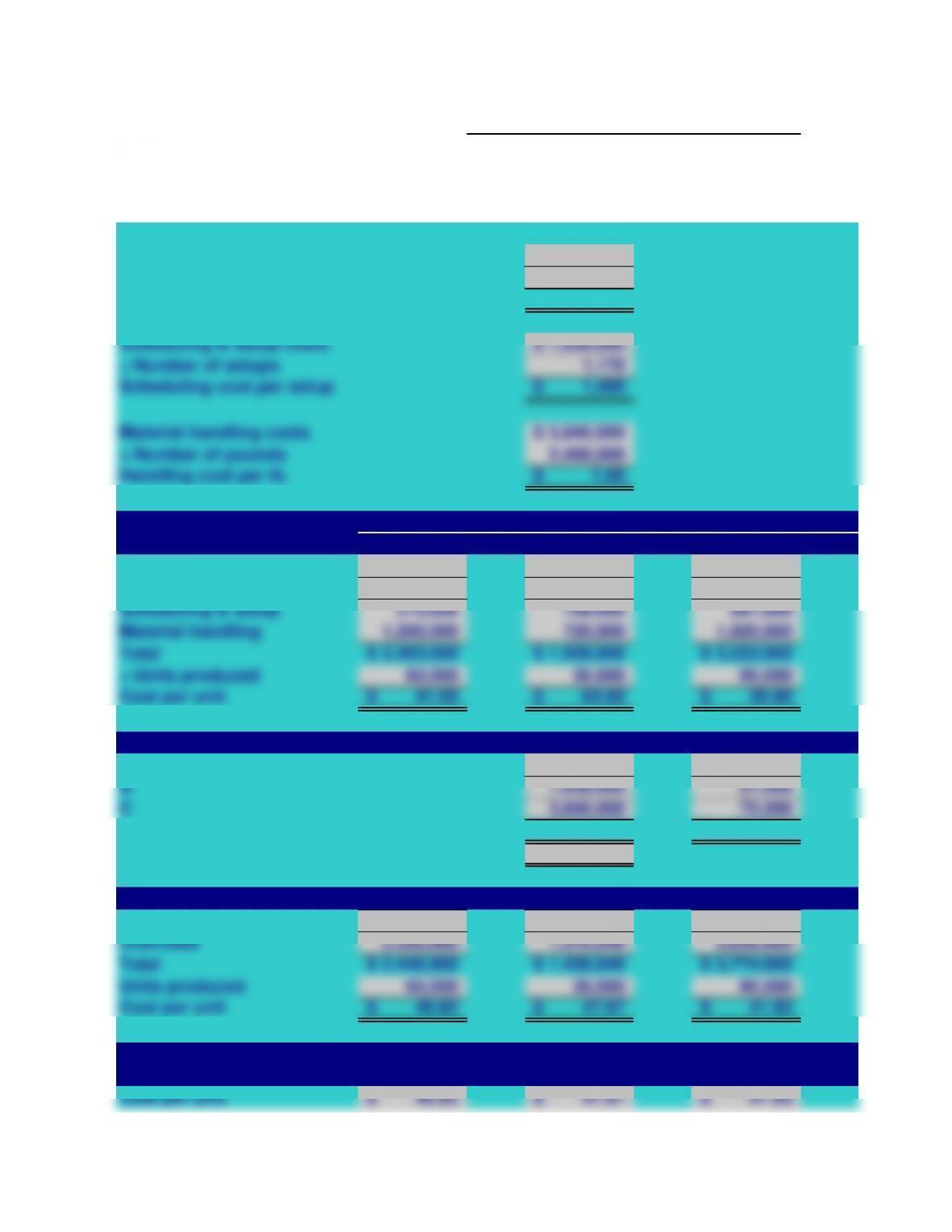
a. Utility costs 1,800,000$
÷ Machine hours 90,000
Utility cost per MH 20$
Scheduling & setup costs 1,638,000$
÷ Number of setups 1,170
Scheduling cost per setup 1,400$
Material handling costs 3,840,000$
÷ Number of pounds 2,400,000
Handling cost per lb. 1.60$
A B C
Direct costs 120,000$ 120,000$ 135,000$
Utilities 900,000 300,000 600,000
Scheduling & setup 273,000 798,000 567,000
Material handling 1,200,000 720,000 1,920,000
Total 2,493,000$ 1,938,000$ 3,222,000$
÷ Units produced 60,000 30,000 90,000
Cost per unit 41.55$ 64.60$ 35.80$
b. Product Overhead DLH
A 1,800,000$ 48,000$
B 1,638,000 27,000
C 3,840,000 75,000
7,278,000$ 150,000$
Overhead rate = Overhead / DLH 48.52$
1) Product A Product B Product C
Direct costs 120,000$ 120,000$ 135,000$
Overhead 2,328,960 1,310,040 3,639,000
Total 2,448,960$ 1,430,040$ 3,774,000$
Units produced 60,000 30,000 90,000
Cost per unit 40.82$ 47.67$ 41.93$
2)
Conventional Product A Product B Product C
Cost per unit 40.82$ 47.67$ 41.93$
Solution
Products
Cost plus markup as % 125% 125% 125%
Selling price 51.03$ 59.59$ 52.41$
ABC Product A Product B Product C
Cost per unit 41.55$ 64.60$ 35.80$
Cost plus markup as % 125% 125% 125%
Selling price 51.94$ 80.75$ 44.75$
c.
The traditional approach to product costing used only one allocation base, direct labor
hours. This allocation base was unable to fully capture the causes of overhead cost
incurrence. The ABC approach developed better overhead allocation because of the
superior relationship between the cost pools and the cost drivers used to allocate the
overhead cost. To the extent that there is error in determining costs, there will also be
mispricing when prices are set based on costs as is evident in this problem. Although
Product A is relatively unaffected by the choice of costing system, Products B and C have
substantially different costs and prices under the two systems. The traditional costing
system would result in underpricing Product B and overpricing Product C. This would
affect both sales volume and company profitability.