Chapter 16: Managing Costs and Uncertainty IM 11
publicly accessible website, in whole or in part.
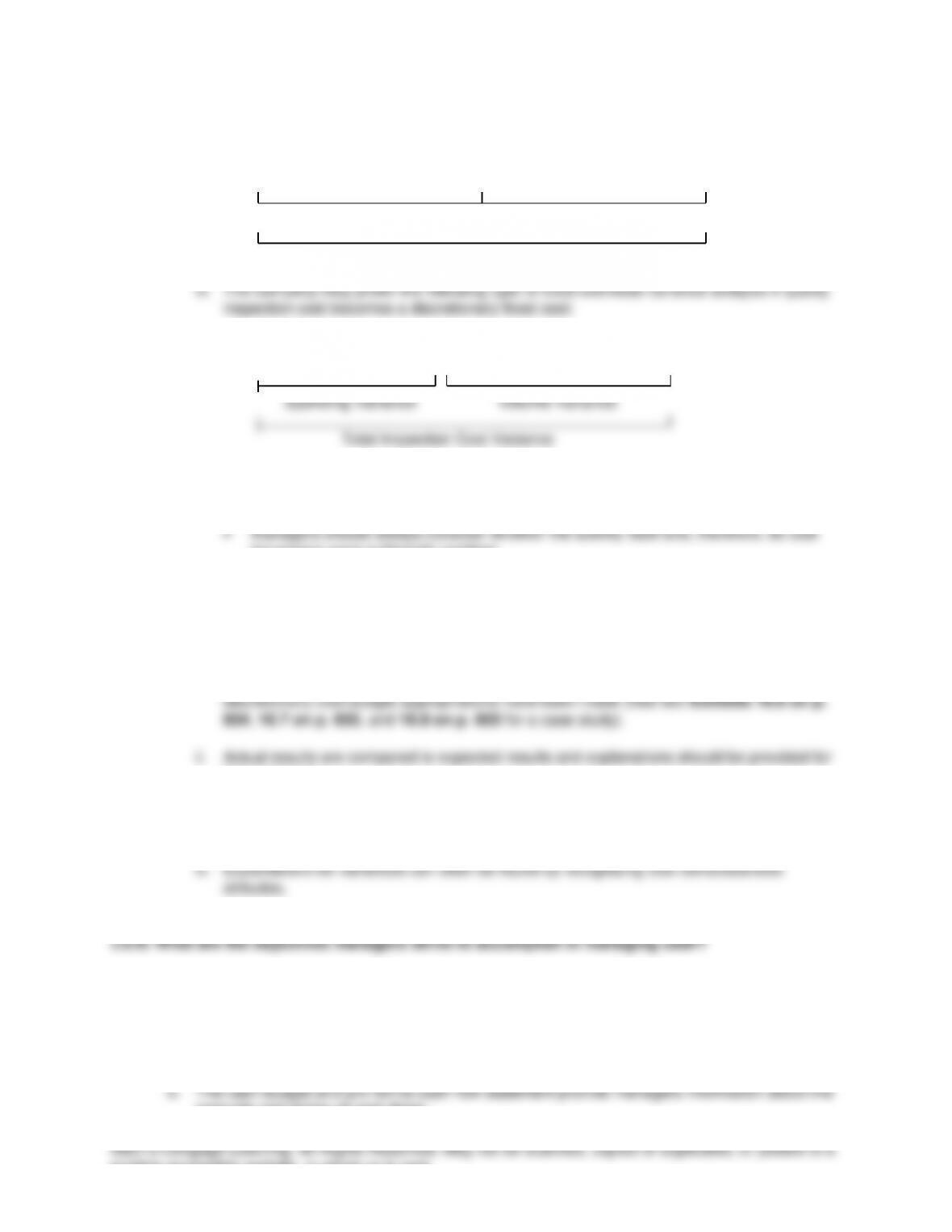
v. The generalized cost variance analysis model can then be used:
AP × AQ SP × AQ SP × SQ
Price Variance Efficiency Variance
Total Inspection Cost Variance
Budgeted Budgeted Fixed Cost x
Actual Cost Fixed Cost Std Hours Allowed
vii. The method of variance analysis and thus cost control must be appropriate to the cost
category and management information needs.
incurrence were sufficiently justified.
Postincurrence audits of discretionary costs are often important in determining an
expenditure’s value.
g. Control Using the Budget
i. Monetary control is accomplished through the use of budget–to-actual comparisons once
the variances.
iii. To ensure variable cost variances are useful, flexible budgeting procedures must be
used.
G. Cash Management
1. General
a. Cash is the most important and challenging resource to manage.
amounts and timing of cash flows.
Chapter 16: Managing Costs and Uncertainty IM 12
©2013 Cengage Learning. All Rights Reserved. May not be scanned, copied or duplicated, or posted to a
publicly accessible website, in whole or in part.
c. An organization’s liquidity depends on having enough cash available to retire debts and other
obligations as they come due.
d. Firms hold cash to liquidate transactions, to cover unexpected events, and for speculation.
e. Cash levels should be sufficient to cover all needs but low enough to constrain opportunity
2. What Variables Influence the Optimal Level of Cash?
a. The actual level of cash maintained can differ from that necessary to meet the cash flow
requirements of the cash budget.
that influences the desired cash balance.
c. To avoid liquidity problems, managers of firms with high variability in the operating cycle must
hold more cash than managers of firms with very stable, predictable operating cycles.
i. Firms with debt may be obligated by loan covenants to maintain minimum levels of cash.
3. What are the Sources of Cash?
a. There are three usual sources for cash:
iii. sales of goods and services.
b. Working capital is the excess of current assets over current liabilities.
i. The normal operating cycle begins with cash, extends to the purchase of materials, and
increase its supply.
i. Accelerating the operating cycle will increase available cash.
and therefore increase cash.
iii. Cash can be increased by slowing down payments for inputs.
Chapter 16: Managing Costs and Uncertainty IM 13
4. What Variables Influence the Cost of Carrying Cash?
b. There is an opportunity cost associated with holding cash as excess cash can be invested in
productive projects or returned to investors.
5. Banking Relationships
a. Accounting and cash flow information are key determinants of loan eligibility, loan limits, and
credit terms.
b. From the bank‘s perspective, credit risk is a primary concern for determining whether, and
i. credit history;
ii. ability to generate cash flow;
iii. quality of collateral;
c. Accountants must monitor the firm’s compliance with loan agreement covenants.
LO.7: How is technology reducing costs of supply chain transactions?
H. Supply Chain Management
1. General
earlier eras.
ii. This dependency creates an incentive to share information and to manage costs across
customers and suppliers.
dependencies.
2. Information Technology and Purchasing
Chapter 16: Managing Costs and Uncertainty IM 14
©2013 Cengage Learning. All Rights Reserved. May not be scanned, copied or duplicated, or posted to a
publicly accessible website, in whole or in part.
a. Today, firms increasingly use electronic exchanges of information and payments to reduce
purchasing transaction costs.
3. Advances in Authorizing and Empowering Purchases
a. Today, firms are increasingly using e-procurement systems to purchase nonoperating inputs.
products and materials available on-line and the purchasing organization’s authorized
personnel then order inputs from those catalogs and pay for the purchases electronically.
LO. 8: Why is uncertainty greater in dealing with future events than with past events?
I. Coping with Uncertainty
1. The world of management and cost accountants is split into two spheres separated by time.
unfold.
2. The Nature and Causes of Uncertainty
a. General
unforeseen events.
b. Understanding Cause and Effect
i. Uncertainty often arises from a lack of identification or understanding of cost drivers.
to the cost driver.
iii. In the context of cost prediction and cost understanding, random refers to the fact that
c. Occurrence of Unforeseen Events
Chapter 16: Managing Costs and Uncertainty IM 15
©2013 Cengage Learning. All Rights Reserved. May not be scanned, copied or duplicated, or posted to a
publicly accessible website, in whole or in part.
i. For example, the events of September 11, 2001, dealt a severe economic blow to most
industries in the United States but for the airline industry the impact of 9/11 was nearly
fatal as airlines lost 100 percent of their revenues for a brief period and a large portion of
revenues for an extended period after that disaster.
ii. When firms plan for unforeseen events, it is impossible to know the severity of all
LO.9: What are the four generic approaches to managing uncertainty?
3. Four strategies for dealing with uncertainty
a. There are four generic strategies for dealing with cost management uncertainties:
i. First, uncertainty can be explicitly factored into estimates of future costs;
b. Explicitly Considering Uncertainty When Estimating Future Costs
i. In the following equation, y is the cost or other item to be predicted (dependent variable);
a and b are, respectively, the intercept and slope in the prediction equation; and X is the
predictor variable (independent variable).
ii. The least squares method is used to develop estimates of the values for a and b in the
prediction equation:
y = a + bX
iii. When alternative independent variables exist, least squares regression can help select
the independent variable that is the best predictor of the dependent variable.
iv. The coefficient of determination is the portion of the variance in the dependent variable
that is explained by the variance in the independent variable.
The value of this statistic ranges between 0 and 1.
A value of 0 indicates the relationship between the predictor variable and the
ideal).
v. Text Exhibit 16.11 (p. 662) illustrates the hypothetical relationship of factory utility costs
to two alternative predictor variables: machine hours and plant production hours.
Chapter 16: Managing Costs and Uncertainty IM 16
©2013 Cengage Learning. All Rights Reserved. May not be scanned, copied or duplicated, or posted to a
publicly accessible website, in whole or in part.
vi. Other statistical techniques such as computer simulations and more elaborate regression
models, which can include multiple independent variables as well as nonlinear
relationships between independent and dependent variables, can also be used to select
predictor variables.
The goal in using more elaborate models is to reduce the prediction error and thereby
the effects of uncertainty on accuracy of predictions.
An example using an equation to predict annual factory maintenance costs is
provided in the text.
rapidly and quickly turn into losses.
ii. Cost and revenue graphs are presented in text Exhibit 16.12 (p. 664) to illustrate two
different cost structures: one that is entirely variable and one that is entirely fixed.
The profits of the company with the fixed cost structure vary greatly with small
demand and the volume of production, the prices of inputs can be influenced by
many other factors.
Thus, although the uncertainty surrounding quantity of input usage may best be
cover the increase in costs.
iii. These companies in particular need effective strategies for dealing with input price
uncertainty; two tools used in such strategies are options and forward contracts.
Options and forward contracts are agreements that give the holder the right to
purchase a given quantity of a specific input at a specific price at a specific time.
as hedging.
Chapter 16: Managing Costs and Uncertainty IM 17
publicly accessible website, in whole or in part.
iv. Text Exhibit 16.13 (p. 665) lists items that are commonly hedged.
e. Insuring Against Occurrences of Specific Events
occurrences.
ii. Whereas other strategies for dealing with uncertainty largely address uncertainty about
iii. Events usually insured against are those that, in the absence of insurance, would
interruption, etc.
Chapter 16: Managing Costs and Uncertainty IM 18
publicly accessible website, in whole or in part.
Multiple Choice Questions
1. (LO.1) Select the response that shows the correct order of the steps in a cost control system.
a. Evaluate → Plan → Respond → Execute
2. (LO.1) Preparing variance reports for a division is a cost control method for which of the following
control points?
a. After an event
b. During an event
3. (LO.2) Cost changes may be attributed to which of the following factors?
a. Volume changes
4. (LO.3) Cost containment is not possible for:
a. reduced supplier competition.
5. (LO3.) The practice of finding acceptable alternatives to high-cost items or not spending money
a. cost reduction.
b. cost management.
6. (LO.4) Committed costs:
investments.
b. include costs such as maintenance and advertising.
7. (LO.4) Discretionary costs are:
c. governed mainly by past decisions that established the current levels of operating and
d. unaffected by current managerial decisions.
8. (LO.5) Discretionary costs are generally budgeted on the basis of all of the following factors
except:
Chapter 16: Managing Costs and Uncertainty IM 19
9. (LO.6) Which of the following is not a reason firms hold cash?
a. To cover unexpected events
10. (LO.6) Which of the following variables influences the cost of carrying cash?
a. Cost of borrowing
11. (LO.7) Purchases of indirect materials and nonoperating inputs such as office supplies are
increasingly being accomplished using an e-procurement system. Which of the following
functions is typically not included in such a system?
a. Payment function
The environment is known as:
a. conflict.
b. risk.
c. uncertainty.
d. certainty.
b. installing new information technology.
c. structuring costs to adjust to uncertain outcomes.
d. insuring against occurrences of specific events.
14. (LO.9) What coefficient of correlation results from the following data?
X Y
1 10
a. – 1
b. 0
c. +1
d. +100
a. – .50
b. .00
c. .50
d. 1.00

Chapter 16: Managing Costs and Uncertainty IM 20
Multiple Choice Solutions
1. d
2. a
3. d
8. b
9. d
10. d
11. c