Learning Objectives
1. What are the functions of a cost control system?
2. What factors cause costs to change from period to period or to deviate from expectations?
3. What are the generic approaches to cost control?
4. What are the two primary types of fixed costs, and what are the characteristics of each?
MANAGING COSTS AND UNCERTAINTY
CHAPTER
16
Chapter 16: Managing Costs and Uncertainty IM 2
publicly accessible website, in whole or in part.
Terminology
Appropriation: a predetermined maximum allowable expenditure
Coefficient of determination: the portion of the variance in the dependent variable (cost) explained by
Committed costs: costs associated with plant assets and the human resources
Cost avoidance: the practice of finding acceptable alternatives to high-cost items and/or not spending
money for unnecessary goods and services
Cost reduction: the practice of lowering current costs, especially those that may be in excess of what is
necessary
Discretionary cost: a cost that arises from a management decision to fund an activity at a specified
amount for a specified period of time; a cost that can be reduced to zero in the short run if necessary
Electronic data interchange system (EDI): the computer-to-computer interchange of strictly formatted
messages that represent documents other than monetary instruments. The interchange is between two
parties either of whom may serve as originator or recipient.
Hedging: the use of options and forward contracts to manage price risk
Option: (see forward contracts)
Price elasticity: a numerical measure of the relationship of supply or demand to price changes

Chapter 16: Managing Costs and Uncertainty IM 3
publicly accessible website, in whole or in part.
Uncertainty: doubt or lack of precision in specifying future outcomes; arises from lack of complete
knowledge about future events
Working capital: total current assets minus total current liabilities
Chapter 16: Managing Costs and Uncertainty IM 4
publicly accessible website, in whole or in part.
Lecture Outline
LO.1: What are the functions of a cost control system?
A. Introduction
1. This chapter explains some of the key contributions of accounting and finance to business
organizations.
uncertainty in budgeting and cost management.
B. Cost Control Systems
organizational costs.
2. An effective cost control system must perform at three points: before an event, during an event,
variance analysis, and responsibility reports.
4. A good control system encompasses not only planning and control functions but also the idea of
cost consciousness.
Exhibit 16.3 (p. 644)).
b. Managers alone cannot control costs.
C. Understanding Cost Changes
1. General
a. Cost control is first exercised when the budget is prepared, but budgets can be properly
from the budgeted amounts.
Chapter 16: Managing Costs and Uncertainty IM 5
2. Cost Changes Because of Volume Changes
determine whether costs were properly controlled.
possible.
3. Cost Changes Because of Inflation/Deflation
a. Fluctuations in the value of money, called general price-level changes, cause the prices of
goods and services to change.
general price-level changes.
ii. Inflation and deflation indexes by industry or commodity can be examined to obtain more
accurate information about inflation/deflation effects on prices of particular inputs, such
as energy resources.
require substantial lead times).
4. Cost Changes Because of Supply/Supplier Cost Adjustments
a. The relationship between the availability of a good or service and the demand for that item
affects its selling price.
products.
i. Price elasticity is a numerical measure of the relationship of supply or demand to price
changes. Price elasticities can be calculated for specific products using historical data
a large change in supply or demand.
c. Specific price-level changes are also caused by advances in technology; as a general rule,
as suppliers advance the technology of producing a good or performing a service, the cost of
the supplier’s control.
e. The number of suppliers of a product or service can also affect selling prices; as the number
of suppliers increases in a competitive environment, price tends to fall.
Chapter 16: Managing Costs and Uncertainty IM 6
©2013 Cengage Learning. All Rights Reserved. May not be scanned, copied or duplicated, or posted to a
publicly accessible website, in whole or in part.
f. Sometimes, cost increases are caused by higher taxes or additional regulatory requirements;
complying with these regulations can increase costs. In response, companies can:
i. pass along the costs to customers as price increases to maintain the same income level;
ii. decrease other costs to maintain the same income level; or
iii. accept a decline in net income.
5. Cost Changes Because of Quantity Purchased
a. Companies may receive discounts for bulk purchases.
b. Involvement in group purchasing arrangements can make quantity discounts easier to obtain.
LO.3: What are the generic approaches to cost control?
D. Cost Containment
1. General
a. Cost containment is the practice of minimizing, to the extent possible, period–by-period
increases in per-unit variable and total fixed costs.
b. Cost containment is not possible for inflation adjustments, tax and regulatory changes, and
supply and demand adjustments.
e. A company can circumvent seasonal cost changes by postponing or advancing purchases.
2. Cost Avoidance and Cost Reduction
a. Cost avoidance is the practice of finding alternatives to high cost items and/or not spending
b. Cost reduction refers to the practice of lowering current costs, especially those that may be
in excess of what is necessary.
Chapter 16: Managing Costs and Uncertainty IM 7
publicly accessible website, in whole or in part.
c. Managers may adopt the following five-step method of implementing a cost control system
(See text Exhibit 16.4 (p. 648).):
i. understand the types of costs incurred by the organization;
ii. communicate the need for cost consciousness to all employees;
d. A cost-benefit analysis should be performed before a commitment is made to incur a cost.
E. Committed Fixed Costs
1. All fixed costs (and the activities that create them) can be categorized as either committed or
2. Committed costs are costs associated with plant assets and the human resources that an
organization must have to operate.
capital expenditures.
5. The benefits from committed costs generally can be predicted and commonly are compared with
actual results in the future.
F. Discretionary Costs
1. General
Chapter 16: Managing Costs and Uncertainty IM 8
©2013 Cengage Learning. All Rights Reserved. May not be scanned, copied or duplicated, or posted to a
publicly accessible website, in whole or in part.
a. A discretionary cost is one that a decision maker must periodically review to determine if it
continues to be in accord with ongoing policies.
i. A discretionary fixed cost reflects a management decision to fund a particular activity at a
specified amount for a specified period of time.
ii. Discretionary costs relate to company activities that are important but whose level of
funding is subject to judgment.
iii. Discretionary costs are usually service-oriented and include employee travel, repairs and
maintenance, advertising, research and development, and employee training and
development.
can be determined only subjectively.
Discretionary costs are generated by activities that vary in type and magnitude from
available to control committed fixed costs.
Since the benefits of discretionary cost activities cannot be assessed definitively,
v. Thus, proper planning for discretionary activities and costs can be more important than
subsequent control measures.
2. Controlling Discretionary Costs
a. General
b. Budgeting Discretionary Costs
reviewed.
ii. Discretionary costs are typically budgeted on the basis of three factors:
the related activity’s perceived significance to the achievement of objectives and
goals;
Chapter 16: Managing Costs and Uncertainty IM 9
©2013 Cengage Learning. All Rights Reserved. May not be scanned, copied or duplicated, or posted to a
publicly accessible website, in whole or in part.
the upcoming period’s expected level of operations; and
managerial negotiations during the budgetary process.
iii. Managers are expected to spend the full amount of their appropriations within the
specified time frame for some discretionary costs, while the “less is better” credo is
appropriate for other discretionary cost activities.
The cost of preventive maintenance is often cited as an example of a cost where
“less is not better.”
activity priorities.
v. The difference in management attitude between committed and discretionary costs has to
do with the ability to measure the benefits provided.
Benefits of committed fixed costs can be measured on a before and after basis
c. Measuring Benefits from Discretionary Costs
i. Companies often assume that the benefits—and the activities—are unimportant since
ii. These types of activities produce quality products and services in the long run; therefore,
measures.
Such an effort requires time and creativity (See text Exhibit 16.5 on p. 651.).
iii. The comparison of input costs and output results can help to determine if there is a
reasonable cost-benefit relationship between the two; managers can judge this cost–
benefit relationship by how efficiently inputs (represented by costs) were used and how
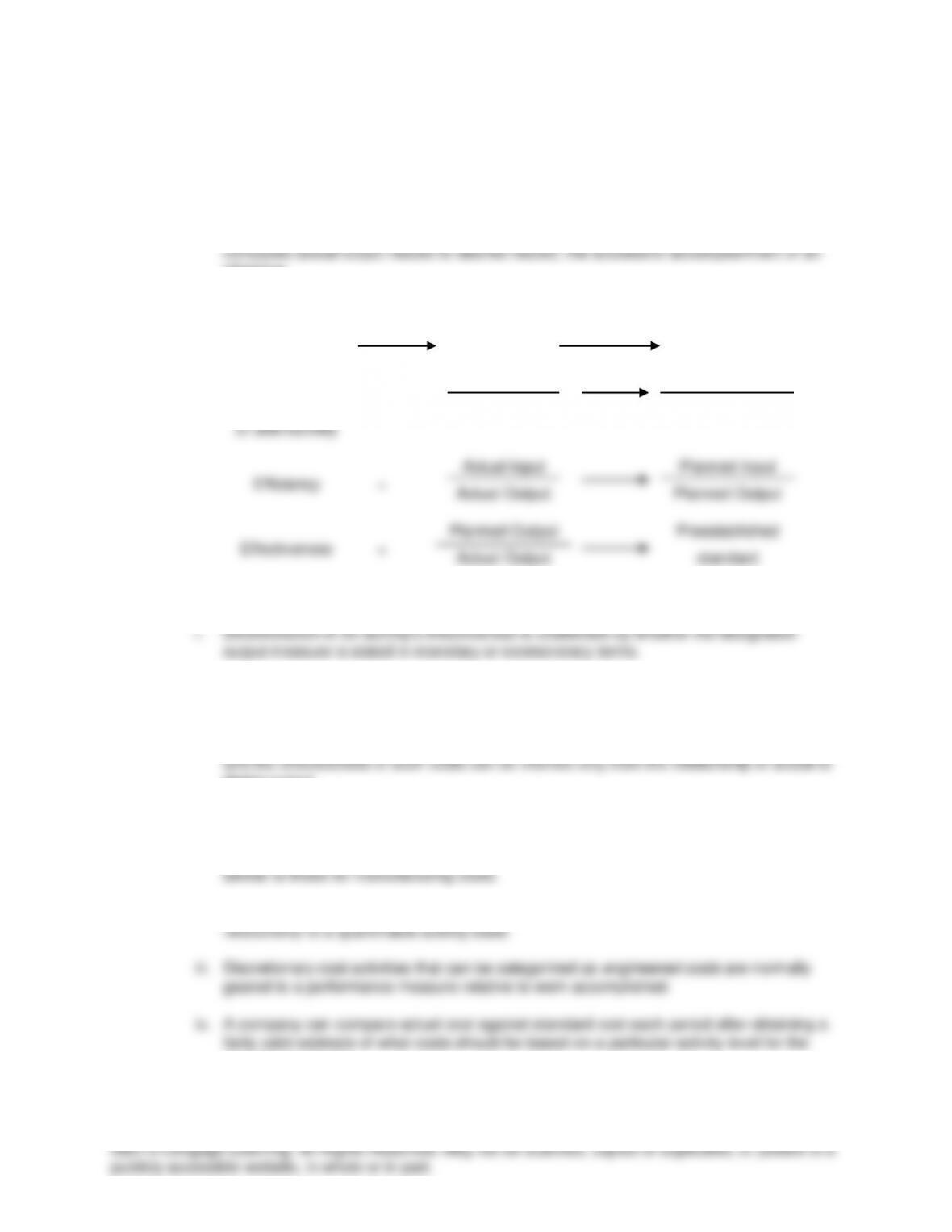
Inputs Outputs Objectives Goals
(Efficiency) (Effectiveness)
Performance
Chapter 16: Managing Costs and Uncertainty IM 10
d. Efficiency
i. Efficiency is the process of performing tasks to produce the best yield at the lowest cost
from the resources available; the degree to which a satisfactory relationship occurs when
comparing outputs to inputs.
ii. Effectiveness is a measure of how well the firm’s objectives and goals are achieved;
objective.
iii. Efficiency and effectiveness can be determined as follows:
Actual Result compared to Desired Result
Actual Output Planned Output
Efficiency = Actual Input Planned Input
e. Effectiveness
ii. Measurement of effectiveness does not require the consideration of inputs, but
measurement of efficiency does.
iii. The relationship between discretionary costs and desired results is inconclusive at best,
desire output.
f. Control Using Engineered Costs
i. Some discretionary activities are repetitive enough to allow the development of standards
ii. An engineered cost is a cost that has been found to bear an observable and known
cost driver volume.