
Chapter 13: Responsibility Acctg., Support Dept. Cost Allocations & Transfer Pricing IM 11
publicly accessible website, in whole or in part.
c. Text Exhibit 13.13 (p. 516) illustrates the step method of allocating support department costs
d. Note that under the step method allocation process, a support department is “eliminated”
e. The step method is a hybrid between the direct and algebraic methods in that while it does
4. Algebraic Method of Allocation
a. The algebraic method considers all interrelationships of the departments and reflects these
b. Text Exhibit 13.14 (p. 517) presents the allocation proportional relationships for ASC’s
c. The simultaneous equations are developed in the text narrative and text Exhibit 13.15 (p.
d. The algebraic method can be solved manually if the company has only a few departmental
5. Determining Overhead Application Rates
a. Regardless of the method used to allocate support department costs, the final step is to
b. After support department costs have been assigned to production, they are included as part
c. As shown in text Exhibit 13.16 (p. 518), the total allocated overhead costs of ASC’s two
6. In conclusion, allocating support department costs to operating divisions makes managers more
a. However, if such allocations are made, evaluation of the operating manager’s performance
b. An alternative to using cost allocation to assign support costs to operating units is to use a
LO.6: What types of transfer prices are used in organizations, and why are such prices used?
G. Transfer Pricing
1. General

Chapter 13: Responsibility Acctg., Support Dept. Cost Allocations & Transfer Pricing IM 12
a. Transfer prices are internal charges established for the exchange of goods or services
b. Transfer prices may be established to promote goal congruence, make performance
c. A pseudo-profit center is created when one responsibility center uses a transfer price to
d. The appropriate transfer price should be one that ensures optimal resource allocation and
promotes operating efficiency.
i. Text Exhibit 13.17 (p. 520) presents the advantages of transfer prices for services
e. The general rules for choosing a transfer price are as follows:
i. the maximum price should be no higher than the lowest market price at which the buying
ii. the minimum price should be no less than the sum of the selling segment’s incremental
f. The difference between the upper and lower transfer price limits is the corporate profit (or
savings) generated by producing internally rather than buying externally.
i. Transfer prices act to divide the corporate profit between the buying and selling
ii. While divided profits are eliminated for external reporting purposes, leaving only the
iii. The supplier-segment manager tries to obtain the highest transfer (selling) price, whereas
2. Types of Transfer Prices
a. There are three traditional types of transfer prices: cost based, market based, and negotiated.
c. Cost-Based Transfer Prices

Chapter 13: Responsibility Acctg., Support Dept. Cost Allocations & Transfer Pricing IM 13
ii. If only variable costs are used to set a transfer price, the selling division has little
iii. Transfer prices based on absorption cost at least provide a contribution toward covering
iv. Modifications may be made to address various issues associated with cost-based
transfer prices.
When variable cost is used as a base, an additional amount can be added to cover
Absorption cost can be modified by adding an amount equal to an average of the
Because actual costs can vary according to the season, production volume, and
d. Market-Based Transfer Prices
i. A market-based transfer price is believed to be an objective, arm’s-length measure of
ii. If operating efficiently relative to the competition, a selling division should be able to show
iii. Several problems can be associated with the use of market-based transfer prices:
transferred products may have no exact counterpart in the external market, which
internal sales can reduce packaging, advertising, or delivery expenditures and
temporary downturns in market demand could result in the transfer price being set at
when different prices, discounts, and credit terms are offered to different buyers,
e. Negotiated Transfer Prices
i. Negotiated transfer prices are often set through a process of bargaining between the

Chapter 13: Responsibility Acctg., Support Dept. Cost Allocations & Transfer Pricing IM 14
publicly accessible website, in whole or in part.
ii. Such prices are typically below the normal market price paid by the buying unit but above
the selling unit’s combined incremental and opportunity costs.
iii. Negotiated transfer prices are often used for services because their value—as shown
Negotiated transfer prices are commonly used for customized high-cost and high-
iv. When segment managers have the autonomy to sell or buy products externally if internal
negotiations fail, dysfunctional behavior and suboptimization are possible. Top
f. Dual Pricing
i. A dual pricing arrangement is a transfer pricing system that allows the selling division
ii. Dual pricing eliminates the problem of having to artificially divide the profits between the
3. Selecting a transfer pricing system
a. The final determination of what transfer pricing system to use should reflect the
b. Transfer prices are not permanent; they are frequently revised in relation to changes in costs,
c. Regardless of what transfer pricing system is used, transfer prices have the potential for both
LO.7: What difficulties can be encountered by multinational companies using transfer prices?
H. Transfer Prices in Multinational Settings
1. The setting of transfer prices for products and services becomes quite difficult when the company

Chapter 13: Responsibility Acctg., Support Dept. Cost Allocations & Transfer Pricing IM 15
publicly accessible website, in whole or in part.
a. In addition, as shown in text Exhibit 13.20 (p. 525), the internal and external objectives of
2. Transfer pricing policies should be followed consistently.
a. For example, a company should not price certain parent company services to foreign
b. The general test of reasonableness is that a transfer price should reflect an arm’s-length
transaction.
c. As indicated in text Exhibit 13.19 (p. 524) Individuals who represent numerous discipline
3. Tax authorities in both the home and host countries carefully scrutinize multinational transfer
a. In the U.S., the IRS can be quick to investigate U.S. subsidiaries that operate in low-tax areas
4. Advance pricing agreements (APAs) are binding contracts between the IRS and a company
a. These agreements usually run for three to five years and may be renewed if no major
changes occur.
d. An important advantage is that APAs may fulfill documentation requirements under the
5. Transfer pricing audits by tax authorities are becoming the rule rather than the exception.
6. More countries are adopting transfer pricing legislation and, as multinational enterprises (MNEs)
a. The Organization for Economic Cooperation and Development (OECD) has been actively
i. In 2007, the European Community adopted OECD recommended guidelines to “simplify
7. Multi-state firms can also employ transfer pricing strategies to move profits from state to state.

Chapter 13: Responsibility Acctg., Support Dept. Cost Allocations & Transfer Pricing IM 16
publicly accessible website, in whole or in part.
a. Firms can take advantage of different income tax rates across states and the fact that a few
Chapter 13: Responsibility Acctg., Support Dept. Cost Allocations & Transfer Pricing IM 17
publicly accessible website, in whole or in part.
Multiple Choice Questions
1. (LO.1) Select the incorrect statement concerning decentralization.
a. When top management delegates decision-making authority to subunit managers,
decentralization exists.
2. (LO. 1) All of the following are advantages of decentralization except:
a. reduces decision-making time.
3. LO.2) A responsibility accounting system is the key management control tool in
a. decentralized organizations.
4. (LO.2) Which of the following is not a basic control function of a responsibility accounting system?
a. Monitor the differences between planned and actual data at scheduled intervals
5. (LO.3) The men’s shoe department at Macy’s is most likely organized as
a. an investment center.
6. (LO.3) Select the incorrect statement from the following.
a. Another term for investment center is profit center.
b. Service departments (e.g., maintenance and housekeeping) are commonly organized as cost
centers.
7. (LO.4) The following sales data is provided for one of J Company’s products:
Budgeted Actual
Unit Selling Price $10 $8
Unit sales volume 10,000 12,000
What was the product’s total revenue variance?

Chapter 13: Responsibility Acctg., Support Dept. Cost Allocations & Transfer Pricing IM 18
8. (LO.5) In allocating the factory utilities support department costs to producing departments, which
one of the following would most likely be used as an activity base?
The next three questions are based on the following information:
M Company wishes to allocate the costs of its support departments, Housekeeping (HK) and
Maintenance (MN) to its production departments, Machining and Finishing. The following
information is provided:
HK MN Machining Finishing Total
Chapter 13: Responsibility Acctg., Support Dept. Cost Allocations & Transfer Pricing IM 19
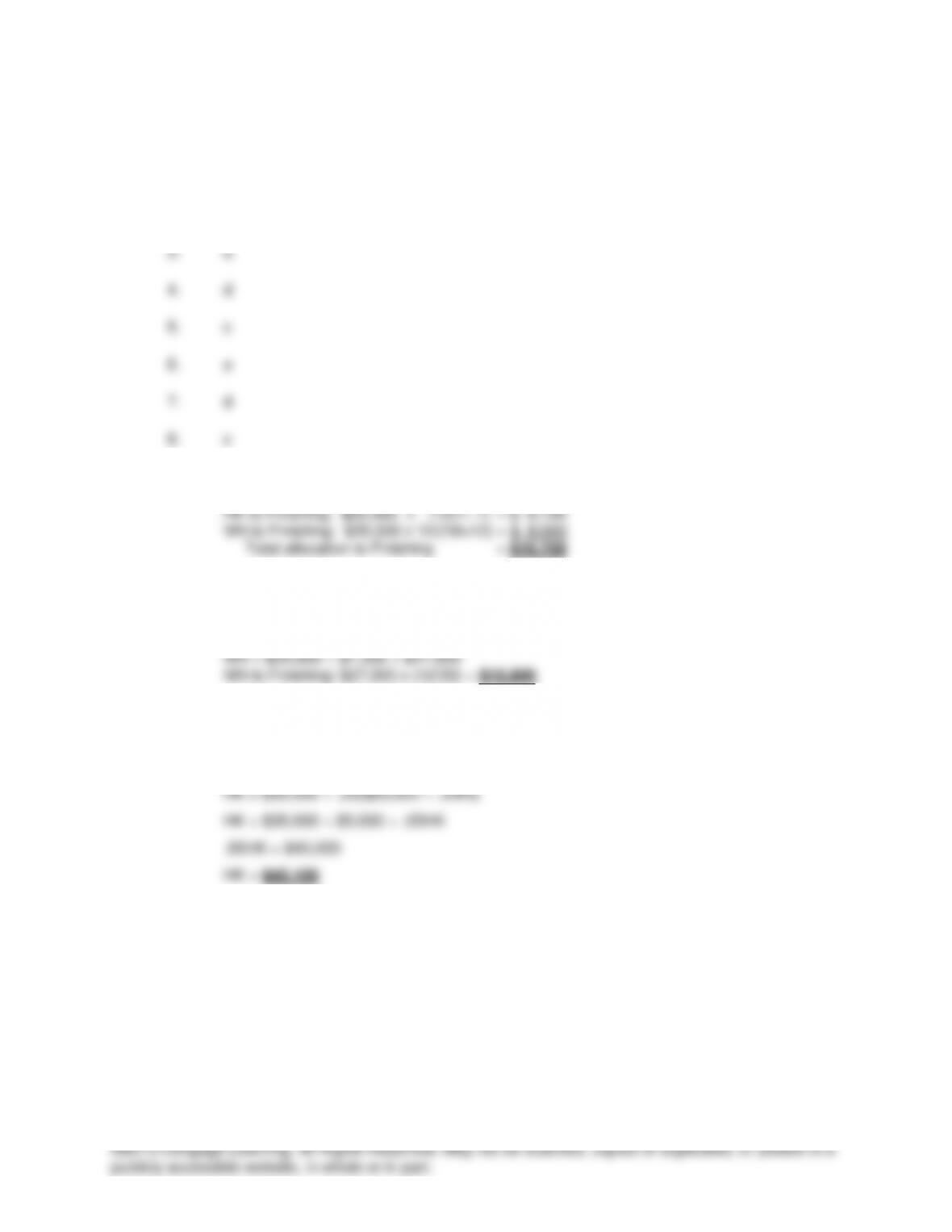
12. (LO.5) The following information is provided for V Company which has two service departments
(S1 and S2) and two production departments (P1 and P2):
S1 S2 P1 P2 Total
Chapter 13: Responsibility Acctg., Support Dept. Cost Allocations & Transfer Pricing IM 20
Multiple Choice Solutions
1. d
2. c
9. d (CMA Adapted)
10. b (CMA Adapted)
HK to MN: $35,000 x (7/35) = $7,000;
Therefore:
11. a (CMA adapted)
HK = $35,000 + .25MN; MN = $20,000 + .2HK
Therefore:
12. b
13. c
14. b
15. d