
Learning Objectives
1. Which factors determine whether a firm should be decentralized or centralized?
2. How are decentralization and responsibility accounting related?
each other?
4. How are revenue variances computed?
RESPONSIBILITY ACCOUNTING, SUPPORT
DEPARTMENT COST ALLOCATIONS,
AND TRANSFER PRICING
CHAPTER
13
Chapter 13: Responsibility Acctg., Support Dept. Cost Allocations & Transfer Pricing IM 2
publicly accessible website, in whole or in part.
Terminology
Administrative Department: an organizational unit that performs management activities that benefit the
Advance pricing agreement: a binding contract between the IRS and a company that provides details of
Algebraic method: a method of allocating support department costs that considers all interrelationships
Benefits-provided ranking: a listing of support departments in an order that begins with the one
Centralization: term used to describe an organization’s approach to decision making in which top
Cost center: a responsibility center in which the manager has the authority only to incur costs and is
specifically evaluated on the basis of how well costs are controlled
Decentralization: is a transfer of authority, responsibility, and decision-making rights from the top to the
bottom of the organization structure
Direct method: a process of support department cost allocation that assigns support department costs
only to operating areas
Investment center: an organizational unit in which the manager is responsible for managing revenues
and current expenses and has the authority to acquire, use, and dispose of plant assets in a manner that
seeks to earn the highest feasible rate of return on the center’s asset base
Negotiated transfer price: an intracompany charge for goods or services that has been set through a
process of bargaining between the selling and purchasing unit managers

Chapter 13: Responsibility Acctg., Support Dept. Cost Allocations & Transfer Pricing IM 3
publicly accessible website, in whole or in part.
Responsibility center: a cost object under the control of a manager such as a division, department, or
geographical region
Responsibility report: report that assist each successively higher level of management in evaluating the
performances of its subordinate managers and their respective organizational units
Sales volume variance (SVV): the variance calculated by multiplying the budgeted sales price by the
difference between the actual and budgeted sales volumes; indicates the portion of the total revenue
variance that is related to a change in sales volume
Service department: an organizational unit (e.g., maintenance department) that provides one or more
specific functional tasks for other internal units
Suboptimization: a situation in which individual managers pursue goals and objectives that are in their
own and/or their segments’ particular interests rather than in the company’s best interests
Chapter 13: Responsibility Acctg., Support Dept. Cost Allocations & Transfer Pricing IM 4
publicly accessible website, in whole or in part.
Lecture Outline
LO.1: Which factors determine whether a firm should be decentralized or centralized?
A. Introduction
centralized organizational structures to highly decentralized structures.
2. This chapter describes the accounting methods that are appropriate in decentralized
B. Decentralization
1. The degree of centralization can be viewed as a continuum.
organization’s activities.
b. Decentralization exists when authority, responsibility, and decision-making rights are
decentralization.
2. Either extreme of the centralization-decentralization continuum represents an undesirable
arrangement.
the goals of the total organization.
c. Most businesses tend to structure themselves according to the pure centralization versus
pure decentralization factors listed in text Exhibit 13.2 (p. 504).
appropriate degree of decentralization.
3. Decentralization does not necessarily mean that a unit manager has the authority to make all of
the decisions concerning a unit, as top management selectively determines the types of authority
b. The need to address environmental issues has presented new challenges when deciding to
centralize or decentralize function addressing these environmental issues. Text Exhibit 13.3
©2013 Cengage Learning. All Rights Reserved. May not be scanned, copied or duplicated, or posted to a
publicly accessible website, in whole or in part.
decision making for environmental issues.
C. Responsibility Accounting Systems
1. A responsibility accounting system facilitates decentralization by providing information about
2. Responsibility reports are reports that assist each successively higher level of management in
evaluating the performances of its subordinate managers and their respective organizational
units.
responsibility reports.
b. A manager’s responsibility report should reflect his or her degree of influence and should
include only the revenues and/or costs under that manager’s control.
3. A responsibility accounting system helps organizational unit managers conduct the following
basic control functions:
expectations and delegate authority;
b. gather actual data classified in accordance with the activities and categories specified in the
plan;
again.
4. Responsibility reports reflect the upward flow of information from operational units to company top
management and illustrate the broadening scope of responsibility.
a. Managers receive detailed information on the performance of their immediate areas of control
Chapter 13: Responsibility Acctg., Support Dept. Cost Allocations & Transfer Pricing IM 6
publicly accessible website, in whole or in part.
i. Text Exhibit 13.5 (p. 507) presents a responsibility report that illustrates this pyramiding
of information.
c. Variances are itemized in performance reports at the lower levels so that the appropriate
i. Under the management by exception principle, major deviations from expectations are
d. The process of responsibility accounting creates some issues for management.
i. The idea of rolling up information to each successively higher level allows potentially
ii. Assuming different units within the responsibility accounting system are competing with
each other for resources, managers could try to promote their own agendas, thus leading
to a lack of goal congruence between or among organizational units.
Goal congruence exists when the personal and organizational goals of decision
interdependencies among units might be obscured.
e. Responsibility accounting’s focus is on the manager who has control over a particular cost
object.
i. In a decentralized company, the cost object is an organizational unit or responsibility
center.
LO.3: What are the four primary types of responsibility centers, and what distinguishes them from
each other?
D. Types of responsibility centers
1. Responsibility accounting systems identify, measure, and report on the performance of
responsibility centers and their managers.
2. Cost Center
a. A cost center is a responsibility center in which the manager has the authority only to incur
Chapter 13: Responsibility Acctg., Support Dept. Cost Allocations & Transfer Pricing IM 7
©2013 Cengage Learning. All Rights Reserved. May not be scanned, copied or duplicated, or posted to a
publicly accessible website, in whole or in part.
b. Cost centers commonly include service and administrative departments.
c. In the traditional manufacturing environment, the production department is the largest cost
center.
i. Cost center managers often concentrate only on the unfavorable standard cost variances
and ignore the efficient performance indicated by favorable variances.
ii. If the management by exception principle is applied properly, top management should
LO.4: How are revenue variances computed?
3. Revenue Center
a. A revenue center is an organizational unit for which a manager is accountable only for the
expectations.
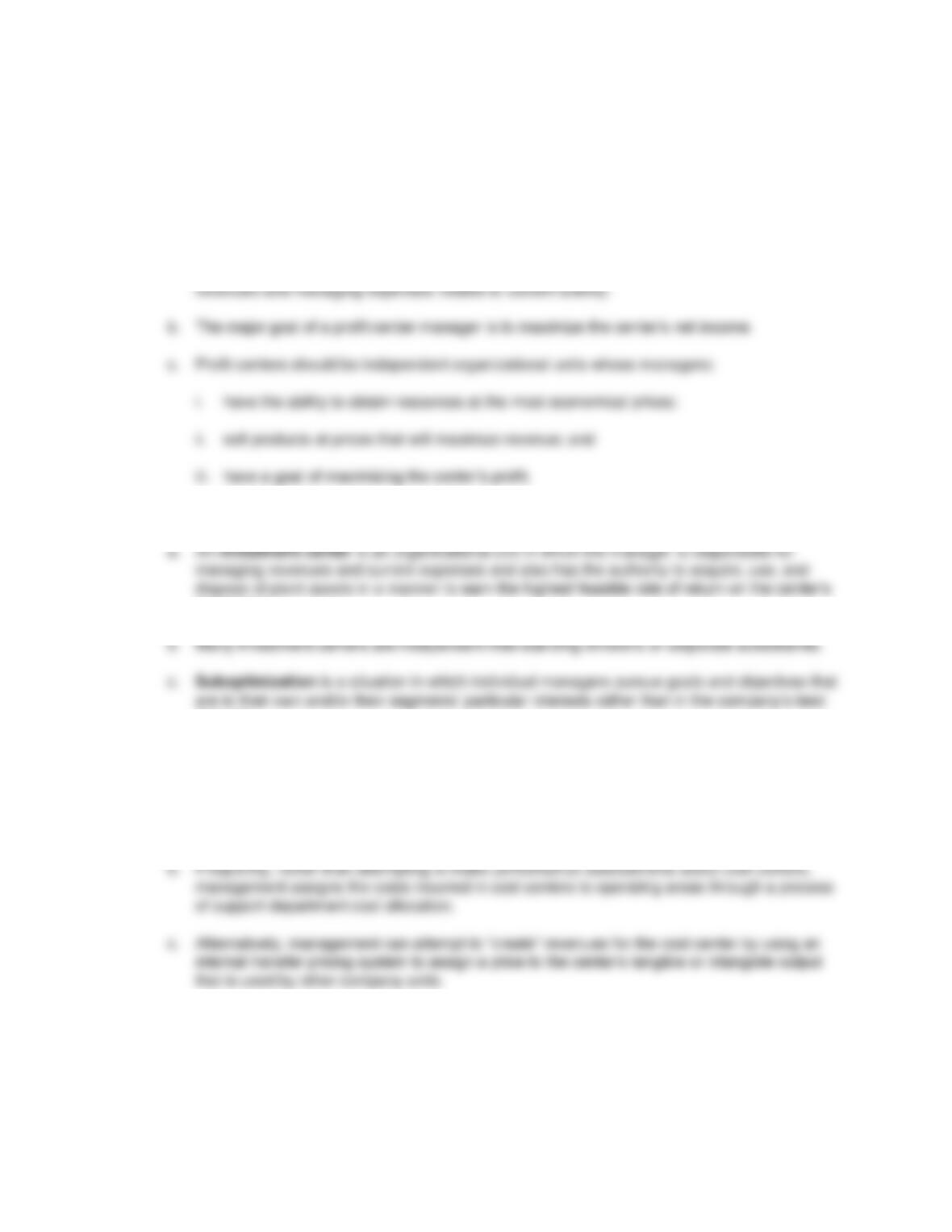
c. Budgeted and actual revenues may differ either because of volume of units sold or price of
units sold.
i. The sales price variance is calculated by multiplying the actual number of units sold by
the difference between actual and budgeted sales prices. This variance indicates the
ASP x ASV BSP x ASV BSP x BSV
Sales Price Variance Sales Volume Variance
Total Revenue Variance
©2013 Cengage Learning. All Rights Reserved. May not be scanned, copied or duplicated, or posted to a
publicly accessible website, in whole or in part.
responsible for managing some costs in their centers. Thus, a more appropriate term for
this organizational unit is a revenue and limited cost center.
4. Profit Center
a. A profit center is a responsibility center in which the manager is responsible for generating
5. Investment Center
asset base.
interests.
6. A unique challenge for the design of responsibility centers arises from the instance in which one
center supplies its outputs largely to other internal centers.
a. Top management must make judgments about the nature and extent of the costs and
revenues to include in such responsibility centers.
LO.5: Why and how are support department costs allocated to operating departments?
E. Support Department Cost Allocation
Chapter 13: Responsibility Acctg., Support Dept. Cost Allocations & Transfer Pricing IM 9
publicly accessible website, in whole or in part.
1. General
a. Organizations incur two types of overhead costs: those directly related to the operating (or
b. As the number of product lines or service types increases, so does the need for additional
functional tasks for other internal units.
ii. An administrative department is an organizational unit that performs management
c. All support department costs must be covered in the long run by sales of products and
services.
making.
ii. See text Exhibit 13.7 (p. 511) for the reasons for and against allocating support
department costs.
2. Allocation Bases
a. Four criteria must be considered in determining a rational and systematic allocation base:
costs incurred in the support department;
iii. reflect the fairness or equity of the allocations between operating departments; and
iv. measure the ability of operating departments to bear the allocated costs.
b. Text Exhibit 13.8 (p. 512) provides alternative bases for assigning various types of support
department costs.
3. Methods of Allocating Support Department Costs
units.
b. Three basic methods are used to allocate the pooled support department costs to the
operating departments:
i. The direct method assigns support department costs only to operating areas;
Chapter 13: Responsibility Acctg., Support Dept. Cost Allocations & Transfer Pricing IM 10
©2013 Cengage Learning. All Rights Reserved. May not be scanned, copied or duplicated, or posted to a
publicly accessible website, in whole or in part.
This is the simplest method but may result in distorted cost allocations if there is
significant exchange of services among support departments as well as operating
departments.
ii. The step method allows a partial recognition of the effects of interactions among support
departments in assigning costs; and
A benefits-provided ranking is a listing of support departments in an order that
begins with the one providing the most service to all other support areas and ends
reflects these relationships in simultaneous equations.
The algebraic method is the most complex method but it is also the most theoretically
correct and, if relationships are properly formulated, provides the most accurate and
reliable allocations.
F. Support Department Cost Allocation Illustration
application rate.
b. Text Exhibit 13.9 (p. 513) provides an abbreviated budget of the direct and indirect costs for
each support department and operating division of ASC.
c. Text Exhibit 13.10 (p. 514) presents the bases selected for allocating ASC’s support
department costs. These bases are proxies for the quantity of services consumed by each
service area and operating division.
2. Direct Method Allocation
costs to operating areas at ASC.
c. Text Exhibit 13.12 (p. 515) presents the company’s total budget pre-tax profits by operating
area if support department costs are allocated using the direct method.
3. Step Method Allocation
a. The step method assigns support department costs to operating departments as well as to
certain other support departments.