Chapter 11: Allocation of Joint Costs and Accounting for By-Product/Scrap IM 9
publicly accessible website, in whole or in part.
2. The value of by-product/scrap in a job order costing system should be credited to manufacturing
undertaken.
3. The by-product/scrap value, in contrast, can be credited to the specific jobs in process if only a
LO.5: How should retail and not–for-profit organizations account for the cost of a joint activity?
H. Joint Costs in Retail Businesses and Not-for-Profit Organizations
1. Joint costs in retail businesses and not-for-profit (NFP) organizations often do not relate to
a. advertising multiple products;
2. Retail businesses may allocate joint costs using either a physical or monetary base.
a. Joint costs for retail businesses usually relate to advertisements rather than to a process.
3. Although retail businesses may decide that allocating joint cost is not necessary, financial
administrative function (management and general activities).
4. No specific allocation method is prescribed; only that the method used must be rational and
situations.
a. A major purpose of this allocation process is to ensure that external users of financial
activities—especially fundraising.
5. There are three tests that must be met for allocation; if all the tests are not met, all the costs
associated with the joint activity must be charged to fundraising:
program or management/general function.
i. A critical element under the purpose test is the compensation test. If a majority of
compensation or fees for anyone performing a part of the activity is tied to contributions
must be charged to fundraising.
b. The audience test must demonstrate that the NFP chose the audience because it is suitable

©2013 Cengage Learning. All Rights Reserved. May not be scanned, copied or duplicated, or posted to a
publicly accessible website, in whole or in part.
management/general functions.
Chapter 11: Allocation of Joint Costs and Accounting for By-Product/Scrap IM 12
publicly accessible website, in whole or in part.
8. (LO.3) LS Company manufactures two products, Product L and Product S in a joint process. The
joint (common) costs incurred are $420,000 for a standard production run that generates 180,000
a. $252,000.
b. $218,400.
9. (LO.3) Products A and B are manufactured in a joint process. The joint (common) costs incurred
are $252,000 for a standard production run that generates 108,000 gallons of Product A which
a. $100,800.
b. $140,000.
per gallon for Product Y, the amount of joint cost allocated to Product Y on a net realizable value
basis is:
a. $280,000.
11. (LO.3) M Company incurs $10,000,000 in joint costs for its three products. The company
estimates the products’ production, final selling price, and separate costs after split-off as follows:
Estimated Estimated
Product Production Selling Price Separate Cost
Product A 3,000 $2,000 $200
a. $4,600,000
b. $4,100,000
c. $1,300,000
d. None of the above
Chapter 11: Allocation of Joint Costs and Accounting for By-Product/Scrap IM 14
Multiple Choice Solutions
1. d
2. b
3. c
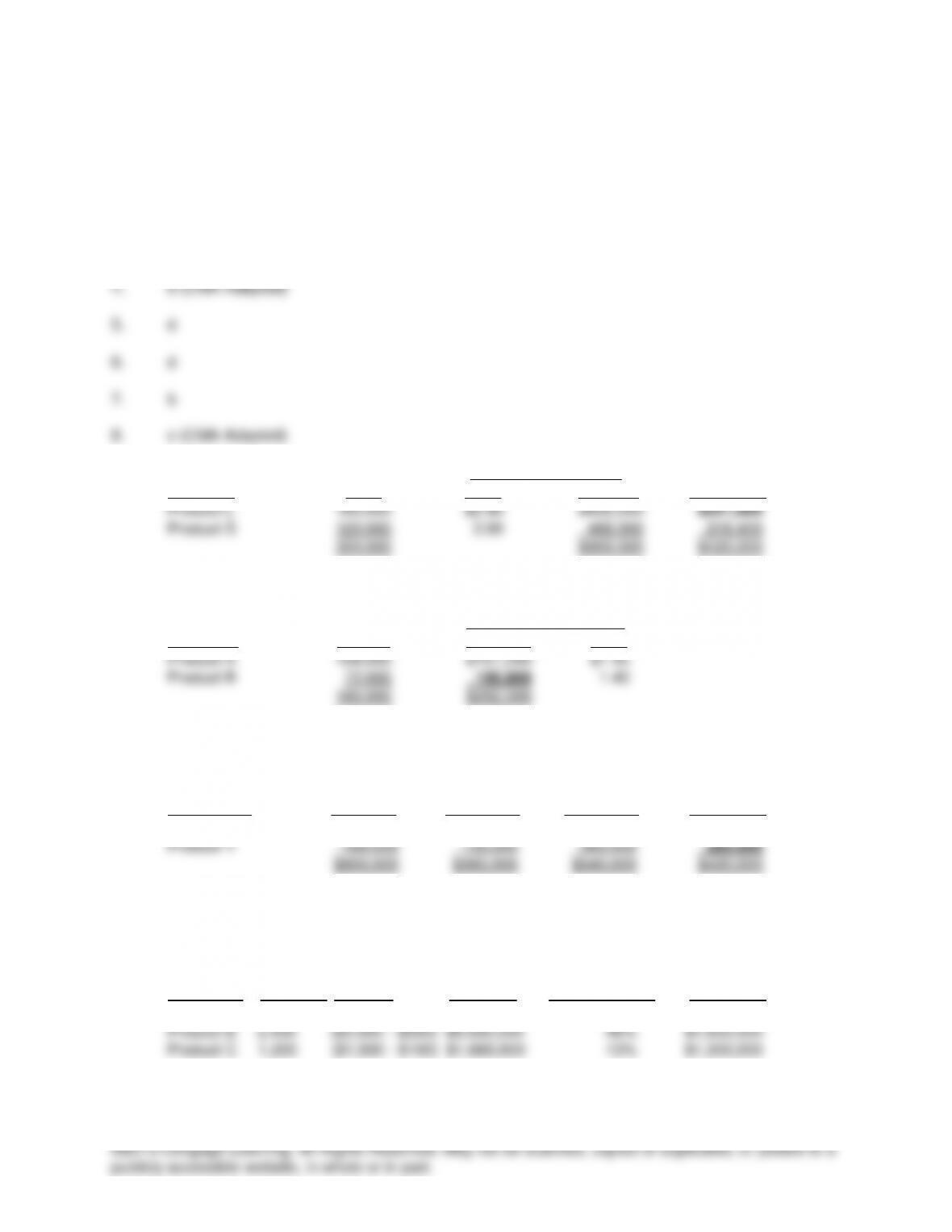
Final Sales Value
Product Units Unit Total Joint Costs
9. a (CMA Adapted)
Joint Costs
Product Gallons Total Unit
10. a (CMA Adapted)
Final Net Net
Sales Separable Realizable
Product Value Costs Value Joint Costs
Product X $432,000 $252,000 $180,000 $140,000
11. b (CMA adapted)
Approximated
Units Approx Total
Product Produced NRV NRV Proportion Joint Costs
Product A 3,000 ($2,000 – $200) $5,400, 000 41% $4,100,000
12. a