Chapter 07: Standard Costing and Variance Analysis IM 11
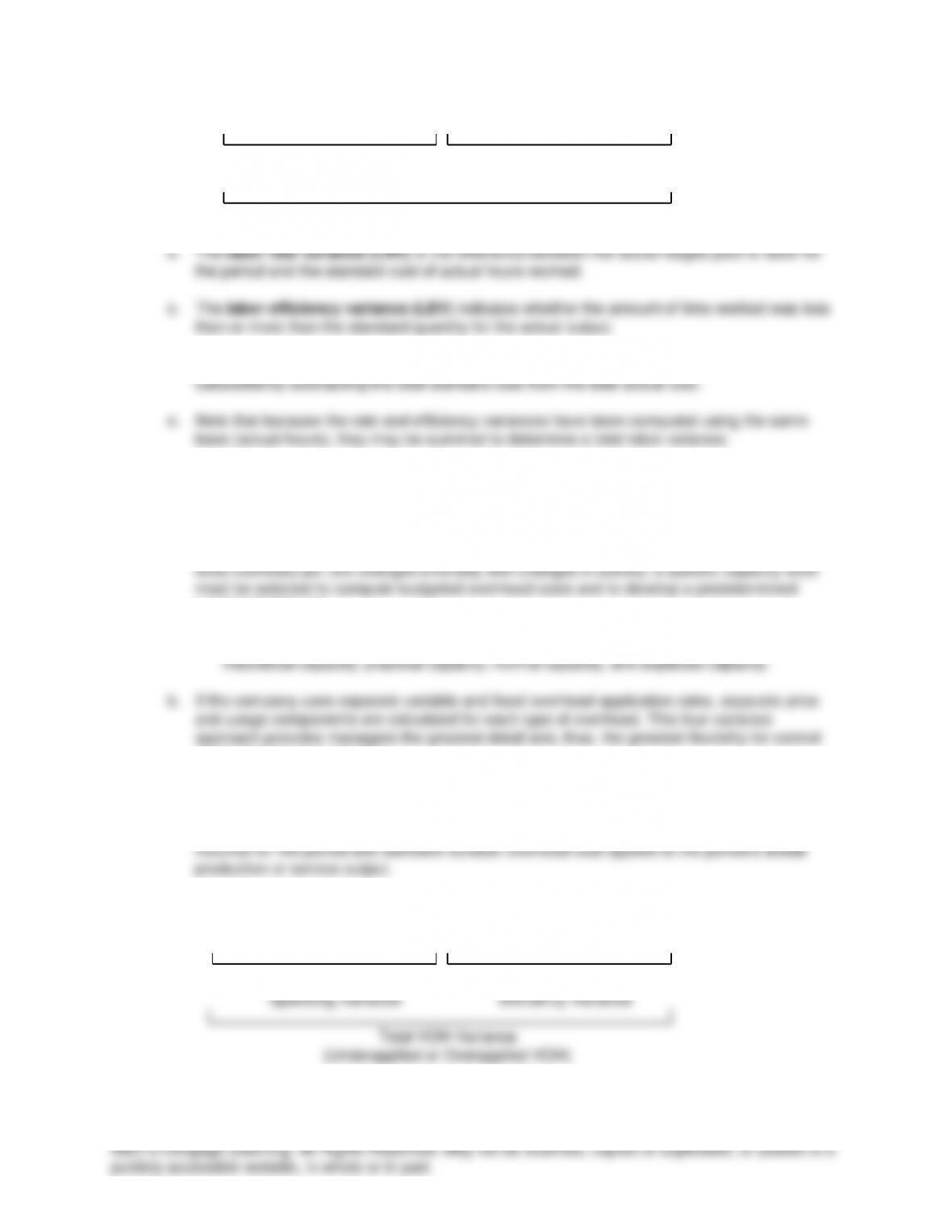
AP × AQ SP × AQ SP × SQ
Labor Labor
Rate Variance Efficiency Variance
Total Labor Variance
d. The total labor variance is the summation of the individual variances or can also be
G. Overhead Variances
1. Overhead Variances
a. Because total variable overhead changes in direct relationship with changes in activity and
overhead (OH) rate.
i. Capacity refers to any measure of activity. The most common capacity measures are
and performance evaluation.
2. Variable Overhead
a. The total variable overhead variance is the difference between actual variable overhead costs
Actual VOH Budgeted VOH Applied VOH
(for actual activity) (for standard quantity allowed)
AP × AQ SP × AQ SP × SQ
VOH VOH
Chapter 07: Standard Costing and Variance Analysis IM 12
©2013 Cengage Learning. All Rights Reserved. May not be scanned, copied or duplicated, or posted to a
publicly accessible website, in whole or in part.
b. The variable overhead spending variance is the difference between total actual variable
overhead and the budgeted amount of variable overhead based on actual hours; it is caused
by both component price and volume differences.
i. Variable overhead spending variances associated with price differences can occur
because, over time, changes in VOH prices have not been included in the standard rate.
ii. Variable overhead spending variances associated with quantity differences can be
c. The variable overhead efficiency variance is the difference between budgeted variable
allowed for the production achieved.
i. This variance quantifies the effect of using more or less of the activity or resource which
is the base for variable overhead application. When actual input exceeds standard input
3. Fixed Overhead
a. The total fixed overhead variance is the difference between actual fixed overhead costs
incurred and standard fixed overhead cost applied to the period’s actual production.
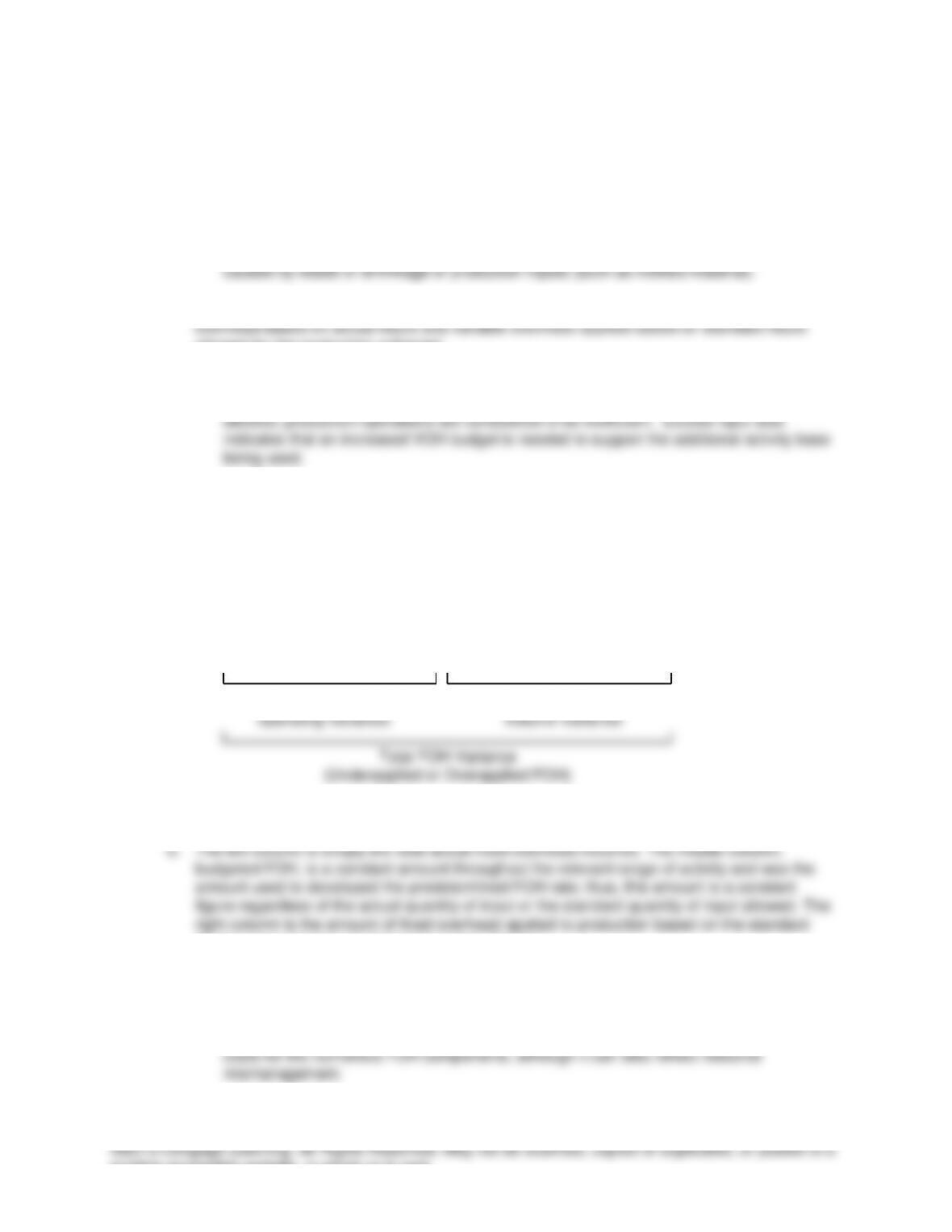
Actual FOH Budgeted FOH Applied FOH
(for standard quantity allowed)
SP × SQ
FOH
fixed overhead rate and standard quantity allowed.
c. The fixed overhead spending variance is the difference between the total actual fixed
overhead and budgeted fixed overhead.
i. This variance amount normally represents the differences between budgeted and actual
Chapter 07: Standard Costing and Variance Analysis IM 13
©2013 Cengage Learning. All Rights Reserved. May not be scanned, copied or duplicated, or posted to a
publicly accessible website, in whole or in part.
d. The fixed overhead volume variance is the difference between budgeted and applied fixed
overhead.
i. Although capacity utilization is controllable to some degree, the volume variance is the
ii. The volume variance merely translates under-or-over-utilization into a dollar amount. An
action.
4. Alternative Overhead Variance Approaches
a. A four-variance approach can be used only if the accounting system distinguishes between
variable and fixed costs.
b. The total overhead variance is the difference between total actual overhead and total
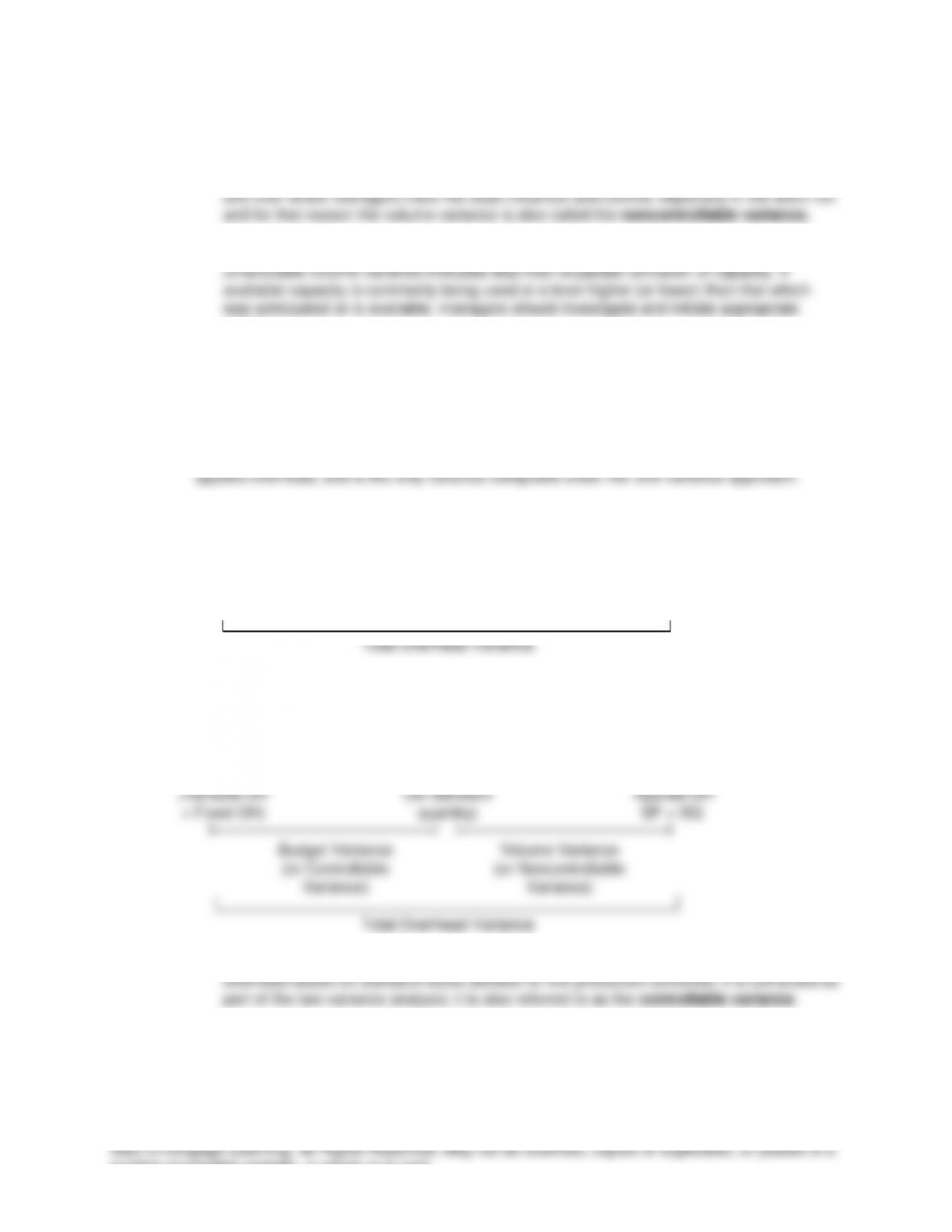
Actual Overhead Applied Overhead
(Variable OH + Fixed OH) (SP × SQ)
c. A middle column representing budgeted overhead based on standard quantity is inserted
between total actual overhead and total applied overhead under the two-variance approach:
Actual Overhead Budgeted OH
i. The budget variance is the difference between total actual overhead and budgeted
ii. The volume variance can be computed under the four-variance, three-variance, or two-
variance analysis.
Chapter 07: Standard Costing and Variance Analysis IM 14
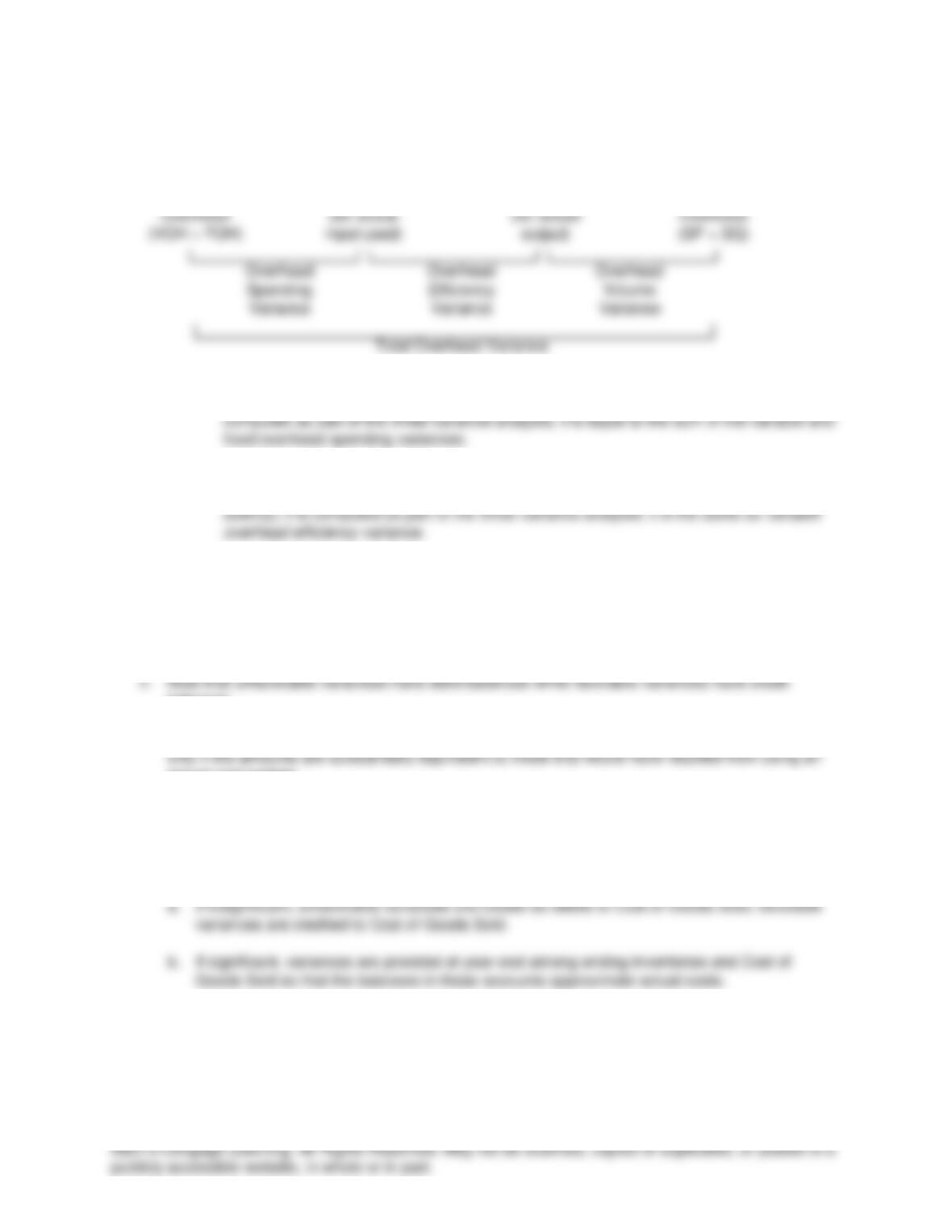
d. A column representing budgeted overhead based on actual hours is inserted immediately to
the right of total actual overhead under the three-variance approach:
Budgeted Budgeted
Actual Overhead Overhead Applied
i. The overhead spending variance is the difference between total actual overhead and
total budgeted overhead at actual input activity; thus, a flexible budget is required. It is
ii. The overhead efficiency variance is the difference between total budgeted overhead at
actual input activity and total budgeted overhead at standard input allowed (output
e. Text Exhibit 7.6 (p. 262) shows the interrelationships of overhead variances.
H. Standard Cost System Journal Entries
1. Standard cost system journal entries are presented in text Exhibit 7.7 (p. 263).
balances.
3. Although standard costs are useful for internal reporting, they can be used in financial statements
actual cost system.
I. Disposition of Standard Cost Variances
1. At year-end, adjusting entries are made to eliminate standard cost variances. The entries depend
on whether the variances are, in total, insignificant or significant.
i. Proration is based on the relative size of the account balances as illustrated in the
example provided in the text narrative (pp. 264-5).
Chapter 07: Standard Costing and Variance Analysis IM 15
LO. 4: How have the setting and use of standards changed over time?
J. Changes in Standards Usage
1. Use of Ideal Standards and Theoretical Capacity
a. Many accountants and business people believe that incorrect measurements are sometimes
b. The Japanese philosophy is a notable exception to the practice of not using ideal or
improve performance:
i. Current problems must be identified and their causes must be pinpointed.
ii. Management must be willing to invest in those plant and equipment items, equipment
f. The process of implementing ideal standards is illustrated in text Exhibit 7.8 (p. 266).
i. Such a capacity measure would provide the lowest and most appropriate predetermined
OH rate.
resources.
Chapter 07: Standard Costing and Variance Analysis IM 16
publicly accessible website, in whole or in part.
h. Standards are slowly moving away from the practical and closer to the ideal in order for
2. Adjusting Standards
a. Standards were traditionally set and retained for at least one year.
some aspects of management control and performance evaluation more effective and others
more difficult.
3. Material Price Variance Based on Purchases Rather than Usage
usage.
b. The variance is computed as quickly as possible relative to the incurrence of cost.
4. Decline in Direct Labor
a. The necessity for direct labor variance calculations will be minimized as the percentage of
machine overseers rather than product producers.
LO.5: How does the use of a single conversion element (rather than the traditional labor and
overhead elements) affect standard costing?
automated factories.