Learning Objectives
2. How are equivalent units of production, unit costs, and inventory values determined using the
3. How are equivalent units of production, unit costs, and inventory values determined using the
7. (Appendix 2) How are equivalent units of production, unit costs, and inventory values determined
8. (Appendix 3) How are normal and abnormal spoilage losses treated in an equivalent units of
production (EUP) schedule?
PROCESS COSTING
CHAPTER
6
Chapter 06: Process Costing IM 2
Terminology
Continuous loss: a loss that occurs fairly uniformly through the production process
Cost of production report: a process costing document that details all manufacturing quantities and
Discrete loss: a loss that is assumed to occur at a specific point and that is detectible only when a
Equivalent units of production (EUP): approximations of the number of whole units of output that could
First-in, first-out (FIFO) method (of process costing): a method that separates beginning work in
Hybrid costing system: a costing system that combines characteristics of both job order and process
costing systems
Method of neglect: a method whereby the costs of normal shrinkage and normal continuous losses in a
process costing environment are excluded from the equivalent units schedule thus resulting in a smaller
Total cost to account for: the sum of the balance in Work in Process Inventory at the beginning of the
Total units to account for: the total number of units (whole and partial) worked on in the department
Transferred-in cost: a cost component that represents the costs of the completed units of predecessor
Units started and completed: the number of units completed during the period less the units in
beginning inventory
Weighted average (WA) method (of process costing): a method of cost assignment that computes a
Chapter 06: Process Costing IM 3
publicly accessible website, in whole or in part.
Lecture Outline
A. Introduction
1. General
a. This chapter covers process costing, one of the two prevalent product costing systems found
i. Job order costing is appropriate for companies making products or providing services in
limited quantities that conform to customer specifications.
Kellogg’s Rice Krispies)
c. Both job order costing and process costing accumulate costs by cost component in each
production department. However, the two systems assign costs to departmental output
differently.
contained within the job.
ii. Process costing uses an averaging technique to assign costs directly to units produced
during the period.
B. Introduction to Process Costing
1. General
bricks, gasoline, candles, and paper.
b. Cost assignment in any production environment is essentially an averaging process. In a
expressed by the following formula:
Unit cost = Production Costs / Production Quantity
2. Production Costs: The Numerator
a. The numerator in the average product cost fraction is the sum of the actual direct materials
Chapter 06: Process Costing IM 4
publicly accessible website, in whole or in part.
ii. the cost object to which the costs are assigned:
in job order costing the cost object is the job;
worked on during the period.
c. Text Exhibit 6.1 (p. 193) presents the source documents used to make initial cost
assignments to production departments during the period. Costs are then reassigned at the
relatively steady between periods.
3. Production Quantity: The Denominator
a. The denominator in the unit cost formula represents total departmental production for the
period.
obtain the denominator.
c. However, usually partially completed units remain in a department at the end of the period.
the current period.
ii. Likewise, some costs will be incurred this period on units in ending inventory and more
4. Equivalent units of production (EUP) are an approximation of the number of whole units of
Chapter 06: Process Costing IM 5
©2013 Cengage Learning. All Rights Reserved. May not be scanned, copied or duplicated, or posted to a
publicly accessible website, in whole or in part.
a. The following example illustrates the computation of equivalent units of production when
there is no beginning inventory:
A department worked on 220,000 units in November. 200,000 units were completed and
Exhibit 6.3 (p. 196).
i. Some direct material must be introduced at the start of a production process or there
would be no need for labor or overhead to be incurred. The beginning material is one
completion of labor and overhead.
ii. Additional materials may be added at any point during processing, or continuously during
processing, or even at the end of processing.
concepts makes it less likely that the degrees of completion for direct labor and
1. General
a. The weighted average method is a method of computing production quantity (the
was performed (whether in the prior period or in the current period).
iii. Thus, the weighted average method does not distinguish between units started last
i. The FIFO method separates beginning inventory and current period production and their
costs so that a current period cost per unit can be calculated.
through the production system.
Chapter 06: Process Costing IM 6
©2013 Cengage Learning. All Rights Reserved. May not be scanned, copied or duplicated, or posted to a
publicly accessible website, in whole or in part.
iii. The FIFO method does not commingle units and costs of different periods, so that
equivalent units and costs of beginning inventory are withheld from the computation of
average current period cost. The focus is specifically on the work performed during the
current period, and the EUP schedule shows only that work.
c. The only difference between the calculations under the two methods is that the work
2. One purpose of any costing system is the determination of a product cost for use on financial
statements.
another department).
b. In addition, at the end of any period, a value must be assigned to goods still in WIP.
3. Other considerations in choosing between WA and FIFO:
provide better information about the periodic changes on unit costs of inventory.
4. General approach to process costing
a. Text Exhibit 6.4 (p. 198) outlines the six general steps in a process costing system.
v. Step 5: Calculate the cost per equivalent unit of production; and
vi. Step 6: Assign the costs to inventory accounts (verify that the total costs transferred out
assignment for both the WA and FIFO methods.
i. Text Exhibit 6.5 (p. 200) presents information for the April 2013 production activity of a
candle maker.
Chapter 06: Process Costing IM 7
©2013 Cengage Learning. All Rights Reserved. May not be scanned, copied or duplicated, or posted to a
publicly accessible website, in whole or in part.
LO.2: How are equivalent units of production, unit costs, and inventory values determined using
the weighted average method of process costing?
5. Weighted Average Method
a. Step 1: Calculate the total physical units to account for.
i. The total units to account for are the sum of whole and partial units worked on in the
There were 10,000 units in beginning work in process inventory and 401,400 candles
b. Step 2: Calculate the physical units accounted for.
i. Units were either completed and transferred out or remain (partially completed) in ending
WIP.
c. Step 3: Calculate the Equivalent Units of Production (EUP) using the weighted average
method.
i. The units started and completed equal the difference between the number of units
406,000 candles were completed and transferred out less the 10,000 units in
inventory is 100% complete as to material.
Ending inventory is 80% complete as to labor and overhead. Since the percentage
iv. WA EUP is computed as the units transferred out plus the equivalent units in ending
inventory.
100%); Thus, DM EUP = 406,000 + 5,400 = 411,400 candles.
Chapter 06: Process Costing IM 8
publicly accessible website, in whole or in part.
Conversion: The 10,000 beginning units + 396,000 units started and completed =
d. Step 4: Calculate the total costs to account for.
i. The total costs to account for consist of the cost of beginning inventory ($37,402) plus
ii. The beginning inventory cost and the costs added must be segregated by cost
component:
$37,402
Costs added: DM costs of $642,240 and conversion costs of $507,900 = $1,150,140
e. Step 5: Calculate the cost per equivalent unit of production.
i. The cost per equivalent unit of production is found by dividing the total costs to date by
the EUP quantity for each cost category:
Conversion costs (CC) to date (Beginning CC + CC added / CC EUPs:
ii. Thus, the total cost per equivalent whole unit is $2.89 ($1.59 + $1.30). Note that the total
cost per equivalent unit cannot be calculated by taking the total cost of $1,187,542 (DM +
number of equivalent units of production.
f. Step 6: Assign costs to inventories.
i. The amount of cost transferred to the next department is found by multiplying the number
each equivalent unit in ending inventory:
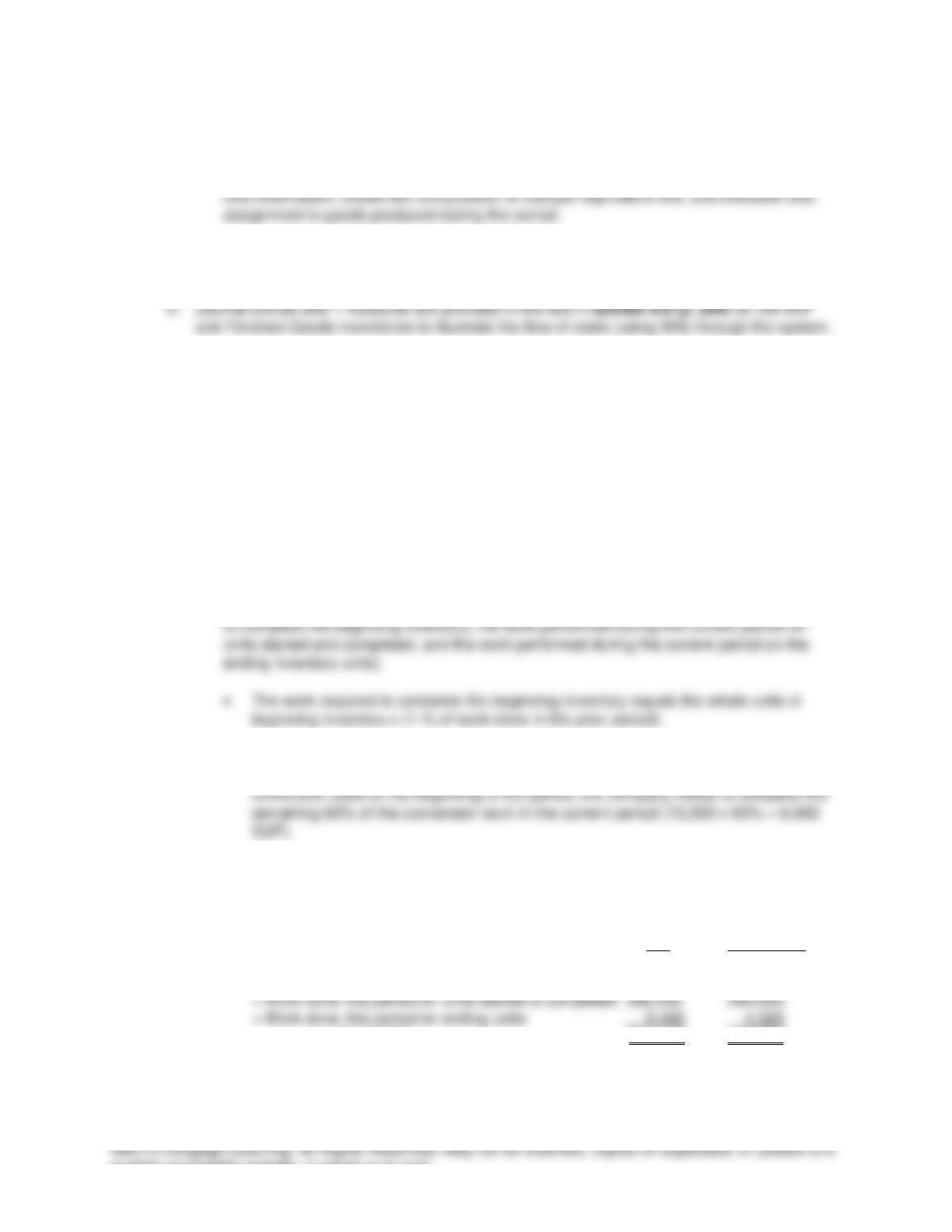
iii. The total cost accounted for is the sum of the costs transferred out ($1,173,340) and the
ending inventory cost ($14,202) = $1,187,542.
Chapter 06: Process Costing IM 9
©2013 Cengage Learning. All Rights Reserved. May not be scanned, copied or duplicated, or posted to a
publicly accessible website, in whole or in part.
g. The six steps listed above may be combined into a cost of production report as illustrated in
text Exhibit 6.7 (p. 203).
i. A cost of production report is a process costing document that details all operating and
ii. Note that the Cost of Production Report presented in the exhibit reflects the Weighted
Average Method of computing EUPs.
LO.3: How are equivalent units of production, unit costs, and inventory values determined using
the first-in, first-out (FIFO) method of process costing?
6. FIFO Method
a. Steps 1 and 2 are the same for FIFO as they are for the Weighted Average Method.
b. Step 3: Calculate the equivalent units of production using the FIFO Method.
i. Under the FIFO Method, the work performed last period is not commingled with work of
the current period.
ii. Only current period work is considered (i.e., the work performed during the current period
Since all DM were added at the beginning of the production process, no additional
material is needed in April. Since beginning WIP inventory was 40% complete as to
iii. Candles started and completed and ending inventory are the same as under the
Weighted Average Method.
iv. EUPs are computed as follows:
DM Conversion
Work done this period on beginning units 0 6,000
Total EUPs 401,400 406,320
v. A reconciliation schedule of FIFO EUPs to Weighted Average EUPs is provided in the
text (p. 204).
Chapter 06: Process Costing IM 10
©2013 Cengage Learning. All Rights Reserved. May not be scanned, copied or duplicated, or posted to a
publicly accessible website, in whole or in part.
c. Step 4: Determine the total cost to account for ($1,187,542). This step is the same as under
the Weighted Average Method.
d. Step 5: Calculate the cost per equivalent unit of production.
i. The cost per equivalent unit is found by dividing the DM current period cost by the DM
current period work (i.e., the DM EUP) and by dividing the Conversion current period cost
by the Conversion current period work (i.e., the CC EUP):
e. Step 6: Assign costs to inventories.
i. A two step computation is needed to determine the cost of goods transferred out under
the FIFO method.
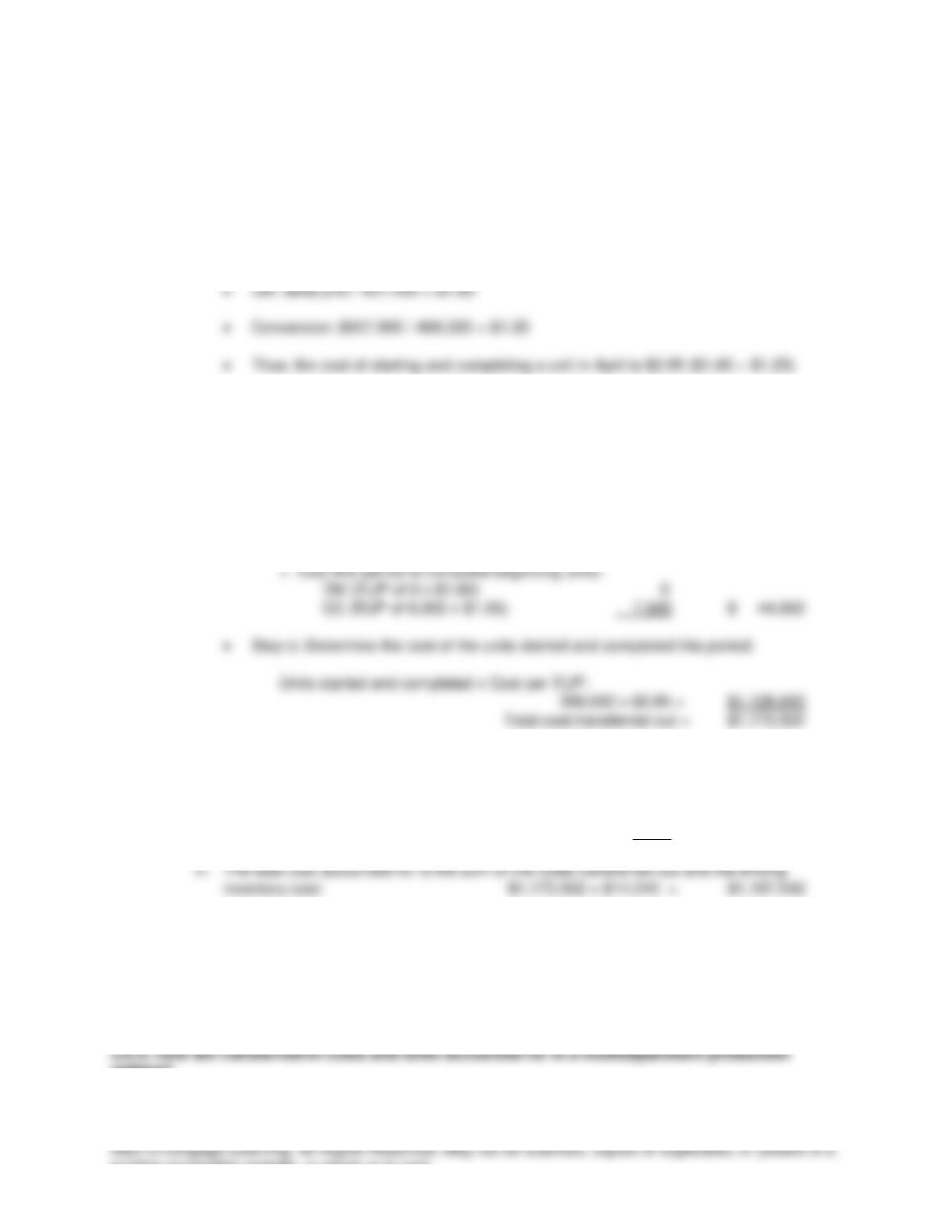
Step a: Determine the total cost of the units started last period and finished this
period (these are the units that were in beginning inventory on April 1):
Beginning inventory cost: $37,402
ii. As under the weighted average method, the amount of costs assigned to ending WIP
Inventory is found by summing the cost of each equivalent unit in ending inventory:
DM (Ending inventory EUP of 5,400 x $1.60) $ 8,640
Conversion (EI EUP of 4,320 x $1.25) 5,400 $ 14,040
f. The six steps listed above may be combined into a cost of production report as illustrated in
text Exhibit 6.9 (p 206).
g. Summary journal entries and T-Accounts for April are provided in text Exhibit 6.10 (p. 207).
setting?
D. Process Costing in a Multidepartment Setting