© 2013 Cengage Learning. All
r
ights reserved. No
d
is
t
r
ibution allowed without express
a
u
t
hor
ization.
b. When the larger uncollectible accounts result from
a
credit-granting policy that increases income overall. A
business might liberalize its credit policy by extending credit to
a new group of customers with the intent of generating net
revenues from the new credit customers that exceed the cost of
goods sold to them and the selling expenses of executing the
sales, including the expenses of uncollectible accounts. The
extension of credit to new customers can increase net income
even though it results in more uncollectible accounts.
c. A higher percentage of uncollectible accounts is better
8.6 If a firm computes the Bad Debt Expense amount at the
end of the accounting period but writes off specific accounts
Solution8-2
8.7 Manufacturing firms typically do not identify a customer or
establish a firm selling price until they sell products. Thus, these
8.8 Under the installment method, accountants recognize
© 2013 Cengage Learning. All
r
ights reserved. No
d
is
t
r
ibution allowed without express
a
u
t
hor
ization.
8.9 Application of the installment method requires a reasonably
8.10 First, the obligation to customers in the event the firm does not
publish the magazines is $45,000. Second, recognition of a
liability of $32,000 requires a remaining credit of $13,000 to
8.11 Both customer returns and bad debts ultimately afect the
net cash collected from customers. In accounting for estimated
8-3Solutions
8.12 Deferred Gross Margin is the diference between the Account
Receivable from the customer (the amount of cash that the firm
8.13 (Revenue recognition for various businesses.)
We have found this question to be an excellent one for class
discussion because it forces the student to think about both
revenue and expense timing and measurement questions. It also
© 2013 Cengage Learning. All
r
ights reserved. No
d
is
t
r
ibution allowed without express
a
u
t
hor
ization.
b. Probably as work progresses using the
percentage-of-completion method. Students might discuss
c. Probably as the firm collects cash using the installment
method. U.S.
d. At the time of
sale.
e. At the time the firm picks citrus products and delivers them to
Solutions8-48.13 continued.
f. U.S. GAAP (Codification Topic 926) but not IFRS provides
© 2013 Cengage Learning. All
r
ights reserved. No
d
is
t
r
ibution allowed without express
a
u
t
hor
ization.
8-5Solutions
8.13 continued.
h. At the time of sale to a specific buyer at a set price. This
will vary, depending on who owns the whiskey during the aging
i. After a loan is made, with the passage of time.
j. The alternatives here are (1) as customers make
k. At the completion of the printing activity and delivery of the
product to the customer.
© 2013 Cengage Learning. All
r
ights reserved. No
d
is
t
r
ibution allowed without express
a
u
t
hor
ization.
l. The issue here is whether to recognize revenue when the
m. At the time the wholesaler delivers food products to stores.
n. The issue here is whether to recognize revenue while the
o. One alternative is to apply the percentage-of-completion
Solutions8-6
8.14 (Income recognition for various business arrangements.)
a. Company A is selling software and access to data and other
software.
b. The issue for Company B is the ability of the newly formed
c. The issue for Company C is whether it satisfies the criterion
that revenues must be “earned” at the beginning of the
© 2013 Cengage Learning. All
r
ights reserved. No
d
is
t
r
ibution allowed without express
a
u
t
hor
ization.
d. Assuming that collectibility is not an issue, Company D will
earn the fee over the period during which it performs its
obligation to provide the customer with access to the auction
8-7Solutions
8.14 d. continued.
cash that Company D will ultimately collect. If the probability
of buyers backing out is either low or highly predictable or
both, then recognizing the transaction fee at the time of the
transaction is appropriate. If Company D cannot reliably
measure the amount of revenue that it will ultimately earn on
the transaction fee, it should delay the recognition of the
transaction fee until the transaction is completed.
e. Company E should recognize the fee paid by the supplier as
f. Company F assumes more product risk in this case than in Part
g. Company G has performed its obligation to the customer at
© 2013 Cengage Learning. All
r
ights reserved. No
d
is
t
r
ibution allowed without express
a
u
t
hor
ization.
Solutions8-8
8.14 g. continued.
h. Collectibility of the revenue is not an issue. However,
i. Assuming that Company I has performed its obligations, the
j. This is a barter transaction. To justify recognizing revenue
8.15 (Meaning of allowance for uncollectible accounts.)
a. This characterization of the allowance account is incorrect.
© 2013 Cengage Learning. All
r
ights reserved. No
d
is
t
r
ibution allowed without express
a
u
t
hor
ization.
b. This characterization of the allowance account is incorrect
8-9Solutions
8.15 continued.
c. This characterization of the allowance account is
d. This characterization of the allowance account is incorrect.
e. This characterization of the allowance account is correct.
f. This characterization of the allowance account is incorrect.
g. This characterization is incorrect for the same reasons the
characterization in Part f. is incorrect.
h. This characterization is incorrect because the Allowance for
Solutions8-10
8.16 (Pret a Manger; revenue recognition at time of sale and
advances from customers.) (amounts in pounds sterling)
a. Journal entry to record original transaction; customer pays
Assets = Liabilities +
Shareholders’
Equity (Class.)
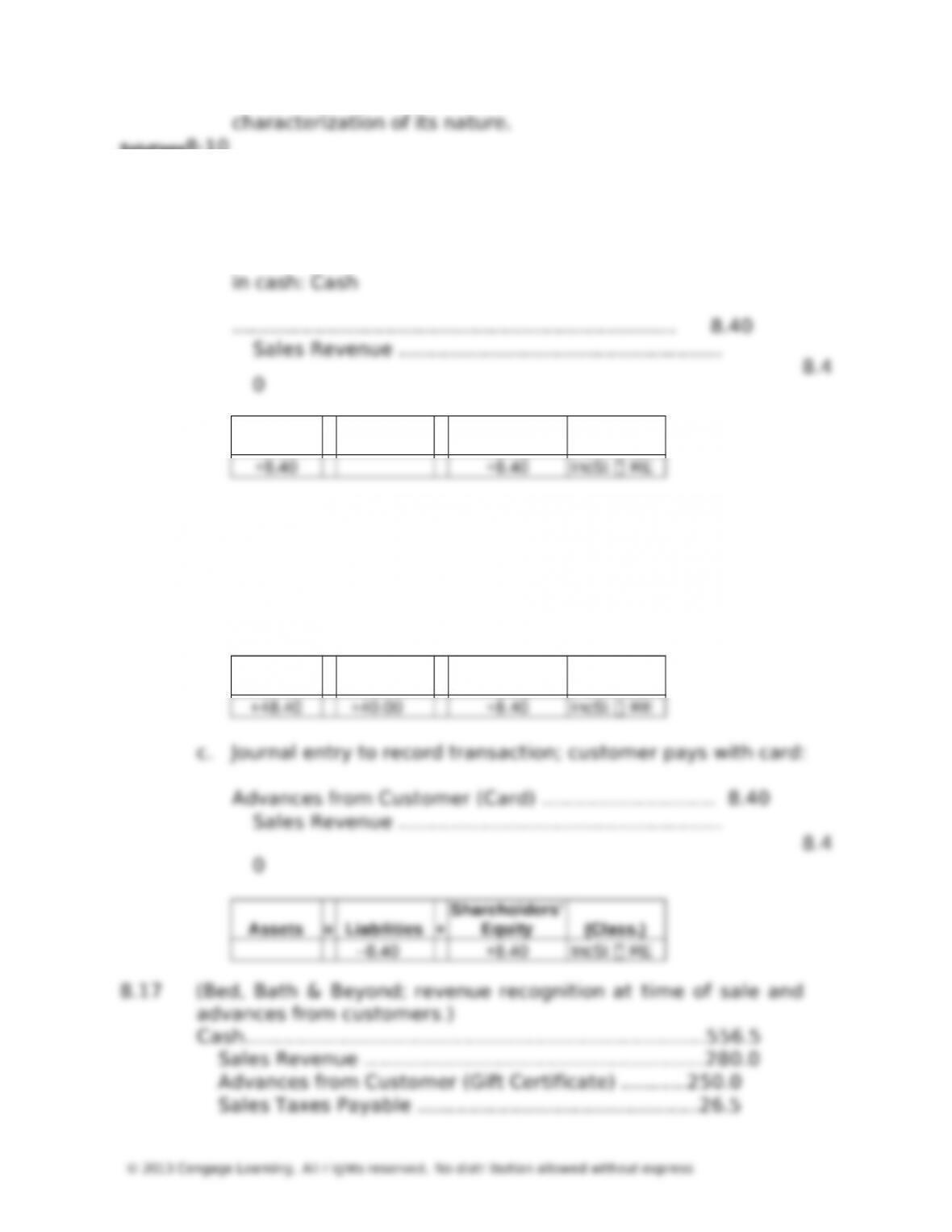
b. Journal entry to record transaction that includes card;
customer pays in cash:
Ca
sh
…………………………………………………………
……..
48.40
Advances from Customer (Card)
…………………….
40.0
0
Sales Revenue
………………………………………………
8.4
0
Assets = Liabilities +
Shareholders’
Equity (Class.)

Assets = Liabilities +
Shareholders’
Equity (Class.)
b. When the larger uncollectible accounts result from
a
credit-granting policy that increases income overall. A
business might liberalize its credit policy by extending credit to
a new group of customers with the intent of generating net
revenues from the new credit customers that exceed the cost of
goods sold to them and the selling expenses of executing the
sales, including the expenses of uncollectible accounts. The
extension of credit to new customers can increase net income
even though it results in more uncollectible accounts.
c. A higher percentage of uncollectible accounts is better
8.6 If a firm computes the Bad Debt Expense amount at the
end of the accounting period but writes off specific accounts
Solution8-2
8.7 Manufacturing firms typically do not identify a customer or
establish a firm selling price until they sell products. Thus, these
8.8 Under the installment method, accountants recognize
© 2013 Cengage Learning. All
r
ights reserved. No
d
is
t
r
ibution allowed without express
a
u
t
hor
ization.
8.9 Application of the installment method requires a reasonably
8.10 First, the obligation to customers in the event the firm does not
publish the magazines is $45,000. Second, recognition of a
liability of $32,000 requires a remaining credit of $13,000 to
8.11 Both customer returns and bad debts ultimately afect the
net cash collected from customers. In accounting for estimated
8-3Solutions
8.12 Deferred Gross Margin is the diference between the Account
Receivable from the customer (the amount of cash that the firm
8.13 (Revenue recognition for various businesses.)
We have found this question to be an excellent one for class
discussion because it forces the student to think about both
revenue and expense timing and measurement questions. It also
© 2013 Cengage Learning. All
r
ights reserved. No
d
is
t
r
ibution allowed without express
a
u
t
hor
ization.
b. Probably as work progresses using the
percentage-of-completion method. Students might discuss
c. Probably as the firm collects cash using the installment
method. U.S.
d. At the time of
sale.
e. At the time the firm picks citrus products and delivers them to
Solutions8-48.13 continued.
f. U.S. GAAP (Codification Topic 926) but not IFRS provides
© 2013 Cengage Learning. All
r
ights reserved. No
d
is
t
r
ibution allowed without express
a
u
t
hor
ization.
8-5Solutions
8.13 continued.
h. At the time of sale to a specific buyer at a set price. This
will vary, depending on who owns the whiskey during the aging
i. After a loan is made, with the passage of time.
j. The alternatives here are (1) as customers make
k. At the completion of the printing activity and delivery of the
product to the customer.
© 2013 Cengage Learning. All
r
ights reserved. No
d
is
t
r
ibution allowed without express
a
u
t
hor
ization.
l. The issue here is whether to recognize revenue when the
m. At the time the wholesaler delivers food products to stores.
n. The issue here is whether to recognize revenue while the
o. One alternative is to apply the percentage-of-completion
Solutions8-6
8.14 (Income recognition for various business arrangements.)
a. Company A is selling software and access to data and other
software.
b. The issue for Company B is the ability of the newly formed
c. The issue for Company C is whether it satisfies the criterion
that revenues must be “earned” at the beginning of the
© 2013 Cengage Learning. All
r
ights reserved. No
d
is
t
r
ibution allowed without express
a
u
t
hor
ization.
d. Assuming that collectibility is not an issue, Company D will
earn the fee over the period during which it performs its
obligation to provide the customer with access to the auction
8-7Solutions
8.14 d. continued.
cash that Company D will ultimately collect. If the probability
of buyers backing out is either low or highly predictable or
both, then recognizing the transaction fee at the time of the
transaction is appropriate. If Company D cannot reliably
measure the amount of revenue that it will ultimately earn on
the transaction fee, it should delay the recognition of the
transaction fee until the transaction is completed.
e. Company E should recognize the fee paid by the supplier as
f. Company F assumes more product risk in this case than in Part
g. Company G has performed its obligation to the customer at
© 2013 Cengage Learning. All
r
ights reserved. No
d
is
t
r
ibution allowed without express
a
u
t
hor
ization.
Solutions8-8
8.14 g. continued.
h. Collectibility of the revenue is not an issue. However,
i. Assuming that Company I has performed its obligations, the
j. This is a barter transaction. To justify recognizing revenue
8.15 (Meaning of allowance for uncollectible accounts.)
a. This characterization of the allowance account is incorrect.
© 2013 Cengage Learning. All
r
ights reserved. No
d
is
t
r
ibution allowed without express
a
u
t
hor
ization.
b. This characterization of the allowance account is incorrect
8-9Solutions
8.15 continued.
c. This characterization of the allowance account is
d. This characterization of the allowance account is incorrect.
e. This characterization of the allowance account is correct.
f. This characterization of the allowance account is incorrect.
g. This characterization is incorrect for the same reasons the
characterization in Part f. is incorrect.
h. This characterization is incorrect because the Allowance for
Solutions8-10
8.16 (Pret a Manger; revenue recognition at time of sale and
advances from customers.) (amounts in pounds sterling)
a. Journal entry to record original transaction; customer pays
Assets = Liabilities +
Shareholders’
Equity (Class.)
b. Journal entry to record transaction that includes card;
customer pays in cash:
Ca
sh
…………………………………………………………
……..
48.40
Advances from Customer (Card)
…………………….
40.0
0
Sales Revenue
………………………………………………
8.4
0
Assets = Liabilities +
Shareholders’
Equity (Class.)
Assets = Liabilities +
Shareholders’
Equity (Class.)